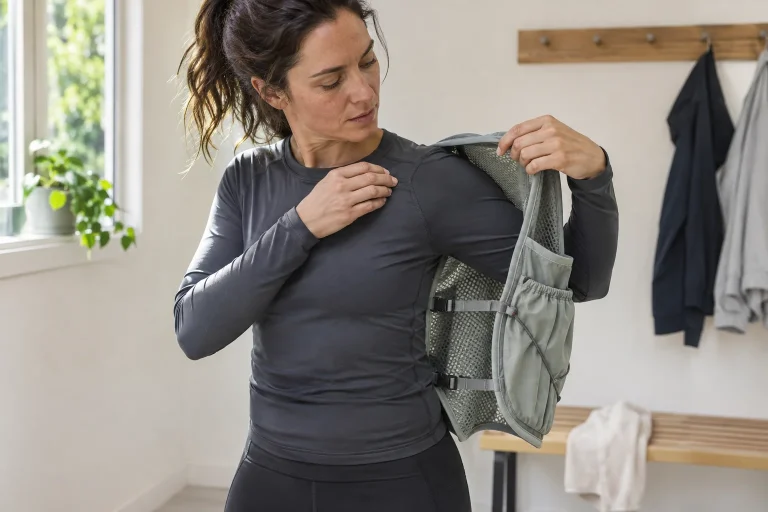
The 2L, 2.5L or 3L on a running jacket’s product page does not tell you how many tops to wear underneath. It refers to material construction: a brief description of the relationship between outer fabric, waterproof solution and internal protection. A half-layer does not mean half a jacket or a lining exactly half as thick. Understanding the number means seeing what is counted within the laminate and what may be a separate part of the finished garment.
This distinction helps during a fitting too. Knowing why a printed inner surface differs from a separate textile lining enables more precise questions about comfort, packability and intended use. We do not turn layer counts into a podium ranking for every product. Understanding construction helps interpret the particular jacket’s data and your own fitting in the right place.
First separate material construction from clothing layers
Choosing a base layer, midlayer and outer jacket means planning a system of several garments. A 3L designation, by contrast, may describe the material construction of one thin jacket. These counts concern different things. A three-layer laminate is not necessarily a warm jacket, and a garment with a separate lining may not count every visible textile in its abbreviated layer number.
Helly Hansen’s manufacturer construction guide, for example, uses the relationship between outer fabric, waterproof membrane and internal protection to describe different solutions. This concerns how materials are arranged together. The finished jacket’s cut, pockets, possible insulation and your base layer remain separate information. Clarify early in your reading which level a particular statement concerns.
In practical terms, ask: “Do the product page’s two layers mean the laminate, with a separate lining alongside?” or “Are the three layers part of one bonded material construction?” This establishes whether you understand the term in the same way. The abbreviation becomes easier to use when you can point to the relevant part of the actual garment.
2L: two bonded layers may be accompanied by a separate lining
In a common two-layer jacket construction, the waterproof layer is bonded to the outer fabric, while a separate, more freely hanging lining inside may provide protection and comfort. Helly Hansen distinguishes this from laminated three-layer construction. A jacket that feels like several pieces of material can therefore still be labelled 2L: the name does not necessarily count every textile piece in the finished garment.
During a fitting, see whether the lining moves independently and how it behaves with your base layer when putting the jacket on. Can you comfortably slide your arms in, does any section bunch awkwardly, and is removal manageable? These are tangible experiences. The lining’s mere presence does not require inferring an exact weight, drying time or waterproofness.
Do not transfer the separate-lining description to every material called two-layer. For another product type, a manufacturer may describe different construction and use. If the abbreviation’s solution is unclear, find the finished garment’s detailed description. The name becomes useful information when connected to that product’s construction.
 Enlarge image
2.5L: the half-layer names the design of internal protection
In a two-and-a-half-layer solution, internal protection may be a light coating or printed pattern rather than a separate, full textile lining. Rab’s Pertex information also distinguishes outer fabric, waterproof membrane and an internal protective coating in its own 2.5-layer example. “Half” is therefore a construction abbreviation, not a lining covering half the area or a universal thickness.
This inner surface may look and feel different from a knitted or woven lining. A visible pattern, however, does not identify the entire material composition or that protective layer’s durability. Product data and your experience complement one another here too: one shows the manufacturer’s statement, the other the sensation important to you.
If you would pack such a jacket small, examine the manufacturer-permitted storage method and space available in your bag using the particular garment. Layer count is not identical to packed size. Pockets, cut, zips and other details also shape what you actually carry. Material construction is one explanatory factor, not the complete packability result on its own.
3L: the inner textile is part of the bonded construction too
In a general description of a three-layer laminate, the waterproof layer sits between outer fabric and an internal protective textile, forming one bonded structure. Rab’s and Helly Hansen’s own explanations use this construction distinction. The internal textile is not necessarily thick or insulating: three-layer is not a thermal-comfort rating.
In a shop, a thin jacket that feels like one material can still be 3L. You need not seek three separate hanging sheets. Lamination means precisely that the components do not simply behave like separate garments worn together. To understand the construction, the product sheet may tell you more than estimating surface thickness by hand.
Try the inner feel with your planned base layer too. Contact differs against bare skin, a short-sleeved top and a long-sleeved layer. Do not adopt someone else’s general “Feels nice” comment as your personal comfort. The manufacturer’s construction statement and a fitting with your own clothing are separate, complementary information.
Layer count is not an automatic ranking of weight or quality
Knowing the three numbers can make it tempting to regard the largest as better in everything, or the smaller as lighter in everything. A finished product combines many details. Outer fabric selection, cut, pockets, hood, fastenings and possible reinforcements all shape what you hold. The construction designation does not establish the final outcome of each.
If weight matters, find the manufacturer’s weight for the particular model, including the stated size and conditions. Two jackets of different sizes or purposes already raise another comparison question. Do not derive “Fewer layers, therefore half the packed size” from one abbreviation. The actual garment can show how much room it occupies in your bag.
Waterproofness and durability also require that product’s data. Layer count indicates construction, not a performance certificate covering every condition. Even with a supposedly more robust fabric, seam and opening design remain separate questions. The number therefore cannot declare a general winner across every detail.
External water repellency and an internal pattern serve different roles
Several surface-treatment details may appear beside the abbreviated construction name. Do not automatically add each as another complete layer. Interpret the manufacturer’s counting method rather than creating your own layer system from every visible or mentioned detail. A thin treatment and a separate textile lining are not the same structural unit.
Likewise, do not confuse a 2.5L internal pattern with external decoration or the base layer’s role. The particular material’s description can explain the precise solution. Dots or another visible pattern are not a general invitation to apply another coating. The care instructions determine the step, not how technical the surface looks.
If you see a change, separation or suspected damage inside, document its location and request assessment for your model. Construction knowledge helps name the affected part, but a photograph does not make everyone a materials tester. Terms learnt from the product description serve a more precise question, not a ready-made fault finding without investigation.
 Enlarge image
Before a running trial, check four things in the shop
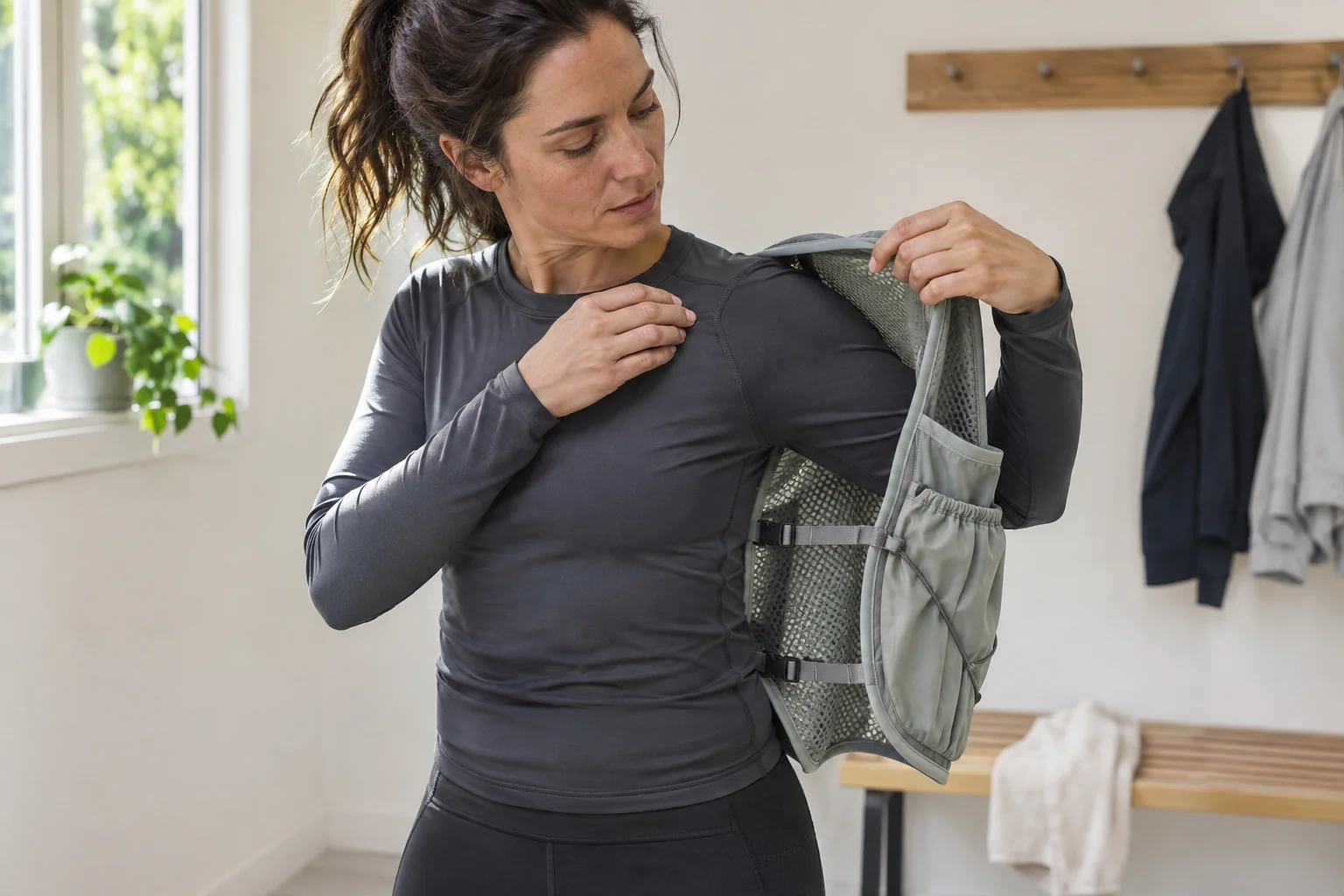
First observe contact with your base layer: how the jacket slides on, whether it binds or bunches at the elbow, and how the neck feels. Second, try movement: simply moving the arms forwards and backwards and turning your head may clarify more practical questions than standing before a mirror. These movements provide experience of cut and fit.
Third is operation: which zips and pockets can you reach with the planned equipment? Fourth is packing: where would you put it when not worn, using the manufacturer-permitted method? If you do not have all the equipment in the shop, note the missing trial. You need not replace an observation you have not made with guessing.
For all four observations, avoid a general “It was good” note. More useful examples are “It did not bunch at the elbow over a long-sleeved top” or “Not yet tried with my vest”. These preserve the circumstances behind your opinion. Real, specific usage information then sits beside the layer count.
How to discuss different jacket constructions
Your first imagined candidate has a separate lining, the second a light internal print, and the third a laminated inner textile. Naming the difference is not a decision, but one preparatory step. Add a review of the exact model, stated purpose, your own fit observations and documented performance data.
| Question | What to write beside the candidate |
|---|---|
| What does layer count mean for this product? | The manufacturer’s specific construction description. |
| Is there a separate lining? | The design of the freely hanging or material-bonded inner section. |
| How does it feel with your base layer? | The sensation actually observed while putting it on and moving. |
| What performance is stated? | The particular model’s figures and the accompanying test context. |
| What remains open? | Missing information or a trial not yet completed. |
If the separate lining feels comfortable to you, describe that as a personal advantage in use. If small packed size matters more, record your experience of that particular garment. Neither needs to become a rule for every runner. Clarifying purpose and contact conditions helps more than declaring a layer count the winner in a brand comparison on its own.
2L, 2.5L and 3L become genuinely useful when connected to the construction of the garment before you. You then see three different design solutions with further model-dependent details, rather than three competing numbers. Afterwards, consider your own running-clothing layers separately for their intended use.
Sources and conceptual scope
For basic construction descriptions, we used Helly Hansen’s own waterproof-clothing information; for specific 2.5- and 3-layer material examples, Rab’s manufacturer explanation of Pertex technologies. Manufacturers’ terminology and products may differ in detail; always read documentation for the particular garment. The comparison sheet and fitting questions are our own editorial aids. Sources checked: 21 November 2026.
How Futószív articles are prepared: our editorial guidelines.