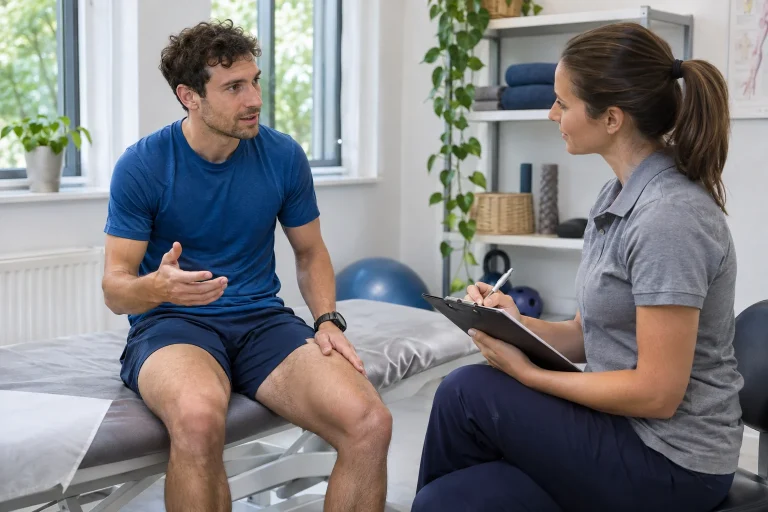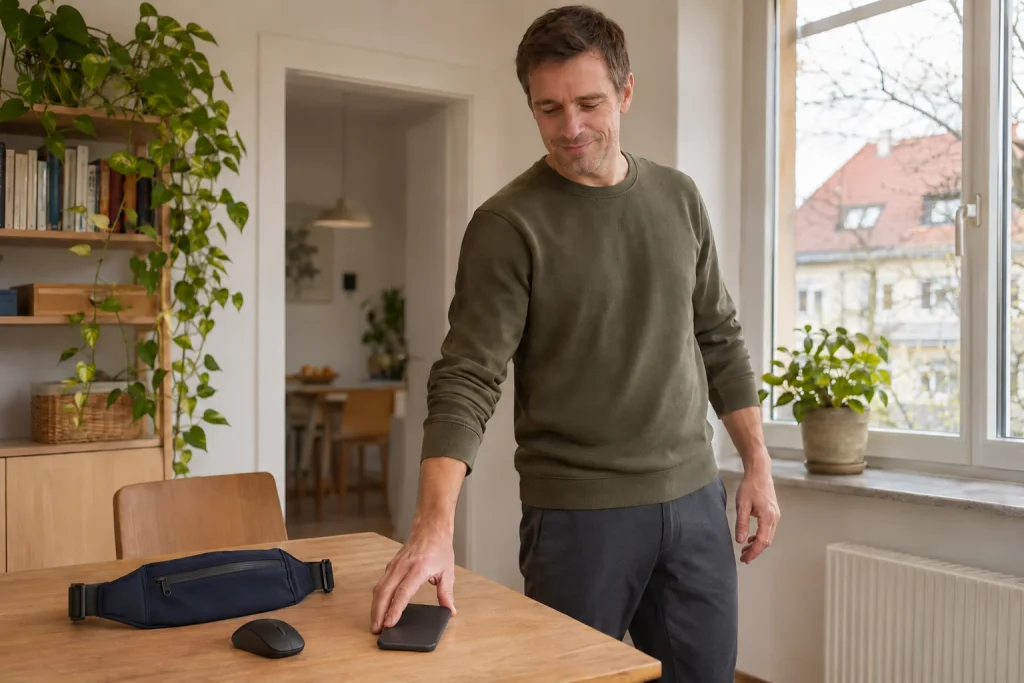
You never play tennis, yet tennis elbow was mentioned for symptoms on the outside of your elbow. As a runner, you may initially struggle to connect the name with your day. Hands and forearms nevertheless perform many tasks around work, housework, equipment and sport. Holding a phone, bottle or tool may be a situation in which you notice symptoms and which deserves precise discussion.
Mapping daily tasks is not a blame list for finding a cause. Phone use or a single painful grip cannot establish a diagnosis. This article helps identify observations to bring to individual assessment and how to ask about modifying your own demands. It does not offer a resisted home test or the same forearm-strengthening programme for everyone.
The name tennis elbow does not belong to just one sport
According to the NHS, tennis elbow’s main symptom is pain on the outside of the elbow. It may worsen with gripping, wrist movement or using the arm, and does not occur exclusively in tennis players. The information also mentions work and leisure activities. The name therefore does not rule out the possibility in a runner, but does not establish it either. NHS: Tennis elbow.
If symptoms have not yet been assessed, start with your own location description: which part of which elbow, when and what kind of sensation occurs. Do not choose a definite diagnosis simply because a drawing shows a similar spot. If the condition has already been identified, describe when and which guidance you received. A current change is still separate information.
Alongside pain around the elbow, report tingling, numbness or changed hand use too. The AAOS describes assessment including symptoms, work, sport and other possible causes. You need not decide which experience relates to a tendon or another structure. AAOS: Tennis Elbow.
Why do the wrist and grip feature in an elbow symptom’s history?
Tendons of forearm muscles that move the wrist and fingers also attach to bone around the elbow. The AAOS highlights wrist-extensor muscles and their tendons in the outer-elbow condition. This explains why grip or wrist use can be relevant even when pain feels higher up beside the elbow.
Everyday observations may involve different tasks: holding, lifting, turning or putting down an object. Weight alone does not describe the whole situation. Describe how and for how long the object was used, alongside the symptom timeline. You need not calculate a tendon-load formula at home; an accurate history supports individual assessment.
Do not try to prove pain can be triggered through maximal gripping or resistance. A professional’s examination and repeated home provocation are different things. If you noticed the symptom during a natural movement, you can already describe it. Information does not become more valuable by repeatedly making the same situation uncomfortable.
Describe the specific situation involving phone grip
Do you carry your phone throughout a run, briefly check the map or read on it for a long time after work? These differ. Phone grip in the title does not mean the device is a proven cause of every outer-elbow symptom. It is a daily task worth mentioning within the whole history if symptoms appear alongside it.
Say which hand holds it, when discomfort begins and what you did immediately beforehand. You can ask about using the other hand or another storage option in line with your own advice. You need not choose a supposedly certain good grip through a series of painful trials. First clarify which symptoms and individual condition are being discussed.
Alongside a phone, holding a bottle, lead, running pole or parcel may feature in your day. Do not merge them into a single ‘running load’ category. A specific task helps the professional give advice achievable in your programme too. Buying new equipment alone does not replace assessing symptoms.
 Enlarge image
Work and housework are equally parts of the history
The NHS lists examples of computer and manual tasks involving repeated hand and forearm use. The AAOS likewise emphasises occupational and leisure history. More matters than minutes marked as training in a sports log. Describe your usual work task and recent changes too.
Did you start using a new tool, do more repair work, gardening, cooking or moving parcels? Perhaps the task stayed the same but its schedule changed? These are circumstances, rather than ready-made explanations. Instead of ‘I worked a lot’, one or two specific movements and their timeline may help: when did you notice symptoms relative to the task?
Discuss opportunities to modify work too. Some tasks cannot simply be dropped because they are your job or daily caring responsibilities. The clinician needs to know this. An individual plan should concern your actual circumstances, rather than an imagined free day. You might ask which detail can change and what help is available.
Symptom timing and changed function are separate information
Do you feel it only during a task, does it persist afterwards, or does it now disturb rest and sleep? The NHS describes symptoms varying in severity and affecting sleep too. Describe your own pattern rather than fitting it to a general account. Alongside current pain intensity, duration and daily consequences may matter.
Make grip difficulty precise with an everyday example. Has holding a cup become unpleasant, is operating a door or tool harder, or do you ask for help with something? ‘My hand is weaker’ alone may cover several experiences. Distinguishing causes belongs to individual assessment; your task is to describe the observed change understandably.
Discuss improvement just as specifically. Has pain eased while a task remains difficult? Do you feel it less often, but for longer? You need not measure the situation through another strength challenge. Bring back experiences from days that occurred naturally, as agreed in your own follow-up plan.
Changes in demands should be targeted and individual
The NHS lists reducing or avoiding activities that worsen symptoms among possible self-help steps. In your situation, however, clarify which task and which modification are meant. Several practical questions lie between arbitrarily stopping all hand use and continuing a programme unchanged at any cost. The appropriate answer should connect with individual assessment.
Ask the adjustment’s purpose and how its effect will be evaluated. Does it concern reorganising a work task, using sports equipment or part of a running programme? How long does the advice apply, and which changes should you report? Translate a vague ‘take care of it’ into actual examples so its meaning is clear at home too.
If physiotherapy or another treatment is recommended, ask for feedback on your own technique. Do not independently add strenuous grip strengthening or painful stretching. Ask individually about a brace, strap or other aid too; do not test whether it works by squeezing as hard as possible. Nor should you independently adjust medication for a planned workout.
Ask about running in more than kilometres
The actual running situation may involve carrying an object, poles, a lead or another task. Alongside training itself, dressing, getting there and handling bags form part of the programme. Describe these together. That a sport mainly loads the legs does not itself answer questions about the elbow and grip.
Name the need behind your sporting aim too. Is regularity, community or a specific race important? If modification is needed, a meaningful solution is easier when the professional understands what you want to preserve. This article does not choose a running workload for you or turn mileage associated with another person’s diagnosis into personal permission.
If you notice symptoms with equipment or a grip, do not prove the connection through another long run. Describe the observation and ask about your individual next step. A training log may supplement the symptom history, but does not describe changes in sensation, grip and daily function for you.
 Enlarge image
A brief task map may support consultation
The table below is neither a diagnostic test nor a load score. It simply organises situations already experienced in your day. Nothing needs trying again or painfully repeating to complete the rows.
| Task type | What should you describe? |
|---|---|
| Holding | When did you notice it while holding a phone, water bottle or another object? |
| Repeated use | Which work or home task recurs, and has it changed recently? |
| Lifting and putting down | Which familiar task became harder or required help? |
| Rest and night | Does it persist after the task or affect sleep? |
| Sport | Which equipment do you use while running, and what is the symptom timeline? |
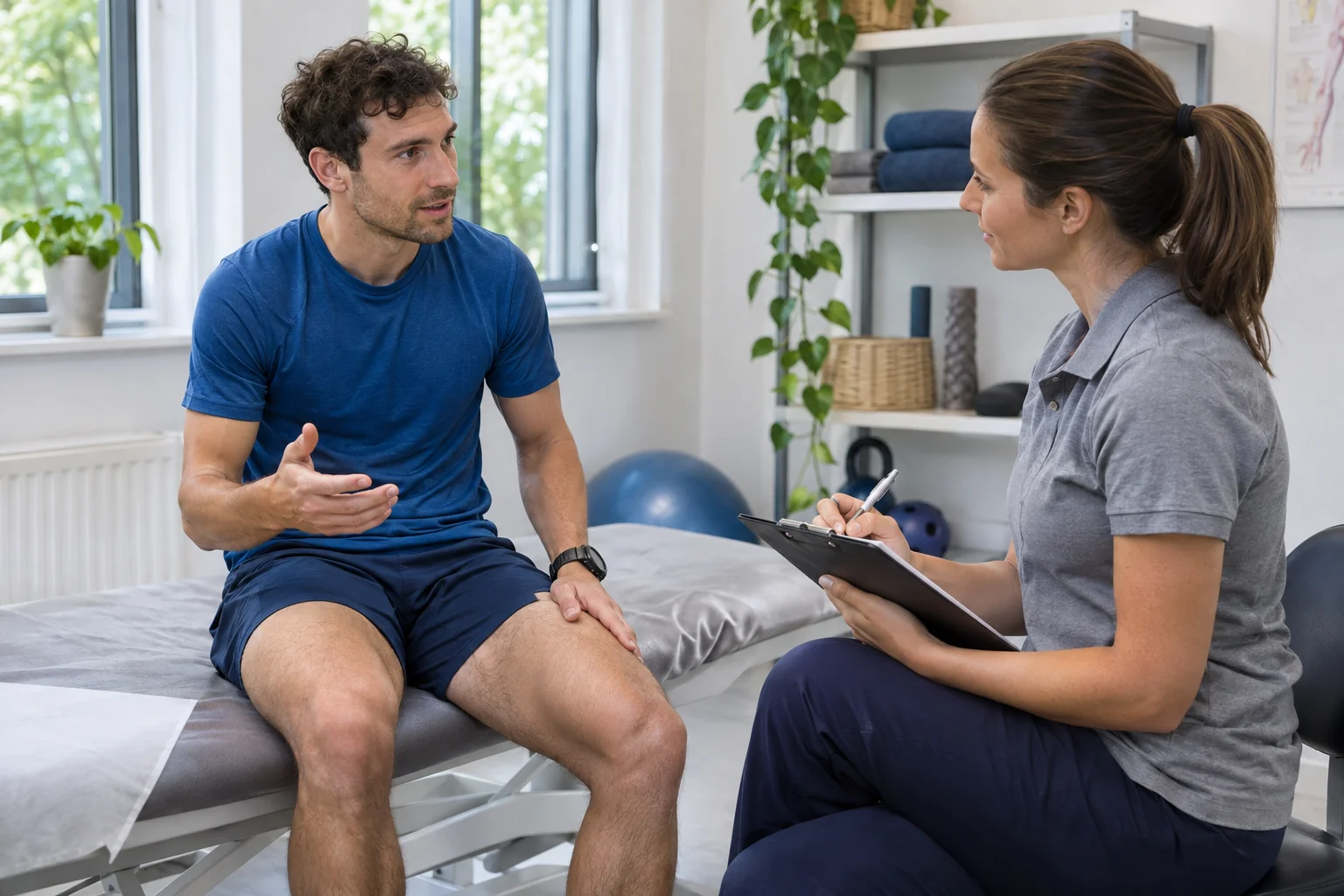
After the table, two or three written questions are enough. ‘What assessment is needed?’, ‘How should I change which daily task?’, ‘What does the advice cover for running and equipment use?’ The aim is understanding an individual decision. Many pages of data collection are not required to discuss symptoms seriously.
If you cannot implement advice at work, say so. A practical barrier is not simply a lack of cooperation. Ask which options may apply in your own situation. At the next review, be able to describe your real day, rather than a programme followed in theory but unachievable in practice.
When should you seek reassessment?
The NHS recommends medical advice if elbow symptoms do not improve with rest and self-help steps. Do not treat this as a compulsory waiting period for new, severe or worsening symptoms. Specifically report substantial loss of function, altered sensation and symptoms following injury. Urgency must be judged from the current symptoms.
Severe arm pain with difficulty moving, altered shape after injury or new numbness requires urgent medical help. Seek prompt assessment for swelling with fever or feeling unwell too. Do not automatically attribute arm pain that occurs during exertion and eases with rest to tennis elbow. Sudden arm pain with chest pressure or tightness may be an immediate emergency; in Hungary, call 112. NHS: elbow and arm pain.
At the end of review, clarify the next step, which change is being followed and when to make earlier contact. Tennis elbow in runners also belongs within the whole history of daily hand and forearm use. A phone, work tool or sporting accessory may be a specific detail; individual assessment helps select an appropriate adjustment.
Sources
How Futószív articles are prepared: our editorial guidelines.