When should rearranging the next workout not be the task?
Severe pain, substantial swelling, changed shape, inability to bear weight or a locked knee require prompt healthcare assessment. A hot, red knee with fever or feeling generally unwell may indicate infection and need urgent care. Choosing a new running shoe or stretching video is not the first task then.
The NHS knee-pain information lists these as warning situations. Seek Hungarian care rather than UK healthcare numbers; call 112 after a severe accident or life-threatening illness. If urgency is unclear, ask for healthcare advice and describe symptoms and weight-bearing capacity precisely.
Do not dismiss less intense but recurring, worsening symptoms or changes to walking as natural for runners either. This article offers questions for understanding and appointments. It does not diagnose from a pain map or prescribe personal medication, exercise amounts or clearance to run.
Was there a specific event, or did it begin gradually?
A turn, fall or sudden movement creates a different account from discomfort appearing increasingly often over weeks. Note when it happened, whether you could continue afterwards and how the knee changed over the following hours. If there was no memorable moment, say so; you need not invent an event afterwards.
Gradual onset does not establish simple overuse, while sudden onset does not itself identify the structure involved. The examiner assesses history, function and examination signs together. A sound or movement name does not replace this.
The training log works as a timeline here. When did it first appear, how much did loading change and when did it begin to matter in everyday life? Include a new job, more stairs or a long hike too. Your knee works beyond runs recorded by a watch.
Where does it hurt, and what does that information mean?
Try describing the area in your own words: around the kneecap, below it, inside, outside or behind. If difficult to point precisely, describe the situation in which it is easiest to recognise. Location matters but is not a diagnosis itself. Several conditions can produce symptoms in similar places.
Everyday speech uses “runner’s knee” for different problems. Online results can therefore mix advice for differing conditions easily. If a report or professional mentions patellofemoral pain, ask what that means for you and what action follows. A shared name does not yet mean shared exercises.
For outside pain, “it must be the IT band” is insufficient too, as is “it must be the meniscus” for inside pain. Location begins assessment. Do not perform forceful twisting or hopping tests at home to fit your account to a search result.
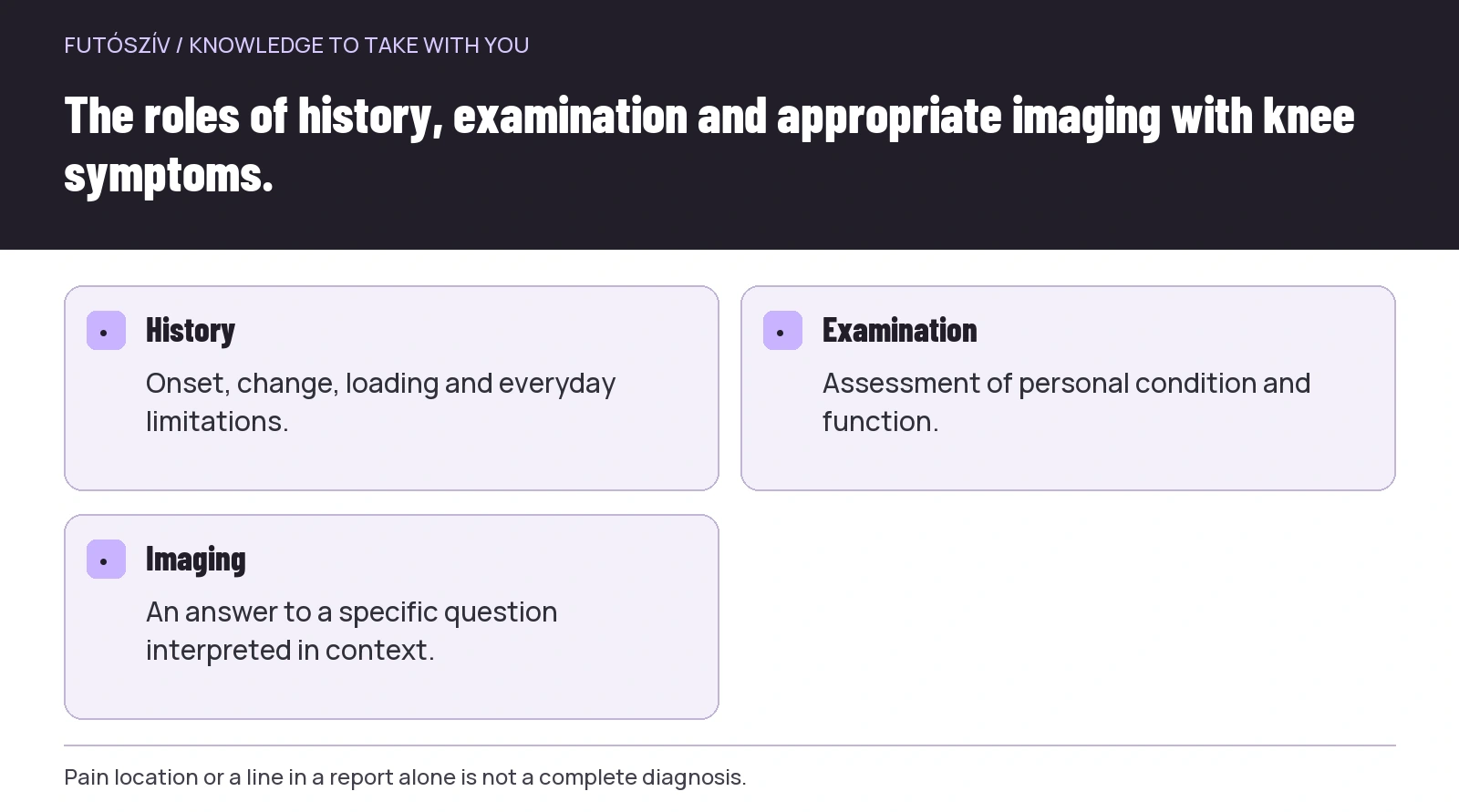 Enlarge diagram
Text version of the diagram
- History
- Onset, change, loading and everyday limitations.
- Examination
- Assessment of personal condition and function.
- Imaging
- An answer to a specific question interpreted in context.
Which movement is difficult in your real life?
Alongside running, consider usual functions: rising from a chair, stairs, starting after prolonged sitting, walking or kneeling required at work. These may offer more precise treatment goals than “make my knee good”. Do not deliberately provoke pain; describe situations already experienced in everyday life.
What you avoid because of symptoms matters too. Do you lead with another leg on stairs, choose a shorter route or interrupt a task? An adjustment may temporarily help organise the day while also informing limitations. Discuss more than training at the appointment.
Such functional goals can later be followed in treatment. What changed when getting to work or during agreed activity, for example? Every goal need not become a time or repetition count. The value is considering activities that actually matter to you and knowing which changes count.
Timing helps describe function too: is starting immediately difficult, do symptoms arise after a particular period or only afterwards? “Stairs hurt” can cover several experiences. A concrete example from an ordinary day makes the goal more precise.
If there is an MRI report, does it certainly contain the pain’s cause?
An imaging report may matter but needs interpreting alongside symptoms and examination. A 2008 population study of middle-aged and older adults found meniscal abnormalities commonly on MRI even among people reporting no knee symptoms in the previous month. The finding is not a rule for young runners with acute injuries.
The study by Englund and colleagues highlights that the connection between an imaging abnormality and symptoms is not always self-evident. This does not imply ignoring your report. Ask how it fits the whole account and which decision it changes.
Before testing, ask its purpose too: which question are we addressing, and what follows according to the result? Every knee pain does not require the same package. Report changes in symptoms or condition again, however, even after earlier imaging.
Can a running video identify the weak link?
A video can show how you move at a particular speed and in a particular situation. Useful questions may follow, but one frame does not prove the cause of knee pain. Movement may change with fatigue, pace or trying to avoid pain. Every difference should not automatically become a fault.
The 2024 best-practice guide for patellofemoral pain discusses running and movement retraining as possible additional measures tailored to individual assessment. It does not recommend the same technical change for everyone. Ask what a modification would aim to do for you and how its response would be followed.
If a technique trial enters the personal plan, clarify exactly what changes and what remains comparable. Changing foot strike, cadence, shoes and weekly volume together is difficult to assess. Video may provide feedback, not medical clearance to run with symptoms.
Why are exercise and education often combined in treatment?
The 2024 patellofemoral guide recommends knee-targeted exercise supported by education, including hip-targeted work where needed, as fundamental. Other options depend on personal circumstances and preferences. Education here means understanding the problem, the task’s purpose and loading adjustments, not merely receiving a printed exercise sheet.
The Dutch anterior-knee-pain guideline discusses patellofemoral pain and patellar tendinopathy as separate conditions while giving exercise treatment an important role in both. Tasks, loading and monitoring are still not automatically interchangeable. Clarifying diagnosis may therefore create practical differences.
For a personal programme, request demonstration and show the technique back. Know how much to do, actions for worsening and review timing. If it does not fit alongside work, explain that. A plan adjusted manageably may help more than an apparently ideal but unworkable list.
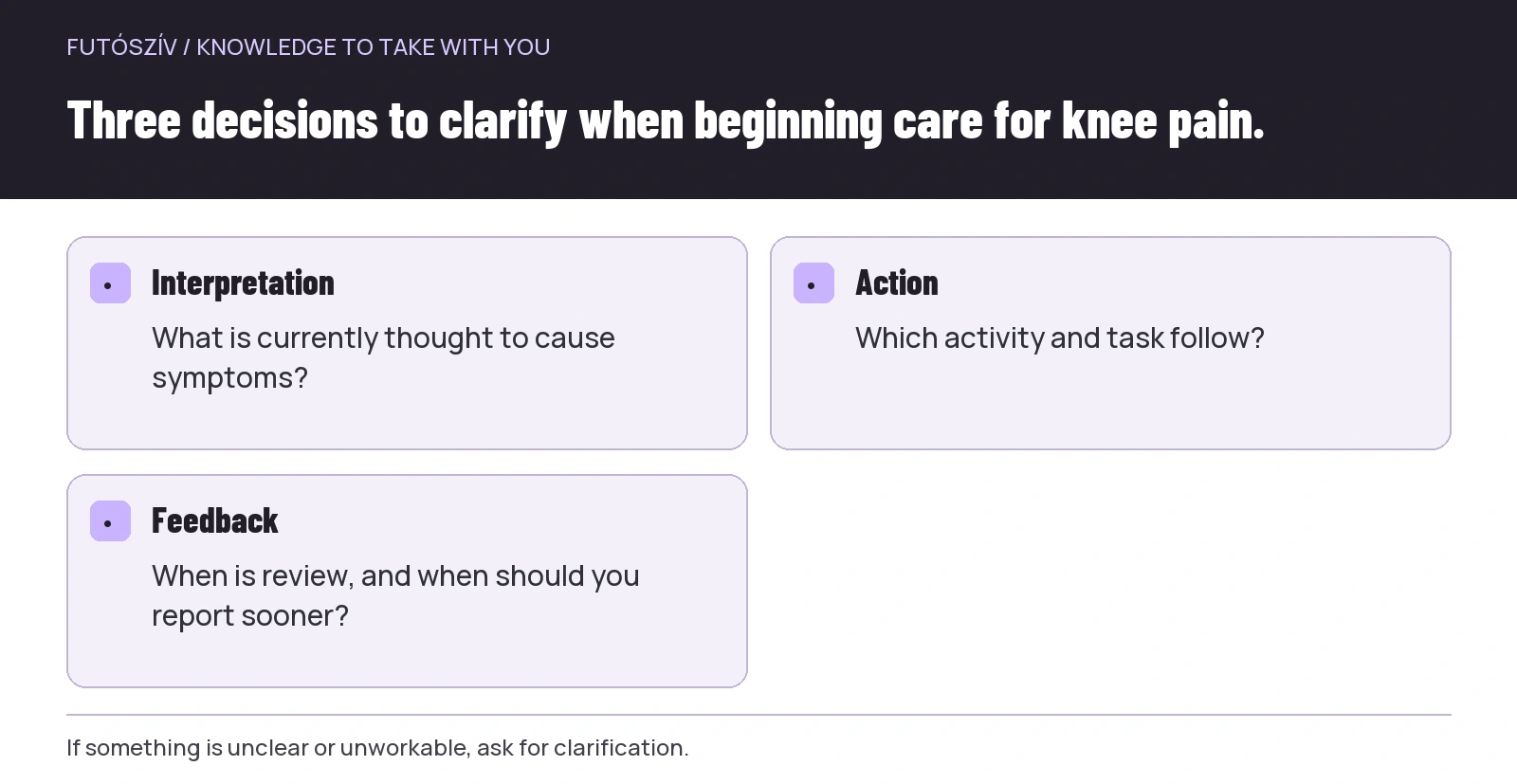 Enlarge diagram
Text version of the diagram
- Interpretation
- What is currently thought to cause symptoms?
- Action
- Which activity and task follow?
- Feedback
- When is review, and when should you report sooner?
How can you discuss running load concretely?
Separate distance, pace, terrain and frequency. Identical weekly kilometres can mean different loading with more descents, accelerations or consecutive days. Share changes around symptom onset with the clinician and coach. Include distribution, not only the total.
If temporary modification is needed, ask for clear boundaries. Which activity can remain, in which form and with which signs indicating stopping? Decisions between complete rest and unchanged running should connect to individual assessment. A general online pain score does not make an identical programme appropriate for everyone.
Include all daily activity in organising too. A working week with much walking leaves different room for household and sporting tasks. The goal is not treating all loading as danger but preventing a rehabilitation plan for an imaginary empty day.
What about races, shoes and quick solutions?
Entry does not certify personal exercise capacity. If the condition is uncertain, decide about starting according to healthcare advice and symptoms, not money paid. A long test run in the final days may not provide the hoped-for answer; it is additional loading too.
A shoe, insole or tape may belong to some plans but does not automatically replace examination and active treatment. Ask an addition’s purpose, duration and how it will be assessed. A brand or striking before-and-after video is not a personal justification.
Masking pain with medication is not sporting clearance either. Use preparations only according to appropriate information and professional advice, considering your history. The aim is not completing the old plan without knee signals but a decision suited to the symptoms’ cause and condition.
Which question should end the consultation?
By the end, have answers to three things: what is thought about the symptoms, actions for the next period and when to contact care again. If further tests await, ask for activity boundaries meanwhile. If given exercises, know their purpose and monitoring. An understandable plan is not a luxury but a condition of implementation.
At home, follow only a few observations: what happened with the designated task, everyday function and any new symptoms. The diary should not become constant testing. You need not provoke pain to have something to write, and a worse day is not a moral failure.
If the plan does not work as discussed, report back. Clarification, different amounts or reassessment may be needed. The useful question is not which online label fits best but which information supports a safer, more usable next step now.
Sources
- NHS: Knee pain
- Best practice guide for patellofemoral pain, 2024
- Englund and colleagues: Incidental meniscal findings on knee MRI in middle-aged and elderly persons
- Dutch multidisciplinary guideline on anterior knee pain: patellofemoral pain and patellar tendinopathy
How Futószív articles are prepared: our editorial guidelines.