Persistent pain is not a single training situation
Knowing someone has been in pain for months does not tell you which sport suits them. Pain may relate to a known illness, a persistent problem involving several factors or overlapping conditions. ‘Move more’ and ‘do not move while you feel anything’ are both overly simple answers. For runners, personal assessment and meaningful individual goals are useful starting points.
Earlier results do not describe the current situation either. Someone who once ran ten kilometres easily may now have a different starting point; someone who has never raced can still have a meaningful sporting goal. The plan is not about quickly reclaiming lost performance but finding participation that fits into life as a whole.
Pain is a real, personal experience
According to the definition from the International Association for the Study of Pain, IASP, pain is a personal experience that can be influenced by biological, psychological and social factors. Mentioning these influences does not mean pain is imagined or that the person is thinking incorrectly. The experience deserves respect even when it is not visible from outside.
It is not a running community’s role to verify whether symptoms are genuine. A test result described as normal does not entitle anyone to call a person lazy or oversensitive. Equally, pain’s complexity is no reason to fit every new symptom into an explanation already known.
Separate understanding from diagnosis. A good conversation can help someone describe their experiences. Appropriate examination and consideration of treatment options, however, belong to healthcare. A coach can cooperate with clinicians but does not replace them.
Why does the distinction between primary and secondary pain matter?
The NICE NG193 guideline addresses chronic primary and secondary pain separately and recognises that they may coexist. Some of its treatment recommendations apply specifically to chronic primary pain. Such a recommendation cannot be transferred unchanged to every persistent pain problem or known disease.
Individual assessment considers the onset, nature and changes in symptoms, previous illnesses, treatments and everyday functioning. Mention running specifically too: during what activity do symptoms appear, what happens later and which movement currently matters to you?
Sport must not override another condition’s particular requirements. An injury, inflammatory illness, neurological symptom or marked general worsening after exertion requires an approach appropriate to that situation. In particular, transferring a general pain-management scheme to ME/CFS or PEM is not a good idea.
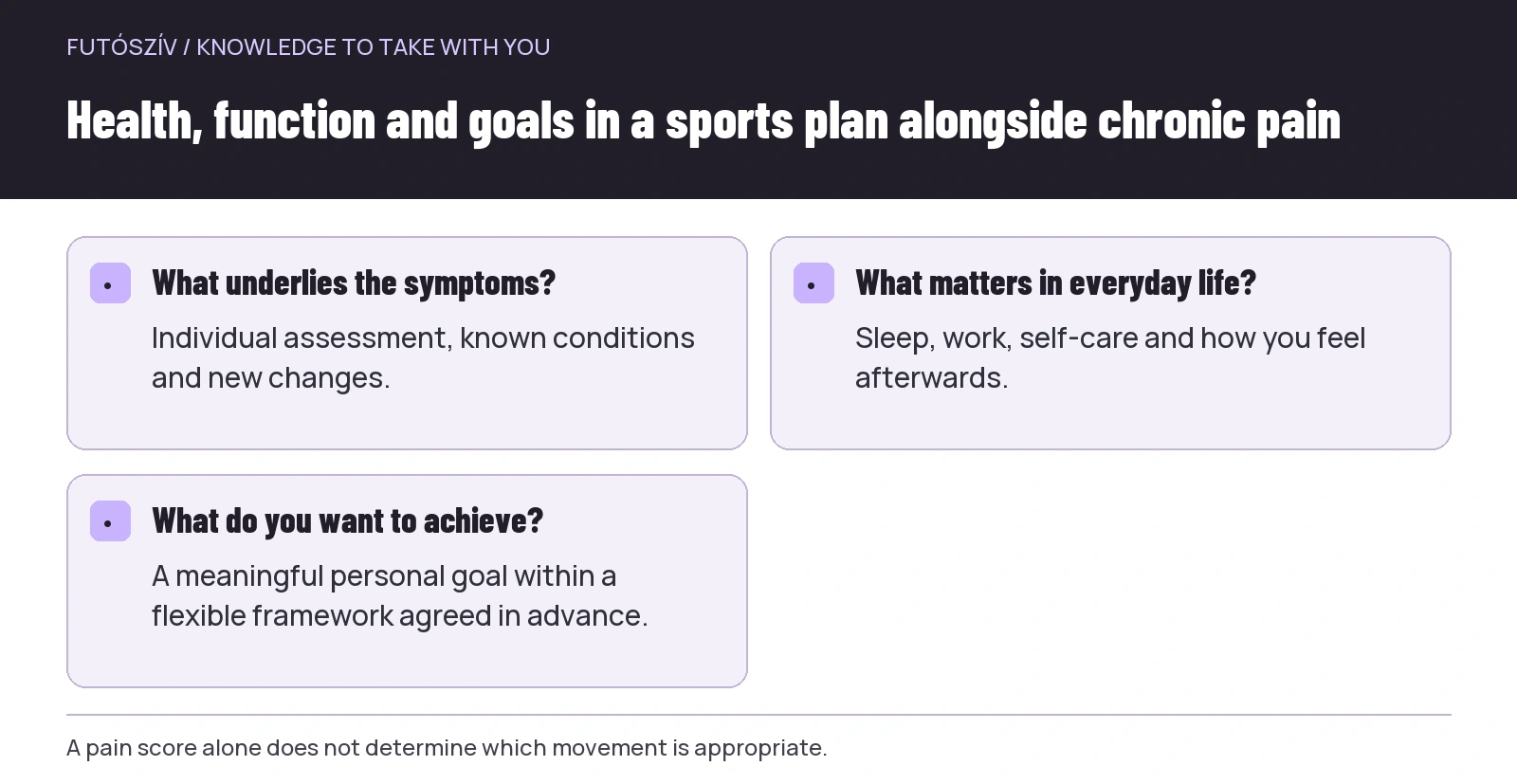 Enlarge diagram
Text version of the diagram
- What underlies the symptoms?
- Individual assessment, known conditions and new changes.
- What matters in everyday life?
- Sleep, work, self-care and how you feel afterwards.
- What do you want to achieve?
- A meaningful personal goal within a flexible framework agreed in advance.
The goal should not only be making pain disappear
Wanting to be pain-free is understandable. In planning, however, identify other important changes too: getting around more easily, participating more fully in family activities, less uncertainty before a short activity or a chosen social pursuit. These are not substitute goals but concrete parts of making life work.
The NHS England decision-support material for chronic primary pain presents various personal options, from preparing for symptom changes to organising daily activity. Individual goals make it easier to discuss which changes genuinely matter to the person.
If running matters, clarify what it means now. Being alone in a park? Moving with a friend? Starting a race? Different arrangements can lead to the same experience. Mileage is only one measure, and not necessarily the most important.
What role can movement have in treatment?
For chronic primary pain, NICE recommends offering a supervised group exercise programme that considers individual abilities and preferences. This is not specifically a running programme or a claim that any form of movement suits everyone. Programme design, access and individual condition all matter together.
People may have previous positive or negative experiences of movement. Listen to them. Do not respond to ‘I tried it and got worse’ by assuming they did not try hard enough. Ask what happened, what the programme involved and whether they received appropriate help to modify it.
The form of movement and the setting for participation can also affect usability. An accessible, calm place may be worth more than a theoretically ideal option involving long travel and constant rushing. An appropriate programme consists of more than exercises.
Start from the real week
Do not plan activity around the best day. Consider work, household tasks, caring responsibilities, travel and activity currently tolerated. The same sport fits differently into a calmer day and one already crowded. A training calendar does not reveal the full picture of overall demands.
Activity management can be personalised with the clinician. Practical questions may be simple: when does movement fit, which task follows it and is modification possible? Do not make a plan that works only if every day is perfect.
A shorter session can have value in its own right. It does not need secret extra activity because ‘that did not count as training’. Monitor how workable the plan is and later functioning alongside the amount completed. Sport must not become pressure to prove something at the expense of functioning needed for everyday tasks.
Use fuller feedback rather than a pain scale alone
Reporting pain intensity can be useful, but one number does not tell the whole story. Changes in walking, sleep, concentration, self-care or the next day’s plans matter just as much. Agree beforehand in the personal plan which changes call for which actions.
There is no universal blog rule stating that every run below a particular pain score is definitely appropriate. The meaning of a number can depend on the underlying condition and specific symptom. Fluctuation in a familiar, previously assessed problem may need a different evaluation from new, sudden or different pain.
A short note can support collaboration: what was the task, what changed during it and later, what helped and what remains uncertain? There is no need to check every minute. If constant symptom monitoring is itself demanding, find another way of following changes with the clinician.
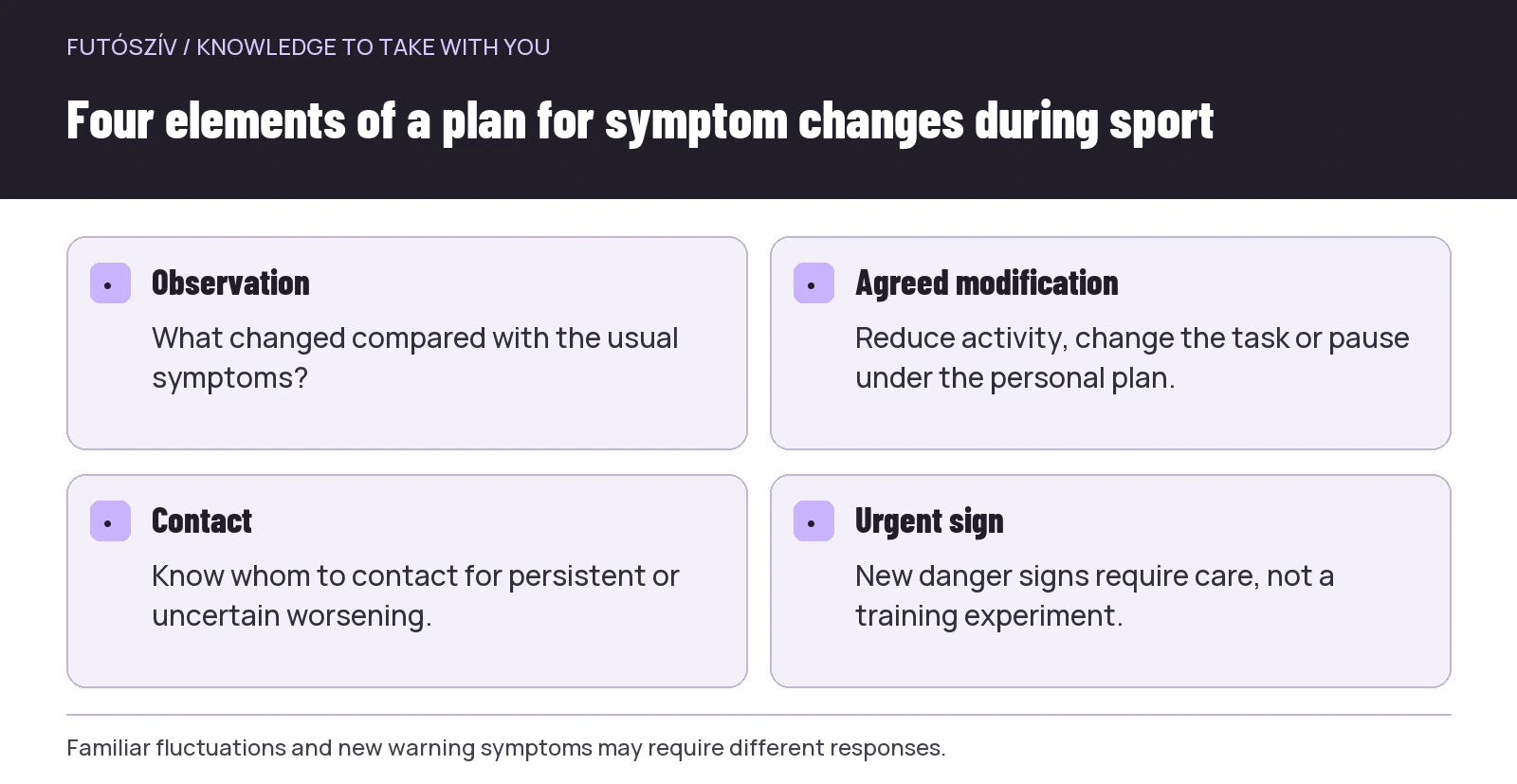 Enlarge diagram
Text version of the diagram
- Observation
- What changed compared with the usual symptoms?
- Agreed modification
- Reduce activity, change the task or pause under the personal plan.
- Contact
- Know whom to contact for persistent or uncertain worsening.
- Urgent sign
- New danger signs require care, not a training experiment.
Have a plan for harder days
Preparing for worsening symptoms is not negative thinking. On the contrary, it can reduce rushing and self-blame. The personal plan can include appropriate modifications, the option to pause and whom to contact if a change persists or is unusual.
An alternative discussed beforehand should actually be easier and workable. A long, tiring change of venue is not necessarily a good exchange for a shorter activity. Rest can be among the options too. Every missed sporting session does not need filling with another activity.
Returning should not automatically mean repaying a debt. Instead of making up the missed amount the next day, start from the current condition and personal guidance. A coach needs a flexible plan and open communication for this, not to discipline the athlete.
A new warning sign changes the task
Persistent symptoms do not make every new symptom harmless. The NICE guideline on recognising neurological conditions for example, describes immediate professional assessment for new bladder, bowel or sexual dysfunction, or altered sensation in the perineal area, alongside severe low-back pain radiating into the leg. This is not a situation for experimenting at home by reducing training.
A serious injury, new significant weakness, symptoms with fever or general illness, chest pain or other warning signs may also require appropriate care. In immediate danger, call 112. The list is not exhaustive and does not replace an individual decision when the situation is uncertain.
An earlier reassuring examination does not cover every later change. Equally, every familiar fluctuation need not be labelled a new injury. A plan agreed with the personal clinician helps explain this distinction.
The role of coaches and running partners
A consistent tone matters in support. Do not call the participant fragile, but do not ask them to ignore pain either. The aim is to let them explain how they feel and make modifications within the agreed framework. They do not need to give the group a detailed medical report before every shared session.
A coach can help with planning within their professional boundaries. They do not change medication, diagnose or promise guaranteed freedom from pain. Information sharing needed for healthcare cooperation should happen with the person’s knowledge and consent.
A community can stay connected when someone temporarily does not run. A short meeting, another shared activity or simple interest can be valuable. Participation consists of more than the amount completed in training.
How can you tell whether the plan has become more usable?
Return occasionally to the chosen goal. Has organising activity become easier? Do harder days create less uncertainty? Are there more choices, with room for important everyday activities too? These changes can matter even if pain has not disappeared completely.
If a plan persistently does not work, reassess it. This is not failure and does not prove the person has not worked hard enough. Another goal, different organisation, further assessment or other support may be needed. Personalisation is not a word stated at the start; it is a process responding to experience.
Sport’s value does not depend on how spectacular the story is. A short activity that feels more manageable, a clear plan for worsening symptoms or the ability to ask for help can also be important achievements. Taking pain seriously and respecting personal decisions help make these possible.
Sources
- IASP: pain as a personal, complex experience.
- NICE NG193: assessment and chronic primary pain.
- NHS England: personal decision-support material.
- NICE NG127: signs requiring urgent neurological assessment.
How Futószív articles are prepared: our editorial guidelines.