A first race as a mother can be a celebration, an exploration, a reunion with running friends or a long-missed experience of your own. It does not have to prove that your old pace has returned. When choosing a goal, consider physical preparation, race demands and family arrangements separately. If only one is in place, the day can still become uncomfortably tight.
Entering a race is not the same as clearance to run after childbirth. Healing, any symptoms and individual assessment come earlier. This guide helps with the next decision when you are already running according to your condition or have a personal return plan. The race date needs to fit that plan, rather than the other way round.
Start with what you want from the day
Write one sentence without a finish time. You may want to move with others again, make comfortable decisions throughout or experience how race day works in your new circumstances. A performance target can go on a separate line later. The goals do not exclude each other, but may require different preparation and practical conditions.
Make sure the goal is yours. Do not choose a race only because friends are going or someone thinks you should have returned by now. Available family support and your budget are real considerations too, not details that make the decision less sporting.
There is also room to decide that you do not want to race yet. Enjoying running does not require a race number. A shared training session, an easy local run or cheering at another event can come first.
Recreational experiences deserve discussion too
A 2025 qualitative study examined the return to recreational sport of fourteen mothers living in Ireland and the United Kingdom. Alongside motivation, the conversations revealed mental load, guilt and a lack of knowledge or appropriate support. Such research cannot show how common an experience is among all mothers, but makes the role of organisation and environment visible.
Difficulty coordinating running with caregiving is therefore not merely an individual failure of time management. Identify which condition is missing: help, appropriate information, a predictable time window or an inclusive community. Naming the problem precisely can lead to a more specific solution.
Create a support list alongside the race goal. Who will take on tasks during preparation, and who on race day? The start has a firmer foundation when the preceding weeks also allow room for movement, food and recovery.
Elite stories can inspire, but should not set a deadline
Success stories about elite athletes’ returns are often striking, but arise within different healthcare, work and family circumstances. A study exploring elite athletes’ experiences also highlighted the importance of more time, changed physical circumstances, breastfeeding and necessary support. These stories do not establish one return speed for every recreational runner.
Look beyond how many months after birth someone raced. You usually cannot see every preparation detail, healthcare support, missed session or arrangement at home. These stories cannot supply an exact calendar for your own decision.
Equally, a slower or more difficult return does not mean you cannot have an enjoyable sporting life later. The first race is not an examination of all your future running ability. It is one day under particular conditions.
 Enlarge diagram
Text version of the illustration
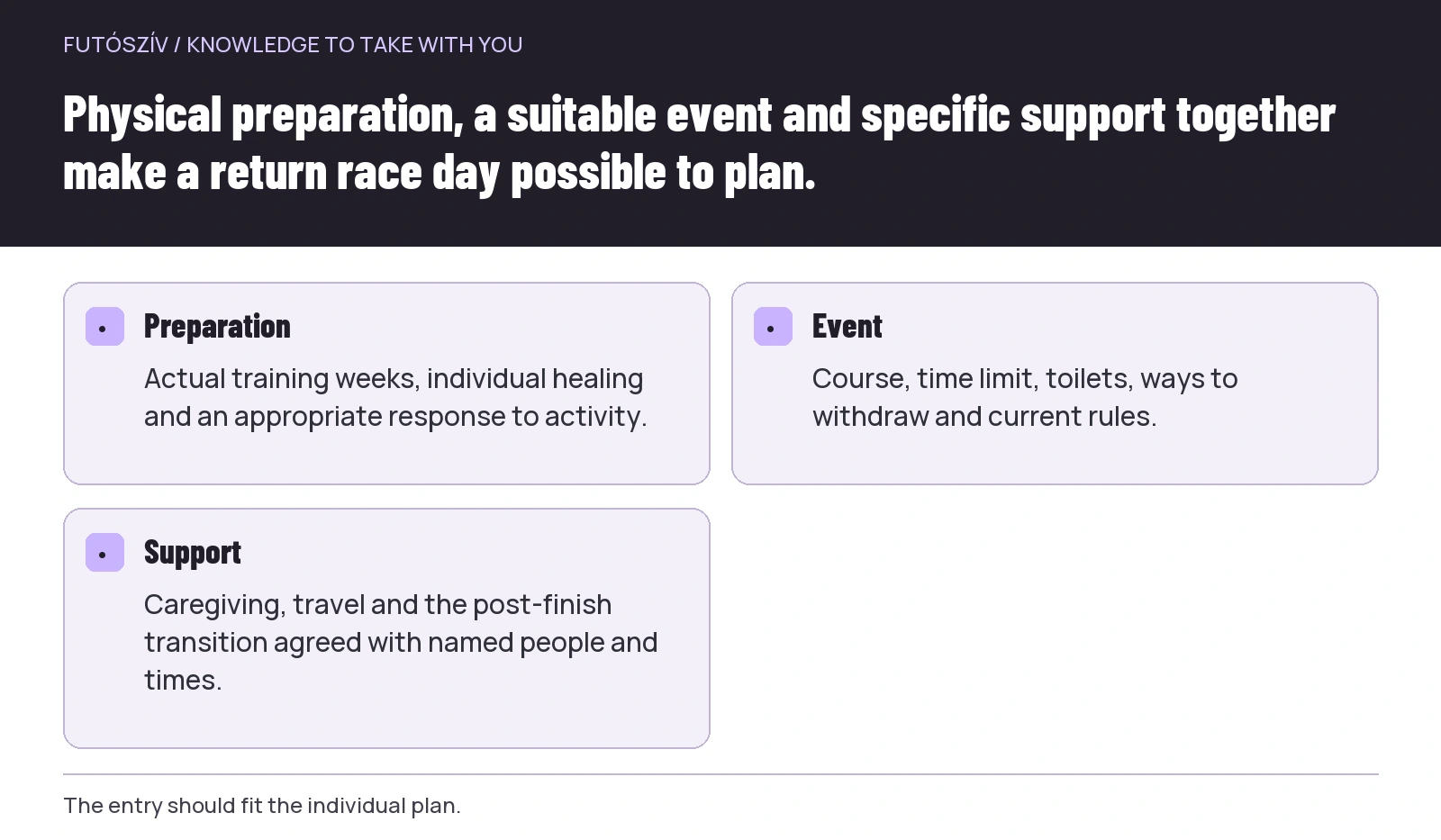
- Preparation
- Actual training weeks, individual healing and an appropriate response to activity.
- Event
- Course, time limit, toilets, ways to withdraw and current rules.
- Support
- Caregiving, travel and the post-finish transition agreed with named people and times.
Let the actual weeks show your preparation
Review the activity you have recently managed with an appropriate response. The question is not what appeared in the ideal plan but what actually happened. If daily life allowed only shorter runs, that is a different starting point for a long race from a regularly manageable workload.
The expert consensus on designing a postpartum running programme emphasises gradual loading and monitoring physical, emotional, sleep, nutritional and other circumstances. This is expert agreement, rather than a universal training plan established by one study. A race date does not justify a sudden jump in volume.
If preparation remains uncertain for several weeks, adapt the goal to actual opportunities. A shorter distance, later race or reduced performance expectation can be appropriate. Missed weeks do not need to be recovered through compressed training before the start.
Course details shape the experience
A distance label alone does not describe the event. Check elevation, surface, expected crowds, the time limit and opportunities to withdraw. A local loop you can easily leave creates a different situation from a remote trail course that is difficult to exit.
If walking is part of your plan, check that the event’s time limit and arrangements allow it. Do not discover at the first kilometre that your manageable pace puts you under constant time pressure. Route accessibility and helpers’ locations are also part of the decision.
Allow flexible decisions in response to expected weather. Do not use the entry fee to justify a poorly chosen workload. Advance organisation should create more manageable choices, rather than make the purchased race number an obligation overriding everything else.
Questions to ask the organiser
- Where are the toilets, and can they be accessed while waiting before the start?
- Where can I feed or express in a calm setting if needed?
- Can I agree a meeting point with my companion in advance?
- What are the rules for switching to a shorter distance, cancelling or transferring an entry?
- Can I withdraw safely during the event, and how would I get back?
- What is the event’s rule on pushchairs, if this is relevant at all?
The organiser’s current information can answer these. Do not assume a previous year’s post or another race’s practice applies here too. Base family participation on specific conditions rather than a general family-friendly label.
Make the companion’s role clear
‘Someone will look after the baby’ is less dependable than a task agreed with a name, time and meeting point. Discuss travel, feeding, changing, time before the start and the transition after finishing. Match care details to the baby’s usual and necessary care.
Plan for delays, an early return or deciding not to start too. The companion should know how to contact you, and you should know how to get back. A simple agreement understood by both can reduce uncertainty around departure.
Help should not end at the finish line. A few minutes to eat, drink, change and settle before taking back everyday tasks can help. This transition is part of the sporting experience too. Requesting it beforehand is more practical than inventing arrangements on site while tired.
When breastfeeding, count the whole time away
Race time is only part of the day. Travel, waiting before the start and activities afterwards can considerably extend the absence. If breastfeeding or expressing, make a plan suited to your established feeding situation, with a professional experienced in breastfeeding if needed.
If expressing and milk storage are needed, arrange equipment, cleaning, storage and transport according to the relevant official guidance. Do not try to resolve this in the final minutes before the start. A local trial can help establish the time required.
Test clothing against the actual day too. Appropriate support, access and freedom from chafing matter more than an outfit that looks good in race photographs. Do not first test comfort at the start, and do not plan around tolerating pain.
 Enlarge diagram
Text version of the illustration
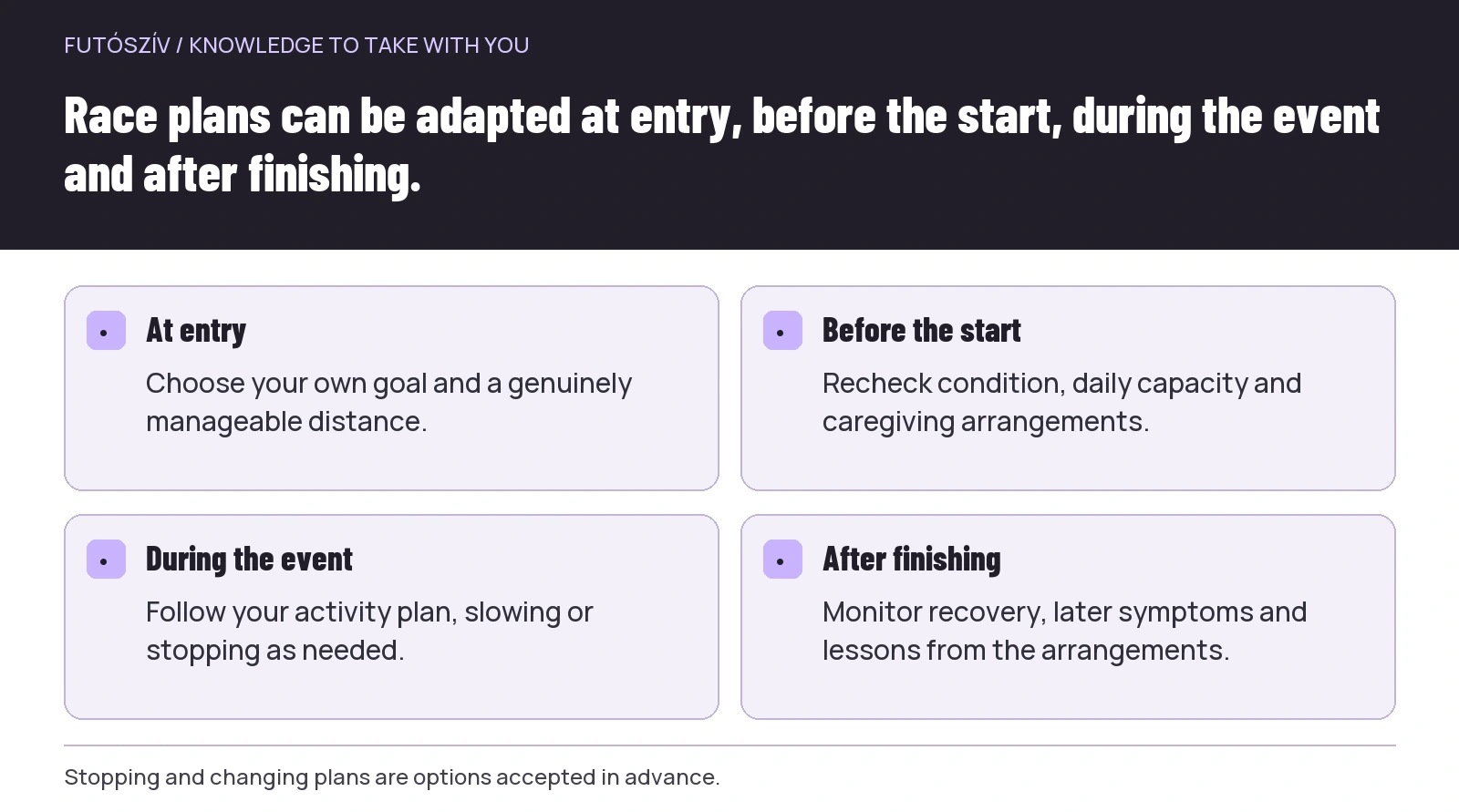
- At entry
- Choose your own goal and a genuinely manageable distance.
- Before the start
- Recheck condition, daily capacity and caregiving arrangements.
- During the event
- Follow your activity plan, slowing or stopping as needed.
- After finishing
- Monitor recovery, later symptoms and lessons from the arrangements.
Agree a plan for changes beforehand
Choose a decision point on the day before the race and on race morning. New signs of illness, symptoms, significant exhaustion or unresolved caregiving can justify a change. You do not need rigid rules for every possibility, but starting should remain a choice.
Within your individual healthcare plan, clarify which symptoms mean stopping and discussing matters with a professional. The readiness-to-run consensus emphasises assessing postpartum symptoms and functioning. Having previously run without symptoms does not provide a general exemption for a symptom during a race.
Stopping can be an accepted part of the occasion in advance. Agree with a running partner that they should not try to encourage you through a situation in which you want to finish. Support here means respecting your decision and providing practical help.
Choose a decision-making goal instead of a pace
A first race back can aim at starting conservatively, noticing your condition and following your plan rather than the surrounding momentum. Such a goal can be assessed: did you slow down, eat, drink or ask for help in time when needed?
If you want a finish-time target, base it on current preparation and condition. An old personal best can be a comparison point, but it is not a debt. Do not wait until the start to decide how much your performance has changed, or judge the entire return from one result.
Make social running genuinely agreed too. The same distance does not imply the same intention. If one person wants a result and another a flexible experience that can be stopped, say so beforehand. Neither then has to guess the other’s expectations during the race.
The next day is part of the story too
The race experience can easily distract from the response afterwards. Record how you feel that evening and the next day, how daily movements go and whether new or recurring symptoms appear. If something is concerning, consult according to your care plan; do not use the medal to measure a symptom’s significance.
Do not decide the next workout at the finish line. Leave room for food, rest and how daily life actually unfolds. Help may be needed after the event as well as during it. This can be included in the family plan in advance.
Separate running demands from practical arrangements in your review. The distance may have been suitable but travel too long; or the day may have been well organised while the course did not fit your current condition. Specific lessons make the next occasion much easier to plan.
Let your own decision be a visible outcome
At the end of the day, ask: did I get what I came for? Which condition helped, and what would I change next time? Completing the event can bring joy, but shortening it, withdrawing or staying home can also be good decisions. They are not identical, but each can connect with your own goal.
Returning to racing as a mother does not mean restoring one previous state. You are finding a place for running under new conditions. Choose a goal that gives your body’s feedback, family arrangements and your own enjoyment a place together.
Sources
- From insight to action: postpartum return to recreational exercise and sport in Ireland and the UK, qualitative study, 2025
- Davenport and colleagues: We’re not Superhuman, We’re Human – elite athletes’ experiences after childbirth, 2022
- Deering and colleagues: Designing a postpartum return-to-running training programme, Delphi consensus, 2024
- Christopher and colleagues: Return-to-running readiness after childbirth, Delphi consensus, 2024
How Futószív articles are prepared: our editorial guidelines.