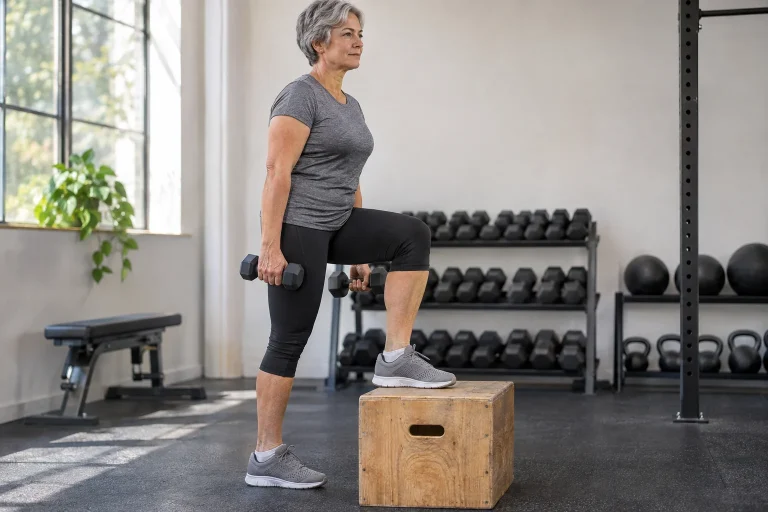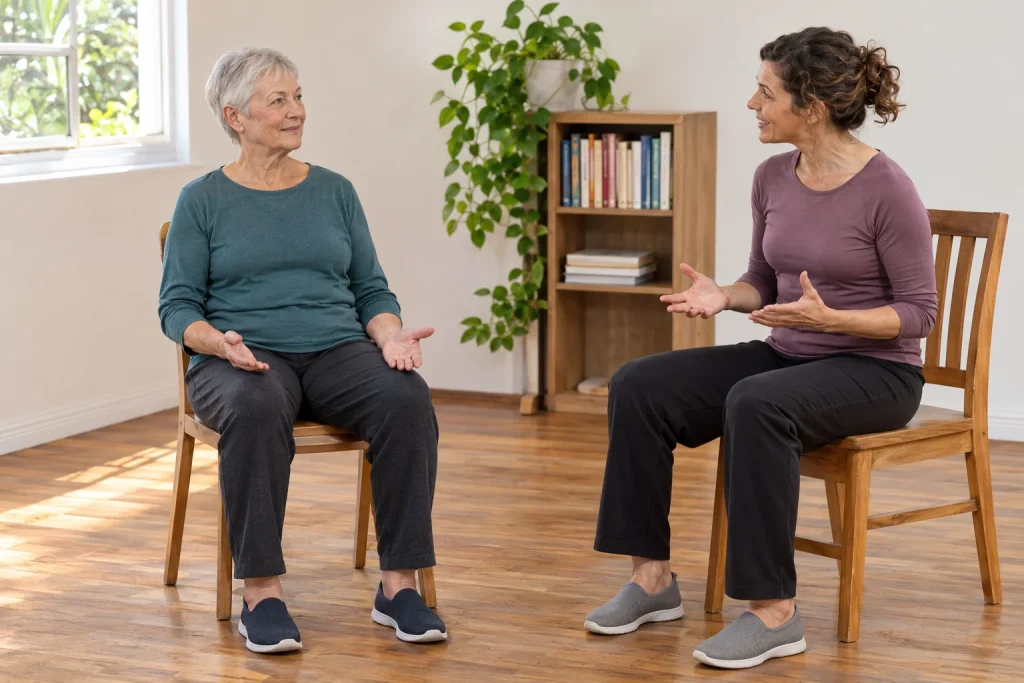
You do not want to go out today, or an outdoor activity is not workable for some reason. Appropriate movement at home may still have a place, but you are not obliged to replace a missed run at any cost. Seated or supported activity becomes a meaningful choice when you know its purpose, it suits your own situation and it can be carried out appropriately in your surroundings.
Being worthwhile here does not mean being identical to running training. A task can have its own purpose without being convertible into kilometres. Equally, sitting does not automatically make every exercise easy or appropriate for everyone. Start with your own possibilities, the individual professional framework and what you genuinely want to practise through the particular movement.
First distinguish why you are staying home today
Bad weather, simply choosing a quieter day and staying home because of acute illness or a new symptom are different situations. With a medical instruction to rest or restrict activity, you do not need to seek a hidden replacement task. General advice about activity at home does not override individual instructions. ‘I am only doing it seated’ does not by itself remove the reason for them.
New, severe chest pain, severe difficulty breathing or sudden neurological symptoms may require appropriate urgent help. Care then matters more than selecting an activity. If symptoms or feeling unwell occur during movement, you do not need to set them aside to complete repetitions. The programme’s purpose is not to prove a symptom can be overcome while seated.
If the issue is simply organising the day, more options may open up. You can choose a previously learned home task appropriate for you, a programme developed with individual help or genuine rest. There is no need to fill every day without running with an activity programme. Your own decision has value even if it creates no new sports watch entry.
What can a seated task aim to do in its own right?
The NHS page on sitting exercises presents specific activities for home and recommends professional discussion if suitability is uncertain. Sitting can be the setting for performing a task, rather than a sign that there is no task. Content matters, however: being on a chair does not yet tell you which capability someone is practising or how.
A programme concerned with range of movement, a specified strengthening task or a learned coordination activity may serve different purposes. The chair alone guarantees none of them. When selecting an appropriate task, it therefore helps to know what to expect from it and what not to expect. Movement’s value does not need validation through running pace, but neither should unlimited effects be attributed to it.
The NIA information on physical activity also presents the different roles of aerobic, muscle-strengthening and balance-focused activity. A single home task does not necessarily cover them together. The point within an individual plan may be to make appropriate room for one specified component now, rather than meet every goal in one seated session.
 Enlarge image
Stable furniture is only one condition
The NHS describes a stable chair without wheels for its seated and chair-based exercises. Check whether the furniture could move on the surface where you use it and whether its size and position are appropriate. The particular task and individual needs determine the seating and support required. An easily available kitchen chair is not automatically suitable for every variation.
Allow space for the task’s movement, without bags, cables or objects that roll getting in the way of your feet. If following a video requires turning in an awkward direction, adjust the screen’s position too. Preparation is not time taken away from the actual movement: it helps ensure your attention is not spent constantly avoiding furniture and equipment.
Support should genuinely be appropriate for the role you intend. Not every small table, chair back or door handle is a suitable handhold. If you do not know what you can lean on during a task, clarify this with individual help. A single general photograph does not show furniture stability or every important detail of your situation.
An apparently easier form does not allow unlimited exertion
Sitting can still involve producing force, repeating for a long time or following a complex task. Not having to stand does not mean any resistance, repetition count or duration is appropriate. Difficulty comes from the content of the whole task. A ‘senior’, ‘chair exercise’ or ‘gentle’ label is therefore insufficient to determine individual suitability.
The NHS home strengthening exercises also emphasise building up gradually. General examples described there do not have to become unchanged individual prescriptions. If you already have your own task, follow its framework; if unsure about a new activity, appropriate demonstration and feedback offer more than a randomly selected long video.
Do not calculate how much seated work you ‘owe’ from the length of your run. The demands and purposes of the activities may differ. A shorter, appropriately selected session may make more sense than arbitrarily increasing repetitions because of missing kilometres. The programme needs to fulfil its own purpose, rather than justify the absence of another workout.
Research does not treat all seated programmes as identical either
An original pilot randomised study published in 2025 compared an online programme combining seated exercises and cognitive tasks with a booklet-based seated programme in 27 healthy participants aged at least 65. Some measurements changed, but superiority between groups was not established for any outcome examined. This was a small study within a defined framework.
The finding does not mean any online video is appropriate or that professional contact is never useful. Nor can it establish that every seated programme has the same effects. Rather, the study reminds us that a label says little without details of participants, tasks and support. Understand the actual content in relation to your own goal.
The word ‘seated’ is therefore neither evidence of effectiveness on its own nor a reason to devalue an activity. The useful questions are which task you perform, from what starting point, with what understandable support and which outcome you want to see. This approach preserves the choice’s value without making a promise unsupported by the source.
How can the home session be easy to follow?
Prepare what is genuinely needed for your individual task within reach beforehand. Do not leave yourself searching for equipment, moving a chair or picking a phone off the floor during the activity. If support forms part of the programme, clarify when and how it is available. Thoughtful preparation makes the learned task easier to follow.
| Preparation | Why is it useful? |
|---|---|
| An understandable task and individual framework | You do not have to work out execution from memory. |
| A stable place and clear movement space | The environment should not become a separate source of uncertainty. |
| Available feedback | A question or change that arises can reach the appropriate person. |
The table is an organisational aid. It does not give every exercise a green light or replace clarification of individual suitability. Equally, the session does not need to be overcomplicated. If the task is already familiar and appropriate, a manageable environment can prevent preparation difficulties from being the reason your chosen activity does not happen.
Make room for finishing too. You do not need to extend every session until you are very tired. After the designated task, return to your day and note what matters for later feedback. Success can mean not only substantial fatigue, but also understanding and carrying out the activity within the appropriate framework.
 Enlarge image
Help can mean more than supervision
The movement itself may be appropriate for you to perform independently, while you need help preparing the environment. At other times, understanding a new instruction or receiving feedback on execution matters. Name the need precisely. Help can then become less of a general obligation to be present and connect more directly to what is actually difficult.
For online sessions, what the leader can see of the space and movement matters too. A camera being switched on does not automatically mean appropriate observation. If the connection drops or the image misses an important detail, clarify the programme’s framework accordingly. Technical operation and individual suitability of the movement are separate questions.
If a family member helps, they should not unnoticedly become the professional interpreter of the task. They can help prepare or remember an instruction, but a new symptom or an exercise modification may require different expertise. Clarifying roles protects both the person and helper from unnecessary expectations. You do not have to solve everything alone, or entrust everything to a family member.
A home option can connect with your whole week
In a fictional example, a woman in her seventies does not attend her usual meeting in slippery weather. She has no new symptoms and already has an appropriately taught home task. She prepares the space, completes the programme within her own framework and calls her companion later. The day’s value does not depend on recreating the same running time inside the flat.
On another day, she has been told to rest because of illness. The same woman then does not choose a compulsory seated replacement workout. There is no inconsistency between the two decisions: her individual situation differs. A worthwhile choice can include both appropriate movement and genuinely needed rest. Maintaining an unbroken streak at any cost is not the aim.
In later planning, the home programme can have its own role. It may be a place to practise a particular capability, a more accessible session or a supported form of learning. Its relationship with outdoor activities is individual. It does not have to replace everything permanently, nor be treated only as a second-class solution reserved for bad weather.
Seated or supported activity becomes a meaningful choice through a clear purpose, appropriate framework and place in your own day. A chair is not a judgement on your fitness or a general safety guarantee. It can be a tool to make a task appropriate for you more accessible.
Sources
NHS: the framework for seated home exercises; NHS: home strengthening tasks and gradual progression; NIA: different forms of physical activity; Kabul and colleagues: pilot randomised comparison of seated programmes, 2025; NHS: breathlessness; NHS: stroke symptoms. Checked: 21 November 2026. The daily examples are our own editorial illustrations, not individual exercise prescriptions.
How Futószív articles are prepared: our editorial guidelines.