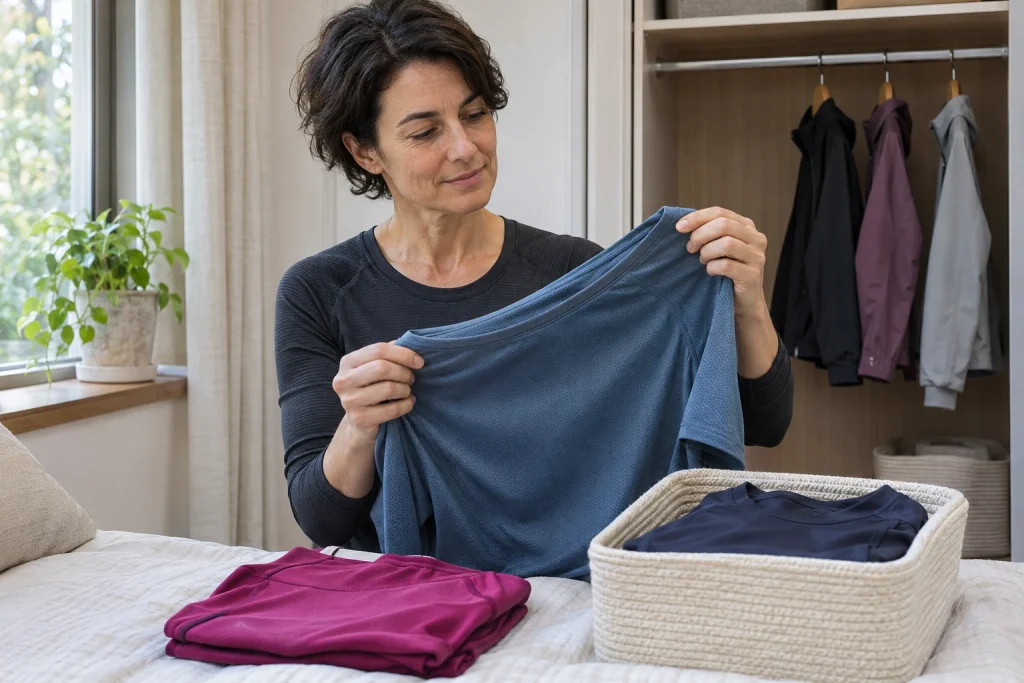
There is no compulsory number of T-shirts, trousers or outer layers that suits every runner. The wardrobe you need depends on actual use, washing and drying facilities, and which garments can replace one another. Five similar tops may make sense for one person and be unnecessary for another. So instead of copying an online wardrobe list, look at how your own clothing works. This article takes you through a practical review: grouping garments by purpose, observing availability and distinguishing a genuine spare from a duplicate that never gets worn.
Look for the same purpose, not the same appearance
Two black tops may not be interchangeable. One might be thin and the other a warmer layer; one might fit well under a vest, while the other has a different cut. Equally, garments in different colours may do the same job. The first step in the review is therefore to name the role. Describe the circumstances and layering arrangement in which you use the garment. Make the category specific enough to reveal interchangeability, but not so narrow that every T-shirt acquires a separate purpose through retrospective justification.
You can use simple names: usual lightweight running top, layer chosen for colder weather, outer layer needed for rain. These describe your own system; they are not universal weather instructions. Describe the real situation in which you use something rather than a precise temperature threshold, because comfort and conditions vary. Infrequent use of a garment needed for a special event does not automatically make it unnecessary; its purpose and necessity matter. A garment may also work in more than one group. Note this, as it can reduce the need for separate spares.
Count the wardrobe by condition too
Separate usable, correctly sized garments from those awaiting repair, needing clarification or no longer worn. The total number of T-shirts in the cupboard is not the same as the clothing actually available. If a top has a faulty hem, is uncomfortable or the wrong size, do not automatically count it as a spare ready for your next outing. Give clothing awaiting repair a specific next step rather than leaving it indefinitely as an imaginary backup. Similarly, something used for another purpose may not be available for running on the day in question.
Lay out the groups or make a simple list. You do not need a full catalogue of every garment, but significant differences should be visible. One line might read: lightweight top, usable, comfortable, suitable for the usual wash. Another: similar top, awaiting repair because of a faulty zip. These two garments do not offer the same availability. During the review, do not immediately buy another garment for the first gap you notice; examine the whole functional group first, because you may own another genuinely suitable substitute.
Observe your own cycle of use
Choose an ordinary period that roughly represents your usual runs. Note which garments you wore from each functional group, when they went for care and when they became clean, dry and ready to use again. There is no need to artificially fill the calendar with an identical number of runs. If the period was unusual, for example because of travel or a rare event, note that. The aim is to see a real pattern, not to produce calculations that justify a purchase already decided upon. Your own washing facilities and drying space often influence the number needed more than a generic beginner’s list.
You can track clothing rotation through four states: ready, in use, awaiting care and drying. A separate awaiting-repair state can sit outside this normal cycle. The four states show where the system gets congested. If most garments are drying at once, the issue may be when or where care takes place. If every suitable garment has been used and there really is no ready substitute, that may indicate a genuine need for a spare. This observation does not prescribe how much to wash; it reveals how your own system works.
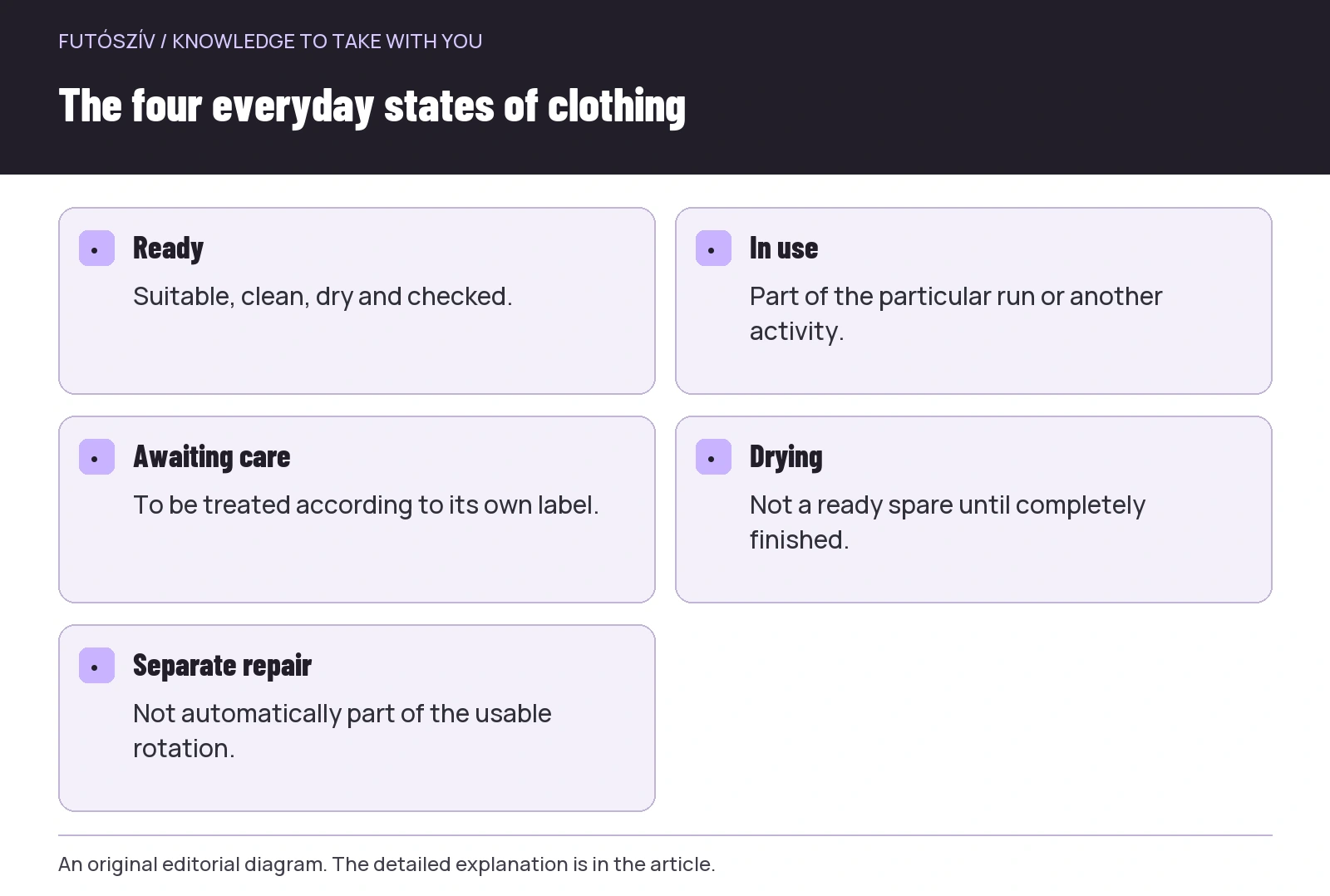 Enlarge diagram
Text version of the diagram
- Ready
- Suitable, clean, dry and checked.
- In use
- Part of the particular run or another activity.
- Awaiting care
- To be treated according to its own label.
- Drying
- Not a ready spare until completely finished.
- Separate repair
- Not automatically part of the usable rotation.
The washing routine and the label both matter
Different garments may need different care and drying, so you cannot calculate the same turnaround time for all of them. The GINETEX guide to care symbols helps you interpret care instructions; you must also follow the particular clothing manufacturer’s directions. Do not solve wardrobe planning by speeding up a slow-to-dry garment in a way that contradicts its label. Proper care is a condition of the calculation, not an obstacle to set aside. Count clothing as ready again only after appropriate cleaning and complete drying.
The Patagonia product care and repair hub also addresses care and repair within its own product range. The broader lesson for consumers is that maintaining existing equipment is a real task, not just acquiring something new. This is not a specific service promise covering every brand; look for the options belonging to your own product. A garment in your wardrobe is a genuine spare when it can be cared for, is in suitable condition and is available when needed. A forgotten repair or missing care information can make that uncertain.
| State | What does it mean? | Does it count among spares available today? |
|---|---|---|
| Ready | Suitable, clean, dry and checked. | Yes, if it suits the same purpose. |
| Awaiting care | Needs its own appropriate care after use. | Not yet. |
| Drying | The permitted process is underway. | Not until completely finished. |
| Awaiting repair | Has a known fault and a next action. | Not necessarily; assess separately. |
| Unsuitable | You do not use it because of size, cut or purpose. | Being on the shelf does not make it a spare. |
Describe the shortage, not just the number of garments
If you cannot find appropriate clothing before leaving, note exactly why. Was every suitable garment awaiting care? Was there too little time to dry? Were ready garments put in the wrong place? Did you take a shared layer for another activity? These are different causes, and a new purchase is not the right response to all of them. Clothing that is ready but cannot be found presents a storage issue; a garment that never properly meets the required purpose presents a selection issue. Naming the fault precisely helps prevent wardrobe expansion from becoming the single solution to every problem.
A genuine need for a spare becomes visible when a recurring, realistic situation leaves you without a suitable ready substitute and reasonable care and storage arrangements do not solve it. You can then describe the missing role: I need another top suitable for this purpose because the existing one regularly fails to become ready in time within my own cycle. That is more specific than saying everyone needs at least a fixed number of T-shirts. The number follows from your observed system, not someone else’s way of life.
Three illustrative wardrobe situations
In the first fictional situation, someone runs a few times between washes and their suitable tops become ready in time. Another garment serving the same purpose does not automatically have a role for them. In the second example, washing opportunities are less frequent, a suitable top is needed on several successive days, and several existing ones are still drying. A genuine need for a spare may arise here, but the care and drying arrangements also need reviewing. In the third situation there are many T-shirts, yet the same two are always worn because the others fit badly.
In the third case, the total count is high but the functioning wardrobe is small. Fit and what happens to unused garments are the questions here, rather than another random purchase. These examples are not universal wardrobe prescriptions and come with no number applicable to everyone. They demonstrate the sequence of thinking: role, actual use, availability and cause of the shortage. Your situation may differ; the method works when it contains information about your actual routine and equipment instead of copied fictional examples.
Clothing kept for rare events is a separate category
There may be a layer or piece of equipment you rarely bring out yet keep for a justified purpose. Do not label it unnecessary merely because it saw little use in recent weeks. Look at the specific circumstances requiring it, whether its size and condition remain appropriate, and whether there is another genuinely suitable substitute. Compare clothing kept as mandatory race kit with the event’s current requirements; remembering an old rule is insufficient. The real purpose reveals the distinction between infrequent use and unnecessary storage.
At the same time, do not invent a special event retrospectively for every rarely used garment. The “it might be useful one day” category makes sense when there is a realistic, named use and suitable condition. Otherwise, passing it on, swapping it or another route appropriate to its actual condition may be considered. Do not pass on an unknown fault as a good spare. The aim is not to minimise the wardrobe at any cost but to understand its functions. A predictable, somewhat larger stock can work better than one so restricted that it constantly causes last-minute scrambling.
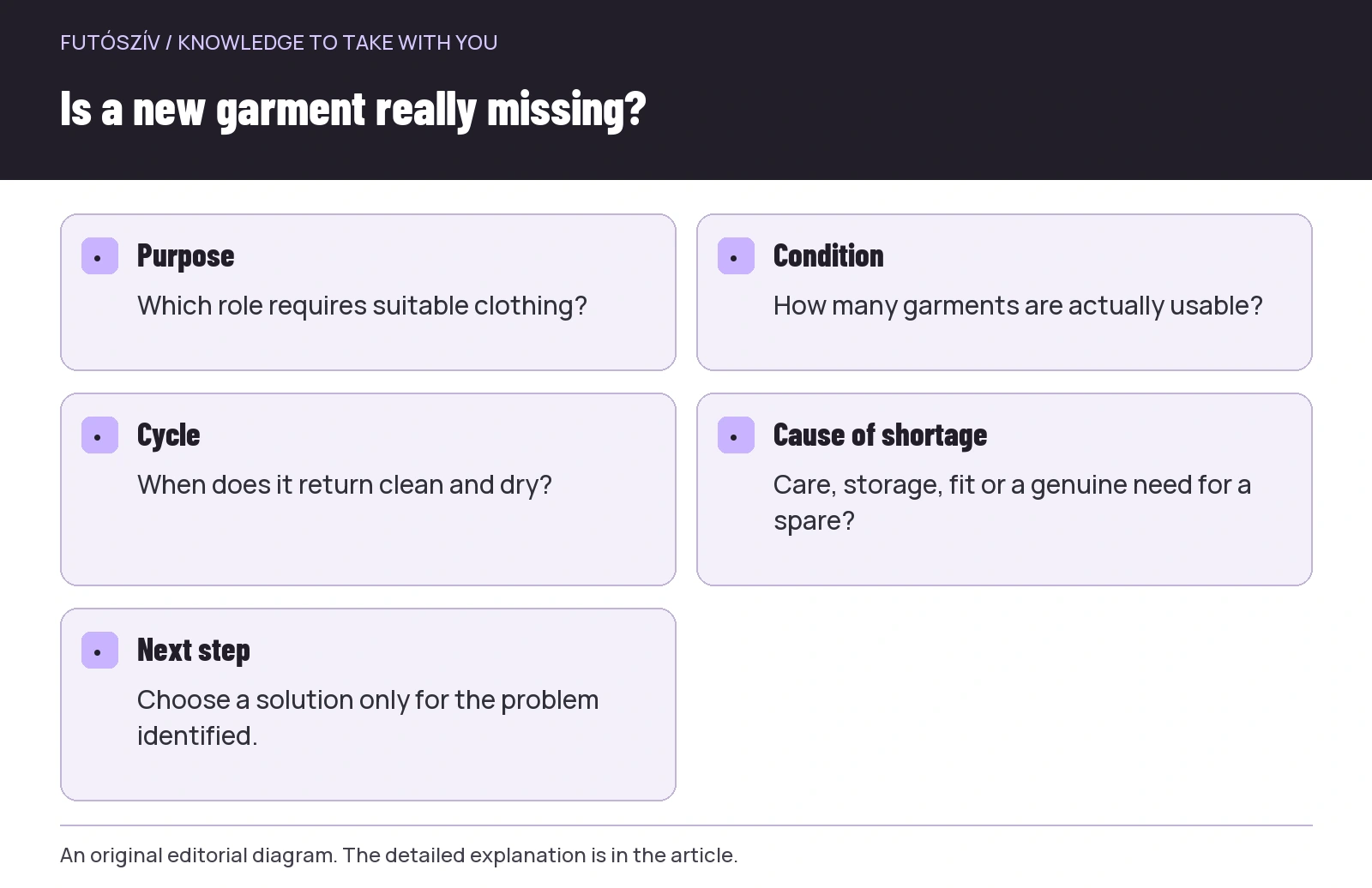 Enlarge diagram
Text version of the diagram
- Purpose
- Which role requires suitable clothing?
- Condition
- How many garments are actually usable?
- Cycle
- When does it return clean and dry?
- Cause of shortage
- Care, storage, fit or a genuine need for a spare?
- Next step
- Choose a solution only for the problem identified.
Travel and unusual weeks: do not make these the permanent baseline
A trip lasting several days, a training camp or successive events may differ from the everyday cycle. Plan the temporary wardrobe needed for these separately, based on actual washing and drying facilities. A rare week does not necessarily justify buying more identical garments for the whole year. Different packing, suitable care facilities or an agreed loan may be options if appropriate for the item. Examine the particular circumstances and do not plan washing or drying that your accommodation cannot actually provide.
After returning home, observe whether normal functioning resumes. Extra spares being useful during a special period does not necessarily reveal a lasting shortage in the everyday wardrobe. Keep the information from these two situations separate. The same applies to seasonal differences: a colder month may call for different layers, but that is not the basis for judging the total number of summer tops. Grouping clothing by role and condition helps you bring out the appropriate garments for changing needs without constantly enlarging the entire wardrobe.
Give unused clothing a responsible next step
The EEA overview of textiles treats longer use and reuse as parts of a more circular system. In your own wardrobe, this does not mean giving everything away, but that genuinely usable surplus may find a better role. Clothing in suitable condition can be passed on or taken to a community swap with an accurate description of size and faults. An unknown or unusable garment is not automatically a donation. Check the receiving organisation’s and local collection scheme’s conditions separately.
If a garment is repairable, decide according to the specific possibility and give it a realistic next step. If you pass it on, describe previous interventions and known limitations. Retained spares should have a role and storage space, rather than remaining on the shelf merely because you dislike discarding things. At the end of the review, every group should be understandable: in use, necessary spare, awaiting a specific repair or seeking another owner. This arrangement also helps at the next purchase, because shortages and unnecessary duplication are easier to recognise.
Before a new purchase, state the shortage in one sentence
The sentence should name the purpose and reason: what clothing you need, and in which recurring situation the present wardrobe is insufficient. If the answer is only that you like it or it is discounted, that can be a personal purchasing consideration, but it is not evidence of a wardrobe shortage. It is worth separating these honestly. When choosing a new garment, its size, purpose and care should also fit the system; otherwise the purchase may add another unused item. The best result of a wardrobe review is a more precise question, not necessarily a smaller or larger cupboard.
Repeat a brief review from time to time, especially before a changed routine or a new season. You do not have to keep a spreadsheet continuously: once you understand the working cycle, a few concrete observations are enough. The required number of garments then comes from your own circumstances. A genuine spare arrives when needed, in the right condition and for the right purpose; surplus does not become a spare merely by remaining in the cupboard for a long time. An understandable wardrobe makes that distinction useful in everyday life.
Sources and further reading
How Futószív articles are prepared: our editorial guidelines.