You take a running top from the machine, dry it and notice an unpleasant smell at the start of the next session. At other times, it already seems wrong on the drying rack. These may not indicate the same problem, and stronger fragrance or higher temperature may not be the right answer. For technical clothing, fabric, treatment, wash programme and drying matter together. Traceable troubleshooting is preferable to a new product every time. This article concerns equipment care; it guarantees no microbiological cleanliness and gives no identical washing recipe for every garment.
When and where does the smell appear?
First describe the phenomenon. Do you notice it when opening the machine, only after drying, from the cupboard or when wearing it again? Is it uniform or mainly in one area? Do other textiles show it, or only one top? These questions guide investigation. Smell on every item from the machine may call for a different check from a recurring local issue in an old running top. Note the observation briefly so you can check the same thing after the next wash.
Do not use perfume strength as the sole outcome measure. Fresh fragrance and suitable fabric care are different. Adding several fragrance layers may obscure what changed. Observe whether a completely dry item treated according to its label is in a suitable state and when the issue returns. This is no laboratory test; absence of smell does not establish hygiene for every circumstance either. The aim is gentle, traceable garment care.
Fabric belongs to the story too
The study by Callewaert and colleagues analysed shirts worn by twenty-six people during exercise after a specified storage period, finding differences between polyester and cotton samples’ odour profiles and microbial communities. This is a defined research setting, not a ranking of every technical top sold today. It illustrates that composition matters and smell cannot be reduced to how strongly scented the wash was. Learn your own garment’s properties and instructions.
Alongside composition, there may be surface treatments, prints, stretch inserts or multi-material panels. “Polyester” alone does not describe the whole construction’s wash tolerance. Merino blends, bonded parts and elastic elements can impose separate limits. Do not automatically apply another garment’s successful process. The aim is not judging materials generally, but understanding permitted care for this item. One troublesome top need not condemn your whole wardrobe’s fabric.
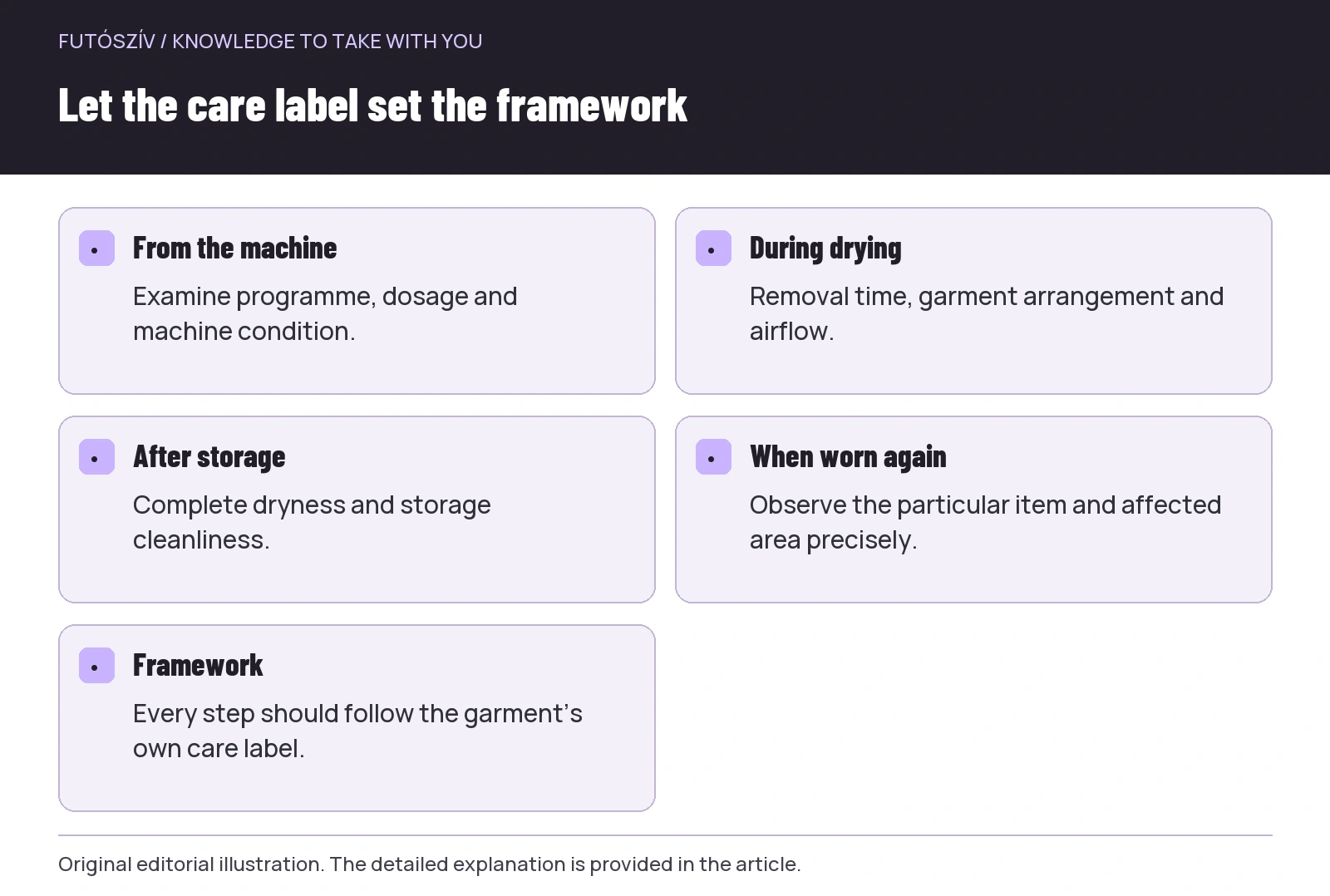
Let the care label set the framework
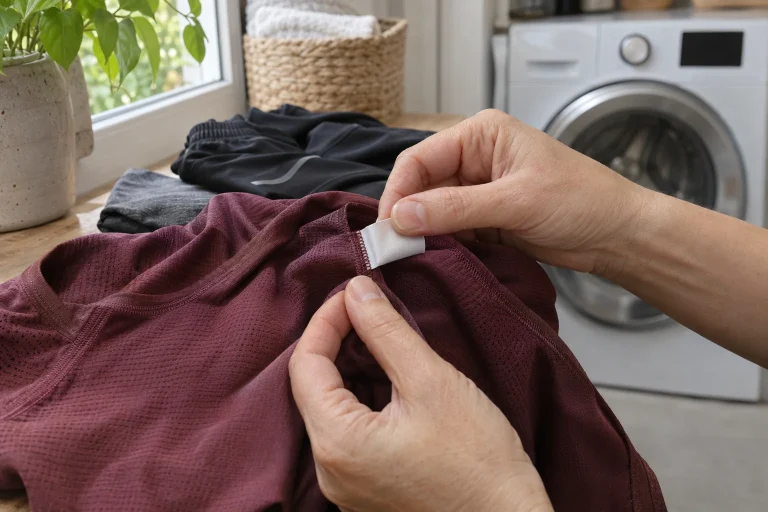
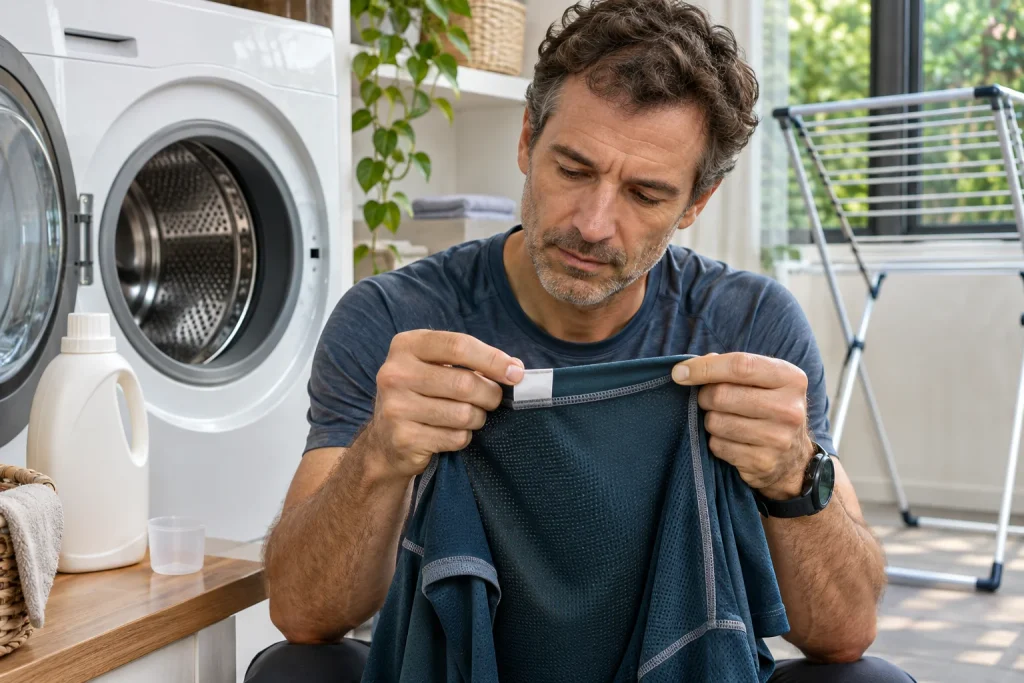
Photograph a hard-to-read label and find supplementary manufacturer guidance. The GINETEX symbol explanation treats wash temperature as a permitted maximum, with lines beneath relating to gentleness. An odour problem does not make the boundary freely exceedable. Washing, bleaching, drying and other treatments have separate symbols. Read the entire sequence; one temperature does not describe the whole process.
If the label is absent or unreadable, identify the product and request appropriate manufacturer information. Do not invent a confident universal temperature. Limits around membranes, prints and bonded sections are not all externally visible. Home troubleshooting stays gentle within permitted conditions. You need not ruin a garment to demand a certain answer after one wash. Selecting compatible cleaning precedes trying new products and stronger programmes.
 Enlarge diagram
Text version of the illustration
- From the machine
- Examine programme, dosage and machine condition.
- During drying
- Removal time, garment arrangement and airflow.
- After storage
- Complete dryness and storage cleanliness.
- When worn again
- Observe the particular item and affected area precisely.
- Framework
- Every step should follow the garment’s own care label.
There is a process between finishing the run and washing too
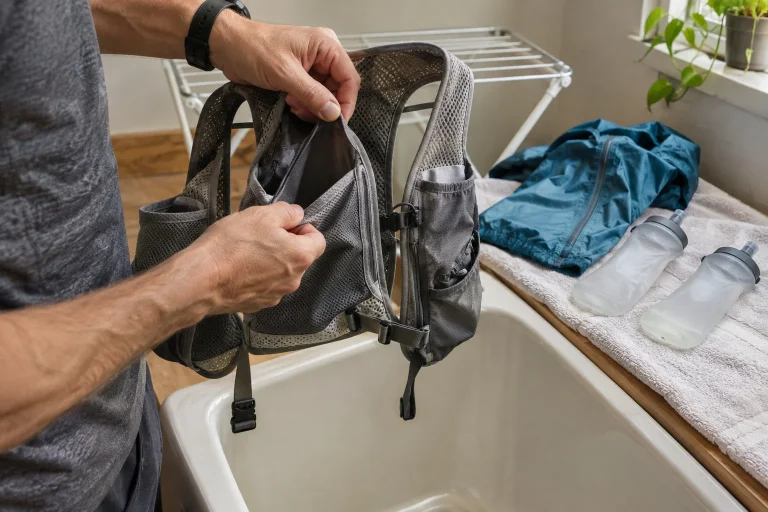
Examine what happens after removing the top. Crumpled damp clothing left for days in a closed bag starts differently from an item taken out promptly. You need not run a separate machine immediately after every outing, but remove used equipment and treat it according to its instructions. Arrange storage if washing later: damp clothing should not disappear at the bottom of a sealed bag. Keep clean and used equipment clearly separate.
Run commuting or travel needs specific logistics. Temporarily separate the used top from other bag contents, but do not make that permanent storage. Taking it out should be an early task at home. If the bag or sack interior is damp too, attend to its care. Do not put the next clean top into the same untreated environment. Look beyond time inside the machine: stages before and after washing also belong to your system.
Dosage: do not increase it by feeling
The detergent label and machine manual together provide dosing conditions. Laundry amount, soiling and specified water hardness may matter. More detergent does not automatically clean better, and randomly using less is not necessarily gentler. First establish the actual dose and whether it follows instructions. Check automatic dosing according to the machine manual too; a full reservoir does not prove product and settings suit the selected garment.
The Bosch support page on clothing odour mentions dosage and clothing left in the drum after washing among possible causes. Machine maintenance cycles and washing running clothes are separate procedures, however. Do not automatically apply higher-temperature machine-maintenance advice to a technical top. Retain separate appliance and textile instructions. Troubleshooting is targeted when the two objects’ different care limits remain distinct.
Conditioner and additives: what does your garment allow?
The Patagonia product-care information discusses possible effects of residue from fabric conditioner and dryer sheets on its technical clothing. Check your top’s manufacturer instructions before using such additions. If prohibited, do not apply them for a nicer smell. Technical function, elastic fabric and other finishes do not have identical care needs on every item. A special sports-detergent label does not mean universal compatibility with every material and coating.
Do not create a home laboratory by mixing vinegar, bicarbonate, disinfectant and stain remover. An online recipe may not match garment and machine permissions. For a specialist product, read intended application, limits and method alongside textile-maker compatibility conditions. Do not mix cleaning products at random. Solving odour should preserve usable clothing rather than stack as many chemical steps as possible. A simple documented routine is easier to evaluate.
| When do you notice the problem? | What should you examine? | What should you note for the next trial? |
|---|---|---|
| On opening the machine | Programme, dosage and machine condition | Garment, load and settings used |
| During drying | Removal time, arrangement and airflow | Where and how did the top dry? |
| From the cupboard | Complete dryness and storage | How long and where was it stored? |
| Only at the start of wear | The particular garment and recurring area | Where and when does it return? |
| On several clothing types | Shared washing and drying process | Did it happen with other textiles too? |
The programme name is insufficient
“Sport”, “quick” or “gentle” can mean different programmes on different machines. Read permitted load, movement, temperature and other conditions in your manual. Follow garment limits alongside these. A quick cycle is not automatically right for every heavily used running garment, nor the longest programme suitable for every piece. Keep load size within instructions too. Check the particular programme’s rule rather than judging apparent free space in the drum.
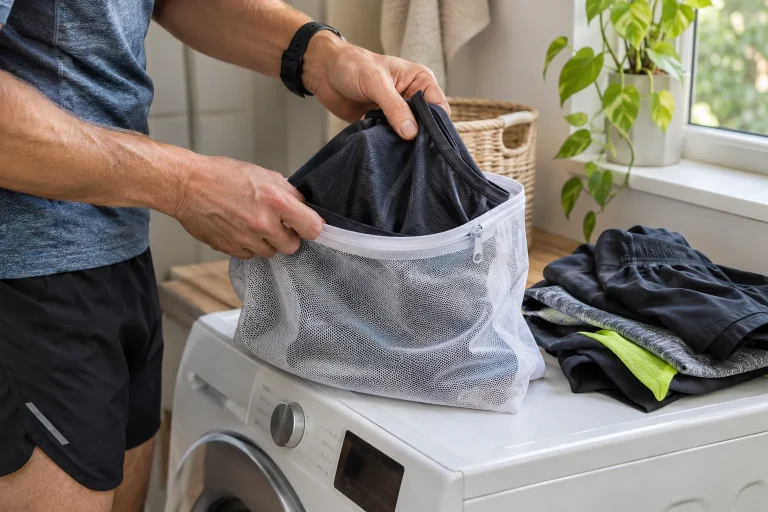
Group clothing by care needs and soiling. A muddy outer layer, delicate panelled top and lint-shedding textile may not form an ideal shared load. Handle zips, hook-and-loop fastenings and pockets according to garment instructions to avoid new damage. Knowing the washing context helps odour investigation too. Separate cycles for every item are unnecessary, but shared treatment should genuinely suit every textile included.
 Enlarge diagram
Text version of the illustration
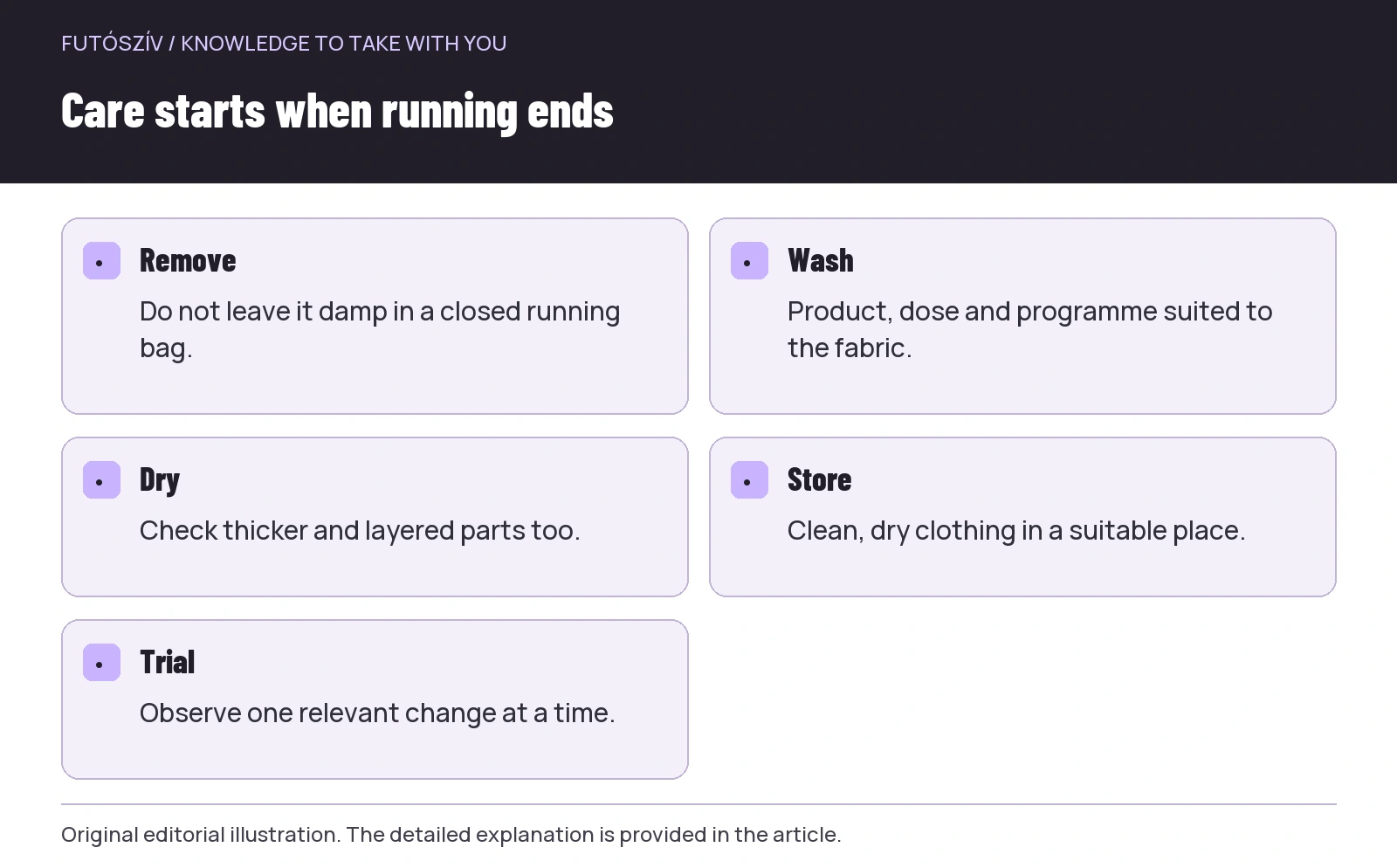
- Remove
- Do not leave it damp in a closed running bag.
- Wash
- Product, dose and programme suited to the fabric.
- Dry
- Check thicker and layered parts too.
- Store
- Clean, dry clothing in a suitable place.
- Trial
- Observe one relevant change at a time.
Check the machine’s condition too
If other textiles and the drum also smell unpleasant, consult the machine maintenance guide. Care for the drawer, seal, filter and other parts depends on the machine. Perform only manufacturer-permitted tasks you can reach safely; dismantling and technical fault-finding are different roles. Use maintenance programmes in the specified empty or otherwise required state. Do not include a heat-sensitive top merely because a higher temperature is prescribed for the machine.
If drainage or another technical problem is suspected, servicing may be more appropriate than another fragrance additive. Describe observations precisely: when, which programme, other garments and any changes. Bosch’s support guidance identifies several possible sources, not one certain solution to every smell. Garment investigation remains separate from machine condition while their relationship is considered. A targeted question leads more easily to suitable help.
Drying: seams and layers should be dry too
Do not leave clothing unnecessarily inside the closed drum after washing. Remove, arrange and dry it according to the label. Shoulders, underarms, thicker hems and layered parts may dry later than thin central fabric. Do not judge the whole item by touching one point. Drying equipment, place and arrangement should suit the product. If tumble drying is prohibited, do not use it merely to save time. A radiator or direct high heat does not become universal because the top is needed quickly.
In a small home, check whether thick damp layers touch on the rack or clothing is already in a damp place. Put the fully dry top into clean suitable storage. A damp item squeezed into a drawer can create another problem before use. If smell appears only from the cupboard, examine storage rather than automatically switching detergent. Washing, drying and storage are consecutive steps; a later fault can obscure an earlier success.
One change can teach more
Choose one garment and a traceable baseline routine compatible with its label. Record product, dose, programme, load and drying. Then change one relevant detail, such as correcting uncertain dosing or removal timing. Do not introduce a new product, programme, long soak and drying method simultaneously. Improvement or worsening becomes easier to understand. Personal observation is not a general product test, but can genuinely support routine use of your garment.
If the issue persists despite permitted care, ask the manufacturer about the specific item. Supply composition, label, routine and when the phenomenon appears. They may offer product-specific care or repair information; do not guess for them. Consider usability and material condition together, not smell alone. One bad wash need not decide an old top’s fate, but endless stronger treatments do not guarantee success either.
Checking questions for a traceable clothing routine
Do you know the top’s composition and care? Do you remove it from the damp bag? Do detergent, dosage and programme fit its limits? Is the machine in order? Does the whole garment dry before storage? These show that odour is not solely a bottle of detergent’s property. Review the actual process. Not every element will be faulty, and everything need not change. Begin with the most likely verifiable step suggested by observation.
A technical top remains useful when care matches its actual fabric and use. Research helps explain material differences; manufacturer instructions define this item’s limits. Your task is traceable application: removal, appropriate washing, complete drying and clean storage. Rather than randomly masking smell, you treat it as a precise question. This provides a gentler, clearer path towards the next comfortable run.
Sources and further reading
- Callewaert et al. – Microbial Odor Profile of Polyester and Cotton Clothes
- GINETEX – Care Symbols
- Bosch – Clothes from Washing Machine Smell
- Patagonia – Product Care, Repair and Washing
How Futószív articles are prepared: our editorial guidelines.