Before opening the app, decide what you want to use it for
An app can put your own run, a friend’s race and an unfamiliar athlete’s outstanding workout on the same screen. These reflect different lives, yet it is easy to merge them into a single ranking. When opening the app, ask a simple question: do you want to record something, find information or stay in touch?
Each of those three purposes can be valuable. Difficulties may begin when brief logging quietly turns into constant comparison and someone else’s post starts shaping your next workout. This article concerns the framework for using an app. It does not diagnose a psychological disorder or claim that every running app affects every person in the same way.
An activity page does not show the full background
Displayed distance and pace do not explain the entire training aim, history, capacity or circumstances of that day. Even “easy” in a title may refer to a different individual situation. Before changing your own plan because of such a post, consider whether the information is genuinely comparable.
This does not mean you can learn nothing from other people’s experiences. You may find a good route idea, an organisational solution or a useful question. The difference lies in how you use it: an inspiring post can inform a conversation with your coach without prompting you to copy that workout the next day. An idea and an individualised task are separate steps.
Give the diary and the feed separate roles
In your own diary, you can examine what happened during a planned session and which circumstances matter for the next decision. The feed is a social space containing moments others have shared. You do not have to review both in the same sitting. You could first record your own experience and respond to community posts at another time.
A simple habit can support this separation. After a run, for example, open only the editor for your own activity, and visit the social section when you actually want a conversation. This requires neither a new service nor a paid tool. The aim is for your own task, rather than the interface’s suggestions, to determine how you spend your time.
Do not confuse visibility with retaining your diary
Strava’s guidance updated in autumn 2026 describes activity-visibility options for everyone, followers or only you. Settings can also affect inclusion in public leaderboards and certain challenges. Keeping your personal diary therefore does not necessarily require full public visibility; always check current details in the provider’s explanation.
Match the choice to your purpose. Recording a rehabilitation or personal session does not require asking for social feedback. Staying in touch with friends does not necessarily require sharing every location and performance detail either. A visibility decision determines the audience for sharing rather than judging the run’s value.
 Enlarge diagram
Text version of the illustration
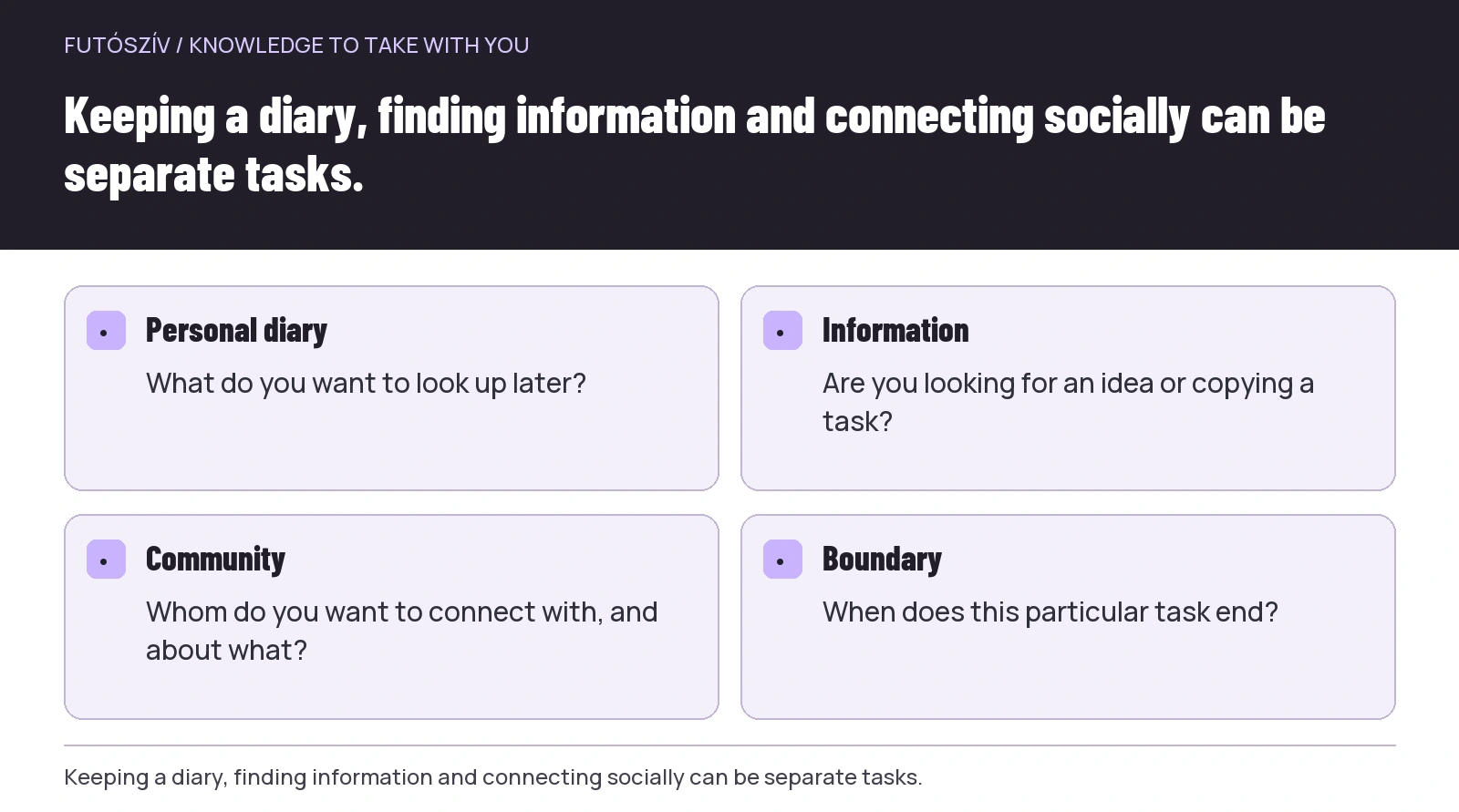
- Personal diary
- What do you want to look up later?
- Information
- Are you looking for an idea or copying a task?
- Community
- Whom do you want to connect with, and about what?
- Boundary
- When does this particular task end?
Muting and hiding can be different operations
Strava’s help on muting your own activity distinguishes leaving it out of the feed from fully restricting its visibility. A muted activity may still appear on your profile according to your settings and count towards statistics. If you do not want others to see it, check the visibility rule separately.
This illustrates why a button’s label is not enough to infer every consequence. Apps’ behaviour and terminology can change. Before sharing personal health, location or relationship information, read the current explanation of that feature. If uncertain, do not use a sensitive post to experiment with what others can see.
Maps and detailed numbers need separate attention
The provider’s privacy help describes hiding various details and also warns that some information may appear on another interface or be inferred from other information that remains. A hidden field does not therefore necessarily mean access has been completely removed. Review map and social sharing together rather than switching off just one number.
After a group run, consider other people’s information too. A route, group photograph or tag may reveal something your companion does not want made public. Asking for consent is simpler than explaining unwanted sharing afterwards. Social connection does not require every participant to expose the same amount of information.
Choose a personal question for the next week
Instead of measuring yourself against every acquaintance’s weekly summary, formulate your own question to support a decision. For example: which route best fits the time available after work, or which shoes felt comfortable during the agreed easy session? The app then retains information relevant to that question rather than delivering a general judgement about you.
Choose a question you can answer from your own experience. You do not need to infer from other people’s results what you should feel or achieve. If interpretation of the data is uncertain, record that too. Noting an inaccurate GPS trace or different circumstances can be a more mature logging decision than seeking a single certain conclusion at any cost.
You can leave a challenge without leaving the sport
A community challenge can offer a fun framework while it fits your own programme. If earning the badge starts determining your load instead of health-related or coaching decisions, reconsider participation. A challenge’s rule is not an individualised training plan and may not know your current condition or other commitments.
Decide beforehand when you would stop following it: if it conflicts with your plan, requires sacrificing rest or becomes oppressive. Leaving does not retrospectively cancel movement you have already done. It simply indicates that this playful framework is not serving your chosen goal now. Social relationships can continue in other forms.
Do not assume an unseen background when giving feedback
When responding to someone else’s activity, do not invent what the number means to them. A slower, short loop might be an important return, or simply a pleasant everyday outing. Thoughtful feedback need not evaluate pace or bodies. You can ask about the location or thank them for time together without judging their fitness.
You do not have to explain every personal detail in advance in your own posts either. Write briefly about what you can share and keep the rest to yourself. A public diary is not a compulsory health report. If a question is too personal, you can say that you do not want to discuss it on that platform.
 Enlarge diagram
Text version of the illustration
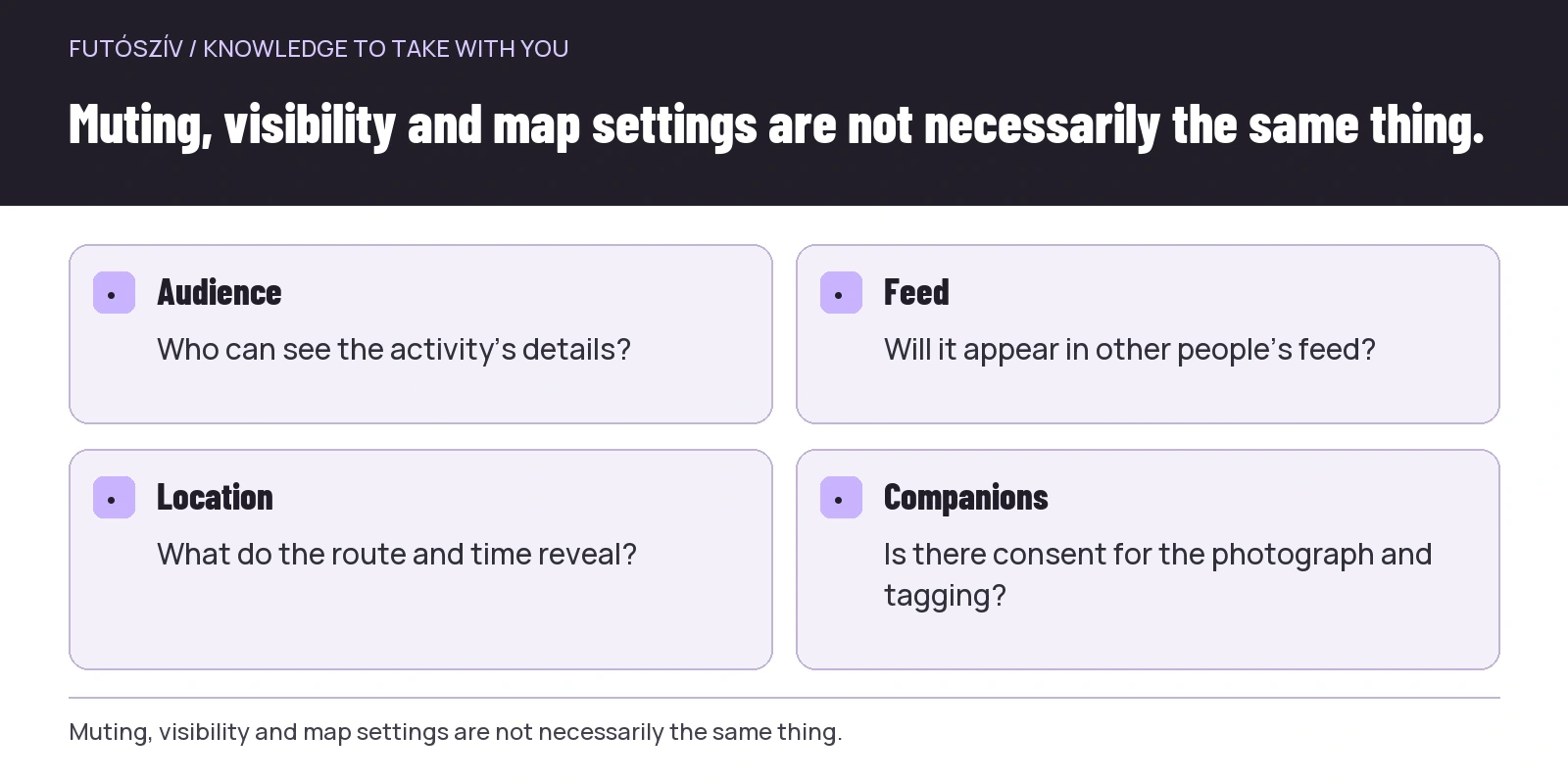
- Audience
- Who can see the activity’s details?
- Feed
- Will it appear in other people’s feed?
- Location
- What do the route and time reveal?
- Companions
- Is there consent for the photograph and tagging?
Notice differences after using the app
In a short trial, observe whether the experience differs between using only your own diary and browsing the feed at length. You do not need to make a mood diagnosis or conduct a scientific experiment. The practical question is simple: did the app help with the reason you opened it, and what next decision did it prompt?
If browsing regularly leads you to plan extra training that would otherwise have had no place, discuss this with your coach. If use involves persistent anxiety, compulsive checking or difficulties disrupting everyday life, appropriate mental-health support may also be needed. You do not have to perfect the interface settings before you can explain the problem.
Club community rules can reduce pressure too
As an organiser, do not make a public profile a condition of belonging to the group. Provide other ways to find programme information and confirm participation. Using one service or holding a position on a public leaderboard does not show how much someone contributes to the community.
Shared reports can include routes, atmosphere, assistance and new encounters too. If every update highlights the most kilometres or fastest time, other forms of participation can easily become invisible. A range of stories does not reject performance. It allows the club to connect genuinely with different runners’ goals.
A personal agreement for app use
Write four short lines for yourself: what I use the diary for; when I view the social section; whom I want to show information to; and when I ask for help interpreting it. These lines need not become rigid rules. Their role is to remind you of your own purpose when you open the app automatically later.
Review whether your needs remain the same monthly or after a significant change in life circumstances. Race preparation, injury or a new work schedule may call for different use. Adapting settings and habits is not inconsistency. The service should fulfil your chosen role; you do not have to find a task for every available feature.
Example: two different goals on the same platform
One runner opens the app so their coach can see the agreed programme. Another wants new local routes and enjoys chatting with friends. Both can use the same service while needing different views and sharing settings. Naming that difference helps move away from one supposedly recommended way of using it for everyone.
Your system works when you know why a feature is there and can freely drop one that does not help. Your run still exists when it does not appear in the feed, and your personal goal can exist without a public badge. The app can offer useful information and connections, but a single screen does not have to summarise the value of your entire running life.
Sources and further reading
- Strava: Activity Privacy Controls, updated October 2026
- Strava: How Do I Mute an Activity?
- Strava: Privacy Controls FAQ
How Futószív articles are prepared: our editorial guidelines.