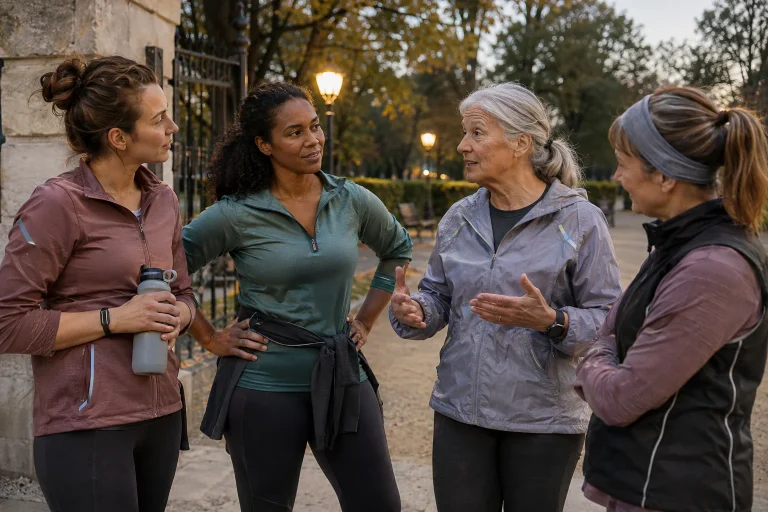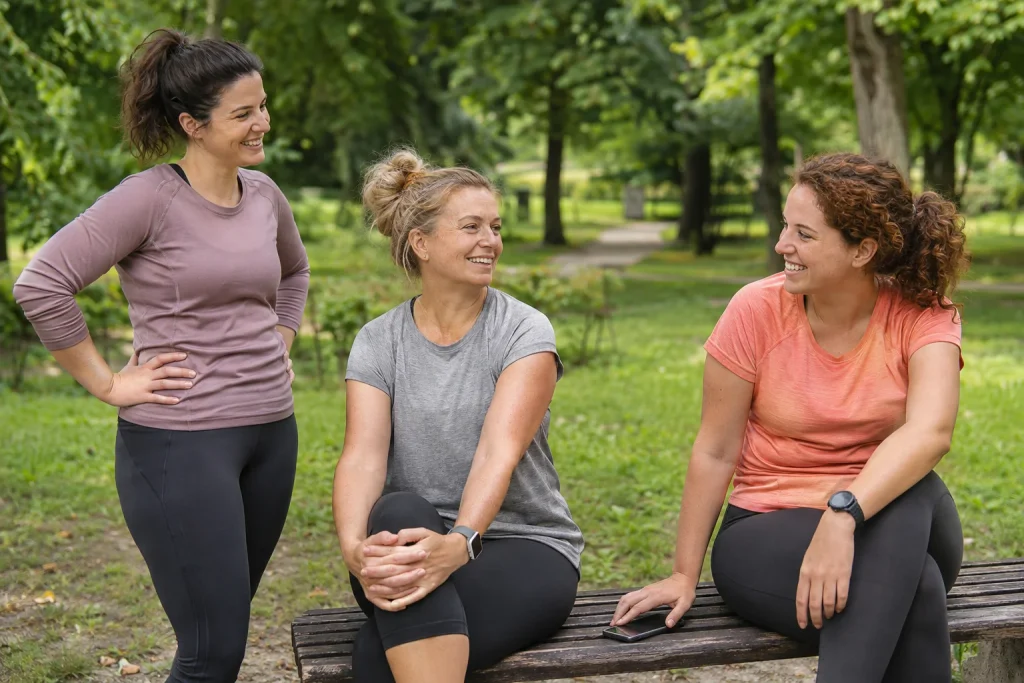
Even after a satisfying run, a photo you find unflattering can be enough to replace the whole experience with thoughts about your appearance. Meanwhile, social platforms place bodies and results side by side, making it easy to construct an imagined ideal runner. As though being a runner required one particular shape, clothing size or appearance.
Changing your relationship with body image does not mean you must like yourself in every picture from now on. A goal can simply be to let appearance dominate fewer decisions about movement. The ideas below offer practical starting points for reshaping your surroundings, language and attention. Persistent, intense anxiety or difficulties disrupting daily life may require professional help.
An ideal runner’s appearance is not a sports medicine report
You cannot reliably read health, training quality, eating habits or recovery from a body seen on social media or at a race. A photograph shows one moment, with its own circumstances, angle and selection. You do not need to infer from appearances which body entitles you to stand at a start line or on a running track.
The comparison often does not even involve the same goal. A professional athlete’s race photo, an advertisement and your own everyday jog tell different stories. Placing the images together does not make the circumstances behind them comparable.
If you notice the thought ‘A runner should look like this,’ ask where that expectation comes from. Is this appearance standard actually necessary for your own activity goal? The question is not whether your feeling is wrong, but how much influence you want to give it over decisions.
Fitness inspiration does not inspire everyone
A 2024 experiment assigned women with and without eating disorders to view different types of Instagram content. Fitness-inspiration content was associated with less favourable body-image and emotional changes in the situation studied. The experiment assessed short-term effects and particular content; it does not prove that every social platform affects everyone in the same way.
The practical lesson is to consider your own response rather than the label. After a supposedly motivational post, do you feel more inclined towards manageable movement, or inadequate and ready to plan a punishing workout? The second response does not mean you are bad at finding inspiration. That content may simply not be helpful right now.
You do not have to wait until a platform is proven clearly harmful. You can choose fewer appearance-focused accounts, view them less often or use them at a different time. You can shape the environment in which you direct your attention without convincing everyone that your decision is right.
A short content review based on your own experience
Look at a few platforms you follow regularly and assess the message rather than the creator’s body. What counts as success there? Does it also show the enjoyment of running, learning and community, or connect almost everything to body transformation? Does it treat difficulty with nuance, or reduce it to a single task of discipline?
Notice what happens immediately afterwards too. Do your eating or training decisions change in a direction you had not otherwise planned? Do you feel an urge to measure, take photos or compare again? The purpose of describing this is to recognise a few recurring situations, not start a self-monitoring competition.
Choose one easy change. For example, hide a type of content that regularly weighs on you and look instead for topics about routes, technical knowledge or community experiences. The change does not have to produce a perfectly purified feed to be useful.
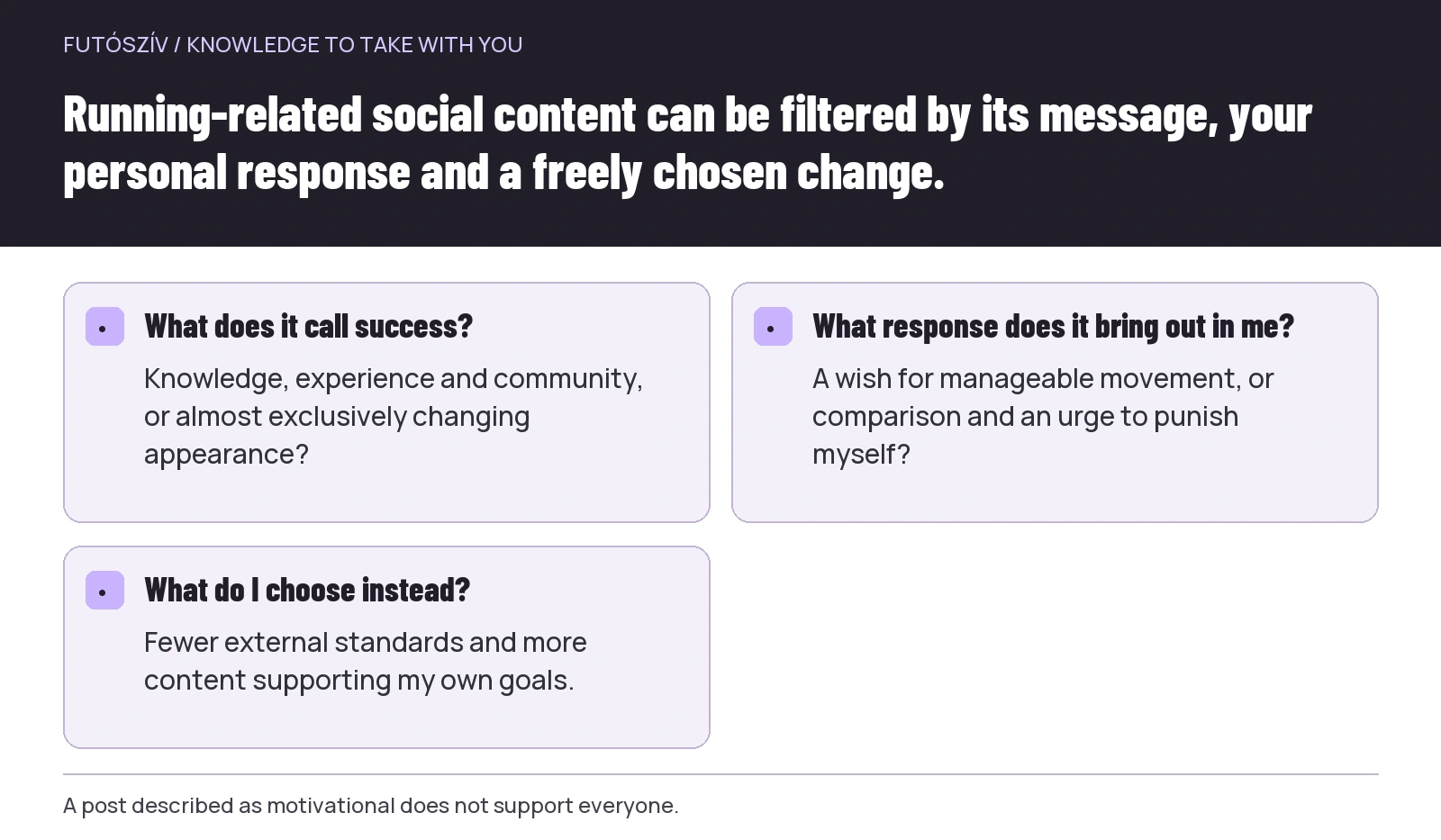 Enlarge diagram
Text version of the illustration
- What does it call success?
- Knowledge, experience and community, or almost exclusively changing appearance?
- What response does it bring out in me?
- A wish for manageable movement, or comparison and an urge to punish myself?
- What do I choose instead?
- Fewer external standards and more content supporting my own goals.
Body functionality can offer another perspective
The Expand Your Horizon randomised study examined a written programme focusing on body functionality among young adult women and found favourable body-image changes compared with the control group. Functionality here is broader than sporting performance. The research is not a universal treatment for every body-image difficulty, and the reflection idea below is neither a copy nor a replacement for the programme.
You might ask what experience your body made possible today: being outdoors, connecting with someone, noticing a landscape or learning something. You do not need to measure this in kilometres or muscle strength. Noticing function must not become another demand that you can be satisfied only if your body achieves a great deal.
With injury, illness or disability, you can still seek a personal connection with your body, but you do not have to turn every difficulty into gratitude. A body’s value does not depend on the length of its list of abilities. The aim is to broaden attention, not introduce a new performance score in place of an appearance score.
During life changes, an old image can take a more neutral place
After pregnancy, childbirth, menopause, treatment or injury, an earlier photograph can easily become an obligatory target. Your former body may also be associated with the security and familiarity of an entire phase of life. You can talk about that feeling without having to change everything back immediately.
A randomised trial among mothers of young children also evaluated a programme focused on appreciating body functionality within a particular life situation. Such research can show a supportive possibility, but it does not mean every parent must feel the same way about their body. Your own story and any necessary professional help still matter.
It can help to separate comfort from appearance expectations. An old pair of trousers digging in is one question; feeling bad because of its size label is another. Movement needs clothes that fit your current body; maintaining a previous size is not a condition of a running identity.
A race photo does not have to be the day’s assessment sheet
A finish photo may show fatigue, a movement or an expression you dislike. That does not retrospectively make the experience a bad one. You can choose not to keep looking at or share a picture. You do not have to publish every image as proof of positive body image.
If looking at pictures turns into a prolonged, repeated search for flaws, try recalling another part of the experience too. What mattered on the course, whom did you meet, which decision did you make well? This does not deny the uncomfortable feeling; it restores a fuller account of the story.
As a group leader, ask about people’s comfort with taking and sharing photos. Community pictures should not show only the fastest participants or one body type. Photo selection also shapes who feels they belong in the group.
Talk about the shared experience rather than judging bodies
Behind praise such as ‘You have lost so much weight,’ you cannot know what happened to the person. It may have involved illness, difficulty or another personal change. In a running community, you can choose feedback about connection and actions: I enjoyed our loop together, it was good to talk, or I liked how you paid attention to your own plan.
Constant talk about working off food or fixing bodily flaws can also narrow what running means. A shared training session need not be part of a weight project every time. Other values of movement can be made visible too.
If someone’s comment about your appearance feels uncomfortable, you can briefly say you would rather discuss the running experience right now. You do not need a detailed justification. Stating a boundary can be the beginning of a more supportive way of talking within the community.
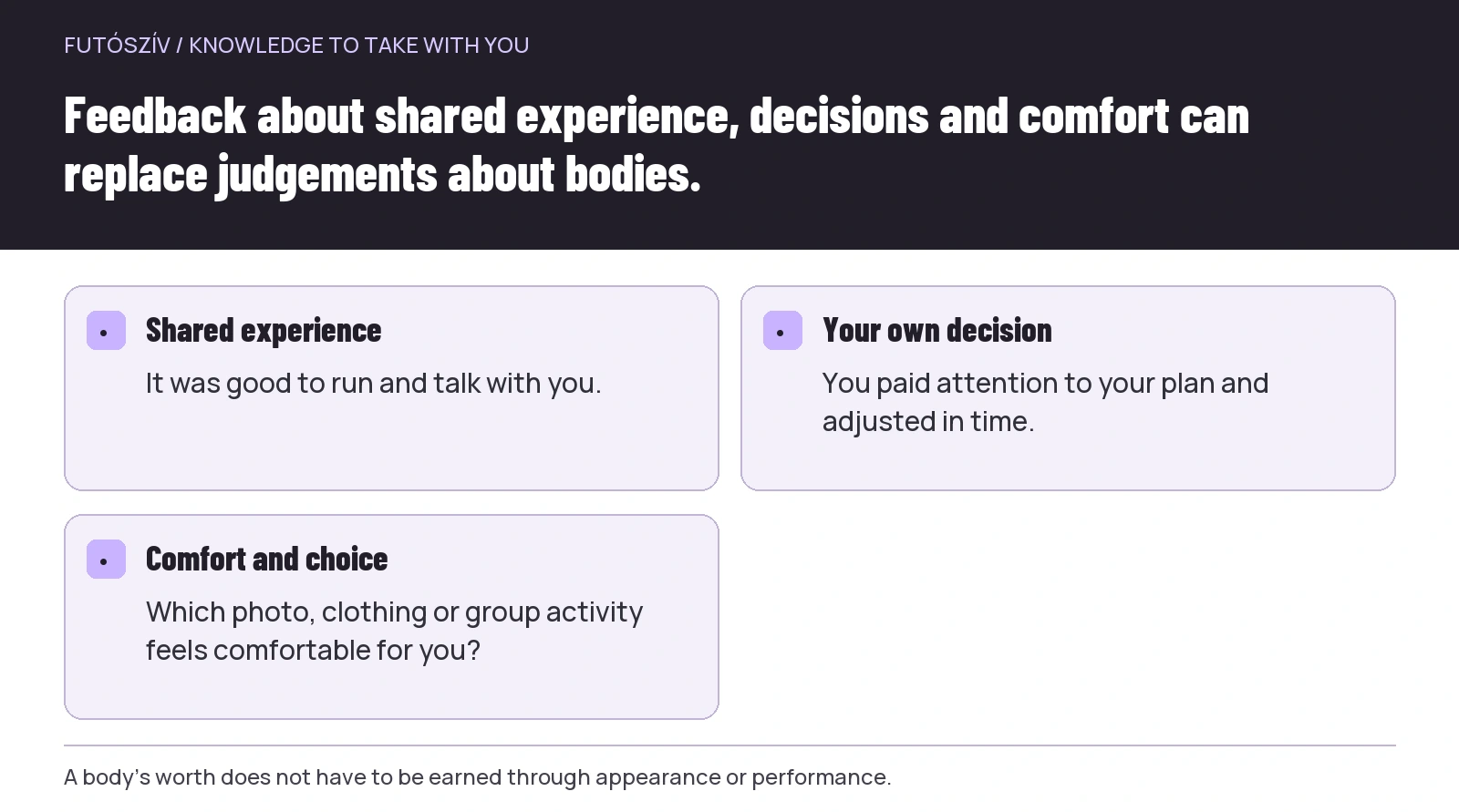 Enlarge diagram
Text version of the illustration
- Shared experience
- It was good to run and talk with you.
- Your own decision
- You paid attention to your plan and adjusted in time.
- Comfort and choice
- Which photo, clothing or group activity feels comfortable for you?
Comparison can appear in performance too
Body image and pace can easily become linked: you may feel that a certain appearance ought to produce a certain result. Actual running performance cannot be predicted accurately from appearance, however. Choose your own goal in light of preparation, health and life circumstances.
If an appearance standard would lead you to accept training that does not fit your plan, pause before deciding. What do you actually want to achieve, and what conditions does it require? Someone else’s appearance does not tell you which training load is appropriate for you.
A performance goal can matter without becoming a test of your body’s acceptability. A slower day or an injury does not diminish your right to participate in sport. Running can make room both for progress and for taking your current condition seriously.
A more neutral relationship can be a realistic goal too
The expectation to love your body every day does not help everyone. An intermediate goal might be checking it less, choosing comfortable clothes and not tying every movement decision to appearance. A thought about appearance can be present without directing every action.
Your own sentence can be simple: today I am moving in this body, and I still need appropriate care even if I do not like my appearance right now. This is not a compulsory positive statement. It is a reminder that food, rest and healthcare help are not rewards for satisfaction with appearance.
If a self-help idea becomes another compulsion or does not help, you can let it go. You do not have to perform work on body image perfectly either. Individual help can also support you in finding realistic, smaller goals of your own.
When is it worth seeking professional help?
The NHS information on body dysmorphic disorder discusses constant concern about appearance, repeated checking and a significant impact on daily life. Not every dissatisfaction with body image means this diagnosis. If thoughts take up a great deal of time or lead you to avoid relationships or movement, seek an appropriate professional assessment.
Restricting food, compensatory exercise, intense anxiety or other mental health difficulties are also matters you need not face alone. A GP or mental health professional can be a starting point for help. Do not try to determine the exact diagnosis from your own test result or an article.
You can bring a few specific situations to the consultation: how much of your day the thought occupies, what you avoid because of it and which decisions it makes difficult. You do not need photographs to prove a perceived flaw. Help aims to reduce distress and daily limitations, not judge your appearance.
Choose one small change for the next running week
- Replace one appearance-focused item of content with a topic offering knowledge or community experience.
- After a run, write down one important experience without evaluating your appearance or pace.
- Choose clothes comfortable for your current body without judging the size label.
- Give your companion feedback about moving together rather than changes in their body.
- If the difficulty persistently limits you, arrange an appropriate professional conversation.
These are voluntary practical options, not a treatment protocol. You do not have to do them all at once, and your body image does not have to change within a single week. The aim is to leave more room in running for the experience of movement and less for constant judgements about appearance.
Sources
- Risks and benefits of social media trends: fitspiration, body positivity and body neutrality, randomized experiment, 2024
- Alleva and colleagues: Expand Your Horizon, randomised controlled study, 2015
- Granfield and colleagues: Enhancing body image in motherhood – randomised controlled trial, 2023
- NHS: Body dysmorphic disorder
How Futószív articles are prepared: our editorial guidelines.