Advice about women runners’ sense of safety often gives those affected another task: choose a different time, route or piece of equipment. Practical arrangements can help, but responsibility for harassment and violence lies with the perpetrator. The solution cannot be confined to runners moving within ever smaller spaces and time windows. Communities, organisers and those shaping the environment have responsibilities too.
This article presents options for shared organisation. No route, device or group arrangement provides a complete safety guarantee, and there is no compulsory checklist for every runner. The aim is more predictable choices, a more considerate community and responses that support the affected person’s decisions.
Do not minimise someone’s experience
The University of Manchester research identified verbal abuse, being followed and other threatening situations in accounts from women runners living in Greater Manchester and Merseyside. This local sample cannot establish national prevalence in Hungary. Nevertheless, the research shows that safety concerns while running can relate to real experiences.
The researchers’ later study also examined the continuous work involved in managing safety: how fear shapes routes, timing and enjoyment of running. It should not simply be described as excessive caution. The recurring burden of decisions can itself affect which opportunities for activity remain available.
If someone describes an unpleasant situation, do not begin by saying it has never happened to you. Your lack of that experience does not disprove theirs. First listen to what they need now: company, a way home, a change to a run or help with the next step.
Feeling safe and knowing the surroundings are different questions
A familiar route may feel more comfortable, but familiarity is not a complete risk assessment. A busy place may be reassuring in some circumstances and crowded or difficult to see across in others. Lighting, exits, transport connections and opportunities to stop can be described more specifically than saying a neighbourhood is generally good or bad.
As a running group, check the planned route at the actual time of the outing too. An underpass, park entrance or bus stop looks different in daylight. Check closures, construction work and places where a participant can take a shorter way back.
Turn the route check into useful information rather than a frightening list. For example, identify stretches with poorer lighting, convenient meeting points and alternative options. Do not label the route guaranteed safe; circumstances can change.
For a group run, think from meeting up to getting home
Group activity does not begin when the stopwatch starts, and it does not necessarily end when the shared loop finishes. Reaching the meeting point, changing clothes and getting home are organisational questions too. For a late outing, it may matter that a participant is not left waiting alone for a long time in an uncertain location.
Provide an exact address or easily identifiable meeting point, and make clear whom to contact about running late. A newcomer should receive more than a pin on a map: they should know where to find the group, when it leaves and what happens if they cannot find it.
Choose a finish location agreed in advance. Ask whether anyone would like to walk back together or needs other help, without making it compulsory for everyone. Good support offers choices rather than another layer of control.
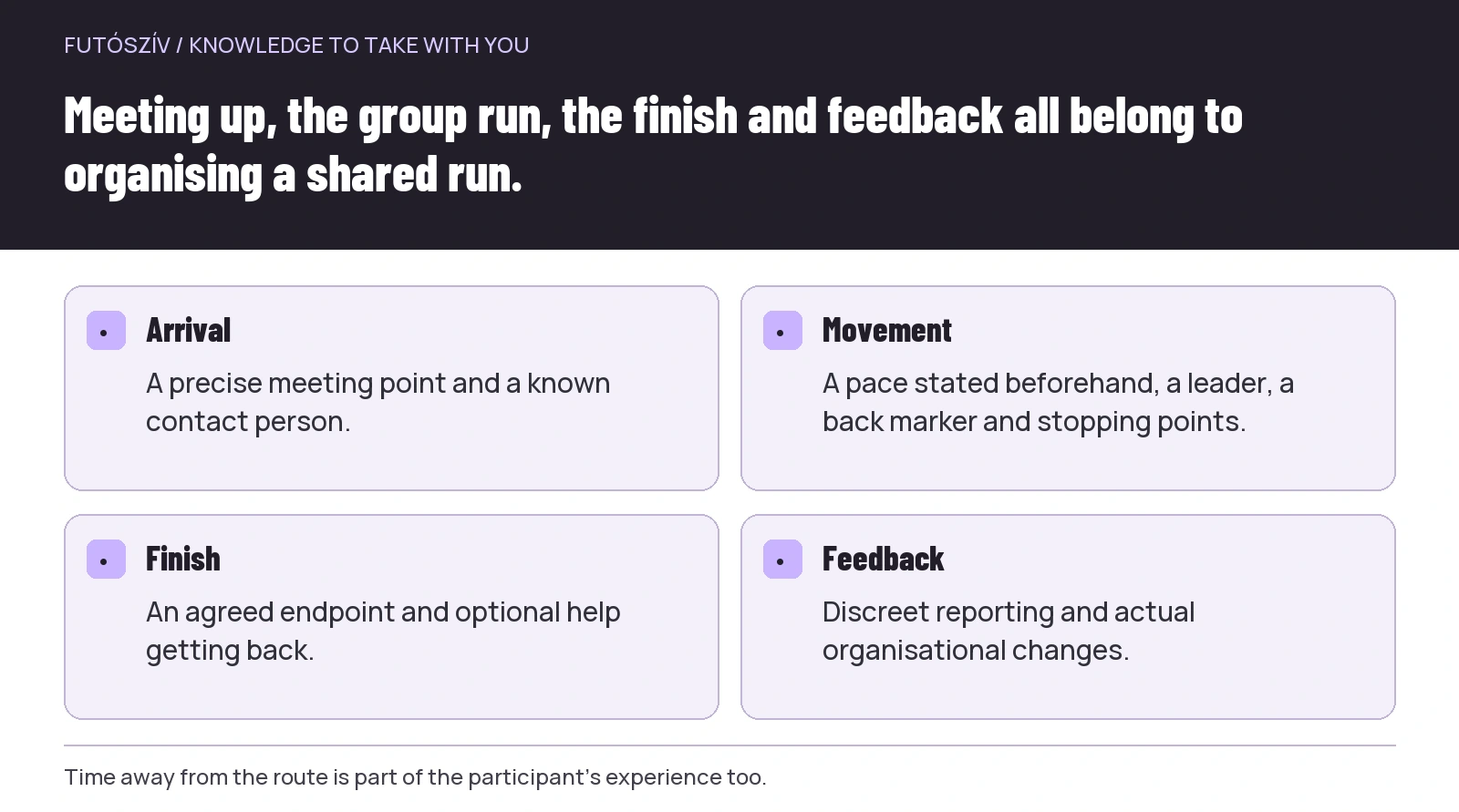 Enlarge diagram
Text version of the illustration
- Arrival
- A precise meeting point and a known contact person.
- Movement
- A pace stated beforehand, a leader, a back marker and stopping points.
- Finish
- An agreed endpoint and optional help getting back.
- Feedback
- Discreet reporting and actual organisational changes.
Make staying together a real agreement
Advertising that nobody gets left behind means something only when supported by arrangements. Have a leader and a back marker, known stopping points and a plan if the group divides into different paces. A slower runner should not merely see everyone else disappearing ahead at an unfamiliar junction.
Make the pace and distance clear in advance. If the planned outing changes, explain that before setting off. Participants can then make their own decisions without being pressured because others unexpectedly choose a longer or different route.
Agree how to leave the outing or shorten it too. There should be no shame in saying that someone wants another route or wishes to finish. The group’s task is not to persuade them to endure an uncomfortable situation, but to support a decision they can accept.
The group’s own behaviour shapes the environment too
Talking about safety only in relation to strangers is not enough. Be clear that sexual remarks, unwanted touching, persistent advances or repeatedly making another participant uncomfortable are unacceptable within the group. Even a remark described as a joke should be taken seriously when someone explains its effect.
Provide a known person or channel for reporting something privately. The affected person should not have to start a debate in front of the entire group as their only option. When receiving a report, do not immediately demand public proof or a face-to-face meeting with the person the complaint concerns.
An organiser should think through the response in advance: listening, immediate practical help, necessary organisational changes and clarifying the next step. A community rule is useful only if leaders apply it to themselves and longstanding members too.
What can a fellow runner do on seeing an uncomfortable situation?
First consider your own safety and that of the person affected. Support does not necessarily mean direct confrontation. You might approach the runner, ask whether they would like to continue together or help them reach a more public, accessible place. Do not escalate the tension to prove a point.
Ask the affected person what help they would like, if the situation permits. Do not automatically take over every decision. In immediate danger, arranging urgent help comes first; discussing the detailed story can follow later.
Afterwards, do not question their clothing, route or timing. Support might mean accompanying them home, contacting a trusted person or offering practical help with making a report. Do not share the story within the group without their approval.
Individual check-in arrangements should be optional
Some people find it reassuring for someone they trust to know their route and expected return time. Others do not want to arrange this every time. The option can be useful, but it should not become a norm whose omission is later treated as a fault.
If you choose such an arrangement, keep it simple: who expects a check-in, through which channel, and what should they do about an unusual delay? Location sharing helps only if the other person understands and accepts their role. Switching on an app is not a complete support system by itself.
Think about publicly sharing routes too. There is no need to show the exact starting point, daily routine and home address for every run. Private sharing and a social post serve different purposes; you can choose delayed or less detailed publication.
Do not let equipment become a false guarantee
A charged phone, an available contact or clearly visible route markings may be practical. A device does not automatically make the surroundings safe, however, and lacking equipment does not cause another person’s abusive behaviour. Your choice also needs to reflect usability and comfort for you.
Get to know an emergency function or location sharing beforehand if you want to use it. An actual incident is not the time to discover where to find it or what the battery and network connection can support. Trying it should be a normal part of learning the device, not compulsively collecting ever more equipment.
A running community should not respond to every safety concern with a shopping list. Changing the route, meeting point, group arrangements or handling of reports can often provide more direct help. These require organisational attention, not necessarily a new product.
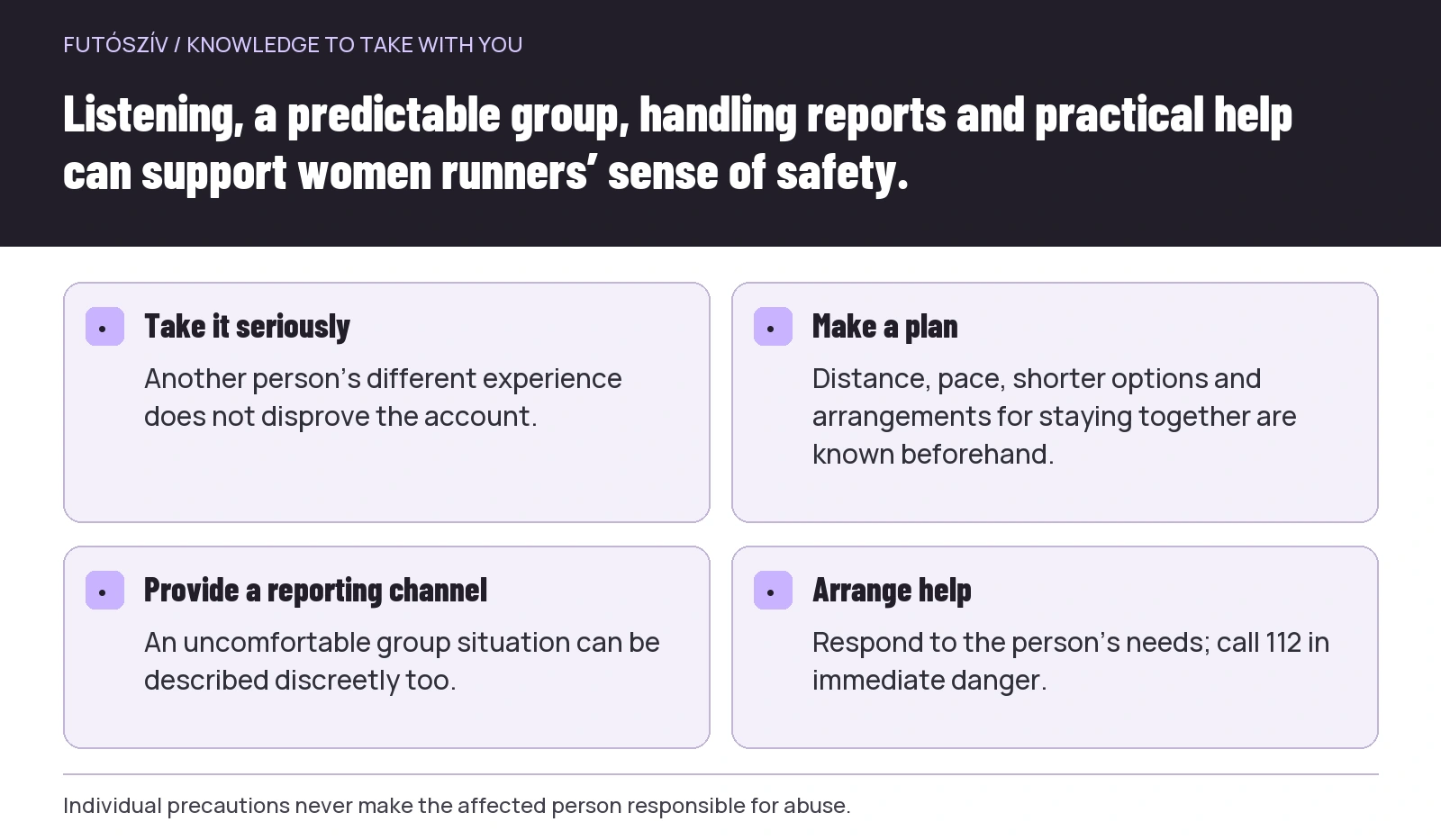 Enlarge diagram
Text version of the illustration
- Take it seriously
- Another person’s different experience does not disprove the account.
- Make a plan
- Distance, pace, shorter options and arrangements for staying together are known beforehand.
- Provide a reporting channel
- An uncomfortable group situation can be described discreetly too.
- Arrange help
- Respond to the person’s needs; call 112 in immediate danger.
Make the route to help clear in immediate danger
The Hungarian Police guidance recommends calling 112 in an immediate emergency. According to the official emergency-call information page, it is important to explain the location, what happened and the condition of those involved, and to follow the call handler’s questions. If you can, give an identifiable location rather than simply saying you are on your usual running loop.
A group leader should know the planned route’s key points and how to reach them. In danger, do not expect a message posted in the community group to bring immediate help. An urgent alert and subsequent information for the community are separate tasks.
Once immediate danger has passed, the person’s decisions still need to be respected. The appropriate authority can provide information about making an official report. A running group should not conduct its own public investigation or identify people from social media posts.
Problems with a route can be reported too
If a section has inadequate lighting, difficult exits or a recurring traffic problem, an organiser can collect the specific location and circumstances. A precise description of the problem is more useful for reporting than stigmatising an entire neighbourhood. Contacting the responsible operator or municipal contact may be a separate organisational task.
The community can make changes within its own remit too: another meeting point, a shorter dark section, returning together or a choice of times. Ask participants which solutions work for them. Decisions should not be based only on the views of people who already feel confident in every situation.
The Sport England This Girl Can initiative presents concerns about outdoor activity in the dark as a community issue. The message is useful locally too: expanding opportunities for activity should not depend solely on individual runners adapting. Arrangements and surroundings can change as well.
A short checklist for a community route check
- Are the meeting and finish points easily identifiable and accessible at the actual time?
- Are the distance, pace, stopping points and shorter options clear?
- Is there a leader, a back marker and a plan if the group splits?
- Whom can someone discreetly tell about an uncomfortable situation?
- Is optional help available with finishing arrangements and getting home?
- Do reports actually lead to specific changes?
Repeat the check occasionally, particularly when seasons, road closures or starting times change. Do not treat participants’ feedback as a one-off questionnaire. If someone stops attending because of this, the group should try to understand which condition was missing without forcing them to explain.
More choices, fewer tasks left to the individual
A well-organised group outing, a report taken seriously or a more precisely planned route can support women runners’ sense of safety. These help when they do not shift responsibility back onto the person affected or further narrow opportunities for activity.
A good community does not demand constant bravery or constant caution. It provides a predictable framework, respects choice and knows when to arrange real help. This can leave more room for enjoyment in decisions about running, and less organisational burden carried alone.
Sources
- Miles and Broad: The Safety Work of Women Who Run – Negotiating Fear, Experiences and Normalization of Abuse, 2025/2026
- University of Manchester: Research reveals majority of women experience abuse while running
- Sport England: This Girl Can launches winter safety campaign
- Hungarian Police: What is the 112 emergency number?
- Hungarian Police: What should I do?
How Futószív articles are prepared: our editorial guidelines.