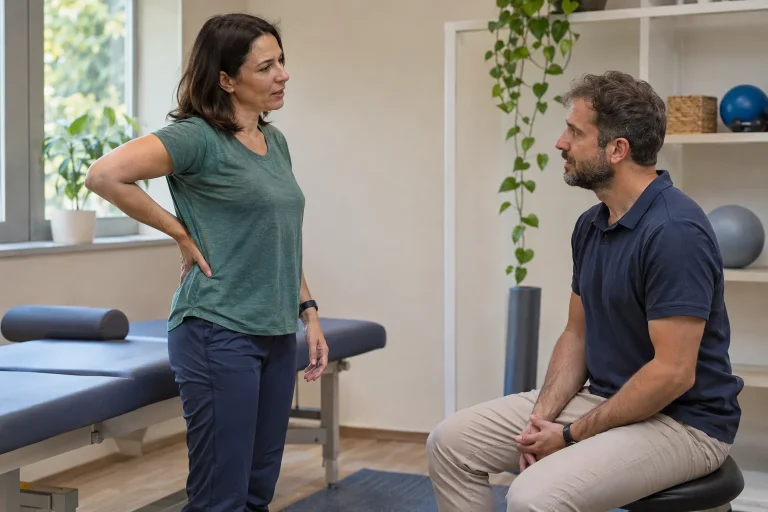
You get up from a chair, swing your leg or start moving and hear a snap around your hip. It may be painless yet frightening because the sound seems louder than you expect from a joint. At other times pain or a catching sensation accompanies it. Describe these separately: sound, pain and movement actually stopping provide different information.
A hip sound alone cannot establish whether something is injured. An unpleasant noise does not always mean damage, while a painful or function-disrupting change should not be called merely a sound. The following explains the basics and organises questions for individual assessment without provocative home tests.
What is called snapping hip?
The AAOS uses ‘snapping hip’ for a snapping sensation or sound around the hip during certain movements. One explanation is muscle or tendon moving over a bony prominence. Its information describes the phenomenon as often painless and harmless, although it can be bothersome and may involve pain in some situations. The AAOS page on snapping hip describes several presentations.
Do not imagine the mechanism as the entire hip joint moving out of place with every sound. The position and relative movement of tissues involved can also produce a sensation. Such a general explanation does not identify what happens in your own case, however. A sound cannot reliably select one particular tendon or other structure.
The basic concept helps prevent the next question from automatically being the worst possibility. You can simply ask: ‘I hear or feel this during this movement, and this accompanies it.’ You do not need to decide beforehand that it is entirely insignificant or definitely a serious injury. A precise description leaves room for individual assessment.
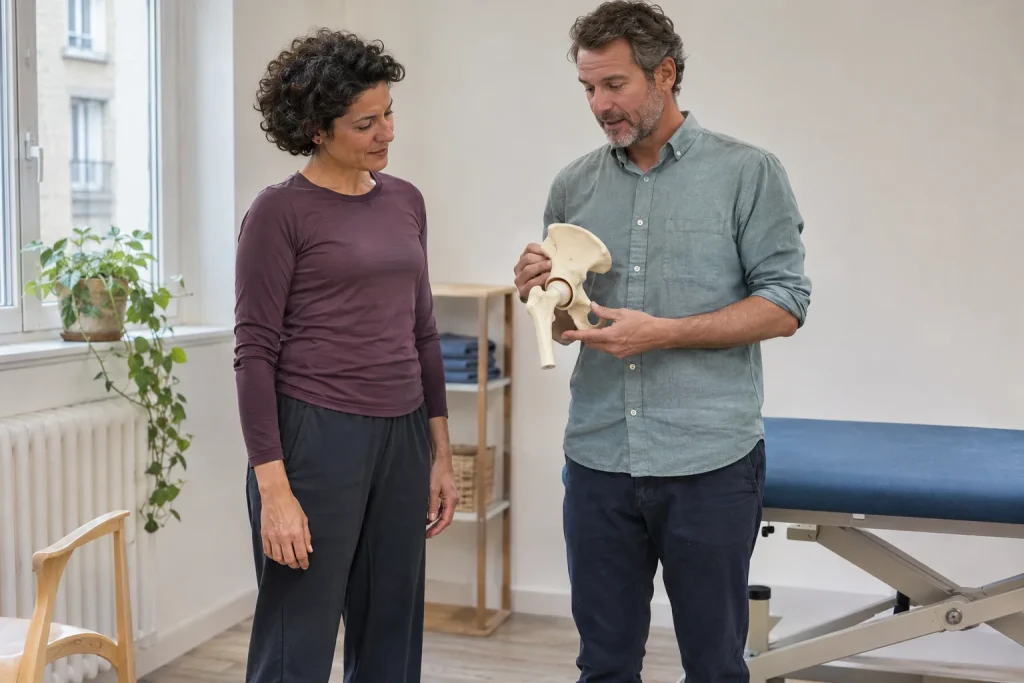
The hip is a ball-and-socket joint: the rounded femoral head fits into the pelvic socket. Alongside surrounding ligaments, tendons and muscles, a cartilage ring lies around the socket’s rim. When discussing sounds near the hip, it matters whether they concern tissues moving around the joint or another internal phenomenon; assessment distinguishes these.
A snapping sensation is not necessarily audible to others. If you feel it but someone beside you hears nothing, your experience is still describable. Your account can distinguish an audible sound from an internally felt movement without independently assigning either a tissue cause.
Location matters too: outer, front and deeper sensations differ
The AAOS describes snapping on the outside and front of the hip and, less often, at the back. Different tendons and soft tissues pass around the hip, so naming location helps history-taking. Your own words are enough: ‘I feel it at the side’, ‘more towards the groin’ or ‘deep in a place that is hard to show’. You do not need an anatomical name.
Deeper pain or a catching sensation may raise other questions. The AAOS also explains that conditions inside the joint can produce similar mechanical symptoms. Behind ‘snapping’, therefore, distinguish a sound alone, a painful sensation and actual movement restriction. You do not need forceful movements to prove the difference at home.
If you notice two different phenomena in two locations, describe them separately. One might be a longstanding painless sound, the other new discomfort. Do not automatically merge them into one story because you feel them in the same region. Describing onset and change helps individual assessment focus on the question that matters now.
 Enlarge image
Sound, pain and locking: what does your own word mean?
‘Catching’ can describe many experiences. Does a movement briefly feel odd, do you stop because of the noise, or can you genuinely no longer move the leg in the same way? You can describe these differences without knowing the cause. Clarifying the word is more useful than independently selecting an injury name.
| Phenomenon noticed | A clarifying question for yourself | What should you bring to the conversation? |
|---|---|---|
| Sound | Do I only hear it, or is there an accompanying sensation? | The movement and circumstances in which it occurs. |
| Pain | Does it appear with, before or after the sound? | Location, sequence and everyday effects. |
| Locking | What cannot continue: does movement stop, or do I stop because I am frightened? | The actual functional change noticed, without speculation. |
The table is not a home test. You do not need to get up now and repeat the situation to answer every row. It puts an event that already happened into words. State uncertainty too: ‘I cannot distinguish it exactly, but this changed compared with before.’
If movement unexpectedly becomes restricted or new pain appears, do not hide that behind the name of an old sound previously understood to be harmless. Earlier experience is important background but does not explain every later change. Individual assessment needs to include the present situation too.
Why not keep making it snap?
When a sound frightens you, repeatedly checking is tempting: is it still there, does it sound the same, does it happen on both sides? Repeated trials do not replace assessment. You do not need larger movements, more twisting or a stronger swing to find the position that definitely triggers it. You can report that it happened previously.
A short description can include familiar activities such as standing up or everyday walking. If the professional wants to observe the phenomenon during movement, clarify the purpose and method there. An examination manoeuvre or resisted task seen online should not become your own comparison test.
A video does not always explain what happens internally, particularly if it only captures or makes the sound audible. If a recording already exists from a spontaneous occasion, ask whether it helps the care provider, but do not provoke pain for filming. Recalling a symptom and deliberately producing it are separate activities.
What does daily function show alongside the sound?
University Hospitals of Morecambe Bay information on hip symptoms notes that creaking or clicking sounds can occur without pain and that sound alone rarely indicates damage. The NHS hospital hip-pain information also values daily function and the overall symptom picture. This does not mean every painful locking episode can be ignored.
Describe changes in walking, stairs, putting on shoes, starting after prolonged sitting or sleep. Distance recorded on a running watch does not reveal these situations. Name activities you have begun avoiding too. You do not need to call this failed training or weakness; you are conveying an actual change.
Worry about the sound can be discussed even without pain. Ask for an explanation of what the individual finding may concern and which changes to report later. Information is not meant to remove every sound, but to help you understand your situation and necessary follow-up.
When does a change need individual assessment?
The NHS recommends seeking medical help if hip pain worsens, recurs or interferes with usual activities or sleep. The NHS information on hip pain in adults also treats changes in symptoms and function as considerations for assessment. Do not describe pain appearing alongside sound as merely another variation of the sound.
Severe pain, inability to walk or inability to bear weight on the leg after an injury or fall may warrant urgent care. The same may apply to new sensory loss following injury. The next stretch or cautious running loop should not be the test. In Hungary, call 112 for a serious condition and seek safe access to care.
Sudden severe pain without injury, a hot swollen area, fever or feeling generally unwell may also require urgent assessment. A history of ‘my hip has clicked for years’ does not automatically make the new situation the same. This article is not a complete list of urgent signs; describe the change and your current condition when seeking help.
 Enlarge image
Take home an understandable explanation, not just a name
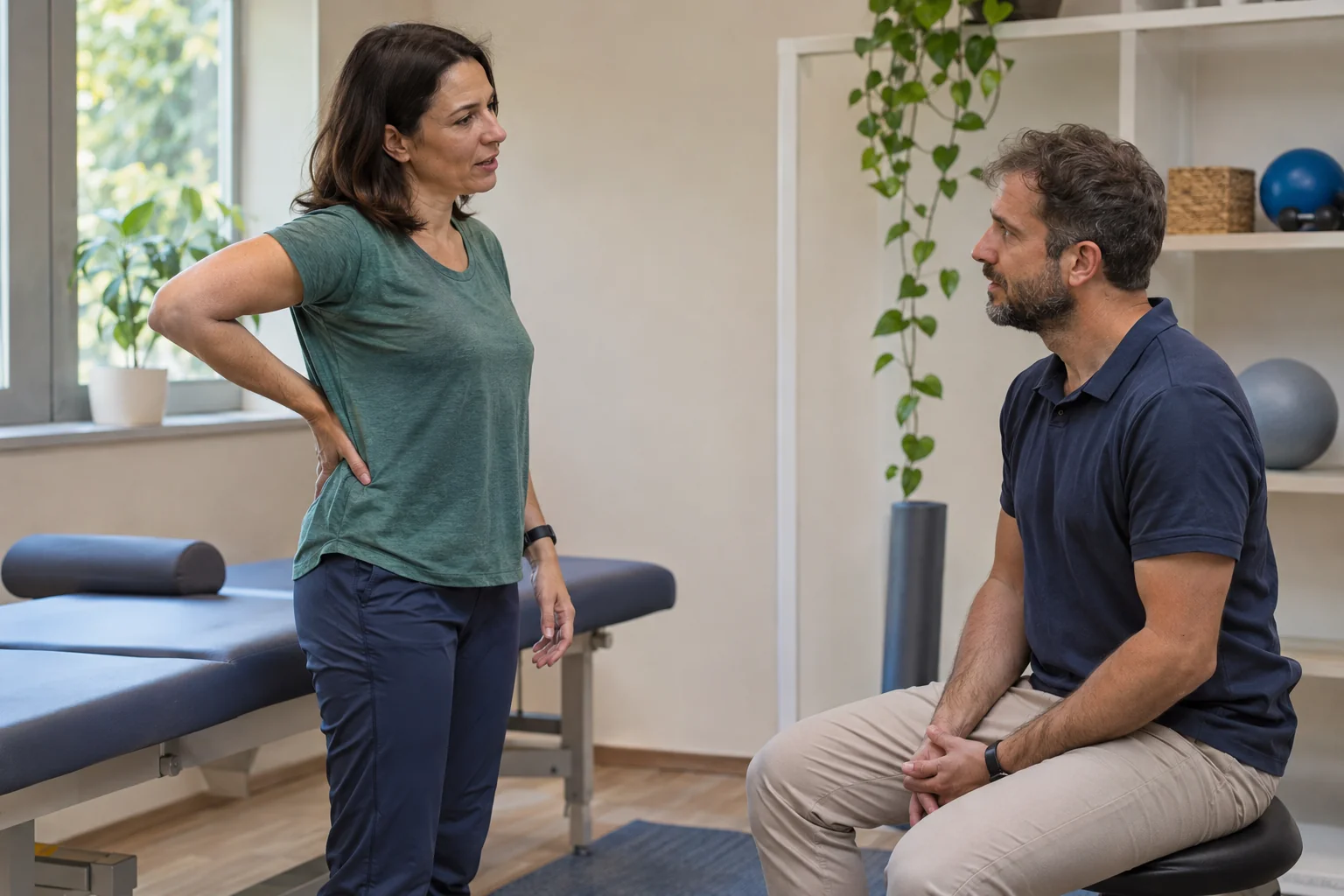
Ask what has been established separately about sound, pain and movement. One may already have an answer while another needs further clarification. ‘Snapping hip’ alone does not explain what you should do or what your individual advice concerns.
The AAOS describes history-taking and individual observation of movement, with further investigations where necessary. Imaging does not have an identical role for every sound. If it is considered, ask which question it seeks to answer. Do not regard another runner’s assessment sequence as the only acceptable model for your own care.
If exercises or activity changes are recommended, understand their purpose and how feedback will work. Do not check only whether the sound remains; ask which changes the professional wants to follow. Eliminating sound is not always the only relevant goal, and persisting pain must still be reported even if snapping becomes less frequent.
How can self-observation remain useful?
A short note may suffice: during which movement, where you feel or hear it, whether pain or actual locking accompanies it and what changed in daily life. Include onset and any injury. If it occurs only occasionally, you do not need to check every minute for its return. Missing information can remain missing.
Do not invent a severity scale from loudness or the number of snaps. A louder episode is not a measurement of tissue condition. An accurate history and individual assessment connect several types of information that a count does not encompass. Clarify training questions in light of symptoms and the advice received.
A hip sound can thus take its proper place in your story: a describable phenomenon that may or may not have other symptoms. You need neither magnify it into a frightening injury nor hide pain behind it. Naming sound, pain and functional change separately helps connect the next step to your actual situation.
Sources
- AAOS OrthoInfo: Snapping Hip
- NHS: Hip pain in adults
- University Hospitals of Morecambe Bay: Hip pain
How Futószív articles are prepared: our editorial guidelines.