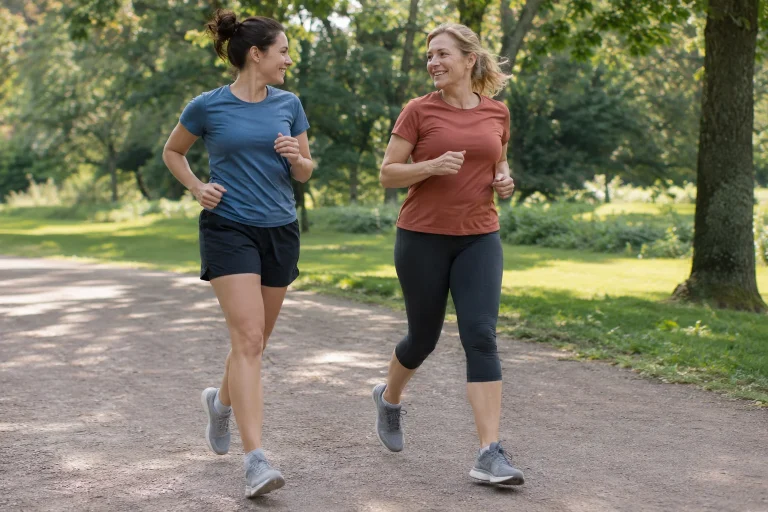
The display shows a slower pace, yet you are breathing hard. It is easy to think that because you are moving less quickly, the effort must be easy. Speed and personally experienced effort, however, are not the same information. As an older runner, understanding this distinction can be especially useful without trying to diagnose every breathing change.
This article provides general orientation for interpreting exertion. It does not determine what causes your heavy breathing. New or unusual breathlessness, or breathlessness that feels disproportionate to your previous activity, is more than training data: professional assessment may be needed. Judging familiar exertion and clarifying a new symptom are different tasks.
First recognise the symptom’s significance
Severe breathing difficulty, a tight or heavy chest feeling, radiating pain, fainting or confusion may require urgent help. The NHS information on breathlessness highlights these situations. Do not then check whether you can pass the talk test or expect a slower section to settle the healthcare question.
Breathlessness that is new, worsening, occurs during usual daily activities or accompanies other symptoms needs an appropriate healthcare discussion. Today’s slower pace does not automatically make it insignificant. Describe the symptom in your own words and timeline rather than replacing it with the app’s training label.
Finishing a session does not prove every circumstance harmless either. The change experienced along the way is information you can preserve. Do not try to reproduce it with the same exertion tomorrow merely to obtain more certain data. You do not need to create a repeated performance test for yourself before a symptom can be clarified.
Pace is external data; effort is an individual relationship
The CDC guide to measuring intensity distinguishes absolute and relative intensity. The latter describes how demanding a task is for a particular person. The same activity can require different effort from people with different preparation. This explains why speed alone is insufficient to call an activity easy for everyone.
Your own earlier pace is not a permanent label either. A speed you once found easy is not automatically the same in your present situation. A break, current condition and the activity’s circumstances belong in the account. The old data can have value for memory and planning without every present experience having to match it.
Slowing down can therefore be a genuine change of pace without personally experienced exertion immediately becoming easy. No single cause can be inferred from this. It reminds us to retain external performance and our own effort separately. One does not always have to tell the same story as the other.
The talk test is not health screening
As a general rule of thumb, the CDC explains that at moderate intensity you can usually talk but singing is difficult; with more vigorous activity, you may need a breath after a few words. The rule helps approximate intensity. It does not establish whether heart or lung disease is present or verify fitness for sport.
There is no need to turn the talk test into a competition or a home exercise stress test. The aim should not be completing a sentence during ever harder movement. If an unusual symptom appears, assessment matters more than still managing some speech. Successfully speaking does not rule out every possible problem.
The setting of a social conversation can differ too. Noise, turning sideways, going uphill or adjusting to a companion’s rhythm can change the situation. A guide’s value comes from using it for the right question, rather than expecting certainty independent of every circumstance. A specific symptom always remains separate information.
 Enlarge image
Why does the exact design of a research test matter?
An original treadmill methods study evaluated a specified talk-test protocol in 25 participants with cardiovascular disease. Researchers used prescribed stages, text read aloud and a comparison from another exercise test. Within this framework, the method showed appropriate measurement properties for estimating intensity. They did not examine any arbitrary conversation in a park or decide whether new breathlessness was harmless.
Professional use and everyday orientation therefore cannot be exchanged without details. Measurement accuracy reported in a study relates to its task and participants; it is not general permission for every home self-test. Keeping the talk test in its own role preserves its usefulness. Guidance for interpreting intensity and identifying a symptom’s cause are separate questions, even when both involve observing breathing.
Describing perceived exertion should not become self-judgement
‘I am weak’ or ‘I cannot manage anything’ gives little detail. It is more precise to name the situation: which task you performed, when it became harder, how breathing changed and whether you had to modify the programme. This account does not diagnose, but is more useful for later planning and discussion if needed.
The NHS guide for older adults also discusses forms of activity suited to individual circumstances and emphasises appropriate advice when someone has not been active for a long time or has health concerns. It does not recommend a single pace assigned by age. Activity history and current circumstances cannot be replaced by an age-group label.
If keeping a diary, you can note your experience alongside pace too. ‘It was harder than usual on a familiar flat route’ may be more precise than an unexplained negative rating. If breathlessness is new or worrying, it needs assessment in the appropriate professional setting; the note only helps preserve the timeline rather than resolve the question.
Record circumstances without calling them certain causes
Even the same route name can conceal a changed task. Were there more hills, were you moving into the wind, had you travelled farther beforehand or set off after a more demanding day? These are worth mentioning, not because any automatically explains every symptom, but because they provide important background for comparison.
An obvious circumstance can sometimes close thinking too easily. ‘It must be the heat’ or ‘I just slept too little’ may be unfounded if the change is unusual or recurring. The more precise statement is that it was hot or you had a poor night, and this is what you experienced. Where necessary, the cause needs professional interpretation.
You do not have to arrange laboratory conditions for every session. Daily movement naturally takes place in a changing environment. Briefly preserving important differences helps prevent inventing a story solely from the pace curve. The note’s value lies in traceability, not an apparently perfect dataset.
Actually agree what a shared easy outing means
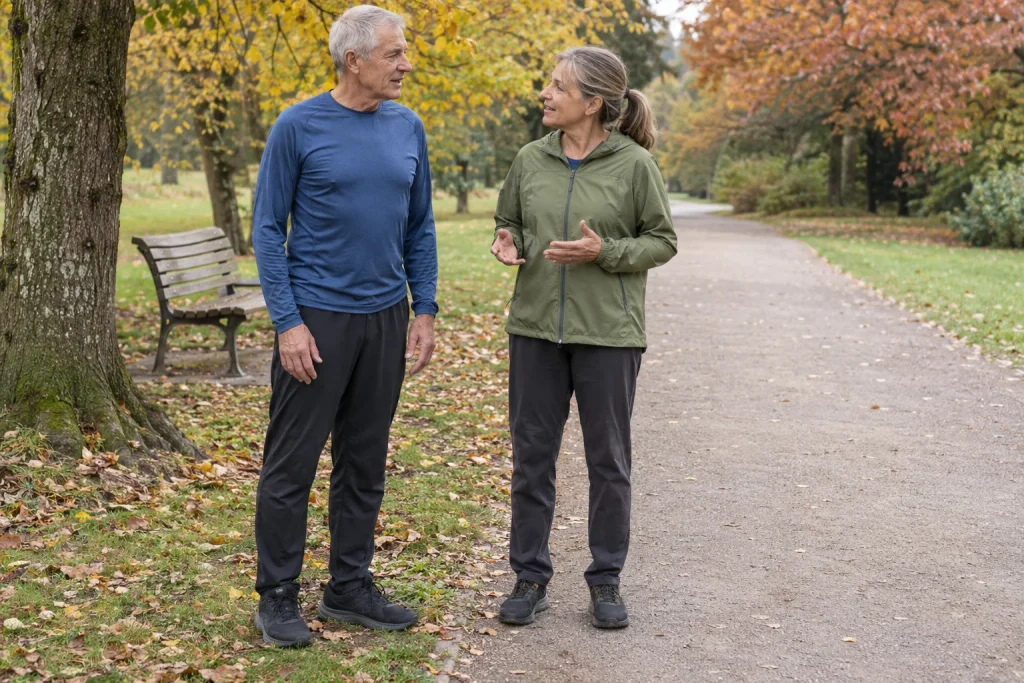
A companion saying it feels easy does not mean it is easy for you too. Individual differences have a place in shared activity. Agree beforehand how to signal a wish for change and what the shared framework is. A faster or more experienced companion’s feelings must not override your feedback.
| What you hear | What to clarify |
|---|---|
| This is easy for me. | What effort does it require from me, and what is today’s shared plan? |
| We have already slowed down. | Speed changed, but has my own experience changed too? |
| You can still talk. | Is there an unusual symptom that needs separate attention? |
The table is not an exertion test. It supports discussion so that shared activity is organised around more than an external speed. If today’s outing does not fit participants’ situations, it can change or another activity can be chosen. Social appreciation does not need to be earned by maintaining a pace agreed in advance.
Alongside age differences, activity history and daily circumstances matter. Two people in their seventies are not necessarily ready for the same shared task. Appropriate discussion therefore involves more than ‘We are the same age’. Discuss the particular programme, your own aims and the framework you can actually undertake.
 Enlarge image
Interpreting a watch also needs your own story
An app may label a recorded session according to pace, heart rate or other data, but does not know the whole story of your symptom. ‘Easy’ on a display is not a medical decision. If data and experience differ, preserve the difference rather than adjusting one afterwards to match the other.
Judging intensity involves more than whether a number remained within the field recommended by a watch. Individual professional guidance, a current symptom and the actual task may all matter more than a pre-made graphical zone. The device can be a useful diary tool, but its role should not extend to judging your entire health condition.
You can separately state uncertainty in measurement too. You do not know whether a reading was accurate, while you genuinely experienced the breathing change. A suspicious measurement does not make the symptom imaginary. Data quality is a technical question, while feeling unwell may need appropriate individual assessment. The two strands do not replace one another.
Keeping the next decision useful
A fictional older runner notices a slower pace yet harder breathing than usual on a familiar flat loop. They do not automatically call this an age-related change or look for another app to supply an easier rating. They preserve when and where it happened and take the new difference to an appropriate professional discussion. Further activity develops from their individual situation.
In another situation, understanding exertion concerns agreeing an already appropriately designed shared session. Here, considering personally experienced effort rather than pace may help. These two situations should not be merged: general orientation about intensity does not replace investigation of unusual breathlessness.
Slower movement alone therefore does not prove easy exertion, and heavy breathing does not identify one cause. Giving external data, your own experience and a new symptom separate attention produces a more useful picture. Let this more precise account support the next choice rather than trying to meet the display’s demands or match an old pace.
Sources
CDC: absolute and relative intensity, talk test; NHS: activity guidance for older adults; NHS: breathlessness and seeking help; NHS: fainting. Marques Vieira and colleagues: original validation of a specified treadmill talk test. Checked: 21 November 2026. The running situations are our own editorial examples, not diagnostic exercise tests or individual intensity prescriptions.
How Futószív articles are prepared: our editorial guidelines.