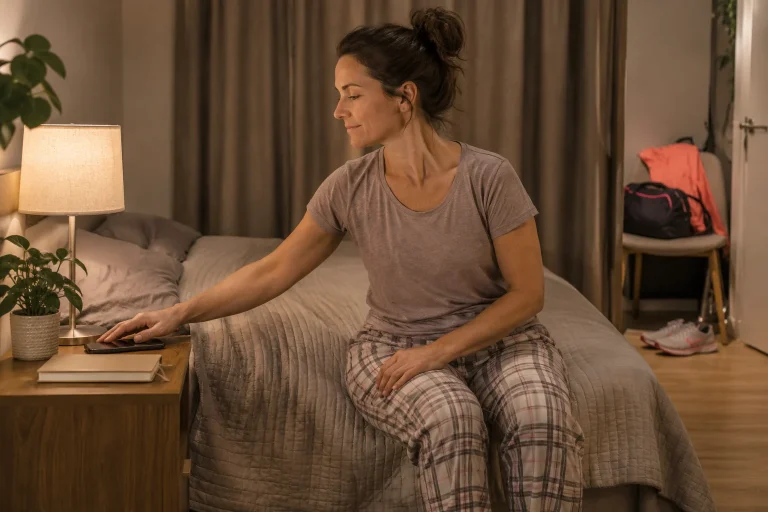
Before bed you already put the phone away, darkened the room and moved running training earlier. Yet many evenings repeat the same pattern: lying in bed, you watch whether sleep finally arrives and how much time remains before morning departure. Another evening rule can then make you feel you are still doing something wrong. Persistent sleep difficulty is not an examination of discipline.
Sleep hygiene means arranging habits and circumstances. CBT-I stands for cognitive behavioural therapy for insomnia: a multicomponent treatment developed for a defined problem. They may connect, but are not interchangeable. For runners, understanding the distinction helps because a manageable evening environment, assessment of sleep difficulty and professional treatment address different tasks.
What is called sleep hygiene?
NHLBI’s sleep-habits information mentions sufficient sleep opportunity, a more consistent schedule and a quiet, dark, cool sleeping environment, among other points. Evening caffeine, alcohol and disruptive light can belong here too. These circumstances may support sleep, but a general list does not establish what maintains your problem. NHLBI: healthy sleep habits.
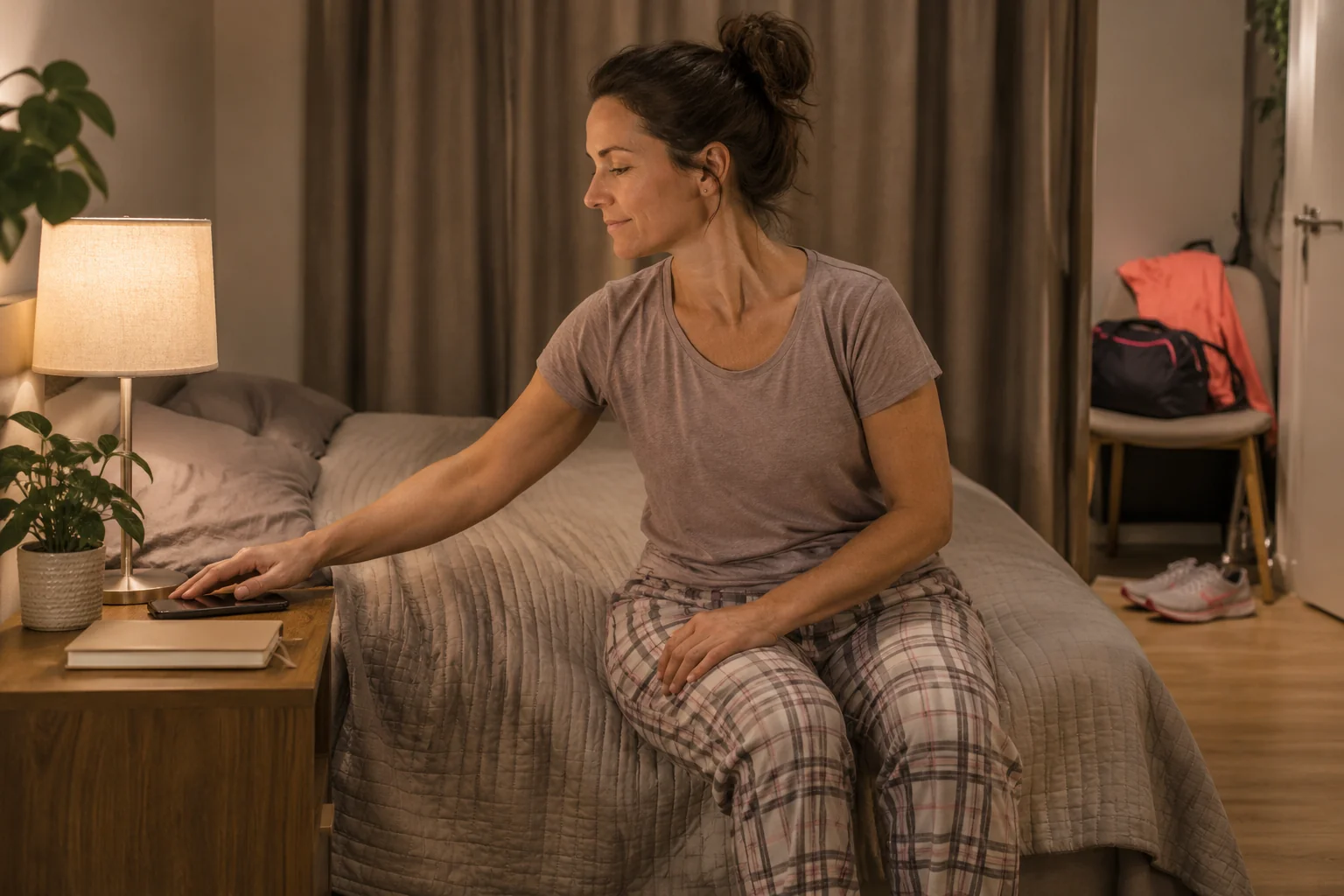
In a runner’s evening routine, such organisation might mean preparing next day’s kit earlier rather than searching for the race-packet collection route in bed. Or discussing beforehand which light stays on when one partner wants to rest. These useful changes make a specific evening obstacle manageable. They need not claim that a disorganised schedule causes every sleep difficulty.
General advice becomes misleading when promised as complete treatment or when persistent symptoms are attributed to failure to comply. You can have a tidy bedroom and still substantial insomnia. The other side matters too: if work and training leave hardly any sleep time, address limited opportunity separately. Examining circumstances and recognising a clinical sleep problem are not alternatives.
When is it insomnia, and who assesses it?
The European insomnia guideline considers difficulty initiating or maintaining sleep, dissatisfaction with sleep and daytime consequences together. Symptoms persist despite adequate sleep opportunity and circumstances. Chronic criteria include at least three occasions weekly for at least three months. This is a diagnostic framework rather than an instruction to wait three months before seeking help. ESRS: European insomnia guideline, 2023.
Your history matters in professional assessment. Is it difficulty falling asleep, frequent waking, waking finally too early or another phenomenon? NHLBI says the doctor may ask about habits, daytime function, health history and other possible factors, and request a sleep diary. Assessment is not equivalent to checking a smartwatch’s sleep score. NHLBI: diagnosing insomnia.
A night shortened by dawn training and difficulty falling asleep despite adequate time may be different stories. A diary can show the real schedule in both without replacing assessment. Do not retrospectively alter data to fit an imagined diagnosis. Uncertain estimates, workday versus free-day differences and daytime consequences are useful information.
 Enlarge image
CBT-I is treatment built from several components
CBT-I generally combines sleep education, behavioural procedures, relaxation and cognitive components. The cognitive part addresses sleep-related thoughts and expectations, while the behavioural part concerns certain sleep habits and learned associations. The 2023 European guideline recommends it as first-line treatment for chronic insomnia in an appropriate in-person or digital form. This does not mean every patient receives an identical programme.
A running-related conversation might consider the thought “if I do not sleep perfectly tonight, my whole preparation will definitely be ruined”. Professional work does not mean ordering yourself to think positively. It explores how experiences, conclusions and efforts organised around the evening connect. You can examine your example with the therapist; the article does not supply an individual psychological explanation.
In describing treatment, NHLBI separately mentions cognitive therapy, relaxation, sleep education and behavioural components. The process is therefore more than one exercise or an evening audio track. Nor must the conclusion be that the problem is exclusively “in your head”: health and sleep background remain important alongside treatment. NHLBI: CBT-I components and insomnia treatment.
Why is a better evening checklist not always enough?
The AASM’s 2021 professional guideline does not recommend sleep hygiene as the sole treatment for chronic insomnia, while it can have a place in a multicomponent intervention. The distinction is not that bedroom conditions or habits are irrelevant, but that alone they often do not constitute suitable treatment for a persistent disorder. AASM: guideline on behavioural and psychological treatments.
If you have tried many general suggestions, the next step is not necessarily making the list stricter. A professional can review each attempt’s purpose, what was feasible and why symptoms persisted. “It did not make me sleep well” is not personal failure. It is information for treatment selection rather than a reason to prescribe yourself more self-monitoring.
Evenings can particularly easily become performance tasks for runners: put the phone away on time, execute every exercise flawlessly and obtain a good watch result. Report this experience in care too. Do not judge a routine’s usefulness by its number of rules. You should understand treatment aims and the meaning of changes rather than receive them only as tasks to execute.
The scheduling component is not home sleep deprivation
Some behavioural CBT-I elements concern the relationship between time in bed and sleep. Such procedures do not aim to remove general sleep needs and are not toughening exercises to add to race preparation. Do not shorten your night independently based on a method’s name or copy another person’s bed and waking times.
The AASM guideline also discusses daytime fatigue, sleepiness and attention difficulty early in treatment. Procedures limiting sleep opportunity may be contraindicated in certain situations, such as high-risk occupations, vulnerability to mania or poorly controlled seizure disorders. Individual suitability, safety and follow-up are therefore part of the method. Enduring discomfort more determinedly as a runner is not the task.
If receiving treatment, tell your coach as much of the practical conditions as you wish, for example temporarily needing another schedule or flexible training. The coach should not modify the clinical programme, and you should not rewrite medical plans for a hard workout. Ask the care provider which daytime symptoms require contact and how to coordinate driving, work and sport.
What does digital CBT-I mean?
Digital format means more than evening advice appearing on a screen. A studied programme may use specified therapeutic content, structure and follow-up. Espie and colleagues’ two-arm randomised trial of 1711 participants compared a digital CBT-I programme with sleep-hygiene education. Digital treatment produced more favourable changes in insomnia symptoms and several self-reported daytime quality-of-life measures. Espie and colleagues: randomised trial of digital CBT-I.
The research concerned a specific programme and selected sample, rather than every sleep app. Participants entered with self-reported insomnia symptoms, and outcomes were not performance measured in a running race. Several authors had commercial relationships with the programme developer, disclosed in the paper. The trial is useful evidence rather than an individual product recommendation or an effect promise transferable to every digital service.
If this option arises in care, ask exactly what treatment is provided, for whom, how suitability is assessed and whom to contact with symptoms. An app only collecting sleep data, relaxation audio and a structured therapeutic programme are separate categories. Language, access, professional links and data handling are practical questions too. Digital format does not remove the need to disclose individual health circumstances.
 Enlarge image
What should you ask at the first appointment?
A good first conversation concerns more than how many hours you want to sleep. What problem is being assessed, which plan is proposed and how will change be recognised? The questions below help understand treatment rather than form a therapeutic checklist to perform at home.
| Question | Why is it useful? |
|---|---|
| Which sleep problem are we investigating? | Separates limited sleep opportunity, insomnia and other symptoms. |
| Is the recommendation sleep-hygiene advice or CBT-I? | Clarifies content and expected professional follow-up. |
| What is each component for? | You receive more than rules to carry out. |
| What should you know about my work, travel and sport? | Daytime safety conditions also enter the plan. |
| Which change will we evaluate, and when? | A traceable process replaces judging one bad night. |
| Whom should I contact with a new symptom? | You are not left alone to judge uncertainty. |
Request clear sleep-diary guidance too. Which details, how and for how long? What if you cannot remember a night precisely? Do not turn estimates into overnight stopwatch tasks. Data collection supports treatment rather than creating another checking obligation at every awakening.
If already using medicine for sleep symptoms, make its exact name and use known. Starting CBT-I is not an instruction to stop independently, and medication does not make reviewing treatment options pointless. Coordinate components with the care provider. An approaching race should not compress this into a quick change borrowed from others.
Seeking help does not require proving a perfect evening routine
The NHS advises seeing a doctor if changing sleep habits does not help, symptoms persist or daytime life becomes substantially harder. Symptoms suggesting another sleep disorder may require further investigation. You need not try every available pillow, audio track or watch setting first. Describe the problem and its consequences to your GP. NHS: insomnia and seeking help.
Keep running’s role precise too: it can offer enjoyment, community and daily structure, but a training plan is not treatment developed for insomnia. Improving evening surroundings and professional help can coexist. Useful support takes symptoms seriously, makes proposed steps understandable and allows feedback. Sleep then need not become another race to perform flawlessly every night.
Sources
- NHLBI – Insomnia: Treatment
- NHLBI – Insomnia: Diagnosis
- NHLBI – Healthy Sleep Habits
- AASM, 2021 – Behavioral and psychological treatments guideline
- ESRS, 2023 – The European Insomnia Guideline
- Espie and colleagues – Digital CBT-I randomized clinical trial
- NHS – Insomnia
How Futószív articles are prepared: our editorial guidelines.