A simple familiar recipe can help plan several days of meals. This does not necessarily mean eating the same cooked food all week. A work sequence, shared ingredients or a useful flavour base can carry over into different dishes. A multi-day menu becomes genuinely varied when personal food needs, fresh preparation and appropriate storage conditions all appear in the plan.
This guide offers adult recreational runners a kitchen-planning method. It is not a personal weekly diet or a guarantee that every food lasts several days refrigerated. Adapt quantities and composition to your needs, diet and activity. Always follow appropriate preparation and storage for the actual food. With allergies, illness or prescribed diets, check every modified version separately.
Distinguish three types of repetition
The first repeats a recipe idea: similar techniques with suitable ingredients freshly prepared another time. The second uses purchased ingredients in several dishes, prepared separately while storage instructions are followed. The third retains properly cooked food for later use. These differ. Reimagining a recipe does not necessarily require storing the same cooked batch for days.
Mark which approach your menu uses. With repeated ingredients, storage and instructions after opening matter. With retained cooked food, the full history and food-specific use limits matter. If only the technique carries over, the next dish is separately prepared. This distinction prevents misunderstandings behind general claims that one cooking session covers the entire week.
Choose a genuinely familiar base recipe
Start with a dish you enjoy, that fits your diet and that you can prepare appropriately in your kitchen. Read the whole method, not only ingredients. Which step builds flavour? What is prepared fresh? Which part needs longer preparation? Build a variation map around these roles. If the base recipe is still unclear, first learn to prepare it properly.
The NHS pasta and tomato sauce recipe for example separates building the sauce from timing the pasta. It illustrates that a shared flavour base and its accompaniment are different tasks. This is a family recipe, not a prescribed portion for runners. Food format and sequence can inform your multi-day plan while individual quantities remain separate.
Describe the recipe through its components’ roles
A flavour base, main component, accompaniment or other base, and finishing addition are four useful fields. They do not separate completely in every dish or represent equally sized plate sections. The aim is to see what can change independently. Changing seasoning differs from replacing a raw main ingredient, which may introduce new preparation and dietary requirements.
Write more than ‘add vegetables’. Specify which vegetable, in what form and at which step. Fresh, frozen and ready-to-eat ingredients can need different operations. Likewise, dried and cooked pulses cannot simply be exchanged by equal weight at the last moment. A variation map helps when it preserves necessary preparation rather than merely changing ingredient names.
| Recipe role | Possible change | What to recheck |
|---|---|---|
| Flavour base. | Suitable seasoning or sauce format. | Ingredients and the actual recipe’s sequence. |
| Main component. | Another appropriate ingredient fitting your diet. | Complete preparation and the whole dish’s composition. |
| Accompaniment. | Another suitable side, bread or serving base. | Personal quantities and a separate cooking process. |
| Texture. | Separate components, a saucy dish or spoonable format. | A texture change must not omit necessary preparation. |
| Timing. | Fresh preparation or an appropriately retained component. | Food history and its specific use limits. |
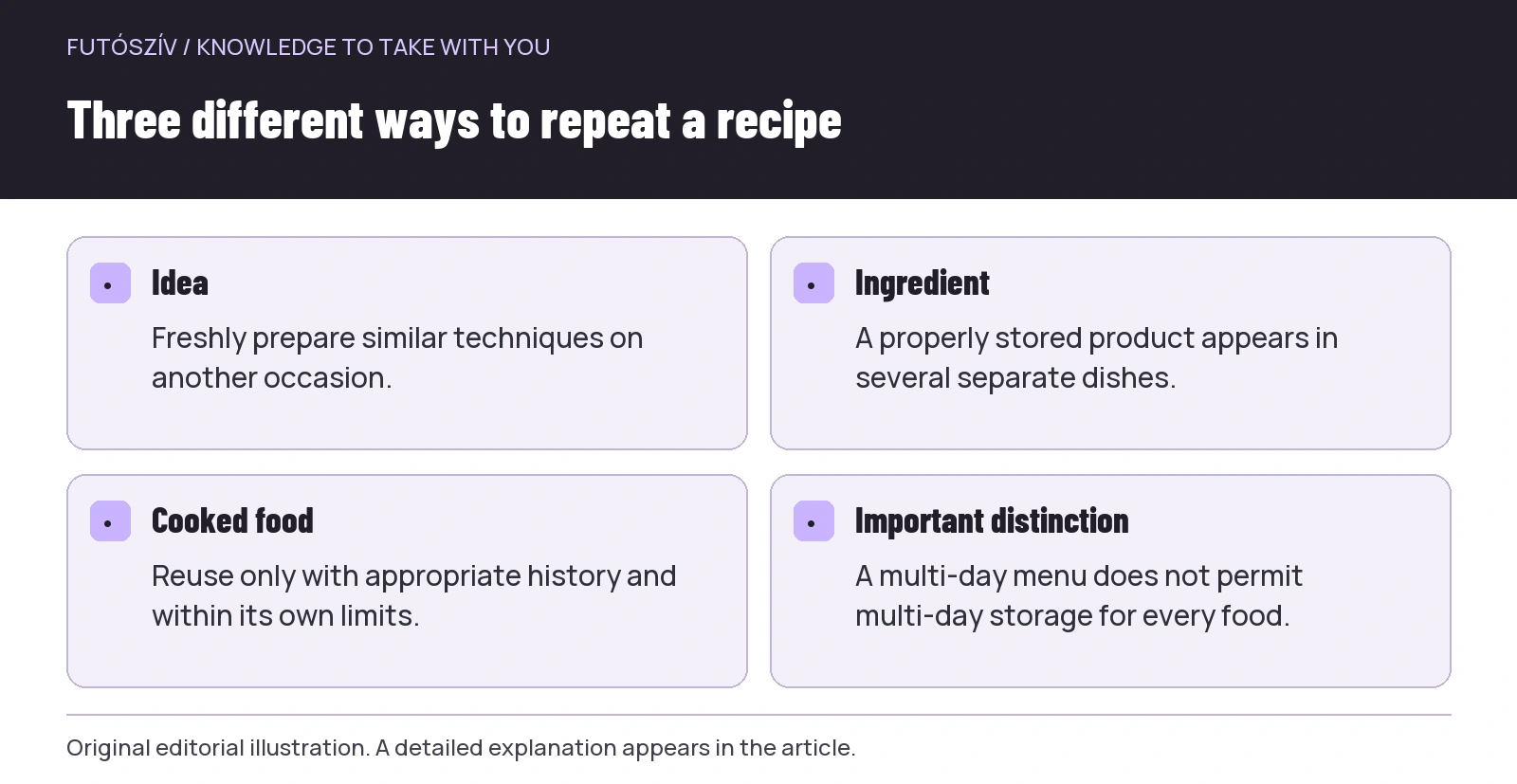 Enlarge diagram
Text version of the illustration
- Idea
- Freshly prepare similar techniques on another occasion.
- Ingredient
- A properly stored product appears in several separate dishes.
- Cooked food
- Reuse only with appropriate history and within its own limits.
- Important distinction
- A multi-day menu does not permit multi-day storage for every food.
First variation: the same idea with another accompaniment
A properly prepared thick dish can combine with several personally suitable accompaniments. The NHS vegetarian chilli recipe also mentions different serving options: rice, baked potatoes or other forms with suitable use. The family recipe offers an idea, rather than automatically determining your portion or later handling. New presentation does not erase the earlier dish’s history.
If reusing only the idea, prepare the next version fresh from appropriately stored ingredients. If serving the same cooked portion again, meet necessary chilling and use conditions. Identify the distinction in the weekly plan. Changing sides adds variety but does not automatically give an earlier dish a new storage deadline.
Second variation: shared shopping, separate dishes
Choose ingredients featuring in several favourites. A suitable tomato ingredient may become sauce one day and another main dish later, if storage and after-opening conditions permit. Everything need not be cooked together. Joint purchasing with separate fresh preparation can save time and decisions when recipes and occasions are known beforehand.
Give an opened large package a specific further use. If this is unrealistic within its own limits, another size or purchasing plan may be better. Shared ingredients aim at actual use, not apparently economical volume. Mark not only which ingredient appears repeatedly, but its form and timing. Keep the stock’s journey clear.
Third variation: one technique, different flavours
A familiar workable frying-pan or sauce sequence can support several flavour combinations. Seasoning and suitable additions change the result. Consider more than taste, however: composition, moisture and necessary cooking can differ too. Lessons from technique can transfer without times and quantities being copied unchanged.
Keep a first variation simple. Changing the main ingredient, side, equipment and seasoning simultaneously makes the difference hard to understand. One or two targeted changes support clearer kitchen learning. This is personal recipe development, not a controlled nutrition study. Appropriate preparation and individual dietary requirements remain fundamental in every version.
Preparation can also have several levels
First choose recipes and make necessary equipment accessible. Second prepare suitable ingredients according to their conditions. Third retain fully cooked food appropriately if chosen. You do not need the highest level to simplify weekdays. A recipe read beforehand, ingredients in a known form and ready equipment can remove many evening decisions.
Do not automatically store cut or washed ingredients like whole products. Follow guidance for the actual food and form. During shared preparation, raw and cooked components and allergens may require appropriate separation. Without necessary fridge space or time, planning recipe ideas may suit better than producing too many partly prepared foods.
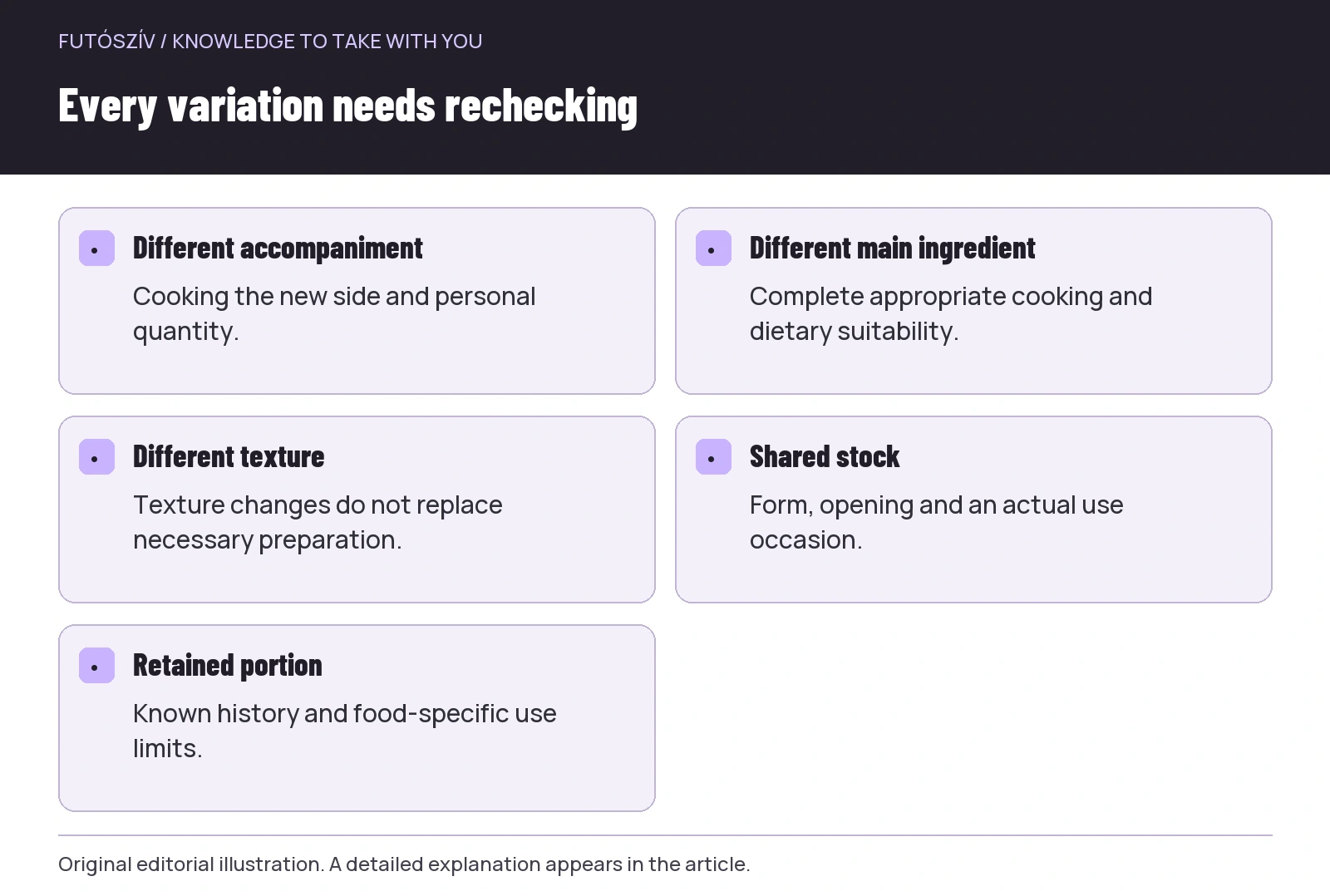 Enlarge diagram
Text version of the illustration
- Different accompaniment
- Cooking the new side and personal quantity.
- Different main ingredient
- Complete appropriate cooking and dietary suitability.
- Different texture
- Texture changes do not replace necessary preparation.
- Shared stock
- Form, opening and an actual use occasion.
- Retained portion
- Known history and food-specific use limits.
Give the weekly menu several real cooking points
A considered example might prepare the base recipe fresh initially, use shared ingredients in another dish later and then use an appropriately retained component. This is an organisational example, not a permitted timetable for every food. Choose days according to product limits and household possibilities. A weekly table does not extend storage life.
The Nébih Wasteless programme recommends menu planning around actual weekly commitments and reviewing existing supplies. Put simpler familiar options on busier days. Do not automatically assign a lengthy new recipe to the latest return home. Variety is sustainable when actual time and kitchen capacity are included.
Reassemble the complete meal
Changing a main ingredient or side can change the whole meal’s amount and composition. Successful flavour substitution is not automatically nutritional equivalence. Adapt the plate to personal needs and seek dietetic support for individual questions. A family recipe’s serving count does not mean the same quantity for every adult runner. A recipe supports learning; an individual plan is another level.
In a shared household, a common base with separate accompaniments may fit different needs. Necessary allergen separation cannot generally be achieved by removing something from the top of a finished bowl. Consider individual requirements while shopping and preparing. Multi-day variety should not come at the cost of uncertain composition; identify every dish clearly.
A garnish alone is not a new menu
A new spice or topping may be an enjoyable change, but if eating the same food for days, call it that in the plan. Format, main ingredient, accompaniment and texture can create genuine variety. Every occasion does not need a wholly new recipe. Considered variations of familiar dishes can provide suitable choices when supported by the overall diet and needs.
Familiar repetition has a place in everyday eating too. Variety does not require unfamiliar ingredients daily. A good menu offers choice alongside dependable dishes. If a new version fails, adapt it through kitchen experience. Do not judge food by a fashionable name or the number of colours on the plate.
A three-column variation sheet
Put the familiar base recipe and main operation in the first column, the component genuinely changing next in the second, and the condition to check in the third. Another side needs its own cooking instructions; another main ingredient a full preparation plan; a retained portion an appropriate storage history. The sheet helps when it shows real connections rather than simply three dish names.
Add a simple backup meal for a missed cooking occasion. Make it available under its own conditions. If you regularly use it, reconsider the main plan’s workload. A multi-day menu aims at real suitable meals you enjoy rather than strict timetable compliance. Knowledge from a recipe and clear ingredient use make this easier.
At week’s end, review which versions were made, which ingredients remained and which steps were too difficult. Improve one specific point next time. One familiar recipe can thus become practical kitchen knowledge: a way of thinking useful across several dishes while preserving fresh preparation, necessary storage and personal eating needs.
Sources and further reading
How Futószív articles are prepared: our editorial guidelines.