A shared route helps when the other person understands their role
Before leaving, you send a map link and say you are going running. This communicates intent but may leave important questions unanswered. Which version will you follow? When do you plan to finish? Will there be coverage? And what does it mean if your usual message does not arrive? Usable route sharing is not a data package, but an agreement clarified beforehand between two people.
The aim is a short, understandable outing sheet. Every easy loop need not become an expedition dossier. Match the detail to the location, route complexity and your own experience. What matters is that the person staying at home genuinely accepts the role and can find the necessary information even when they cannot read a long chat.
First agree who will receive the plan
A public social post is not the same as agreed contact with a specific person. Many people seeing your story does not mean someone is monitoring your finish. Choose someone available during that period who understands the plan and accepts their part.
Do not automatically assume this of a family member or running companion either. They may be working, travelling or unable to follow messages. Briefly agree when you will leave, what confirmation to expect and what happens if the outing changes. If they are unavailable, the plan needs another appropriate arrangement.
The Mountaineering Scotland information on route cards also highlights leaving your programme with a reliable person and confirming your return. The source concerns Scottish mountain settings; its local procedures and telephone details should not be adopted as Hungarian practice. The shared planning principle is clear, however: someone knows your outing and how it will conclude.
Include the date and version in the plan
Put the run’s date beside the route name. If you have previously sent similar plans, this immediately identifies the current one. Clearly name the starting place, main route and intended endpoint. Add a short text to the map link that can be read without opening another app.
Identify the track version too. One file may contain a longer loop and another a shorter finish. Do not expect your contact to infer your choice from file order or the most recent download time. One sentence is enough: today I plan the short version; the long one is only a later idea.
If the outing changes before departure, send one new, complete summary. Several messages correcting each other make the valid plan hard to assemble quickly. Mark the update at the beginning and state which earlier sheet it replaces. This is simpler than changing details in fifteen separate places.
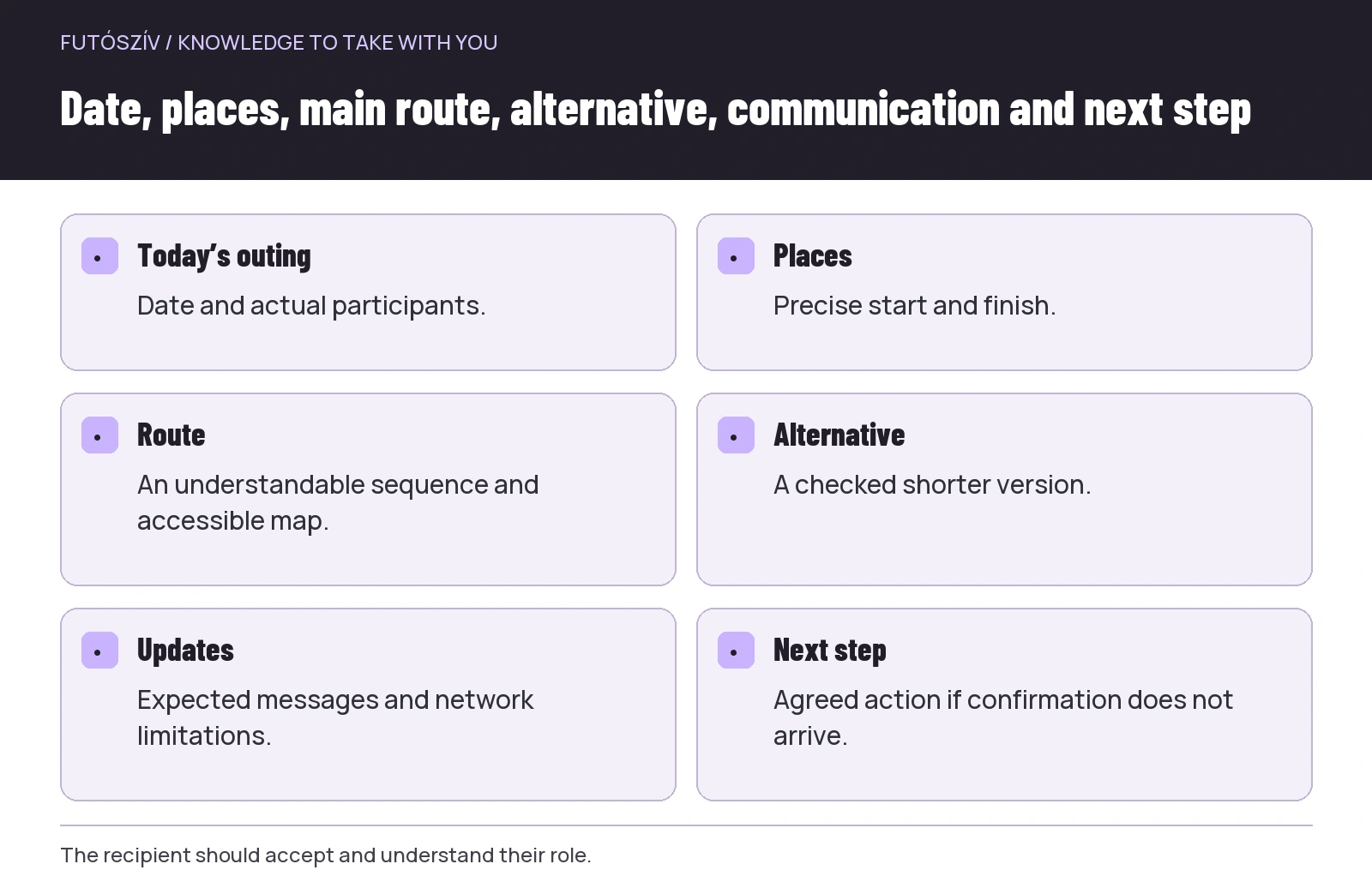 Enlarge diagram
Text version of the illustration
- Today’s outing
- Date and actual participants.
- Places
- Precise start and finish.
- Route
- An understandable sequence and accessible map.
- Alternative
- A checked shorter version.
- Updates
- Expected messages and network limitations.
- Next step
- Agreed action if confirmation does not arrive.
Six fields for a short outing sheet
| Field | What should it contain? | Why is it useful? |
|---|---|---|
| Date and participants | Today’s date and those actually setting out | Identifying the current outing |
| Start and finish | Exact places, not merely an area | The outing’s geographical frame |
| Main route | A short sequence and checked map link | Understandable intended progress |
| Alternative | A shorter version understood beforehand | Interpreting a possible change |
| Communication | Expected updates and known coverage limitations | Clarifying what a message means |
| Next step | Agreed action if confirmation does not arrive | Avoiding a last-minute decision |
The table is an editorial framework, not a compulsory official form. Necessary personal and technical detail depends on the specific outing. Do not automatically add all your health information or home address; share with the appropriate trusted person only what may genuinely be needed.
Finishing time and confirmation time can differ
After the run ends, you may still need to reach a stop or somewhere with a usable connection. Do not therefore give only the planned time for stopping your watch. The other person should also know when and in what form to expect personal confirmation.
Clearly distinguish the planned finishing window from the point at which you agree the next step should happen. Do not keep a hidden margin in only one person’s mind. If you envisage a flexible day while your contact expects an arrival to the minute, you interpret the same information differently.
There is no need to recommend the same number of minutes of delay for every runner. Route, environment, connectivity and personal circumstances matter together. Make the agreement for the specific day rather than automatically transferring arrangements from an earlier short urban loop to an unfamiliar trail outing.
Learn to read the location-sharing signal too
If using live location sharing, have your contact find where the last update time appears. A point on the map may be older information. Different contact gaps may not appear identically in the app either. Clarify this through a simple trial in familiar surroundings before leaving.
According to the GPS.gov explanation , GPS satellites do not track devices on the ground but broadcast a reference signal. Your device determining its position and transmitting it to another person are therefore separate processes. Your position appearing locally does not guarantee your contact receives fresh information.
Do not make location sharing the sole communication method when network availability is uncertain. Keep an understandable written plan and a personal finishing message too. The technical service can complement the agreement, but cannot replace clarifying what the other person considers current information.
Write clearly for someone who does not run locally too
Nicknames used by local runners often do not appear on maps. “The loop after the old beech” or “the usual ridge” means something only to someone who has been there with you. Use official or map-identifiable names and provide a precise point in the link if needed.
Write waymark names in full too. A blue stripe and blue cross are different information. If your contact does not know hiking waymarks, add a short sequence: starting place, main junction, planned return. They need not become a navigation specialist to understand the outing’s geographical frame.
Check together that the map link actually opens for them and is not visible only in your logged-in account. If sharing requires permission, resolve it before departure. A short written summary is still needed alongside a link that does not work.
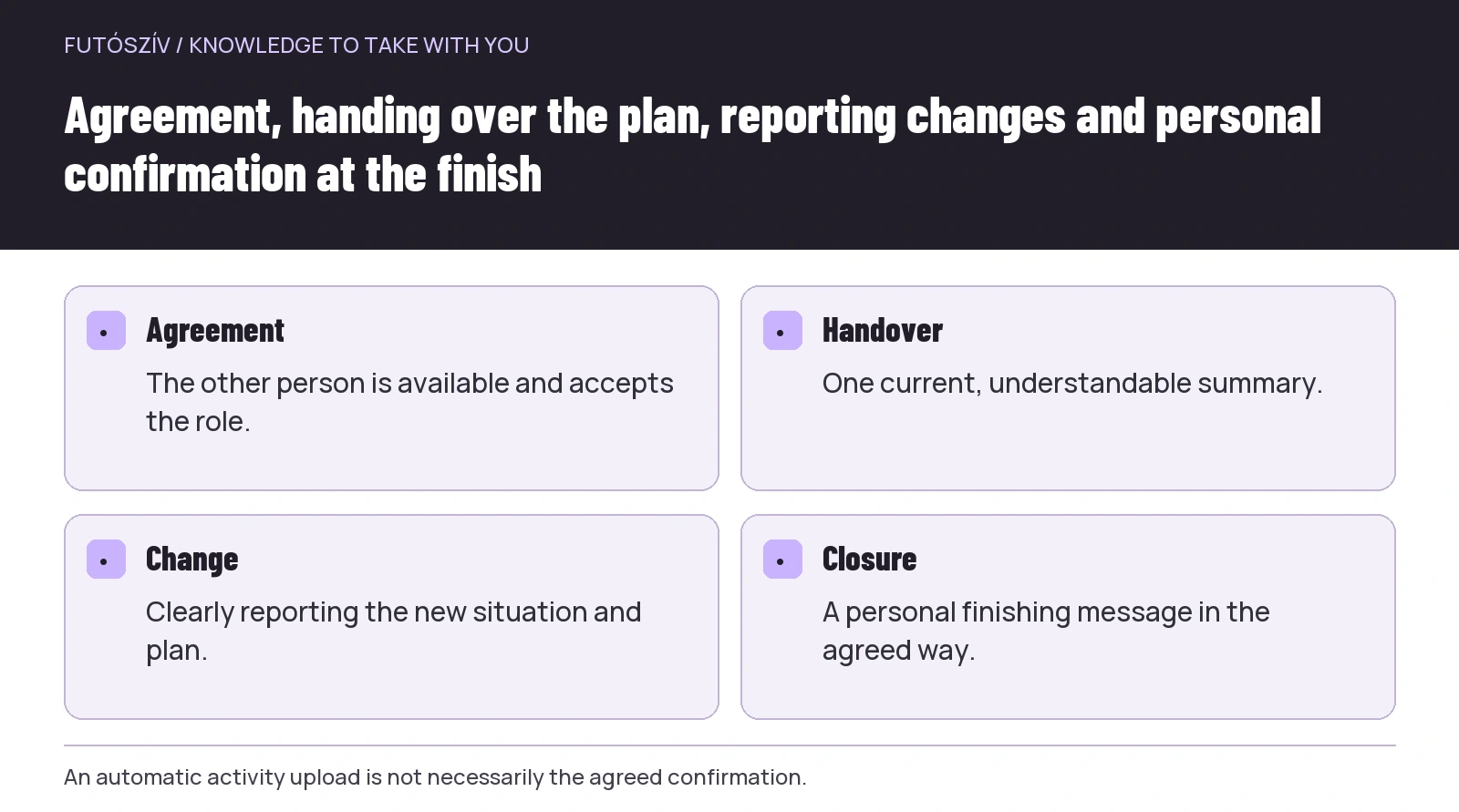 Enlarge diagram
Text version of the illustration
- Agreement
- The other person is available and accepts the role.
- Handover
- One current, understandable summary.
- Change
- Clearly reporting the new situation and plan.
- Closure
- A personal finishing message in the agreed way.
An illustrative example: improving a vague message
The original message says: I am heading to the forest for the long loop, back around midday. The recipient does not know which forest, where you are parking or which long version you mean. “Around midday” does not say when to expect confirmation or when a further step should follow either.
The improved version includes the date, exact starting place, chosen loop’s name and map, connection to the shorter version, and agreed arrangement for personal confirmation. The contact confirms receipt and understanding too. This example deliberately gives no real place name or general delay threshold: fill those in for the specific outing.
The improvement is not that the message has more sentences. The information’s role has changed: the other person now knows which outing you mean and how to interpret its conclusion. A short, well-completed summary can therefore be worth more than a full activity file without explanation.
Keep the plan traceable when changing it
If circumstances lead you to shorten the outing or choose another checked finish, clearly report the change where possible. State the actual new decision: where you are, which version you will follow and how expected confirmation changes. Do not merely say everything is fine when the geographical frame has changed.
With weak coverage, a message may not arrive immediately. An indication of sending and confirmation from the other person are different. Handle this uncertainty with knowledge of your app’s operation, and do not automatically assume the recipient already sees the new version.
A change must not mean unchecked improvisation on the trails. The shorter plan also needs understood, permitted connections. Sharing organises information, but does not itself make a route appropriate when its on-site conditions are unknown.
Clarify the next step beforehand
If confirmation fails to arrive, your contact should not need to speculate in several running groups about what it means. The agreed plan should clearly state how they will try to make contact, which information they will gather and when they will seek help appropriate to the situation. Do not build a universal waiting rule identical for every circumstance.
In an urgent emergency in Hungary, the 112 emergency number is available. The police information lists necessary basic information, including the location, what happened and who needs assistance. The route plan can provide an information base, but does not replace accurate answers to the call handler’s questions.
Keep confirmed and assumed information separate. The planned route does not prove the runner’s current location, while the time of the last position update is an important part of that information. If something is unknown, say so rather than retrospectively constructing a confident-sounding story.
Keep the outing sheet accessible, but no more public than necessary
Sending the plan to the right person does not require publicly sharing your entire route on social media. Clarify the purpose and audience. Publishing a sports diary, keeping in touch with family and providing information needed for assistance are three different tasks.
The recipient should keep the sheet somewhere easy to find. This could be a pinned message or another mutually understood format. If many other topics appear in the conversation, the map should not need a last-minute search. The short summary should state where the detailed version is.
Collecting unnecessary personal data does not improve the plan. Usable location information, contact details and the outing’s arrangements matter more than an all-inclusive document. Check sharing permissions in the actual settings of your chosen service.
The finishing message closes the agreement
Once the outing has ended in an orderly way, send the agreed personal update. Do not assume the other person already understands what happened from an automatically uploaded activity or social photograph. If you finished at another time or place, mention that briefly too.
Afterwards, review together whether the sheet was understandable and communication realistic. Was there an abbreviation or place name only you understood? Did the link work? Was the last location-update time visible? These can make the next agreement more precise.
Route sharing becomes routine when it is a consistent, short exchange of information rather than complex administration. The runner knows what they handed over, the contact knows what they accepted, and both understand how the outing concludes. This clarity remains a separate task alongside the technical tools.
How Futószív articles are prepared: our editorial guidelines.