
A shared running trip is not automatically the same day for everyone
One friend wants a long trail loop, another wants to stop at scenic places and a third needs to be home in the afternoon. They all said yes to a shared running trip without necessarily imagining the same programme. Different expectations are easiest to clarify while the meeting, travel and route can still be changed.
You do not need to turn every friendly occasion into a strict contract. A brief programme sheet understood by everyone may help, however. Which part are you actually committing to together? What is separately optional? How will everyone get home? These concrete questions can create a usable framework for the day.
Let everyone state their own goal first
Before asking where to go, ask why you want to go. Learning a route, a social day, an unusual location or a personal running task may create different organising needs. Naming the goal is not a compulsory personal confession; the expectation relevant to today’s programme is enough.
The plan should not contain only the idea of the most enthusiastic or quickest-speaking person. A quieter companion’s specific time frame or comfort matters equally. If someone does not yet know which route they can commit to, that creates a further information question, not automatic agreement to every idea.
The Mountaineering Scotland planning guide treats participants’ experience, skills and the whole group’s circumstances as foundations for choosing a programme. The source addresses Scottish winter mountains, so its details need not be transferred unchanged to a running day out in Hungary. The basic question is useful here too: choose a programme for the actual people.
Separate the shared part from individual options
The shared part should have conditions understood by everyone committing to it. This may be a particular route or another appropriately defined session. Extensions, photography or separate activities beyond it should not quietly slip into the original agreement.
| Programme part | What needs clarifying? | Why is it a separate task? |
|---|---|---|
| Setting off together | Precise place, time and travel | Everyone should arrive at the same place |
| Agreed shared loop | Distance, character, support and finish | The meaning of participation together is clear |
| Optional continuation | Participants, independent plan and conditions | Not compulsory for the whole group |
| Getting home | Who leaves when and how? | A different programme may affect others too |
A separate choice does not automatically mean the group has fallen apart. It may be an understood, appropriately arranged option. However, both parts need to work independently; others setting off does not replace knowing your own route and finish.
 Enlarge diagram
Text version of the diagram
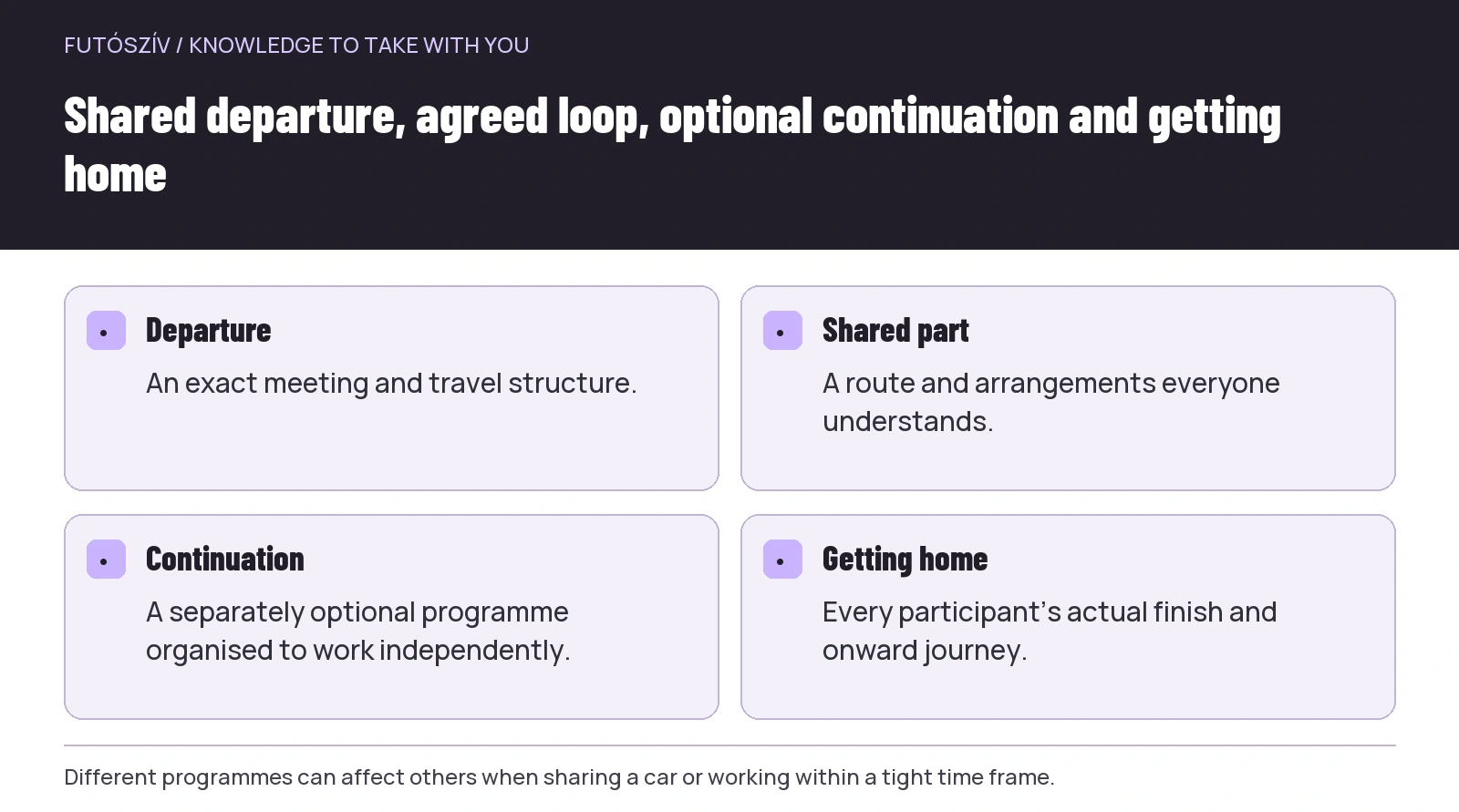
- Departure
- An exact meeting and travel structure.
- Shared part
- A route and arrangements everyone understands.
- Continuation
- A separately optional programme organised to work independently.
- Getting home
- Every participant’s actual finish and onward journey.
Compare the whole task rather than pace
Similar road results do not imply identical trail experience. Differences in following markers, ground conditions and equipment use may matter. Ask about actual experience relevant to the chosen route rather than merely placing one pace beside another.
The rhythm of a social programme may differ from individual training too. Stops, route checks and shared meeting arrangements belong to the whole day. If someone wants to complete a precise training task, they may need to clarify its fit with their own programme with a coach.
The solution should not be that everyone will adapt on site. Adaptation needs boundaries too: will you stay together, regroup at defined points or form several independent groups? Make the decision fit the venue and the group’s actual knowledge.
Everyone should understand the full time frame the same way
The estimated run length is not the trip’s total duration. Travel, preparation, stops, meals and returning may all belong to it. Someone with a specific commitment at home needs to plan their whole absence, not only the activity measured on a watch.
Name the latest manageable finish precisely. Arriving in a town, reaching the railway station and entering your front door are different points. Connect the time frame to the finish location from which the next part of the plan actually makes sense.
Your travel-time estimate remains an estimate. Particularly on unfamiliar terrain, it cannot underpin a transport promise accurate to the second. Orderly planning may also involve appropriately understood spare time and a checked shorter version suited to the circumstances.
With a shared car, differing programmes become connected
If everyone arrives in the same vehicle, one person’s extension affects others’ waiting and journey home. Do not first discuss this at the end of the route. Before leaving, make clear when the vehicle departs and which different options are available.
A waiting programme also requires specific conditions. Where can people wait appropriately and lawfully, for how long and with which services actually available? A building or rest area visible on a map is not automatically an open, comfortable meeting base.
If no version suits every participant, choose another programme or travel arrangement. Friendship does not make other people’s time unlimited. A clear transport agreement can prevent many later personal misunderstandings.
For public transport, today’s connection matters
The MÁV Group information on journey planning and service changes provides a starting point for checking the particular day. A departure time in an earlier route report is not automatically the current timetable. Identify the precise stop and direction too.
If planning different finishes, check the journey home for each. One runner’s shorter loop may not reach the same transport point. Understand the connection on the map rather than comparing only town names.
In the shared plan, keep timetable information separate from your estimated arrival. The former may be a checked time; the latter is a personal assumption. If the whole day depends on one tight connection, review that structure before the trip.
Costs and comfort needs can be stated too
Travel, meals, possible admission or other services may create differing expenses. Before the shared programme, name what is known and what each person undertakes. Use current sources for actual amounts rather than passing old memories or optimistic estimates off as facts.
Allow separate choices about paid extras if they are not part of the agreed shared foundation. Belonging should not be proved by purchases or accepting a more expensive service. A simpler alternative is usable when meeting and getting home remain organised too.
Personal finances need not be explained in detail before the whole group. Planning requires only manageable boundaries and a choice. If these do not fit together, another shared occasion can be sought instead of persuasion on site.
 Enlarge diagram
Text version of the diagram
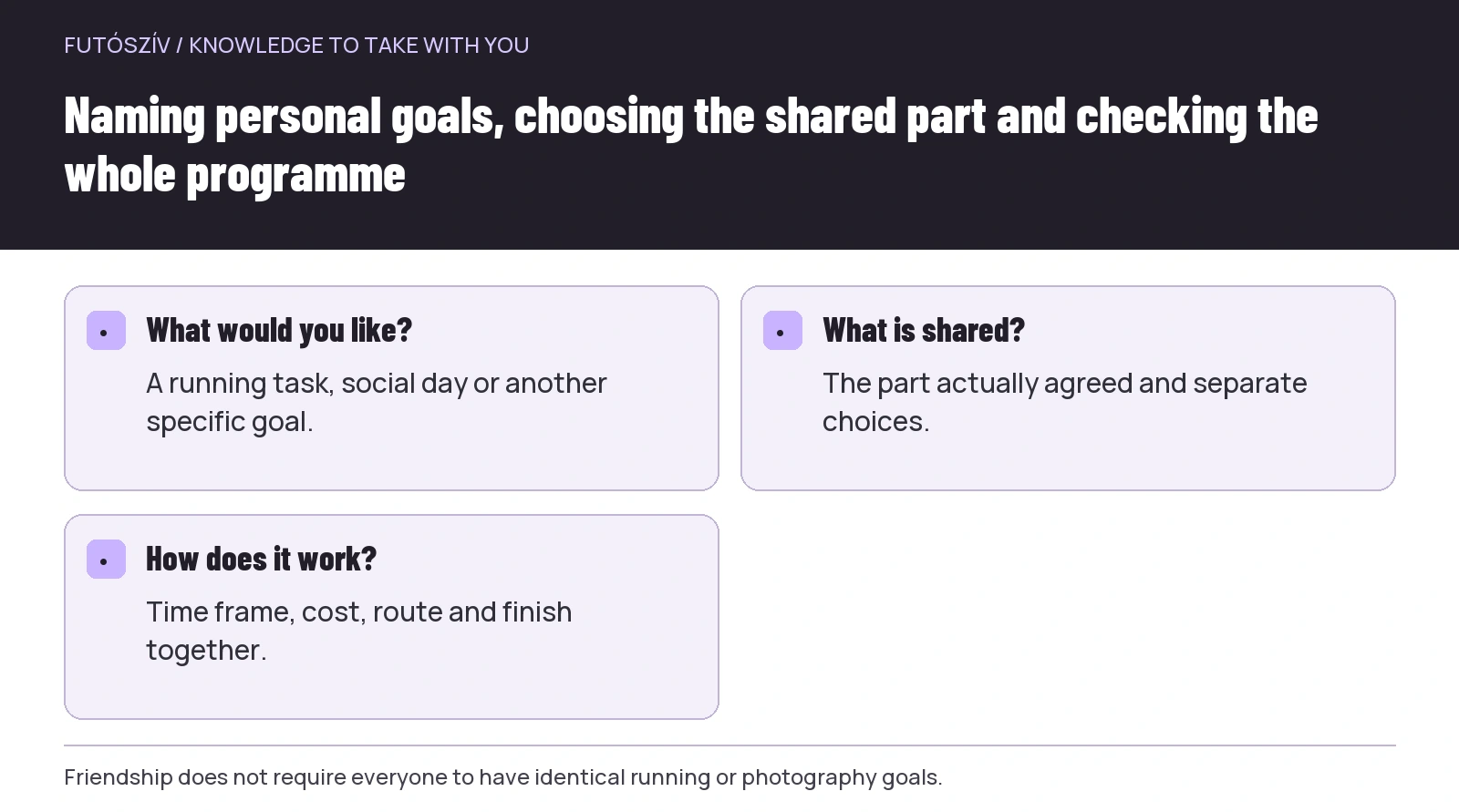
- What would you like?
- A running task, social day or another specific goal.
- What is shared?
- The part actually agreed and separate choices.
- How does it work?
- Time frame, cost, route and finish together.
An edited example of three different expectations
Three friends plan a day in the forest together. The first wants a new, longer route; the second wants to photograph some familiar points; the third needs to get home earlier. The first plan contains one long loop and a shared car. This shows the differing goals do not yet fit within the same structure.
In the revised agreement, they seek a shared part whose conditions all three understand. An extension becomes a separate option organised to work independently, or moves to another occasion. They include photography time and plan the journey home from the precise finishing point.
The example does not prescribe a route model. The friends may ultimately choose a completely different programme. The result is visible expectations: discovering three separate days behind a shared yes should not wait until they are out on the trail.
Agree a brief procedure for changes beforehand
Weather, access or personal circumstances may change. Check the MTSZ warnings concerning hiking trails and the responsible land manager’s notices for the chosen route. If a change is needed, clarify the new programme’s conditions too.
Keep one current summary in the group. Which route, meeting and finish are valid? Participants should not each have to assemble a new day from corrections scattered among old messages. Anyone unable to commit to the changed programme should be able to say so clearly.
A change should not automatically mean drawing the same kilometres onto another unknown area. The alternative should also be an appropriately understood programme. Not going or choosing another time can equally be part of orderly organisation.
On site, the distance already covered should not determine continuing
Travel to the venue and the first section already covered can make sticking to the longer continuation tempting. Yet assess the next task from today’s situation and conditions on the remaining route. An earlier commitment must not override new information or personal decisions.
If someone changes their programme, clarify finishing and communication. A shared day does not mean changing another person’s choice through group persuasion. Where needed, appropriate help or professional advice has a separate role.
Splitting up should happen only with a genuinely working plan. Every participant should understand their own route, suitable finish and communication. An unknown shortcut or a map screenshot sent after someone has left is not automatically an independently usable programme.
Agree social content creation too
If photos or video have an important role in the trip, say this beforehand. Many repeated setups may alter the time frame and character of the run. Someone arriving for a shared run has not necessarily committed to a longer content-creation session.
Appearing in images and public sharing should remain separate decisions. A participant not wishing to appear should still receive information needed for finishing and the next meeting. A shared experience does not require identical publicity from everyone.
When recording, consider the location’s rules and other visitors too. Seeking a good viewpoint does not permit arbitrary departures from the route. The photography goal belongs within the whole programme’s conditions just as the running part does.
After the day, review the agreement
Examine whether everyone understood the shared part alike, the time frame was appropriate and getting home remained orderly. Alongside total distance, these experiences reveal how the programme with friends worked. There is no need to reduce the day to a single successful or unsuccessful label.
If a difference caused tension, name it specifically. Was the shared car’s departure unclear, did photography take longer or did the short version fail to lead to an understood finish? This creates an achievable improvement for next time rather than general judgements of participants.
A running trip can remain a shared experience when the boundaries of joint commitments and individual choices are understandable. Goals, travel, route and finish belong on one sheet. The group can then experience the programme actually shared instead of negotiating unstated expectations afterwards.
How Futószív articles are prepared: our editorial guidelines.