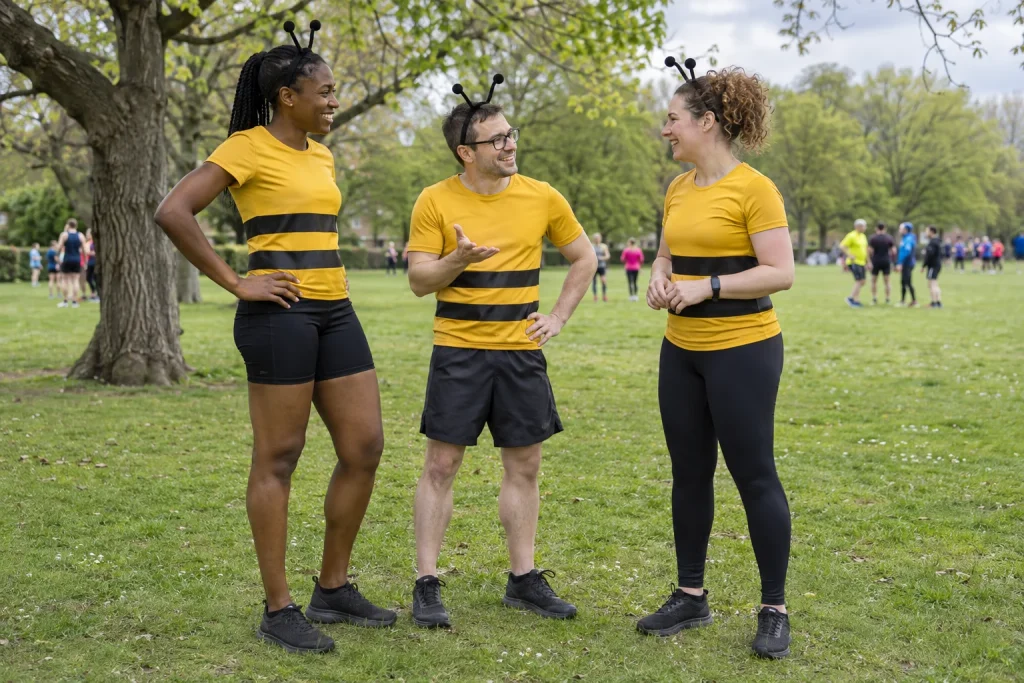
Starting in shared costumes can be a striking social experience, but a shared appearance does not automatically mean a shared pace. Friends may enjoy the same theme while preferring different distances, ways of moving or goals. If you do not discuss this beforehand, the opening minutes can easily reveal that one person expected to stay together throughout while another wanted to run their own race.
Split organisation into two separate agreements: what the appearance should be and how participation should work. The two can connect, but neither overrides the other. These suggestions are intended for an outing among adult friends. They are neither general pace prescriptions nor substitutes for the event’s own start, course or team rules.
Make clear in the invitation what is shared
State from the invitation whether you plan shared travel, a shared start, moving together throughout or meeting after the finish. “Let us go together in costume” can mean any of these, so is not clear enough. Anyone preparing for a time goal can then explain early that they would undertake something different on the course.
Allow choice in costumes too. A shared colour, small motif or theme involving different characters can accommodate several outfits if the event allows. Not everyone needs to carry the same large prop. A shared appearance remains voluntary when participants can choose a permitted version that works for them.
Before applying, state the programme’s primary aim. A shared, conversational fun run and a race towards a personal result require different agreements. You need not regard either as more valuable, but cannot swap them unnoticed along the way. A group photograph does not prove everyone agreed to the same thing.
You can choose between three workable structures
The first is staying together throughout. Everyone genuinely accepts the shared arrangement, and the chosen race’s conditions fit it too. It is not enough to say you will adapt to the slower person: discuss how different needs will be signalled and what stopping or changing pace means on the course.
The second is a shared beginning followed by separate running agreed in advance, if the start system permits. Here, meeting after the finish is a plan of its own. Nobody expects another person to turn back, wait at a narrow point or start a confusing search. Separation is an element of the shared programme rather than improvisation.
The third structure involves several smaller participation groups or different races. Costume theme and meeting can be shared, while nobody has to match a single pace on the course. This also requires checking distances, start times and accompanying-adult or group rules. Different races should not become hidden rankings within the group.
| Structure | What stays shared? | What needs arranging beforehand? |
|---|---|---|
| Together throughout | The agreed social part across the whole course | Way of moving, signals and event conditions |
| Shared beginning, separate continuation | The start that is actually permitted | How to separate and meet after the finish |
| Several groups or races | Theme, travel or afterwards | Individual entry, timetable and independent finishing |
The table is our own breakdown for planning an outing. It does not name official race categories. Choose the appropriate structure according to the group’s actual expectations and event rules, rather than the fastest participant’s automatic decision.
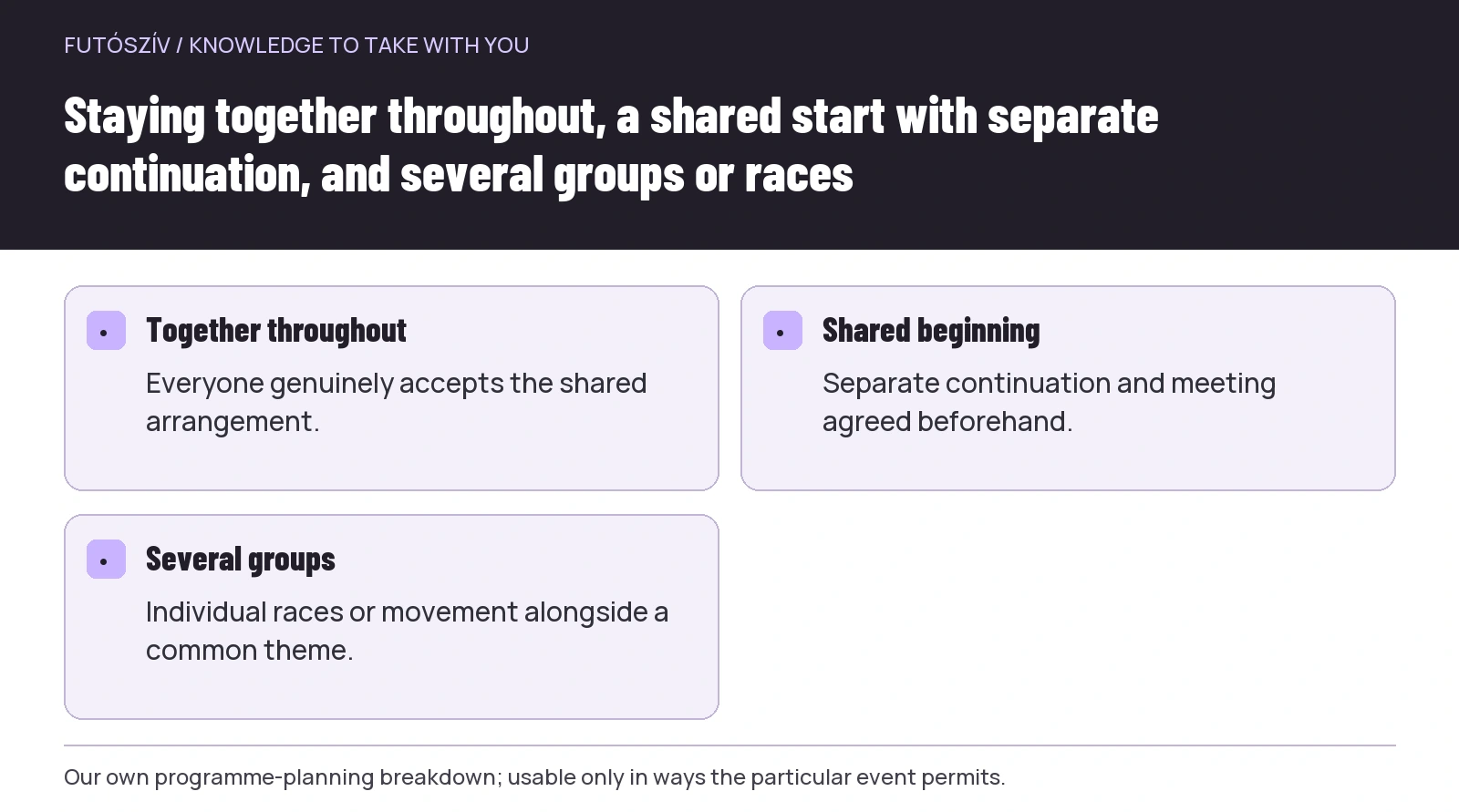 Enlarge diagram
Text version of the diagram
- Together throughout
- Everyone genuinely accepts the shared arrangement.
- Shared beginning
- Separate continuation and meeting agreed beforehand.
- Several groups
- Individual races or movement alongside a common theme.
Consider the shared pace together with the costume
A familiar easy run from home and a mass costumed event are different situations. Clothing, lights, narrower sections, photo points and start conditions may alter how the day unfolds. Do not treat usual watch data as a social contract valid for everyone. Personal goals and the shared programme need separate discussion.
The official RunTogether participant questions consider pace, distance and experience separately when choosing a group. This is an organised English system, rather than rules for a Hungarian costumed event. Separating those three factors is useful in group planning: the same distance goal does not imply the same preferences for moving.
If someone would undertake only a shorter programme in costume, they should not have to enter a longer distance for the group. There may be a shared picture before starts or after finishes, at an actually accessible place and time. A shared appearance does not require everyone to wear it for the same number of kilometres. Choose races according to individual preference and organiser conditions.
Social stops may affect the time limit too
Check whether there is a time limit and how it is calculated. A costume theme or fun-run label does not establish unlimited opportunities to stop and take photographs. The organiser determines course operation. Include stops and understanding the start system alongside the chosen way of moving in your shared plan.
The official 2026 PENNY Santa Run five-kilometre page , for example, supplies timing information and a separate time limit. This is one particular race’s condition, rather than that of every Santa or costumed event. It reminds you to read completion arrangements despite themed clothing. Do not substitute a cutoff from an old edition or another race.
If the planned group outing would work only by ignoring the cutoff, choose another race or occasion. Do not ask others on site to hurry for the sake of a shared photograph after all. Instead of arguing about pace, restore clarity about the aim: what did you agree to, and does the event actually allow it?
Do not let the shared spectacle occupy the route
A group costume can be particularly wide when everyone wants to appear side by side. But the course is shared space where others move too. A group maintaining a formation across its full width can obstruct the start, overtaking or narrow points. Agree beforehand that the row imagined in the picture will break up as needed to give others room.
The official runDisney answer on costumed participation also makes costumes conditional on other runners’ uninterrupted participation at its own events. This is an overseas organiser’s example; follow the specific conditions of your event. The practical principle is simple: your shared idea cannot take control of course use.
Do not connect yourselves with improvised string, a shared rigid prop or a structure relying on one another. A common motif remains recognisable when participants can move separately and in a different order if needed. Clarify permitted objects with the event, and include every individual outfit in your own functional rehearsal.
Choose a separate moment for the photograph
Do not try to rearrange into a side-by-side formation on the running course for the group picture. An event-permitted, usable point before or afterwards may work better. Include your own meeting and entry checks in pre-start photo timing too. Someone entering another race should not be made late by it.
If you want to stop along the way, do so only in a permitted place without obstructing others. Distinguish intended photo timing from what is actually possible on site. The chosen point may be crowded or inaccessible. In that case, skipping the picture is an organised decision too; you do not need to create a new obstruction at another narrow section.
Make the photo agreement among companions clear as well. Someone may happily appear in a family keepsake but not want a public post. Taking and using a picture need separate consideration, alongside applicable conditions. Dressing in costume and entering together is not general permission for every later appearance.
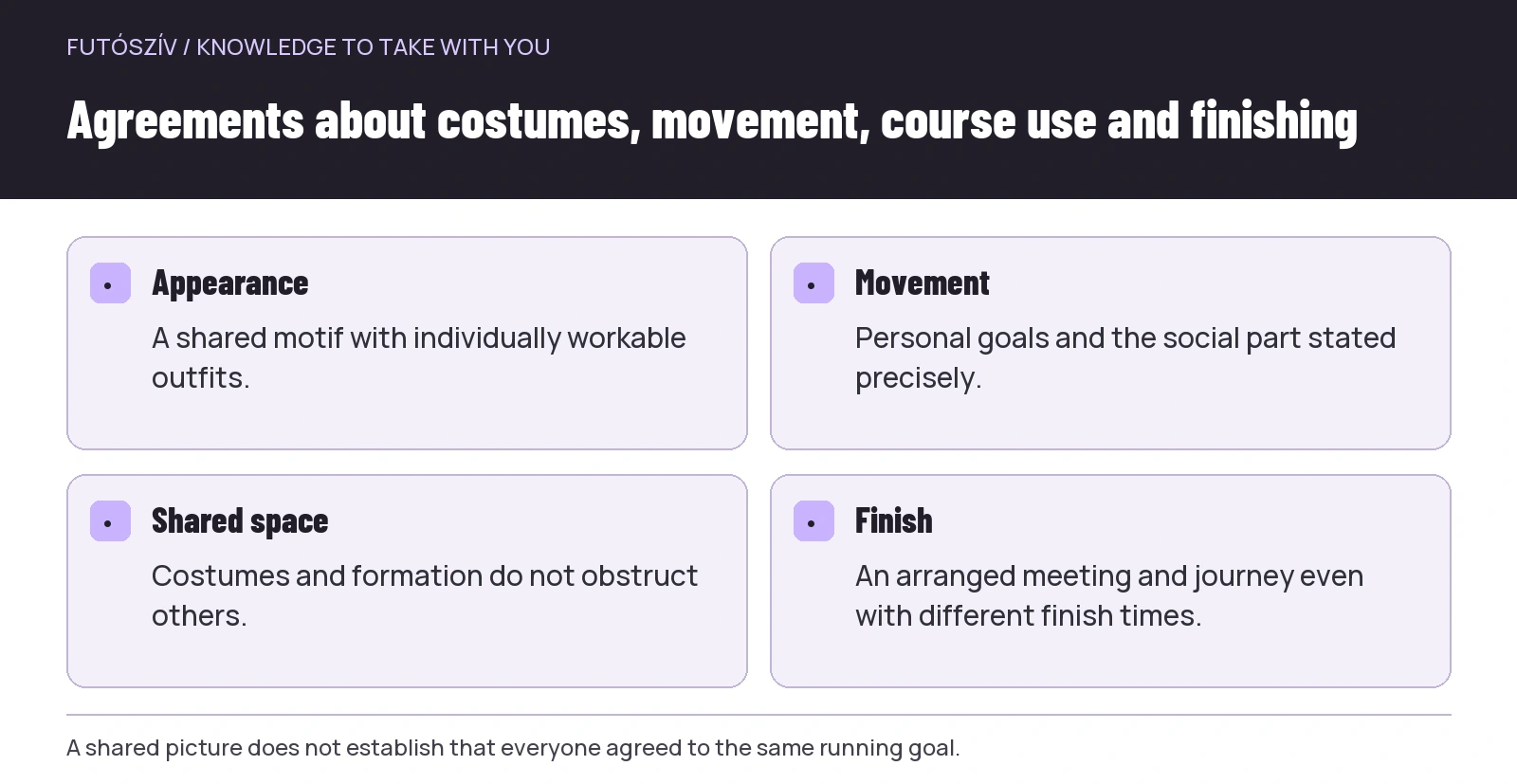 Enlarge diagram
Text version of the diagram
- Appearance
- A shared motif with individually workable outfits.
- Movement
- Personal goals and the social part stated precisely.
- Shared space
- Costumes and formation do not obstruct others.
- Finish
- An arranged meeting and journey even with different finish times.
Have a simple, known procedure for separating
Plans may change even when you intended to stay together throughout. Do not wait until the course to discover how someone signals a wish for a different arrangement. Make the signal brief and clear, with practical consequences agreed beforehand. Follow the organiser’s route and instructions then too; separation cannot mean an independent shortcut or setting off in an unknown direction.
Anyone reaching the finish earlier should know where to wait and when they may leave. With a shared car or fixed transport, meeting time should not be determined solely by the fastest finisher. The full time taken by separate finishes also belongs to the group day. Distribute personal belongings and keys accordingly.
With a genuine need for help, on-site organiser procedures and appropriate assistance come first. Do not turn a signal into a performance argument or assume a missing message must be merely a technical fault. A general friends’ plan does not replace decisions in every specific situation. What matters is that companions know who follows up the necessary coordination and how.
An imagined example with five friends and two ways of running
The following situation is fictional. Five friends want to attend a themed event in matching-colour costumes. Two want individual results in their own race, while three would move together and focus on the atmosphere. They check event conditions beforehand and choose only races genuinely compatible with their own plans.
The shared part is a pre-start picture at an agreed accessible location and a post-finish meeting. The two participants do not promise to stay with the others throughout. Members of the three-person social group make their own agreement about movement and signals. The shared appearance remains without either group rewriting the other’s programme along the way.
Now change the situation: one participant can start comfortably only in a simpler costume. The group keeps the colour or small motif as the shared element instead of demanding identical props. This is not a universal recipe; it shows that several structures can create a shared experience. The key is genuine agreement and following event conditions.
Restate five points before the start
Which race and start system are you using? Who will genuinely move together? How does someone signal a change? Where and how will you meet afterwards? What happens to shared travel if you finish at different times? Answers need not be long; they just need to mean the same thing to everyone concerned.
Do not hold this discussion in the middle of the starting gate while others are trying to move. Leave room for necessary administration and personal preparation too. Check shared clothing and fastening, but do not change another runner’s equipment without being asked. Help is an offer, and knowing their own equipment remains each participant’s responsibility.
If someone ultimately chooses another activity, arrange the group consequences: travel, bags and meeting. Whether this spoils the group photograph should not be the main question. Group identity is not established by completing the full distance in matching costumes. An agreed, keepable arrangement is worth more than unity demanded afterwards.
Do not measure the shared day by differences in speed
After the outing, review whether the chosen structure worked. Did everyone know what to expect? Was there a point where costumes or group movement disturbed others? Were meeting and getting home arranged? These can lead to concrete improvements next time rather than judgements on one another’s performance.
Someone who ran for a personal goal can share the result if they wish, while others tell their own experiences. You need not put one story above another. A costumed outing can be both sport and shared play if participants understand beforehand which part they have agreed to. The next occasion need not repeat the same distance or arrangement either.
Planning a shared costumed run at different paces works when appearance and movement receive separate decisions. Companions retain room for their own clothing, goals and clear meeting arrangements. The common motif then becomes an enjoyable framework connecting participants without imposing a running programme any of them never agreed to.
How Futószív articles are prepared: our editorial guidelines.