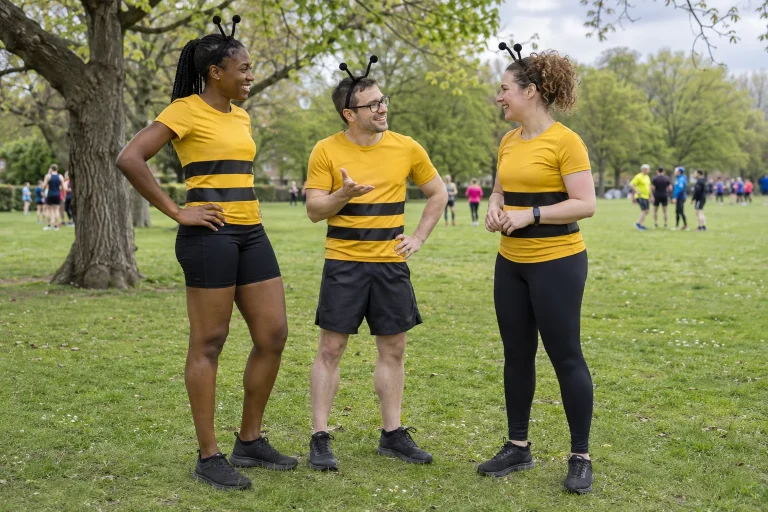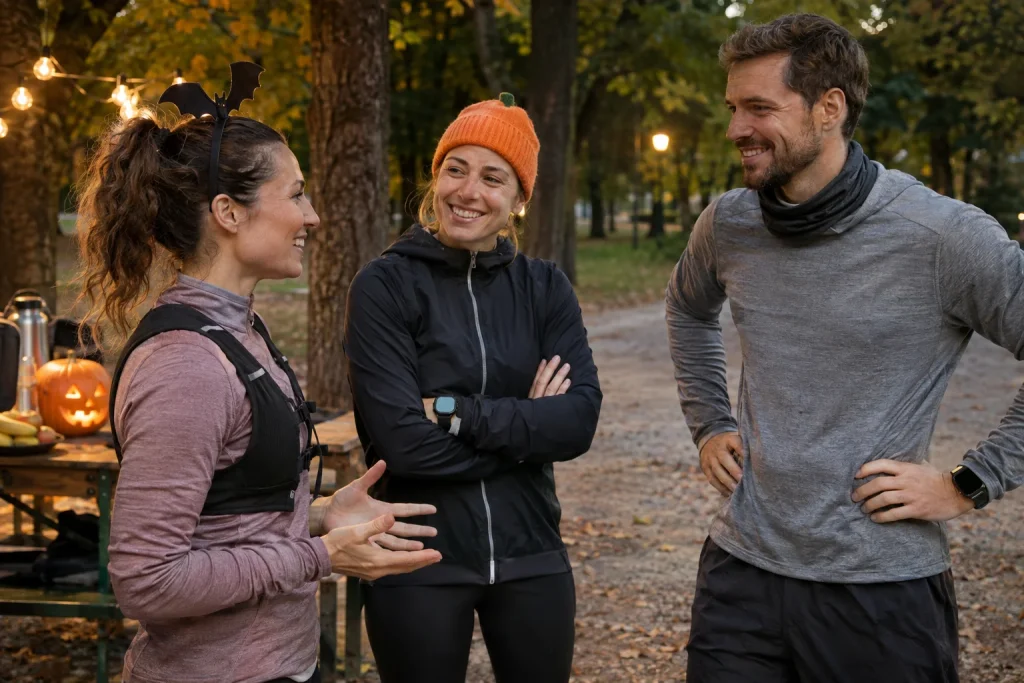
A Halloween run can be a shared costumed outing, a spectacular evening event or an experience deliberately built around frightening elements. Yet members of a group are not necessarily agreeing to the same thing. One person may go for the outfits and lights, another may be curious about a tunnel course, and someone else may not want unexpected scares at all. It is worth understanding these differences before entering.
A good shared plan does not require everyone to enjoy the same atmosphere. The task is to reconcile the actual event with participants’ choices. The following method is our own suggestion for organising a group outing, rather than a fear-management or healthcare programme. Friends’ enthusiasm or a general event description cannot decide an individual health question.
Ask about the actual content behind the “Halloween” title
An event’s name does not describe the experience in detail. Check for actors, sound effects, lighting effects, darker sections or an underground part. It also matters whether the theme appears only in the event centre or throughout the route. A short edit of an earlier video does not establish the character of this year’s entire course.
The official BBU 2026 Halloween Run page , for example, presented its own event with above-ground and cellar-system sections and themed effects. The event of 7 November 2026 had already taken place by 18 November 2026, so it is used here as a dated example. It does not establish a new Halloween date or mean the next edition will offer the same experience.
Translate promotional language about the programme into verifiable questions. What does a surprise mean? In which race and which part does it occur? Is there an officially available participation option in a different environment? Do not let a friend’s reassuring memory be the only information, because their earlier race and your chosen event may differ.
Do not turn the question into a courage competition within the group
Ask others what attracts them to the outing and what they do not want. You do not need a detailed personal explanation if someone dislikes scares or enclosed spaces. Stating a personal boundary may be enough information for the shared choice. The group’s job is not to disprove or test it.
“We will find out there” is a genuine option only if the participant really accepts that, and leaving or choosing another activity on site is possible under the event rules. If someone would attend only within a clear, known framework, do not turn it into a surprise gift. A paid entry does not prove they understood and accepted every circumstance.
The UK Coaching inclusion guide emphasises planning from individual needs and building a relationship with participants. This is a British professional coaching source; its legal and qualification sections are not Hungarian rules for social groups. The useful perspective for a shared outing is listening to participants’ differences rather than assuming uniform enthusiasm.
 Enlarge diagram
Text version of the diagram
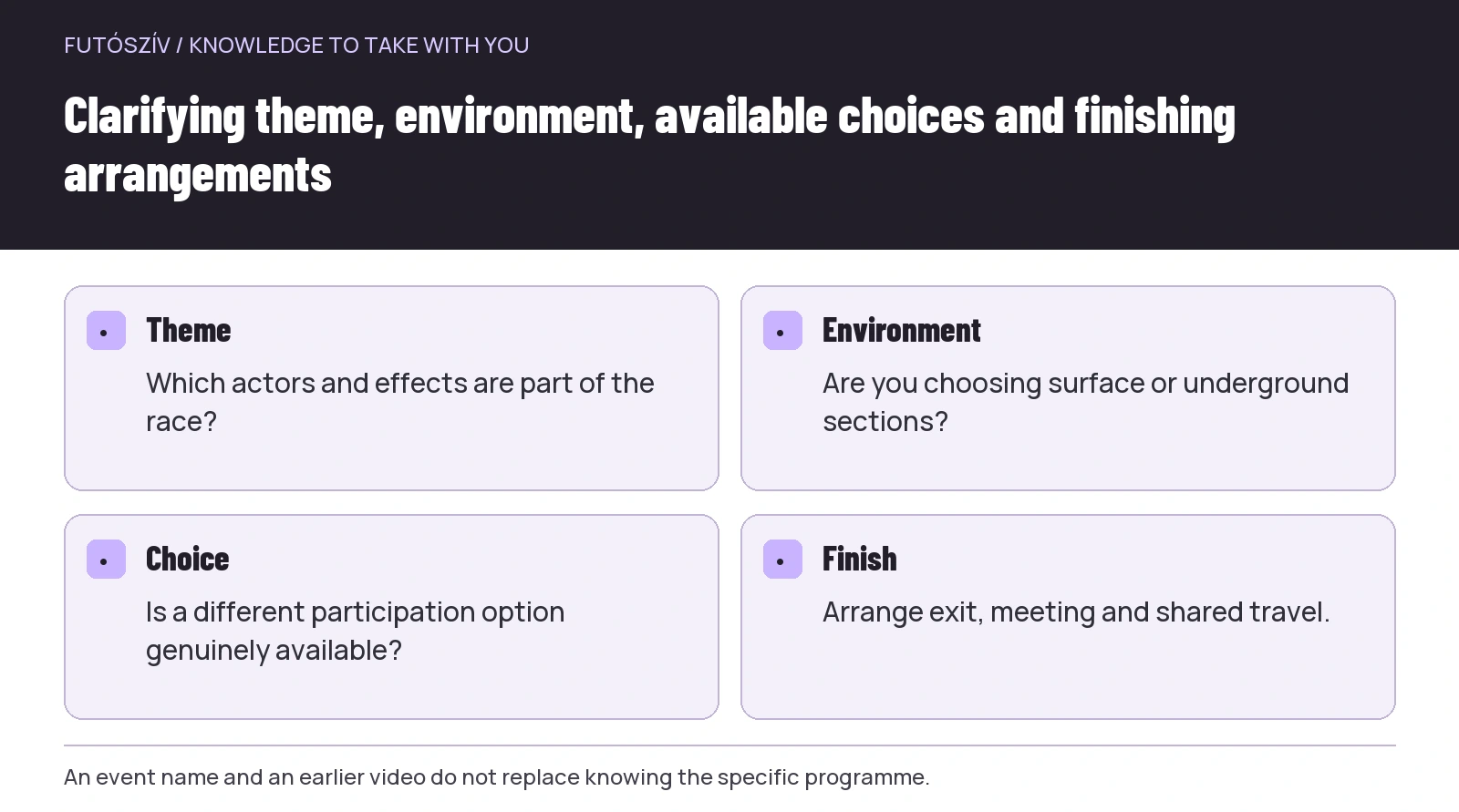
- Theme
- Which actors and effects are part of the race?
- Environment
- Are you choosing surface or underground sections?
- Choice
- Is a different participation option genuinely available?
- Finish
- Arrange exit, meeting and shared travel.
Prepare a short description of the experience for the decision
You can add your own factual summary beside the event link shared with the group. Give distance and course, theme, timetable and any unresolved detail separate lines. Do not turn a question mark automatically into a yes to make deciding together simpler. The organiser can answer the uncertain part.
| Topic | What is worth finding out? | What should you not assume? |
|---|---|---|
| Theme | The nature of costumes, installations, actors and effects | Every Halloween event is the same |
| Environment | Surface sections and any underground sections | The entire race matches the part shown in the video |
| Distance and time | Your own race, start and organiser’s time limit | A shorter distance automatically means a different experience |
| Participation choice | Which race or spectator programme is actually available | The course can be shortened however you like |
| Unclear condition | A direct organiser’s answer is needed | Silence means permission |
| Finish | Exit, meeting and getting home | The finish line brings everyone directly together |
The description should not be a lengthy advertisement or a copy of the organiser’s text. A few facts needed for the group decision, with a precise source link and checking date, are enough. If one specific condition is decisive for a participant, clarify it separately rather than burying it at the end among impressive details.
Ask the organiser precise questions
Name the event year and chosen race in your question. For example, you may want to know whether the described themed elements are inseparable parts of the route for every participant, or whether an officially available different programme exists. When asking about lighting effects or access, request specific information about arrangements rather than a general judgement about personal suitability.
The organiser may not be able or willing to reveal every surprise beforehand. Even so, information about the event’s essential environment and participation conditions may be necessary. If the information received is insufficient for a decision, you can accept that outcome too: you will not enter this programme now. Social pressure need not bridge uncertainty.
Make sure the affected participant knows the answer too. It is not enough for the friend corresponding with the organiser to say “it will be fine”. Share the relevant actual answer and its limitations. When the event later updates information, check whether the detail on which you based the decision has changed. An answer for a previous year does not automatically apply next time.
A shared day can involve different participation
A group outing does not necessarily mean one single race. You might travel together, choose separate races and agree to meet afterwards. Someone could also join as a spectator in a permitted area. These options work only when access, waiting and the timetable are actually arranged, rather than based on an uncertain on-site promise.
BBU’s official report of 11 November 2026 also describes different participation formats and changes to the course. This is a past example from an organiser showing how a themed event can bring several activities together. It does not prove that any format is free of scares, suitable for everyone or available unchanged in the next edition.
Someone choosing another form of participation should not automatically become a bag minder or all-day photographer. Ask separately what they want to undertake. Their programme should count fully within the shared day too. If group timing and travel would work only with one race compulsory for everyone, it is worth finding another shared event.
Do not let costumes become surprise role-play
When planning group costumes, say what you are agreeing to as well. A shared colour, story or playful name can provide a good framework, but does not imply permission to frighten one another unexpectedly. Someone who chose only the costumed atmosphere should not later be placed in a role you never discussed. The same applies to photographs and videos.
Other participants are not automatic characters in your friends’ game either. Do not block routes, touch them with costume props or imitate organisational duties. The organiser plans interaction between official performers and runners; your own idea does not authorise extending it. Express creativity within the shared agreement and on-site arrangements.
Check costume function too: it should not cover vision, the race number or actual lighting, or take up unreasonable space. Choosing simpler clothing should not make someone less part of the group. More important than identical appearances is everyone being able to complete their own chosen activity in functioning equipment.
 Enlarge diagram
Text version of the diagram
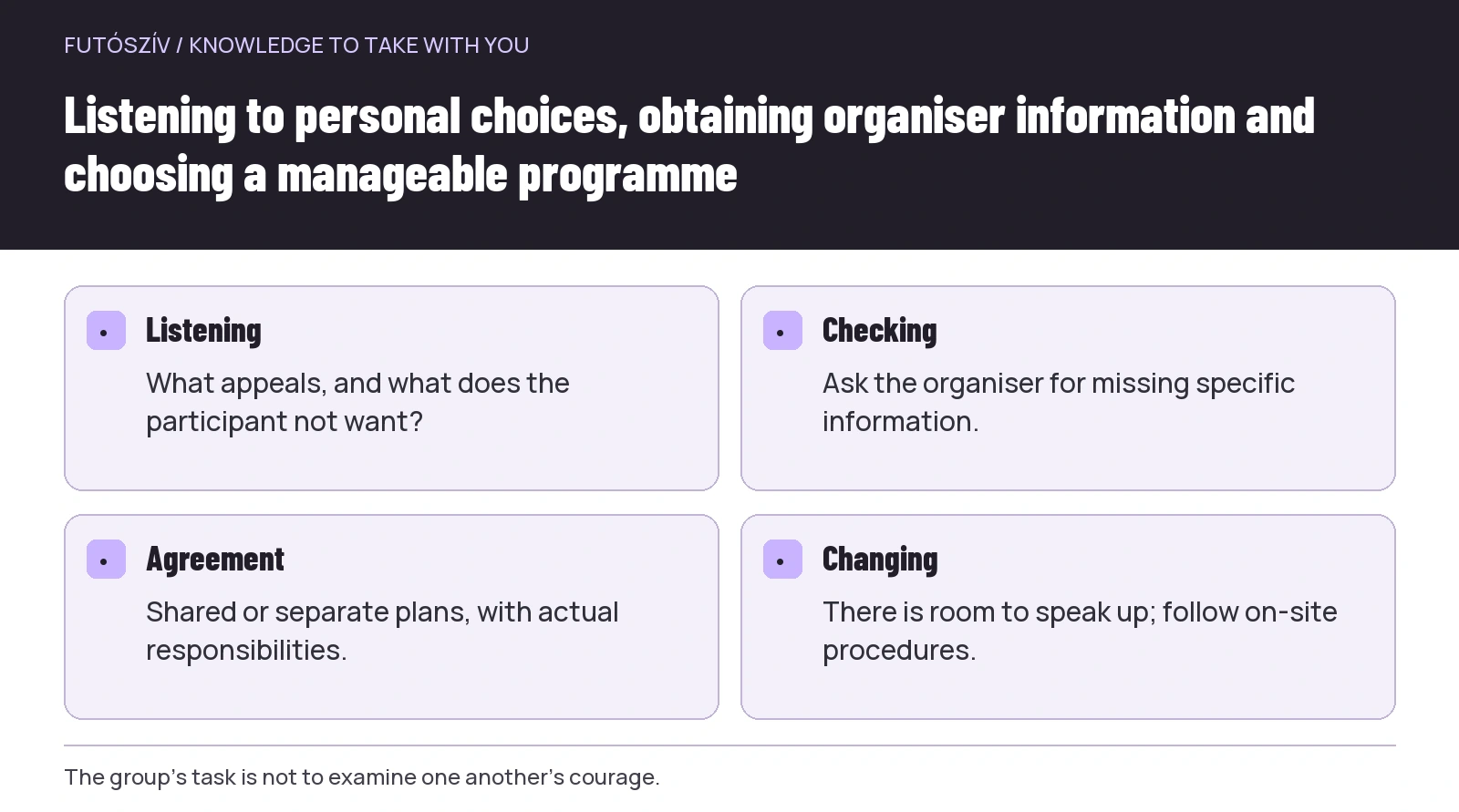
- Listening
- What appeals, and what does the participant not want?
- Checking
- Ask the organiser for missing specific information.
- Agreement
- Shared or separate plans, with actual responsibilities.
- Changing
- There is room to speak up; follow on-site procedures.
Agree how to signal a change
Before the start, make clear how someone can say they want to modify the plan. This can be a simple sentence that companions do not debate at length in the middle of the course. Actual stopping, exiting or seeking help follows the particular event’s procedures. Do not choose your own shortcut, an unknown exit or a prohibited route merely because the shared plan has changed.
Do not make changes conditional on a test of proof. A participant need not present detailed justification to the group if they want another activity. Necessary practical coordination naturally remains: whom they will be with, where you will meet and what happens to shared travel. Personal choice and organisational tasks affecting others can be addressed together.
If genuine illness or an urgent situation occurs, appropriate organiser or emergency assistance is needed, rather than a motivational argument among friends. This article gives neither a method for psychological symptoms nor a medical decision threshold. The group plan should make room for speaking up and prevent a participant being left alone in changed circumstances.
An imagined decision involving three friends
Anna would go for the costumes, Bence wants to try the themed course, while Dóra does not want unexpected scares. The three names and situation are fictional. The good first step is not Bence explaining why Dóra certainly has nothing to fear. They first check which parts of the event can actually be chosen.
If the organiser says there is no separate programme she finds manageable, Dóra suggests a shared costumed walk the next day, while Bence decides individually about running. Another agreement might have Anna and Dóra joining the permitted central programme, if both want to, and meeting Bence separately later. Neither solution is automatic; travel and timing also need adding.
The example is not intended to assign these roles to every group. It shows that different choices can produce several organised programmes. A shared experience does not require crossing the same boundary, and friendship need not be proved at one themed run.
Children’s participation needs a separate conversation
If a child wants to come, the adults’ decision between themselves is insufficient. Explain the programme clearly, who will be with them and which environment they may encounter in the chosen race. An age limit is an entry condition, rather than a personal recommendation that the child will enjoy the theme. A short distance does not establish that the atmosphere suits them either.
A sibling’s or adult’s enthusiasm should not override the child’s wishes. If they would prefer just to look around or choose another activity now, discuss this genuinely within the family’s possibilities. An adult should take named responsibility for necessary supervision. An older sibling’s presence or organiser staff is not an automatic childcare arrangement.
Do not make a surprise entry for a part whose character the child does not know. A shared costume or gift can be enjoyable, but understandable information about the actual programme is still needed. If the adult lacks enough information about the venue, they need to ask the organiser or make another choice.
Leave room for every viewpoint in the story afterwards
After the run, do not ask only who was brave enough or most frightened. You can discuss which visual element was interesting, how meeting up worked and what you would choose differently. Someone who chose another participation format can have their own story about the day too. The majority’s mood need not become an opinion applied to everyone.
Before sharing pictures, check separately whether every person shown wants that use and which audience you intend. A video of someone being startled that seems funny may be uncomfortable for them. Alongside good practice among friends, applicable image-rights and data-protection conditions need addressing; participation together is not general permission for every later publication.
Planning a Halloween run for a group with different preferences is primarily about accurate information and considerate discussion. Know the actual effects, available programme choices and how to make changes. The theme can then become a shared outing, or experiences alongside one another, that everyone genuinely chose, rather than a test of companions’ boundaries.
How Futószív articles are prepared: our editorial guidelines.