
A community year-end run need not be a race or large event. It can be a short, clearly described occasion to meet, move in the agreed way and thank people for shared parts of the year. Good organisation begins by stating the purpose and not trying to squeeze every running idea, awards ceremony and follow-on activity into one morning.
The following method helps think through a year-end outing for a smaller adult community. It is our own organisational suggestion, rather than an official race script or guide to permits for events in public spaces. If scale, location or the nature of the programme calls for other arrangements, address these separately with the relevant venue and appropriate parties. This article focuses on community operation.
Define in one sentence why you are meeting
The initial purpose might be to bring together people who run in different groups during the year or thank those helping shared outings. The appropriate programme size follows from this. If connection is the aim, it does not require a long route or an identical pace for everyone. Movement and meeting can also be planned as separate parts.
Do not hide a performance test behind a social invitation. Someone expecting an easily accessible year-end gathering should not encounter an unexpected pace task or excessively long loop on site. If you want a competitive element too, make its rules and optional nature clear beforehand. Community celebration does not require everyone to accept the same sporting goal.
The England Athletics material on festive running programmes suggests involving people who are not currently running alongside social connection. This is an overseas community idea source rather than a Hungarian event calendar. Its useful thought for your gathering is that the value of meeting is not expressed only in distance run.
Helpers’ time matters when choosing the date too
Participants’ calendars can differ over the festive period, and no day is certain to suit everyone. Offer a few genuinely organisable options and check whether people will undertake necessary tasks when deciding. Even the day receiving most votes does not automatically work if nobody can lead or close the programme.
Published timing should describe the whole participation. Meeting, movement, shared closing and optional continuation can have separate slots. This also lets someone plan if they have time only for the short part. Instead of “we will stay afterwards”, make clear when the organised shared part ends and what people can join separately.
The official parkrun information on special days treats additional occasions as optional local commitments within its own international system too. This does not verify a Hungarian location or festive running date. As an example, it shows that alongside tradition and the calendar day, an actual decision by the local team is needed.
The venue should accommodate the whole community programme
Find a starting point and route usable with the planned numbers, timing and group arrangement. A familiar running location may have different access because of an event, maintenance or another use on that occasion. The shared meeting point must not block an entrance, pedestrian connection or others’ exercise.
Think through a finishing point alongside the movement part. Conversation, brief thanks or a group photograph need a permitted, manageable space too. The same narrow point used for an everyday group run’s start may not suit. Do not try to resolve an important venue condition afterwards by appealing to enthusiasm.
Consider access according to participants’ actual needs. The connection between stop or car park, meeting point and finish matters together. An easily reached start should not be paired with an unexpectedly difficult departure route. Give enough advance information about the optional follow-on location and cost to let people decline it.
 Enlarge diagram
Text version of the diagram
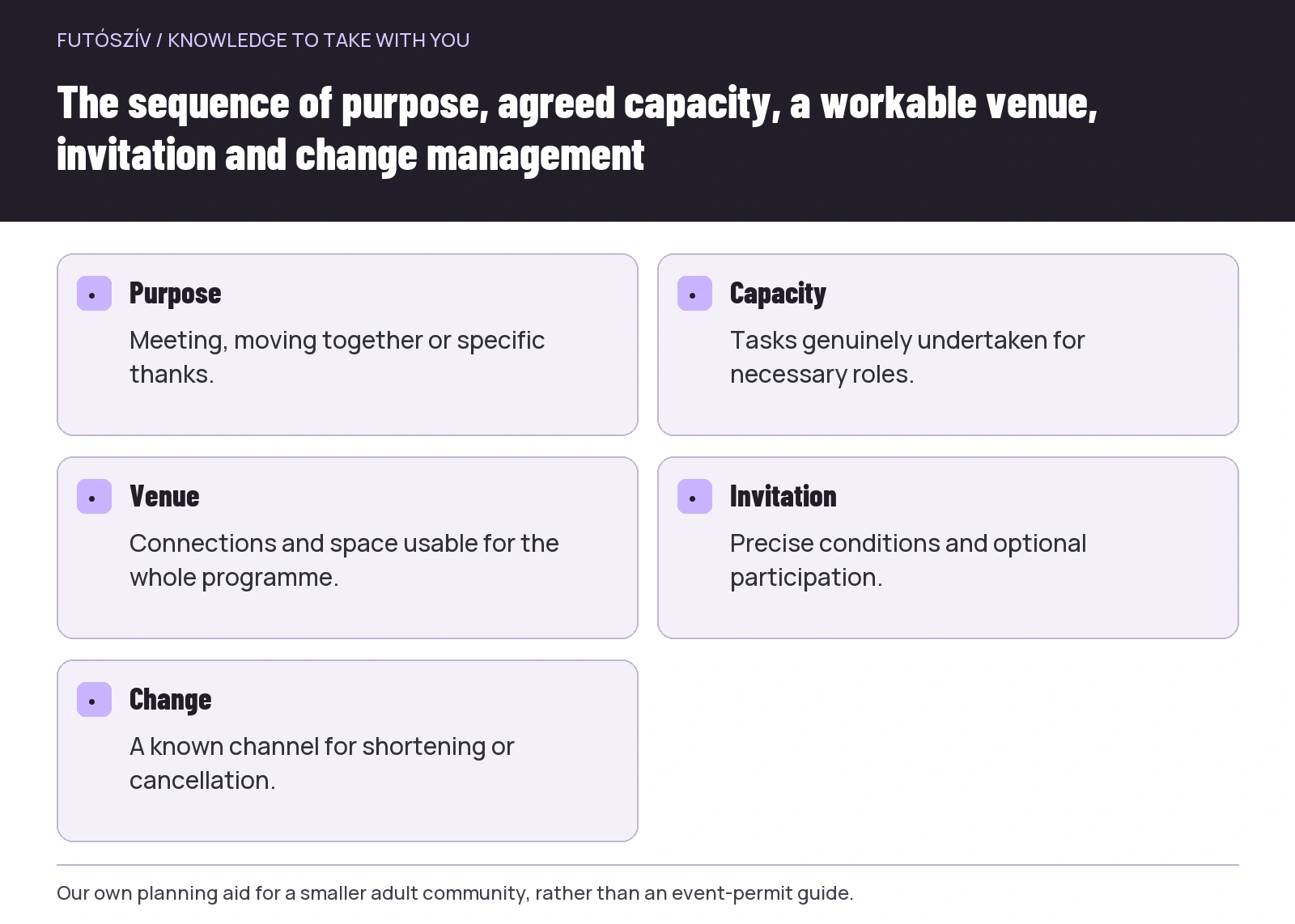
- Purpose
- Meeting, moving together or specific thanks.
- Capacity
- Tasks genuinely undertaken for necessary roles.
- Venue
- Connections and space usable for the whole programme.
- Invitation
- Precise conditions and optional participation.
- Change
- A known channel for shortening or cancellation.
Include different participation formats in the plan itself
There may be a short shared part, a separate extension and participation only in the closing, if each can genuinely be arranged. These should not be side solutions invented on site for those declining the original programme. Describe them as clearly in the invitation as the main running activity.
Several routes also mean more organisational tasks. Every independent group needs its own operation, necessary leadership and finish. Nobody should set off on an unknown extension simply because others want to continue. If the team has capacity for one short shared programme, that may be a better year-end outing than three half-arranged versions.
A non-running participant should not automatically mind bags or take pictures. You can separately ask them to undertake a task they enjoy, but meeting together can matter in itself. Arrange departure for someone staying only briefly. The gathering should not become an all-day test of belonging to the community.
Create a few clear responsibilities
First list what is necessary for the chosen programme to function. A contact person, checking venue and route, participant information, leading group operation and responsibility for closing can be separate tasks. Each need not have a different person, but commitments should be clear and realistic.
| Task | What should it cover? | What should remain clear? |
|---|---|---|
| Contact | Questions and final information | Who answers, and through which channel? |
| Venue check | A usable route and shared point | When were current conditions checked? |
| Group operation | Agreed movement and necessary roles | Who knows the group’s progress and finishing point? |
| Closing | Shared ending and any thanks | When does the organised part end? |
| Managing changes | Communicating a shorter programme or cancellation | Where will affected people find it? |
Do not invisibly load tasks onto the usual helpers. Ask what they can undertake now. A year-end occasion may be precisely when a regular organiser prefers to join as a participant. If there are insufficient volunteers, reduce the programme rather than creating guilt in the community afterwards.
Make the invitation brief and actionable
Include the exact date, place, time frame, nature of the movement and participation conditions. Do not merely use atmospheric wording that it will be relaxed. Explain what staying together means in your group, which shortening or separate participation options exist and whether advance confirmation is needed. Communicate costs factually too.
A themed accessory or gift should genuinely be optional if promised that way. “Not compulsory, but everyone should bring one” is unclear. Participation should not depend on a hidden purchase or shared consumption not everyone wants. Allow separate discussion about personal appearance and photography too.
Give changes one primary communication location. If the invitation spreads through several groups, make updated information accessible in each. Invitees should not have to reconstruct the starting point from different screenshots. A checked, final short notice can prevent many organisational questions.
An example structure for a simple year-end outing
The following is a fictional programme outline, rather than a real event invitation. Locations, times and details can be filled in only after actual venue checks. It does not recommend a training amount; it separates parts of the shared occasion.
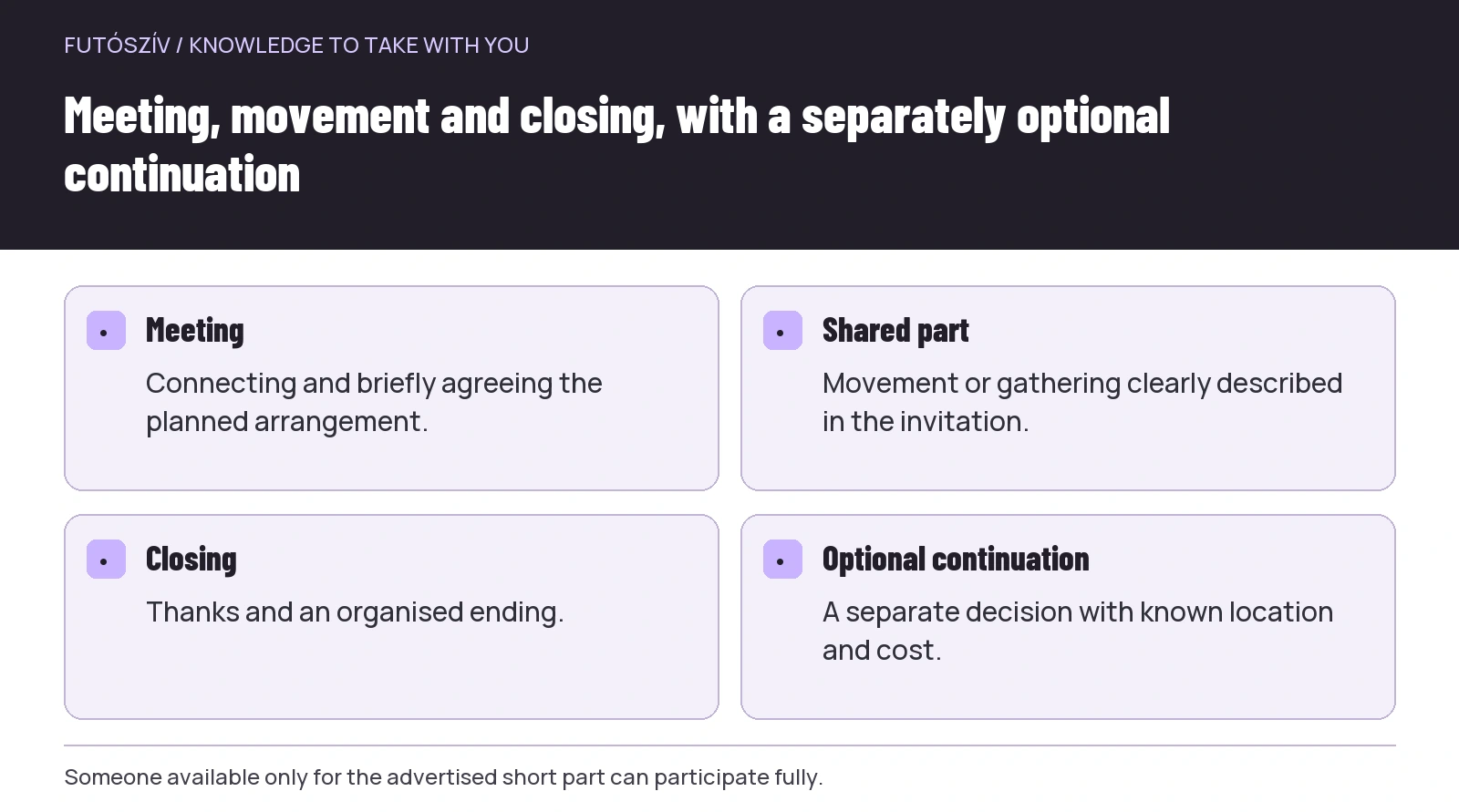
People gather at a familiar point usable for the group. A brief explanation identifies who leads the movement, how long the agreed shared programme lasts and where it ends. Participants already know from the invitation how movement works. People joining only for the gathering receive a separate accessible finishing place and time window.
The closing includes a few specific thanks and an optional shared memory. Conversation or refreshments afterwards are a separate opportunity announced in advance. Someone leaving is following their original agreement rather than participating incompletely. The programme stays small, but every part is clear and agreed.
 Enlarge diagram
Text version of the diagram
- Meeting
- Connecting and briefly agreeing the planned arrangement.
- Shared part
- Movement or gathering clearly described in the invitation.
- Closing
- Thanks and an organised ending.
- Optional continuation
- A separate decision with known location and cost.
The year’s review should not be only about top performers
A community’s year may involve many contributions: regular organisation, welcoming a newcomer, coordinating a route, occasional help or simply reliable presence. You can speak specifically about these without creating an award category for everyone. Thanks need not become a competition.
If giving recognition, clarify the criterion and participation format beforehand. A humorous title should not be based on someone’s uncomfortable situation, body, age or personal difficulty. What seems an innocent joke to organisers can be an unwanted public appearance for the person concerned. Leave room for personal requests and opting out.
You can collect the year’s shared memories in participants’ own words if they wish. One brief question is enough: which occasion do they fondly remember, or what would they preserve about how the community works? Do not automatically turn answers into a performance list. Other forms of connection fit into the shared story alongside results.
Fundraising needs separate organisation
If you want to attach donations, discuss this with the receiving organisation first. What do they request, in what condition, when and where can they receive it, and who will deliver? Even a well-intentioned collection can add unnecessary work if actual needs are not checked. A donation should not be a surprise condition added to participation later.
Transport and handover of items should not become an improvised task during the run. If the finishing point is a receiving location, check actual opening hours and access separately. England Athletics’ festive ideas material draws attention to this advance coordination for community donation outings too. For implementation locally in Hungary, the chosen recipient’s information is the basis.
Keep communication factual: what went to whom and in which form. Support does not give general authority to photograph beneficiaries or publish their personal stories. You can preserve the community memory by describing the collection’s result and your own organisational lesson without unnecessary personal data.
Have a shorter version and a cancellation option
At year-end, adapt the programme to actual conditions. The official HungaroMet warning page lets you check current weather warnings, while the venue’s own announcements may add conditions. A regional warning is not individual route clearance; the specific place and programme also matter to the organisational decision.
State in the invitation when and where modifications will be announced. A shorter version should also rely on a checked location and usable route, rather than an unknown detour invented at departure. If shared movement is cancelled, a differently arranged gathering or full postponement may be possible if genuinely organisable. No modification is compulsory in itself.
Do not turn cancellation into a perseverance test. A community’s value is not shown by keeping the original route in every circumstance. A clear decision communicated in good time respects participants’ travel and time too. Thanks and connection can happen later or in another format.
One lesson afterwards may be enough
Check whether the programme genuinely delivered what the invitation promised. Did the shared time frame work, were optional parts clear and could those taking on tasks realistically be present? One or two specific responses can improve the next occasion. You do not need to turn the year-end event into another lengthy evaluation job.
Do not immediately make a successful element a compulsory tradition. Next year, the community, date and organiser capacity may differ. Memory and useful experience can remain while programme structure changes. This makes the year-end outing a living community occasion: a meeting agreed by those people, rather than a performance to repeat at all costs.
How Futószív articles are prepared: our editorial guidelines.