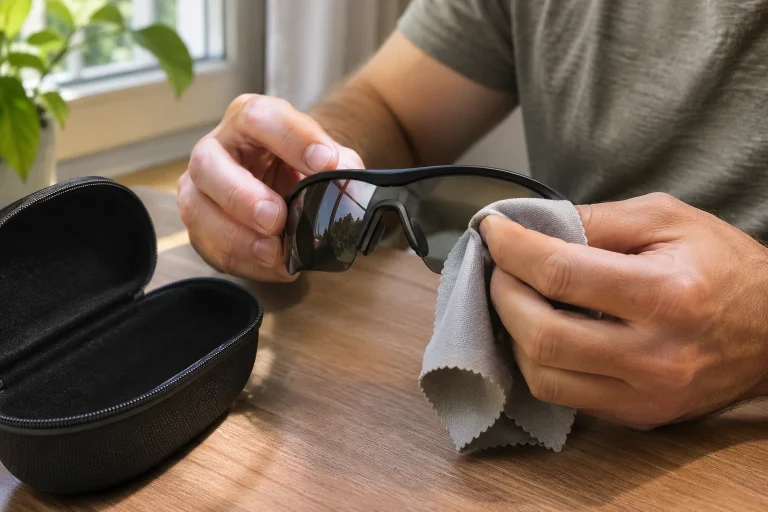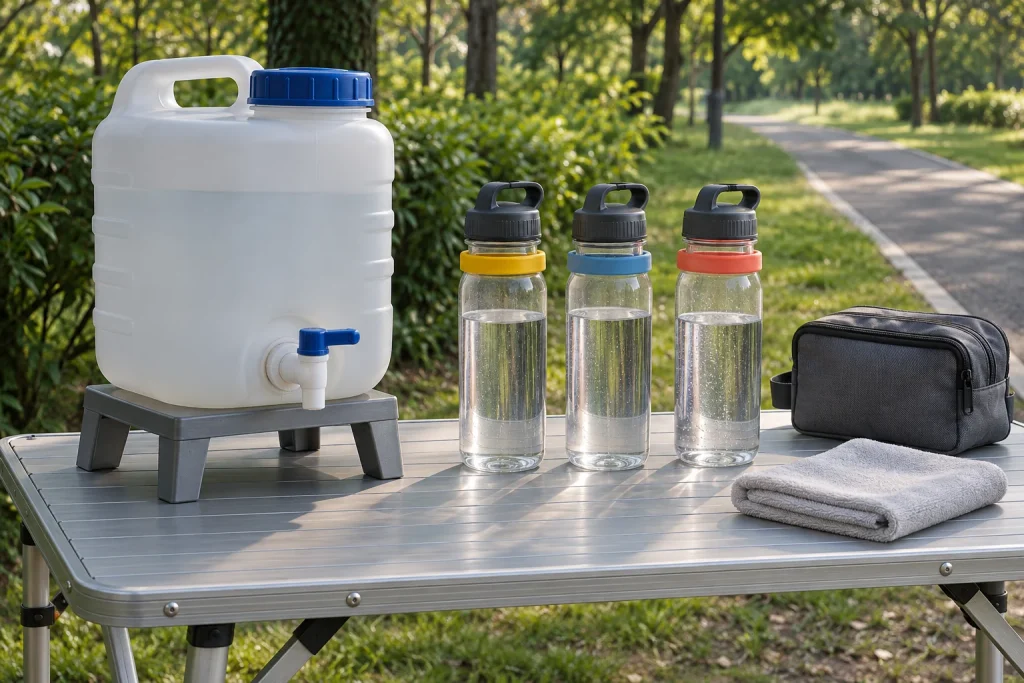
A running team’s shared water supply works when every participant understands where it comes from, where it is and how water reaches their own bottle. A large container alone is not a logistics system. Clean refilling, distinguishable personal equipment and task handovers matter at least as much as purchasing the total quantity. Shared organisation should help meet individual needs, rather than fit everyone to the same amount.
This guide discusses organisational practices for small running teams, not a complete professional or legal plan for public-event drinking water provision. It specifies no shared litres, disinfection recipe or individual electrolyte intake. If serving a larger event, check appropriate professional and regulatory requirements separately. Your own containers’ use and cleaning instructions always apply. The examples are planning patterns, not on-site water-quality tests.
Distinguish two levels of supplies
First is the team’s appropriately handled shared refill supply. Second is each runner’s own identifiable drinking equipment. Refilling from shared stock does not mean drinking from a communal mouthpiece. Everyone should use their own bottle or cup without swapping them. Separate roles help beyond hygiene: they show which container is available for refilling and which belongs to one person’s plan.
In an entirely fictional team, six people set off from a shared meeting place for smaller loops. Refill supplies stay at the stop while personal bottles travel with the runners. A designated person knows what remains, and runners use supplies according to their own appropriate drinking plans. This does not imply six identical bottles or identical consumption. Defined roles establish provision arrangements, not personal nutrition instructions.
Water origin and container suitability need separate checks
The CDC safe water storage information emphasises preventing recontamination of water already suitable for use. It describes a container that protects contents, closes and permits dispensing without reaching inside. A vessel previously holding toxic chemicals must not be used. For the team, this means a reliable water source and suitable container are both necessary; neither replaces the other.
Do not bring an unknown canister simply because it is large and looks clean. Know its previous use and suitability for drinking water too. If intended use is unclear, choose a verifiably suitable option. A homemade tap, seal or connector can introduce new questions. Use the container and every associated part according to manufacturer instructions; convenient dispensing does not justify installing unknown materials.
Make cleaning part of the team discussion
Do not discover at the starting point that nobody cleaned the container. Name a person responsible for preparation and make clear which instructions they follow. Arrange cleaning, rinsing, drying and storage beforehand. A quick on-site rinse should not conceal a lack of appropriate care. Responsibility for shared supplies includes preparation too.
The European Commission food contact materials information includes storage containers and kitchen equipment in this category. General descriptions such as ‘plastic’ or ‘metal’ are therefore insufficient for practical choice. The actual product’s intended use and conditions matter. A team need not invent its own material-safety certification: obtain suitable, identifiable equipment and handle it as instructed.
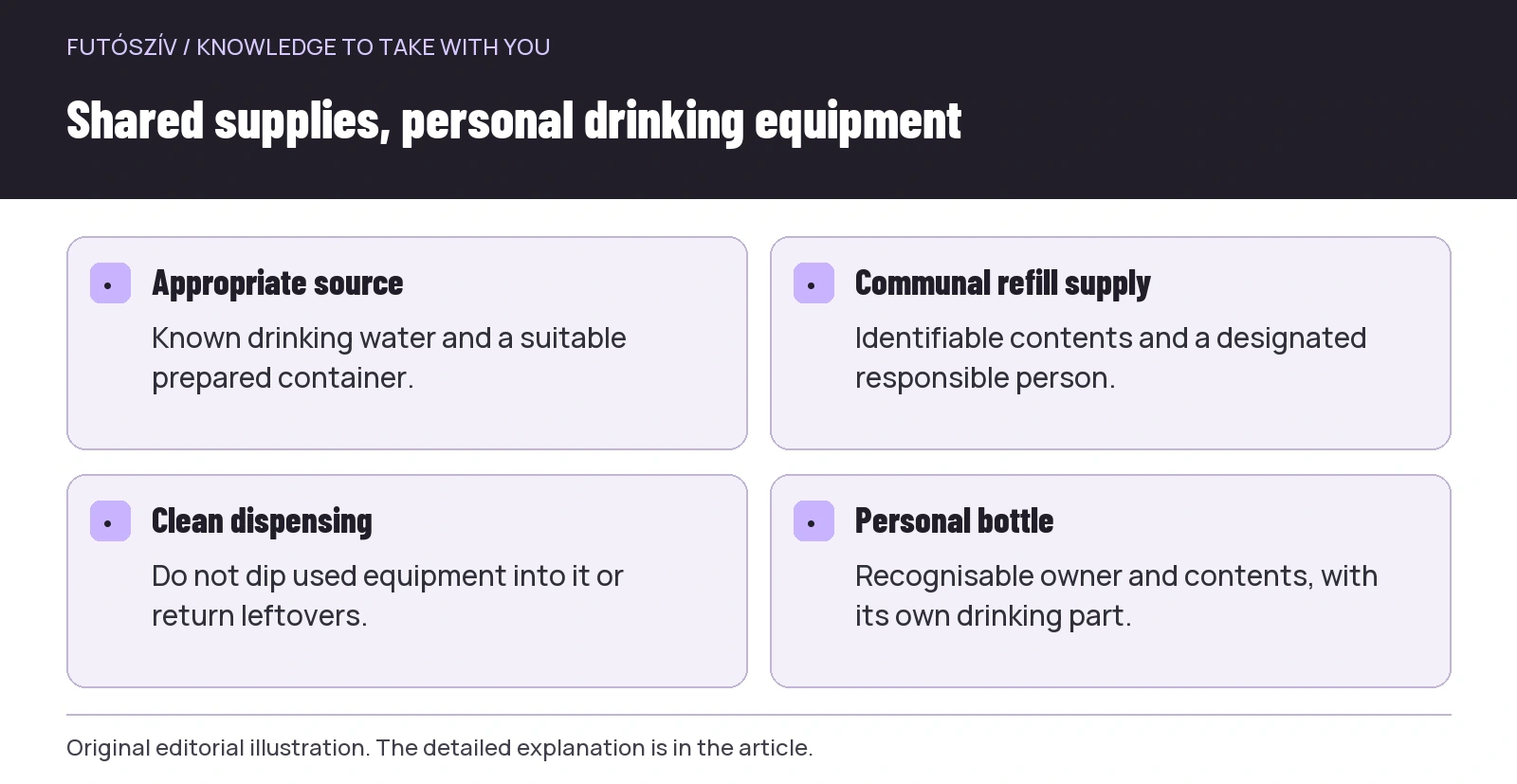 Enlarge diagram
Text version of the illustration
- Appropriate source
- Known drinking water and a suitable prepared container.
- Communal refill supply
- Identifiable contents and a designated responsible person.
- Clean dispensing
- Do not dip used equipment into it or return leftovers.
- Personal bottle
- Recognisable owner and contents, with its own drinking part.
Four short details on the shared container
Clearly label contents, the supply’s role, relevant preparation or filling time and the person responsible. ‘Team water, for refilling’ is clearer than an unlabelled canister. Distinguish it from any other drink. Add words beside colours so newcomers and people perceiving colours differently understand too. Place information where it remains readable with wet hands without interfering with container use.
Do not make claims a label cannot establish. Instead of ‘definitely sterile’ or ‘suitable for everyone’, record observable information. A team drink mixture creates a new task of precise identification and composition, not replaced by the nickname ‘isotonic’. Nobody should independently alter shared supplies, for example by adding a leftover sachet. Keep water and other drinks’ roles clear throughout use.
Personal bottle identification should be clear to the runner too
A small label hidden inside identical bottles may be insufficient at a stop. Choose an identifying feature the owner quickly recognises, compatible with cleaning and use. Put a name or clear marker on the outside, not the mouthpiece. Explain the team’s practice to new members too. Full personal health or dietary information is unnecessary for identifying an owner.
Anyone using two bottles with different contents should distinguish them within their own system too. Identifying ownership and contents are separate tasks. A helper should know which gets water and which must not be touched. Nobody should guess mixing or quantities from a turned bottle. A precise question clarifies the situation more quickly than correcting it afterwards.
Keep used equipment out of the shared supply while dispensing
Your bottle’s mouthpiece should not touch the shared dispenser, and the cap interior should stay in a clean place. Do not dip used cups into communal water or pour leftovers from personal bottles back into shared stock. Match dispensing to the container’s design. If tap height or bottle shape requires contact and uncertain manoeuvring, rearrange the space or choose more appropriate equipment.
The Nébih prevention information also emphasises clean hands and equipment, drinking water and protecting ready-to-eat food from later contamination. Keep the refill area orderly too. Used cloths, bins and running shoes should not occupy the surface for clean bottle preparation. The aim is distinguishing clean paths from dirty ones.
A refill location should work, not merely be designated
Choose a suitably stable, clean position for the container. Personal bottles should fit beneath the outlet, with room to open, close and step aside. Someone filling a bottle should not obstruct other participants. Discuss assistance or different approach needs before running. A canister on a table does not itself establish usable access for everyone.
The CDC describes cool storage protected from direct sunlight and chemicals. Consider that protection at the team stop alongside particular container and drink instructions. A tools or fuel compartment is not appropriate company for drinking water. The responsible person should know where the container waits during the run too. Moving shade or a vehicle leaving can change the original arrangement.
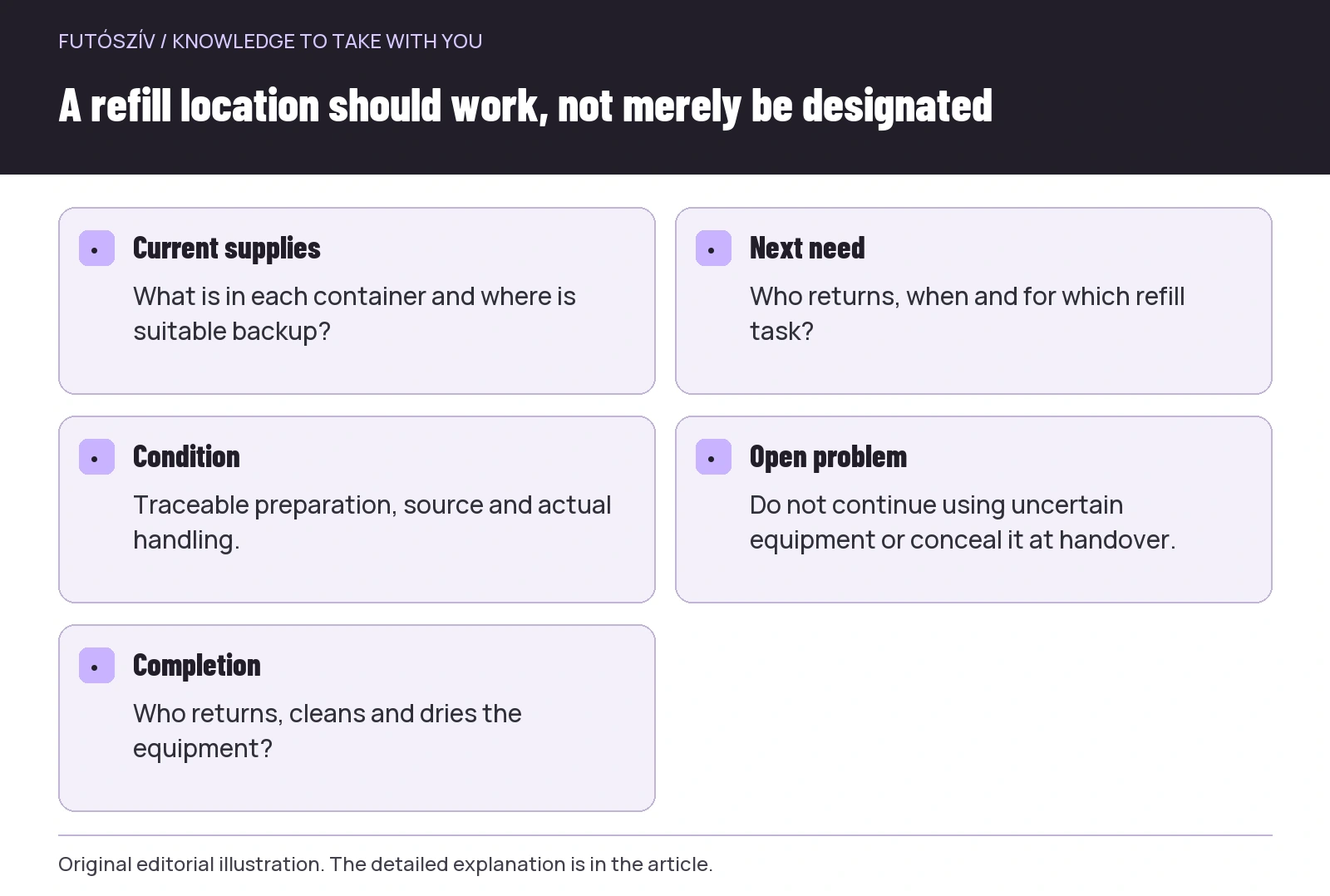 Enlarge diagram
Text version of the illustration
- Current supplies
- What is in each container and where is suitable backup?
- Next need
- Who returns, when and for which refill task?
- Condition
- Traceable preparation, source and actual handling.
- Open problem
- Do not continue using uncertain equipment or conceal it at handover.
- Completion
- Who returns, cleans and dries the equipment?
Plan shared quantities from individual plans
Do not prescribe identical consumption for easy purchasing. Gather practical access needs beforehand: how many people expect refills, after which sections, with which personal equipment, and where other suitable options exist. Personal health details need not be shared publicly. Organisers should know the task and supply plan, while individual sports-nutrition decisions remain within each person’s appropriate plan.
Account for organisational reserve and monitoring supplies without inventing a percentage for every team. Circumstances, replenishment and expected numbers differ. Report uncertain stock or replenishment promptly and adjust the run’s conditions. A shortfall cannot be solved by someone continuing without necessary access or teammates limiting each other to unknown quantities.
| Task | Who should know? | Information needed at handover |
|---|---|---|
| Container preparation | The designated equipment contact | Which equipment, under which instructions and in what condition? |
| Filling with water | The person managing supplies | Source, time and container identity |
| Providing a personal bottle | The owner and helper | Whose bottle is it, what goes in it and what stays separate? |
| Changing the responsible person | The outgoing and incoming contacts | Current supplies, next needs and open problems |
| Completing use | The person responsible for return transport and cleaning | What remains, what needs handling and which equipment should be separated? |
A change of responsibility needs a real handover
If the person at the shared point goes running, the next contact should not inherit an empty table and assumptions. Show supplies, backup location, each container’s role and any problem. A long record is unnecessary: a few precise details and looking around together may suffice. ‘The others know anyway’ tends to fail when the person holding the knowledge is no longer within reach.
Introduce new contents or containers only with clear identification. Do not pour supplies of unknown origin or unsuitable condition into existing stock. A late change can make all earlier information uncertain. Keeping a container separate is simpler than reconstructing where communal water came from and what touched it. Combining supplies should be deliberate, not automatic tidying.
Have an answer for a forgotten bottle beforehand
If someone forgets personal equipment, passing around an already-used bottle should not be the only idea. Prepare an appropriately clean, ready-to-use spare clearly assigned to that person for the outing. Arrange its use and later cleaning too. The spare solves access, without confusing owners and contents of personal equipment.
If dispenser or supply condition is questionable, stop using it and switch to an appropriate alternative. Do not guess improvised water-treatment methods on site. Without suitable drinking-water access, changing the programme may be necessary. Teamwork helps notice and resolve problems promptly, not share uncertainty equally among everyone.
Packing away is a shared task too
Do not put used personal bottles, clean backup and the communal container into one unidentified bag. Assign manufacturer-required cleaning and drying to a person and time before the team disperses. Next time’s preparation should not mean retrieving a forgotten container closed after the last run. Brief, orderly completion lets the next run genuinely begin in an appropriate condition.
Good shared water logistics rests on a few clear rules: appropriate source and container, identifiable shared supplies, personal drinking equipment, clean dispensing and traceable handovers. A team can then support different personal plans within one system. The arrangements do not standardise consumption; they ensure everyone understands and can use their access.
Sources and further reading
- CDC: Safe Water Storage
- European Commission: Food contact materials – General information and contacts
- Nébih: Preventing foodborne illnesses
How Futószív articles are prepared: our editorial guidelines.