Few small things are as distracting during a run as a fingerprint in the middle of your glasses or a lens fogging at the top of a climb. It is easy to wipe it with a sweaty shirt and spread more smears and dust across the surface. Caring for glasses need not be a complicated ritual: a few conveniently placed tools and knowing your model’s instructions remove much scrambling. This article brings cleaning, transport and fogging situations into one system. It does not rank brands or promise a chemical or anti-fog trick that works for every pair.
Your lens instructions are the first tool
Identify the model and lens before choosing a cleaner. The frame name alone is not always enough: one product family may include lenses with different treatments, mirrored surfaces or interchangeable designs. The manufacturer’s care page and supplied information together may give a precise answer. The Oakley product-care information , for example, specifically addresses protecting certain coatings and recommended cleaning tools. This does not mean the same agent can be used on every product from another manufacturer. Do not compare coatings through home experiments.
Make a brief note: what cleaning is permitted, whether the lens is removable, which parts adjust and where official servicing is available. A prescription insert may have separate instructions. Smart-glasses electronics can introduce further limits; a simple sunglasses washing routine cannot automatically transfer to them. Appropriate cleaning always starts from the particular object, not both looking sporty from outside.
First decide what is obscuring your view
Fog, droplets, fingerprints and dried dust are different problems. Fog may form a fine, continuous haze; rain leaves separate drops; greasy marks can create visible smearing in the light. You do not need to inspect this while moving. Slow, find a safe place and stop if your view is uncertain. Half a minute before cleaning creates a much better situation than wiping one-handed on a technical trail. Glasses are no reason to divert attention from the path ahead.
Recognising the situation also helps with later solutions. If fogging occurs at the same point every run, note the pace change, hat position and whether it happens uphill or when stopping. If the outer edge of the right lens is always smeared, perhaps that is where you adjust them. If streaks appear immediately after cleaning, examine the cloth or process. These are everyday observations, not laboratory lens-quality measurements, but they support targeted changes.
Do not rub dust across the surface
The official Julbo care answer also warns against wiping a lens with dirt or debris on it. Rinsing and cleaning permitted for the model aim to avoid moving particles under the cloth. A sweaty running top, glove or tissue does not become an optical cleaning tool because it is handy. Without an appropriate solution, stopping and getting home safely may be sensible; vigorous dry scrubbing is not a compulsory intermediate step.
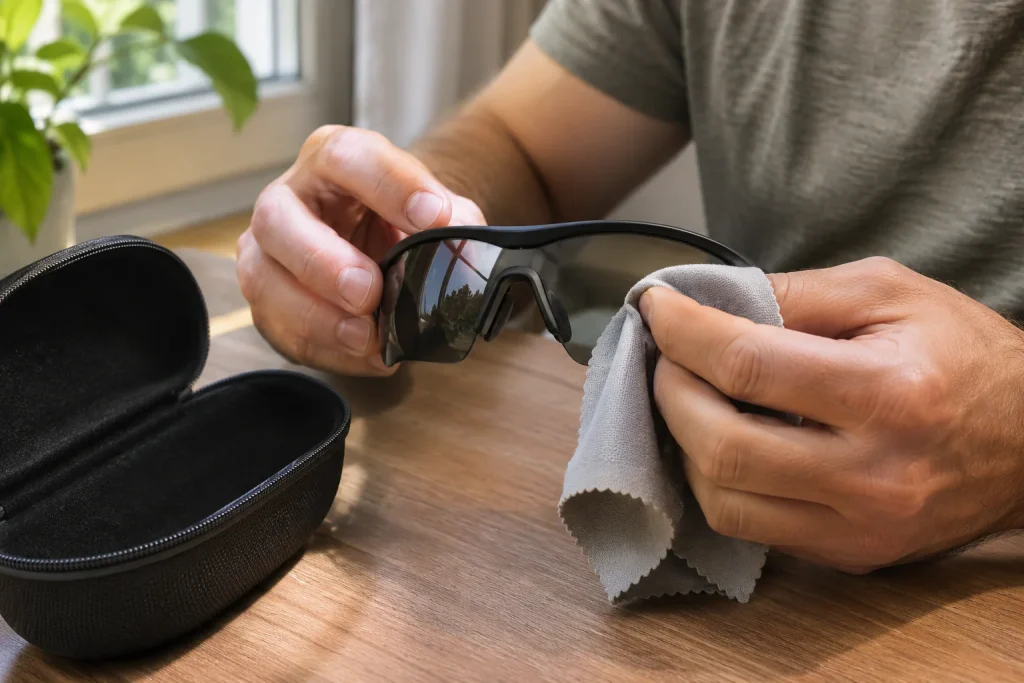
Have an organised cleaning place at home. Wash your hands, prepare a clean surface and use water temperature, cleaner and cloth permitted by the manufacturer. Do not start by pressing the lens: hold the frame steadily without stressing it. At a sink, prevent small parts disappearing down the drain. After cleaning as instructed, let gaps around frame and lens dry too. Immediately sealing wet glasses in a case only postpones the task.
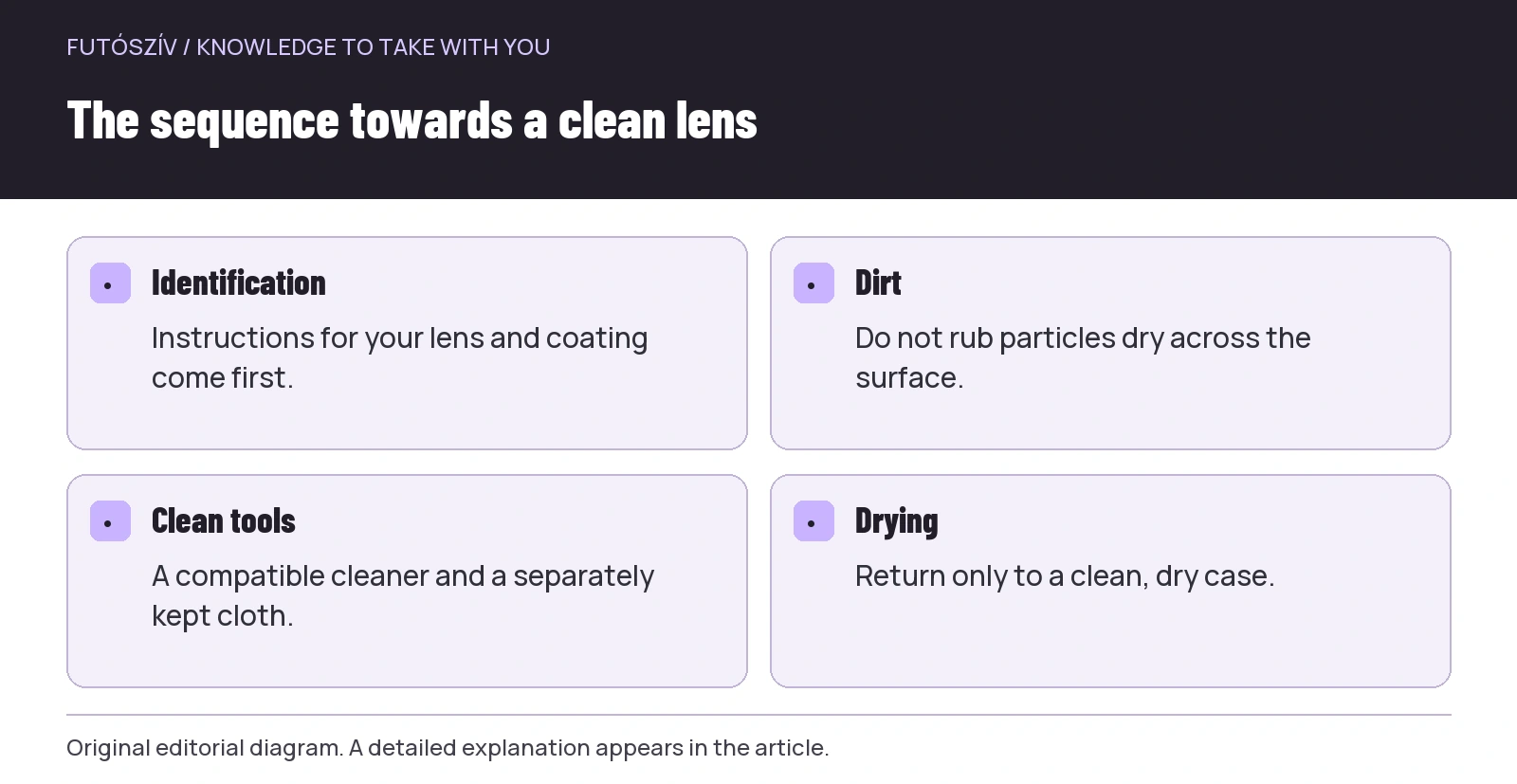 Enlarge diagram
Text version of the diagram
- Identification
- Instructions for your lens and coating come first.
- Dirt
- Do not rub particles dry across the surface.
- Clean tools
- A compatible cleaner and a separately kept cloth.
- Drying
- Return only to a clean, dry case.
The microfibre cloth is equipment too
A sandy cloth crumpled in a glasses case is not a good starting point. Keep it separate from keys, gel wrappers and running-shoe dust. If the pouch serves both as storage and a cleaning cloth, pay particular attention to what you place beside it. Oakley also mentions regular hand washing and air drying of its own Microclear pouch. This is specific manufacturer guidance for its own product; check your cloth’s care markings too. Cleaning-tool condition is as much part of maintenance as lens condition.
Keep a clean, dry spare cloth at home and a ready-to-use one beside your running kit. This does not necessarily mean two new purchases: first check what you own and what remains usable. Do not treat the cloth as an all-purpose rag. After wiping chain oil, strong cleaner or dirt from a phone case, do not continue onto your glasses with it. Without clear instructions about fabric softener or another household product, do not invent a recipe; ask the manufacturer or follow the product description.
| Observation | What should you check first? | A useful next step |
|---|---|---|
| Streaked lenses after cleaning | Cloth cleanliness and cleaner compatibility | Clean again as instructed with clean tools |
| Recurring fog during running | Hat, fit, airflow and situation | Change one setting in an easy trial |
| Dust returns inside the case | The inside of the case and pouch | Clean storage and give it a separate place |
| Fingerprints always in the same place | Where do you hold it during adjustment? | Use a suitable part of the frame |
| A distracting surface even when clean | Scratches, damage and coating condition | Manufacturer or optician inspection |
Fogging: change the system one detail at a time
Hat brim, the top of the glasses and space around your face together can affect airflow there. A hat pressed tightly down creates a different situation from looser headwear. Adjustable nose pads should be adjusted only if the model is actually designed for it; do not bend rigid parts randomly. For the first trial, choose a short, easy, familiar route. Note what you changed, and do not replace hat, strap, lens and cleaner together. The change then stays more interpretable.
Treat an anti-fog coating and separately applied anti-fog product according to their own instructions. Advice for the inner lens of ski goggles must not transfer to running glasses without checking. The Julbo product-care page also discusses sunglasses and ski goggles separately, with a specific inner-surface treatment warning for the latter. Differences between product types are a useful reminder: similar appearance does not guarantee the same cleaning suitability. Toothpaste, home polish and randomly chosen alcohol-based agents do not replace that check.
Keep the scenario simple while running
If your view worsens, first manage your movement: slow, leave traffic and stop somewhere appropriate. Only then touch your glasses. Know where their case or pouch goes beforehand; searching in a deep, full vest pocket is awkward. If removing them, do not hang them insecurely from a shirt neckline where they may slip or a bottle may press on them. Test storage during running at home with the vest actually loaded, because an empty pocket seems much more forgiving.
Pushing glasses onto your head seems obvious during a brief stop, but not every frame stays there securely. Grip may also differ on a hat or hair. Do not discover during a race that they fall when you next bend over. If you need prescription correction, removing glasses cannot be addressed with a simple general tip: develop a running and stopping plan that preserves adequate vision. Recurring visual symptoms or uncertain sight need professional clarification; cleaning is neither an examination nor treatment.
A case protects when its position is good too
A soft pouch and rigid case serve different tasks. A pouch can help separate the surface from other objects, while an appropriate rigid case may also protect against pressure in luggage. Even so, do not put it at the suitcase’s most heavily loaded point. The frame should not be strained inside, arms should fold as instructed and the lens should not touch hard accessories. A spare lens needs a separate suitable space; stacking two lenses together is not careful storage.
Julbo also highlights using a protective case and avoiding hot car dashboards in its care advice. At the end of a run, do not put glasses beneath the windscreen while changing. Give them a consistent, shaded, organised place in the bag. Forgetting glasses in a damp pocket is not good storage in winter either: retrieve, clean and dry them as permitted when home. Care is regular not because it takes a long time, but because the item does not disappear into a closed bag for days.
 Enlarge diagram
Text version of the diagram
- Situation
- Note climbing, stops and weather.
- Headwear
- Inspect the space between hat and frame.
- Fit
- Touch only genuinely adjustable parts.
- Another trial
- Compare on a familiar, easy route.
- Safety
- With poor visibility, slow and stop first.
A scratch cannot be cleaned off
If the same line or mark remains after cleaning, do not increase force indefinitely. Scratches and damaged coatings are not ordinary dirt, and home sanding or polishing may alter the surface. Inspect the lens in good light outside a run; if unsure, ask the manufacturer or an optician. Do not check protection by looking through it at the sun. Lens colour, cleanliness and UV protection are different properties, and care alone does not recertify a product.
Replacing a small screw, nose bridge or temple tip may often matter more than buying a new frame. Identify the part and check official compatibility. Not every loose part should be fixed by overtightening at home, and not every arm can be adjusted with heat. Glue or solvent used for repair near lenses can be a particularly poor experiment. If glasses are damaged or sit unstably, resolve this before the next run. Examine surface condition and frame support together.
Three realistic care routines
After a short urban run, inspect lenses and frame, then clean as needed by the manufacturer’s method. If simply putting them away, check that the case interior is dry and clean too. After a dusty forest run, emphasise particle removal and do not return the cloth without inspection either. After a rainy session, address moisture, water in gaps and drying. The principle stays the same, but dirt and the particular product determine task order; you do not need to dismantle every part daily.
Before travel, prepare a small glasses kit: suitable case, clean cloth and only a cleaner approved for your lenses. Seal liquid separately from clothing and follow transport rules. Do not let the last free gap before departure determine the glasses’ position. Keep the case accessible on arrival so glasses do not end up on the edge of the hotel table or beside shoes after running. A well-chosen bag position can prevent more everyday damage than a carefully written but impractical deep-cleaning plan.
Build a clear system over a week
On day one, find your product’s description and organise case and cloth. During the next easy run, observe when you adjust the frame and where fog or smears appear. At home, make one sensible change, then test in similar conditions. Note the result briefly: for example, “hat pressed down less; still fogging at stops”. This is more usable than judging a lens good or bad across every circumstance.
The final check questions are simple: can you see clearly and safely in the situation you plan to use it, does the frame sit stably, is storage accessible, and do you know how your model can be cleaned? If anything is uncertain, keep working on that specifically. Glasses care works well when you no longer need to deal with it at the start of the next run: retrieve them clean, put them on and attend to the route rather than the lens surface. This requires no spectacular trick, only manageable, product-appropriate habits.
Sources and further reading
How Futószív articles are prepared: our editorial guidelines.