You do not need a different body before you can run
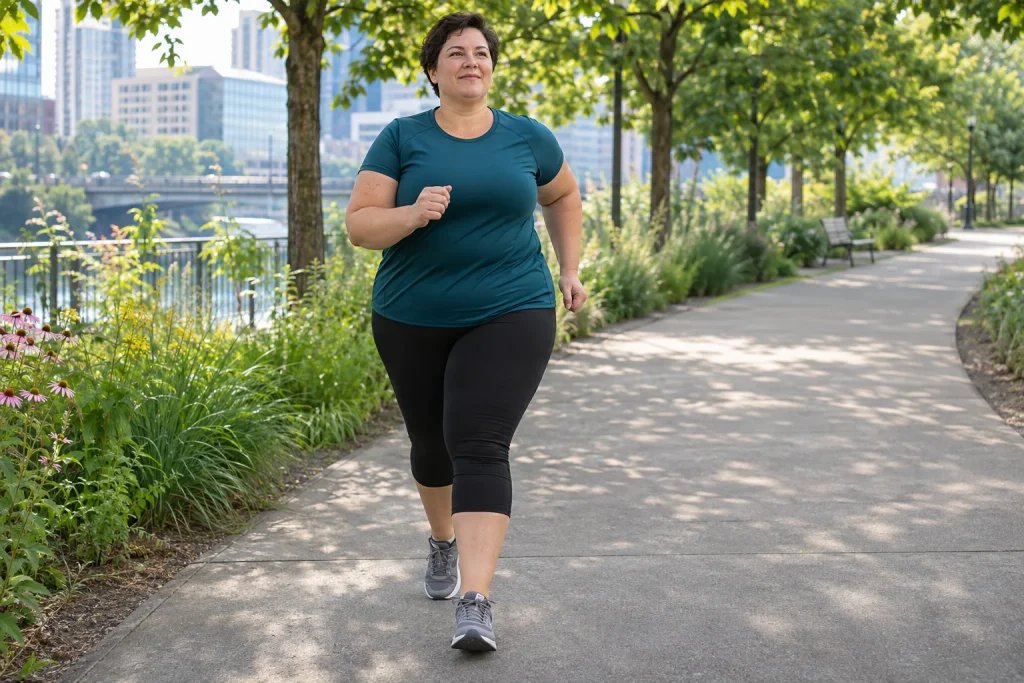
Images of running communities often feature the same body type, while many different bodies move at start lines and in parks. Higher body weight alone does not reveal how much you walk, your endurance, whether you have pain or which activities feel good. The first sentence of a usable beginner plan is therefore not about the scale. It is more about where you are starting, what you want to experience and within which boundaries you can regularly give time to activity.
The value of physical activity cannot be measured only through weight loss. The US NIDDK information specifically emphasises that regular activity’s important health benefits may remain even without a reduction in body weight. This does not mean every workload suits everyone, but that beginning activity need not depend on reaching a future weight. The Staying Active at Any Size guide is a useful starting point for considering barriers.
This article offers decision points to help arrange more comfortable first outings. It does not provide a personal medical opinion on fitness to participate or prescribe a weight-based kilometre limit. Your history, current symptoms and response to exertion say more about the next step than a general online label.
Look at your current everyday life first
Describe an average week without polishing it into a training week. How much are you on your feet at work? How long can you currently walk without difficulty? When is there time without immediately having to rush elsewhere? An evening after standing work may provide a different starting point from a free morning at home. Household and transport-related movement are also part of your day, even if your watch did not call them exercise.
The WHO summary on physical activity says all movement counts and some activity is better than none. For a beginner, that means even a short walk is not a wasted session. You do not need to meet longer-term public-health targets in the first week. The WHO recommendation points towards regularity; choosing a starting amount also requires knowing your own circumstances.
Separate the available time from time spent running. You may get out to the park for twenty minutes but initially want to jog only a few short sections. Walking there, stopping and walking home also belong to the outing. You do not have to fill all free time with uninterrupted running for it to be a real beginning.
What do we know about starting kilometres?
In a small four-week randomised trial, 56 beginners with a BMI between 30 and 35 were allocated to two groups. One group began at three kilometres per week and the other at six. The intention-to-treat analysis was uncertain: the confidence interval around the estimate remained compatible with no difference. An analysis restricted to those adhering to the programme gave a more favourable picture of the lower starting amount, but this is a different analysis more susceptible to bias.
It would therefore be misleading to conclude that exactly three kilometres is the safe weekly amount for everyone in a larger body. Short follow-up, few participants and differing adherence limit generalisation. The study examining starting running distance offers more of a caution about an excessive initial amount than a universal recipe.
The practical lesson is not to copy another person’s enthusiastic first week. Seek a start after which everyday walking remains comfortable and you can observe the following day. A successful first outing does not prove the next can immediately be twice as long. Being able to try something and being able to repeat it are two separate questions.
 Enlarge diagram
Text version of the diagram
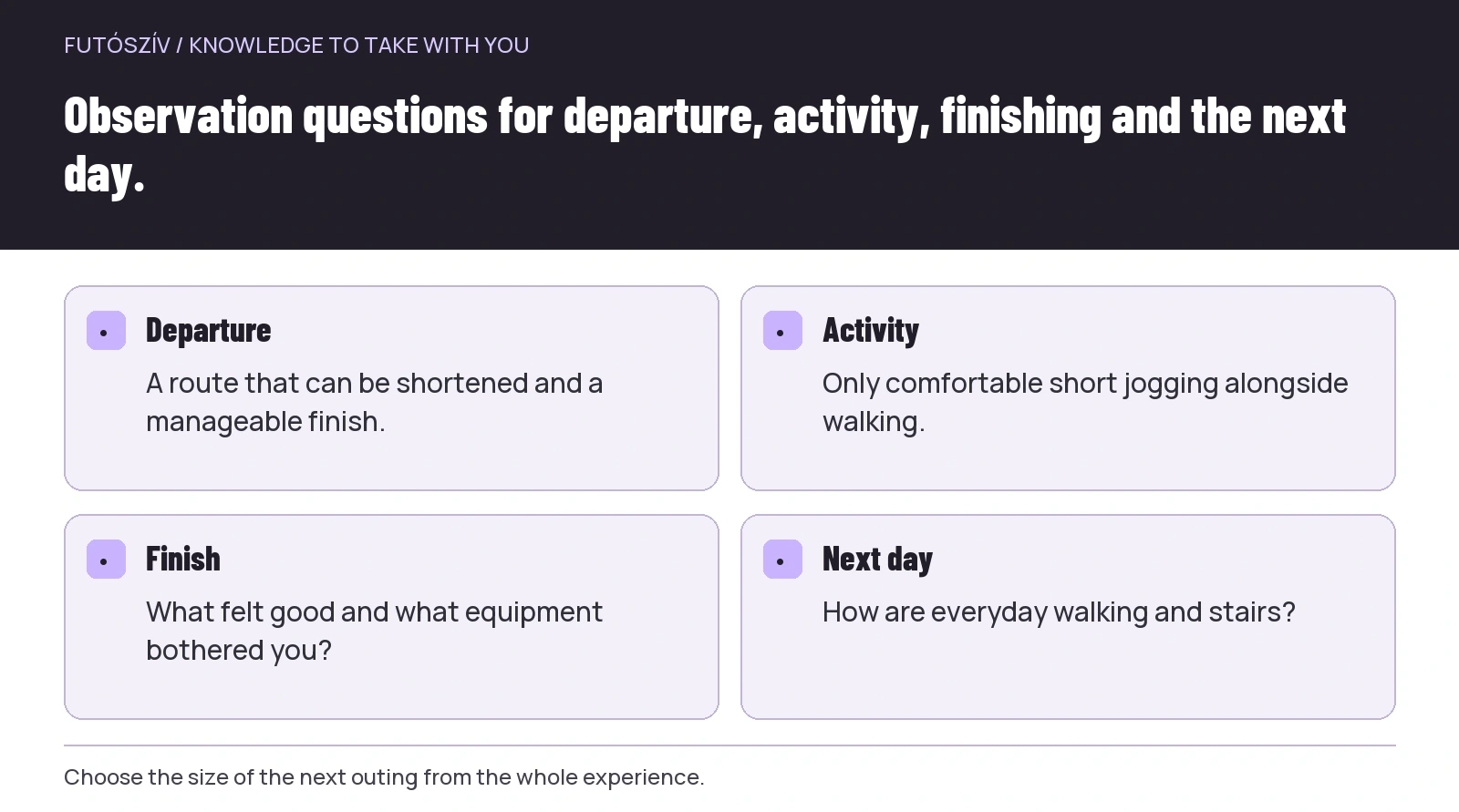
- Departure
- A route that can be shortened and a manageable finish.
- Activity
- Only comfortable short jogging alongside walking.
- Finish
- What felt good and what equipment bothered you?
- Next day
- How are everyday walking and stairs?
A first trial with four stages
Before departure: choose a familiar route that can be shortened and decide what will determine finishing. It may simply be wanting to walk home comfortably. Do not choose a loop where, halfway around, getting home requires covering the same number of kilometres again. A phone, a way home and clothing suited to the weather are more practical companions than a distance undertaken from a need to prove yourself.
During activity: begin with walking and try short, relaxed jogging only if it feels manageable that day. There is no mandatory run–walk ratio. Walking is not punishment or a sign of failure but one tool in the programme. If jogging becomes rushed and strained, switch back even if the designated tree or lamp post is still far away. A landmark does not make health decisions.
At the finish and the following day: note how comfortable the activity was, what clothing bothered you and whether any new symptoms appeared. Check usual walking and stair climbing too. These notes help with repeating the same outing, shortening it or discussing it with a professional. The next outing need not automatically be longer; retaining a successful amount is a deliberate decision too.
Choose a route that genuinely helps
A smooth section with good visibility and few crossings removes many decisions. On the first outing, you do not need to learn running, steep descents and root-covered trails all at once. Ground that looks softer is not necessarily more comfortable if it is uneven or slippery. Instead, examine how confidently you can move on it and whether there is room to go at your own pace.
A short out-and-back, a small park loop or a route offering several turning-back points can help. Think about toilets, drinking water and where you can stop without obstructing cycle traffic too. These details are not signs of beginner insecurity. They belong to good route planning just as a return journey does on a long hike.
If other people’s looks make you uncomfortable, you can choose a quieter time or a supportive companion. You do not have to hide, and solving other people’s prejudice is not your task. The right location is somewhere you feel safe and can actually get started. Walking in a gym, an indoor track or another form of activity can also be valid if that is what fits your life now.
Equipment should provide comfort, not conceal your body
For shoes, begin with fit during use: enough room, no rubbing and no troublesome heel slipping. Try them with the socks you would use for activity and walk in the shop. Body weight alone does not determine the suitable brand or sole type. A painful shoe does not become a good choice because the packaging promises special protection.
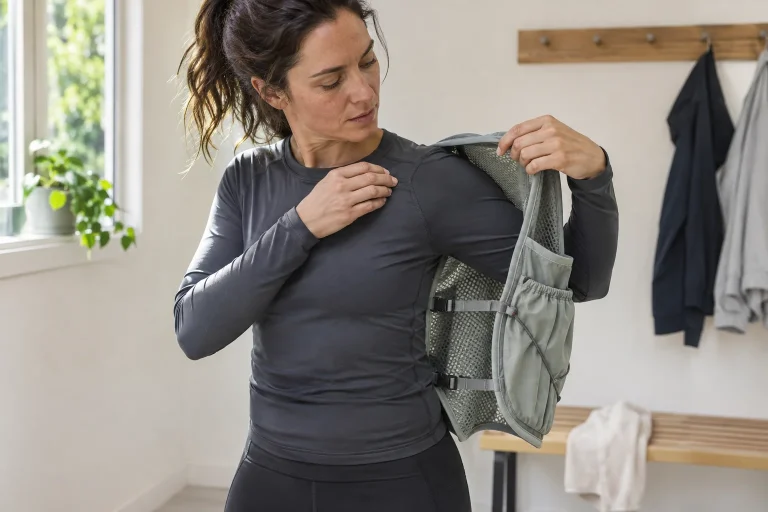
For clothing, check seams, the waist, sections riding up around the thighs and loaded pockets. Move in the fitting room rather than merely standing before the mirror. Choosing an appropriately supportive sports bra or other support garment often requires trying several styles. Breathing, freedom of movement and comfort at contact points matter more than the size label.
With chafing, first look for the specific location and cause: a bunched sock, damp fabric, moving belt or badly placed seam? Do not try to toughen damaged, painful or repeatedly troublesome skin through longer running. If a wound does not heal, changes suggest infection or the cause is unclear, seek healthcare help. Improving equipment and investigating symptoms are separate tasks.
Describe symptoms precisely and without shame
Heavier breathing during exertion does not by itself establish whether intensity is appropriate. Observe how manageable the situation feels and whether unusual symptoms appear. With chest pressure, severe breathing difficulty, fainting or another sudden episode of illness, stop and seek urgent help; in Hungary, call 112 if a life-threatening situation is suspected. Do not explain every warning sign as surely just your weight.
Recurring, worsening musculoskeletal symptoms or those changing your walking also deserve assessment. Bring a specific account to the medical conversation: where symptoms occur, when they begin, how stopping changes them and what they obstruct in everyday life. These support meaningful assessment questions rather than “it hurts because I am heavy”. Body size does not replace investigation of symptoms.
If you have a known condition, new symptoms or uncertainty about exercise capacity, ask your clinician about personal boundaries for activity. Seek an answer explaining which form you can begin, what to watch for and when review is needed. General advice to “move more” can be clarified too. You are entitled to request a plan you can actually begin.
 Enlarge diagram
Text version of the diagram
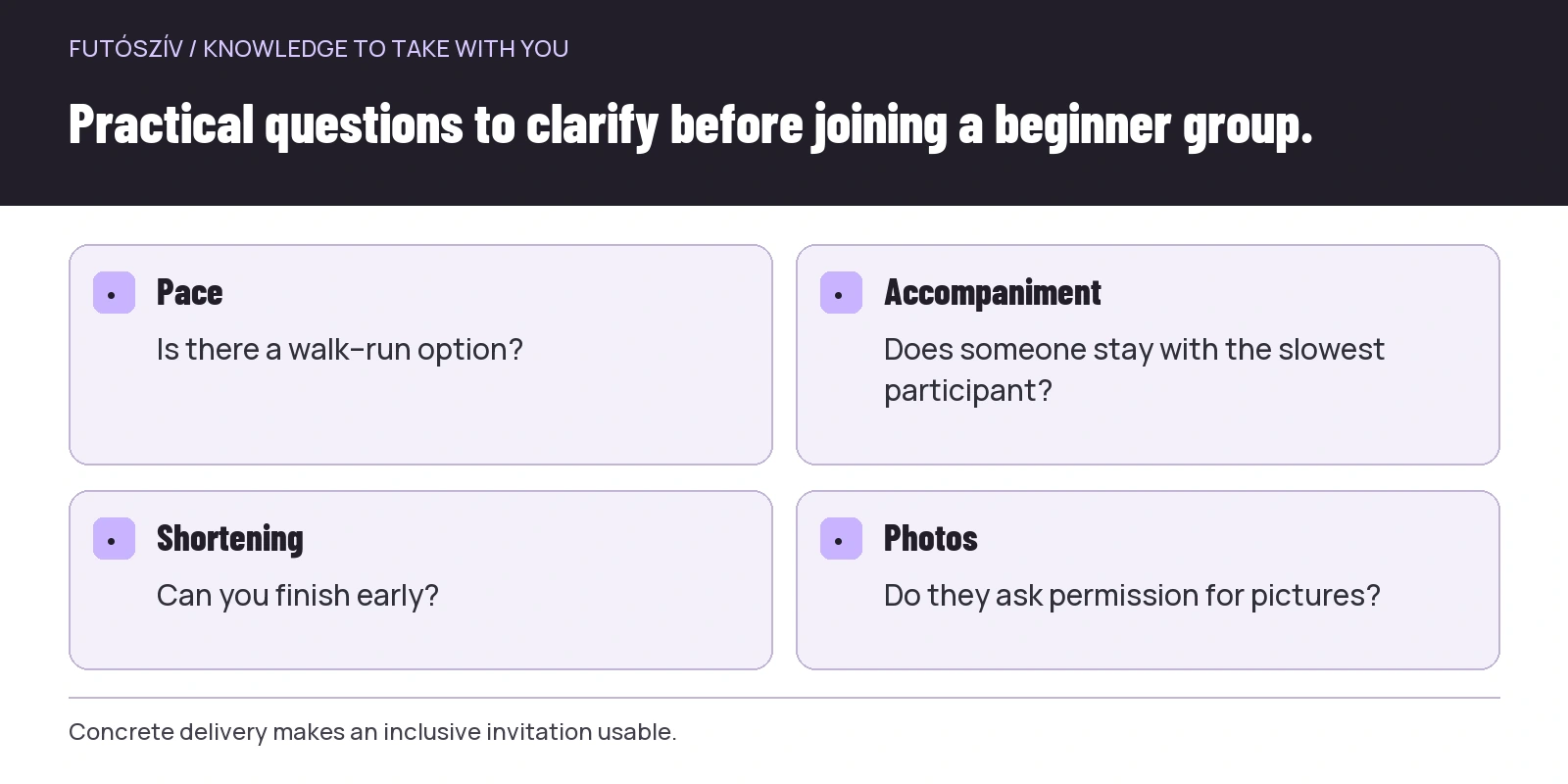
- Pace
- Is there a walk–run option?
- Accompaniment
- Does someone stay with the slowest participant?
- Shortening
- Can you finish early?
- Photos
- Do they ask permission for pictures?
How should the programme grow if it goes well?
First repeat what worked. If you then make a change, choose one clearly describable element: for example, slightly longer total time outside or an additional short jogging section. After increasing pace, distance, frequency and terrain demands together, identifying what caused a problem would be difficult. Consider the size of the change according to your circumstances and response, not a compulsory weekly percentage.
Rest and other forms of activity can also have a place in the week. Walking, cycling or activity in water can be useful companions when enjoyable and appropriately framed. They are not offered because someone has “not yet earned” running. They provide different experiences and loading situations. When using equipment, check fit and the manufacturer’s load-capacity requirements too.
If you return to an earlier amount after a difficult week, that does not erase previous work. Regularity does not mean numbers must be higher every week. It is better to have activity you can manage in real life than a few major outings after which you do not want to start again for weeks.
A supportive community: questions worth asking beforehand
Before a group run, send the organiser a few specific questions. Is there a walk–run option? Does a companion stay with the slowest participant? Can you finish early? “Everyone welcome” is most useful when delivery follows it in detail. You do not need to disclose your body weight to receive these answers.
Say what you need during the shared session: your own pace, no unsolicited weight-loss advice or no photos without permission. You set the boundaries for comments about your body. A supportive companion does not arrive as a food monitor but moves with you, follows the agreed plan and accepts a switch to walking today.
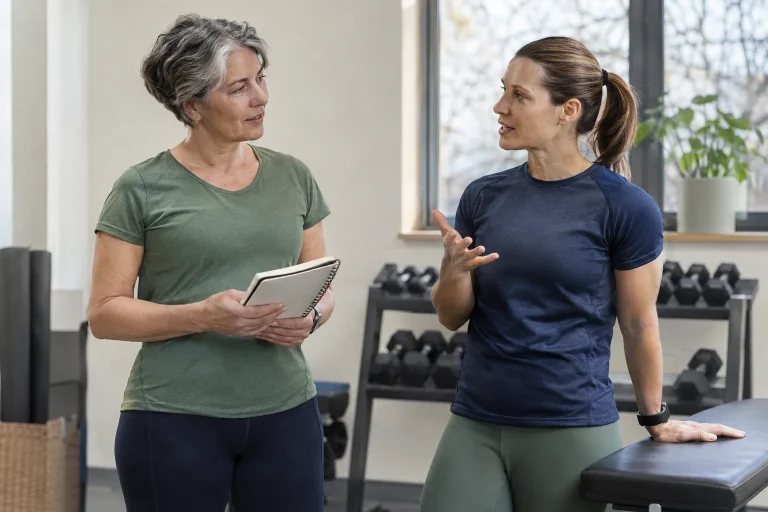
When choosing a coach, the questions opening the relationship are revealing too. Do they ask about history, opportunities and your goal, or immediately treat weight as the sole explanation? You can request a shared goal involving enjoyment of movement, more comfortable everyday life or completing an event. Cooperation requires respect as well as a training plan.
What can you record instead of the scale?
Four short lines may be enough: what I did, how I felt during it, what happened the next day and what I would change next time. You can add a practical success too: the sock did not slip, I found a good route or I had the confidence to turn back in time. These details build the environment in which being regularly active becomes easier later.
If a race is a distant goal, read the event’s actual conditions first. Choose according to cut-off times, elevation gain, road closures and refreshments, not only the medal picture. A short community walk–run may be an appropriate goal too. Entering does not oblige you to start with symptoms or dictate how much to train next week.
Write one concrete sentence for the next outing: when, where and what easily shortened programme you will try. This helps more than a general promise to become a completely different person from now on. With the same body, you can build a new habit, more experience and more confident decisions. Your right to movement is not a reward for a future result.
Sources and further reading
- NIDDK: Staying Active at Any Size
- The start-to-run distance and running-related injury among obese novice runners: a randomized trial
- WHO: Physical activity
How Futószív articles are prepared: our editorial guidelines.