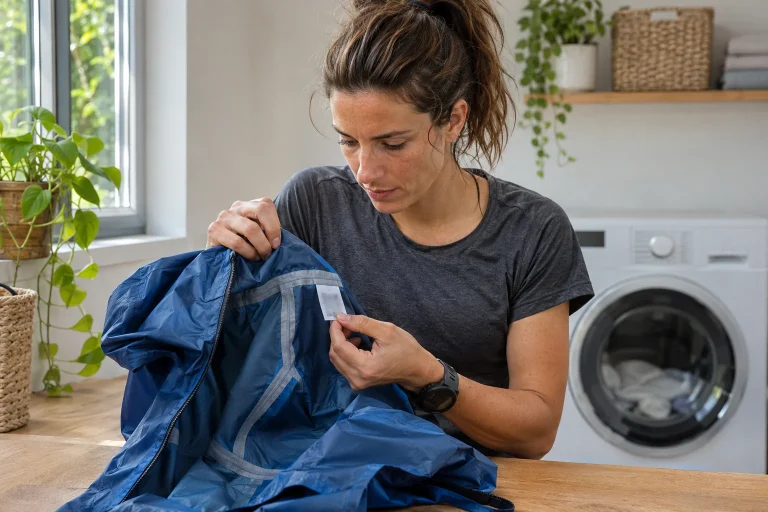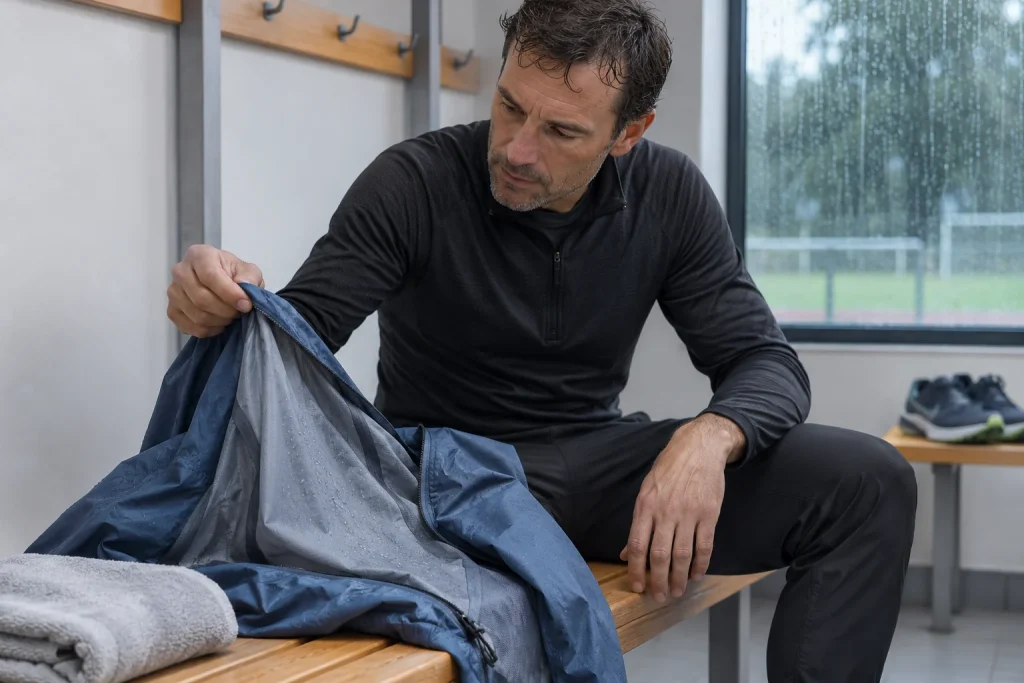
You remove your rain jacket after a run and find the material wet inside. The first thought is understandable: it must have leaked. Yet the moisture you see could have arrived by several routes. It may have entered from outside through part of the garment, flowed through an opening, come from your base layer, or condensed from vapour inside. A single wet surface cannot establish which explanation is correct.
This guide helps organise observations. It does not provide a home warranty decision or replace the manufacturer’s own assessment. The aim is to describe your experience usefully and keep what you observed separate from its assumed cause. Our examples illustrate this thinking process; they neither prove nor disprove a fault in a particular jacket.
The runner is also a source of moisture inside the jacket
Alongside rain from outside, moisture enters clothing from the body. Under suitable temperature conditions, water vapour inside can become liquid water. HungaroMet’s introductory meteorological material explains the dew point and condensation associated with cooling as general physical processes. A jacket’s detailed moisture conditions are more complex, but the principle helps explain why water found inside need not originate outside.
Rab’s own clothing information also discusses moisture accumulating inside and the role of condensation. The ability of vapour to escape is not a promise that the inner surface will always remain completely dry during intensive activity. Moisture production and its escape under particular conditions may differ. This does not automatically establish the correct explanation for a specific patch, however.
Make the distinction in your own language too: “I found the jacket’s interior damp” is an observation; “The membrane definitely lets rain through” is a technical conclusion. The first statement remains important and real even though the second requires further investigation. You do not need to name a fault immediately for your experience to be taken seriously.
The liquid’s location is a clue, not a ready-made diagnosis
Once you have changed in safe, comfortable conditions, examine where the moisture appeared. You can record the neck area, shoulders, back, sleeves, pockets and base layer separately. You need not draw an elaborate clothing map: a short list or a few photographs may suffice. Do not remain in wet equipment unnecessarily for the sake of investigating.
If moisture began around the neck, water entering through an opening is one possibility. If your back and base layer were very wet, an internal source is also worth considering. These are possible lines of interpretation, not certain findings. Water can move while the jacket is worn, removed or stored in a bag, so the patch’s later location need not be where the process began.
Chronology is another common uncertainty. Feeling moisture during the run conveys different information from noticing it only when unfolding the jacket crumpled up at home. Put “When did I first see it?” beside “Where was it?” A calm observation made as soon as practicable usually provides a more useful description than a certain-sounding story reconstructed from memory the following day.
 Enlarge image
A wet outer fabric does not imply only one possible fault
The outer surface’s water-repellent treatment and the waterproof layer may serve different roles in garment construction. Gore’s own DWR information explicitly distinguishes saturation of the outer fabric from the membrane’s waterproof function. A cold, clammy sensation alone therefore does not prove a torn waterproof layer. Equally, an apparently intact outer surface does not automatically establish every detail of the finished garment.
You can describe whether water remained in droplets on the surface or the fabric looked darker and soaked. Do not immediately attach a homemade repair recipe. First find the precise model’s own care instructions. A procedure recommended for another brand’s similarly named material does not necessarily apply to yours.
The outer surface’s condition matters because it provides context about the whole wearing situation. You need not decide whether moisture is “only” discomfort or a “real” leak: the experience remains describable while its origin is uncertain. To compare expected performance at purchase with the condition now observed, the manufacturer or retailer can evaluate a specific model and situation.
What happened before the rain, during it and after stopping?
Use a short timeline to separate starting layers, adjustments made during the run and the finish. Perhaps you started with the zip closed, opened it on an uphill section, then closed it again in the rain. These are several states of use within the same garment. If your note records only “It rained for forty minutes”, important details disappear.
Include the vest, backpack, hood and pocket configuration where relevant to the observation. You do not need to seek faults everywhere or quantify strap pressure. Simply state what you wore and where you noticed a difference. Do not turn uncertain origin into definite causation merely because the patch appeared near a piece of equipment.
The picture can change after returning home too, if the jacket goes into a bag beside a wet top or is placed inside out on a wet bench. Record what actually happened when handling it after removal. A perfect story is not the point; the aim is to avoid confusing moisture arising during running with moisture arising during storage in any later assessment.
Why do two apparently similar workouts not automatically provide proof?
In our first imagined case, someone removes a jacket after easy activity in rain and finds a small damp area beside the neck. In the second, the back and base layer are wet after a longer climb in drier weather. The two accounts raise different questions for investigation. The first may warrant discussing entry around the neck, while the second also warrants considering internal moisture. Neither account establishes the origin on its own.
An error often begins when the second experience is used retrospectively to explain everything about the first. Condensation appearing likely once does not require you to classify a later, different wetting episode automatically in the same way. Likewise, a previously confirmed repair does not mean that every future instance of moisture will occur in the same place for the same reason.
Look for differences as well as similarities when comparing. What layer was underneath, was equipment worn over the jacket, and did effort or fastening change? If many factors differed, state this. Careful observation does not necessarily provide an immediate answer; it helps further investigation start from a genuine question rather than fitting one convenient story to every situation.
What should you photograph for customer service?
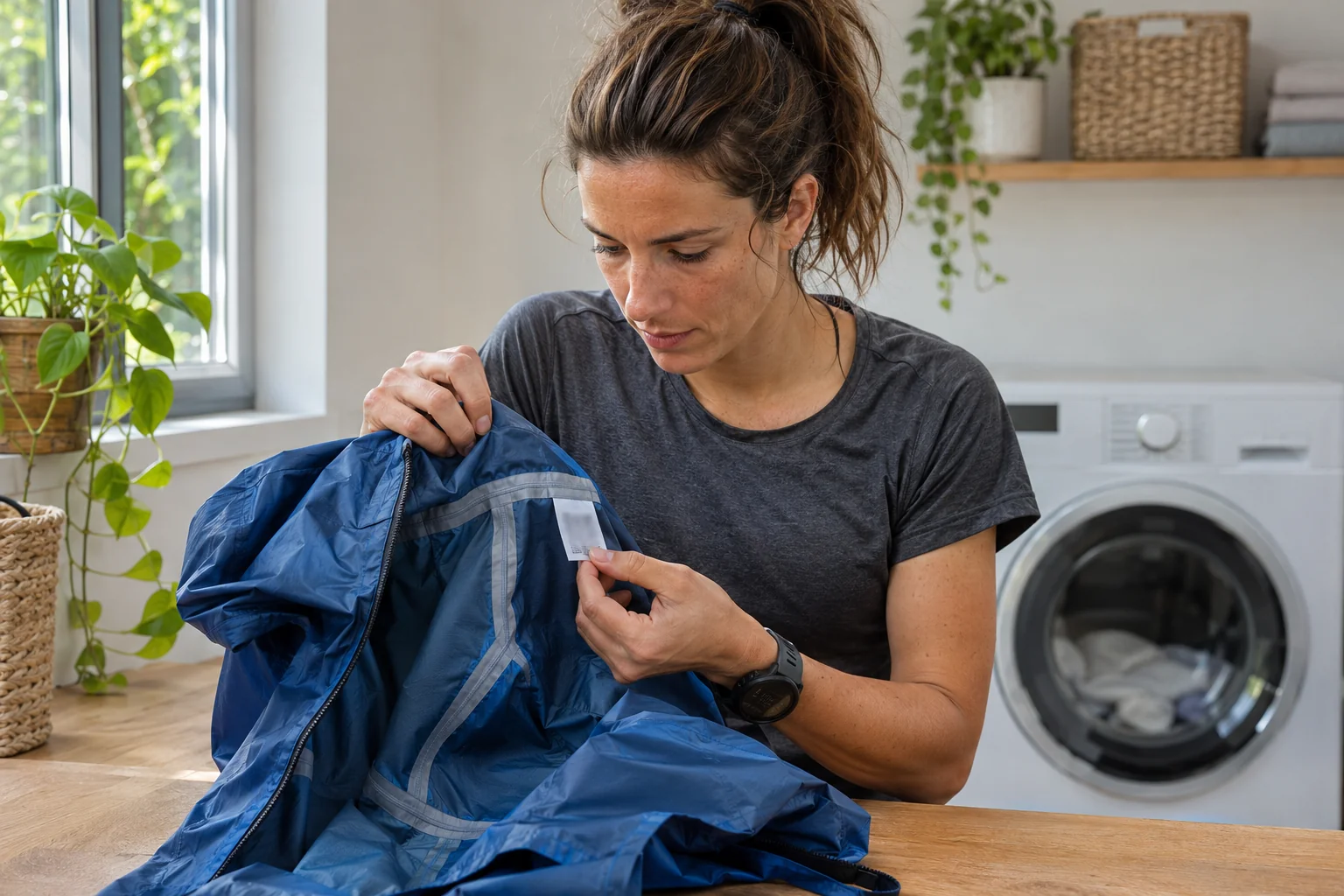
If you want to contact the retailer or manufacturer, first check what documentation they request. Depending on this, photographs may show the whole garment, the affected area and the label needed to identify the model. Their purpose is to show condition and location, not provide a waterproofness measurement from an image.
A wider view showing which part of the jacket is pictured may help alongside a close-up. Otherwise a grey, wet piece of fabric can be hard to interpret. State when the photograph was taken relative to removal and whether any treatment occurred beforehand. If it has already dried, do not try to recreate the patch artificially merely to obtain more striking evidence.
Pass on relevant usage information from your notes, not your entire private running diary. Exact model, known age, care history, layers worn and how moisture appeared usually provide a more focused starting point than a route image also showing your home address. Share documents needed for the process according to the actual request. Understanding the clothing question does not necessarily require every personal training detail.
 Enlarge image
Clarify the next assessment step instead of proving the case at home
Do not assume that a garden hose, shower or weight placed on the fabric adequately replaces manufacturer testing. Such a trial’s conditions and evaluation may differ from those underlying the product claim; it may also create new uncertainty about the garment’s condition. If a test is suggested, request the precise procedure for your model and clarify what observation is expected.
Checking care instructions, sending the garment in or examining a particular section may be separate questions. You do not have to assemble these from online suggestions. A next step is useful when you know what you may do, what to document beforehand and who will provide an interpretable answer. If the description is unclear, ask for clarification before intervening.
A “covered by warranty” or “not covered by warranty” decision depends on the particular case and applicable conditions. An equipment article cannot decide this from the location of moisture. Your role here is an accurate account of condition and following the requested steps; the technical finding should have an appropriate assessment basis. This keeps your real experience distinct from its professional evaluation.
A short moisture diary with room for uncertainty
You do not need to keep this record after every run. It can help when you want to describe a recurring situation clearly. The editorial template below separates circumstances, observation and the open question. It is not a diagnostic tool and makes no automatic decision about the jacket’s condition.
| Field | Example of precise wording |
|---|---|
| Circumstances | Rainy open section followed by a more sheltered return; one technical layer under the top. |
| Use | I opened the zip uphill, then closed it; the vest was over the jacket. |
| Observation | On removal, the inside back and base layer both appeared wet. |
| Chronology | The photograph was taken after changing; the jacket had not been put in a bag beforehand. |
| Open question | The moisture’s origin is unclear; I am seeking manufacturer guidance. |
Add what the later discussion established and what remained uncertain. If you received only care advice, do not call this a membrane fault confirmed by investigation. If a section was actually inspected or repaired, identify it precisely. The experience of another run then remains distinct from earlier assumptions and the information received.
With a jacket wet inside, your task is therefore not immediately to choose between the two possibilities in the title. First organise the different moisture routes and your own chronology. If the situation persists, take the precise description to the appropriate customer-service or repair discussion. “I do not yet know the cause” is often more accurate and useful than a confident fault diagnosis without assessment.
Sources and interpretive limits
For internal moisture and clothing comfort, we used Rab’s official water-vapour transmission explanation; for distinguishing outer water-repellent treatment from the membrane, Gore’s DWR information. Background on the basic concept of condensation comes from the moisture section of HungaroMet’s introductory meteorological material. These are general or manufacturer explanations, not test reports for your jacket. The cases, diary template and documentation questions are our own editorial aids. Sources checked: 21 November 2026.
How Futószív articles are prepared: our editorial guidelines.