Choosing a shared running game for siblings of different ages involves more than shortening the same distance for the younger child. One may want to invent rules, another join a story, and neither may want competition that day. A shared game works when participation is possible in several ways while the adult can still keep track of the situation.
The following ideas are for family play planning. They offer neither age-group training plans nor recommended running distances: choose according to current needs, location and necessary supervision. A game can change or stop too. Time together need not always be framed by a start, timing and a winner.
Consider interests alongside age
Siblings’ ages provide important background but do not alone describe how they enjoy playing. The same child may follow a longer story one day and prefer one simple task another. The older sibling may not always want to direct, while the younger need not participate only as a follower.
First ask what appeals: looking for something together in the designated area, imitating movements or acting out a brief imaginary story? Do not turn choosing into a long family vote. Offer two or three achievable ideas and hear if a child currently wants another kind of activity too.
The Play Scotland information on active play highlights choice, enjoyment and play with companions. In family planning, this perspective helps shared movement become more than adult-assigned tasks. The versions here are original ideas, not reproductions of the website’s programme.
Five details can be changed separately
You can make a game easier or interesting differently through more than speed. Change the number of rules, designated space, way of moving, role and finishing condition. Changing all five together leaves nobody knowing what happens; clarify one or two at a time.
For example, rules may involve one simple signal or several sequential parts. Space may be a small visible section, without sending the older child farther away unsupervised. Movement may be walking, running or another approach appropriate to the place and participant. Do not turn differences into public ability classifications.
Roles and endings particularly shape atmosphere. People can be storytellers, signal-givers, observers or participants, and exchange roles. Finishing may mean completing a story together or everyone adding one chosen element. The end need not depend on who arrived first.
| Adjustable part | Simpler version | A different challenge within the same game |
|---|---|---|
| Rule | One chosen movement for one signal | Children invent a new signal themselves |
| Space | A shared small area within view | Several stops within the same supervisable place |
| Movement | Everyone moves in their own agreed way | Another rhythm or story-related movement |
| Role | Doing it together | Briefly becoming signal-giver or storyteller |
| Ending | Completing one shared task | Everyone added something to the story |
The table is not an age-based performance ladder. Neither column requires “progressing” to the other. The aim is choices within the same framework so children with differing interests receive more than an identical task labelled with different difficulty.
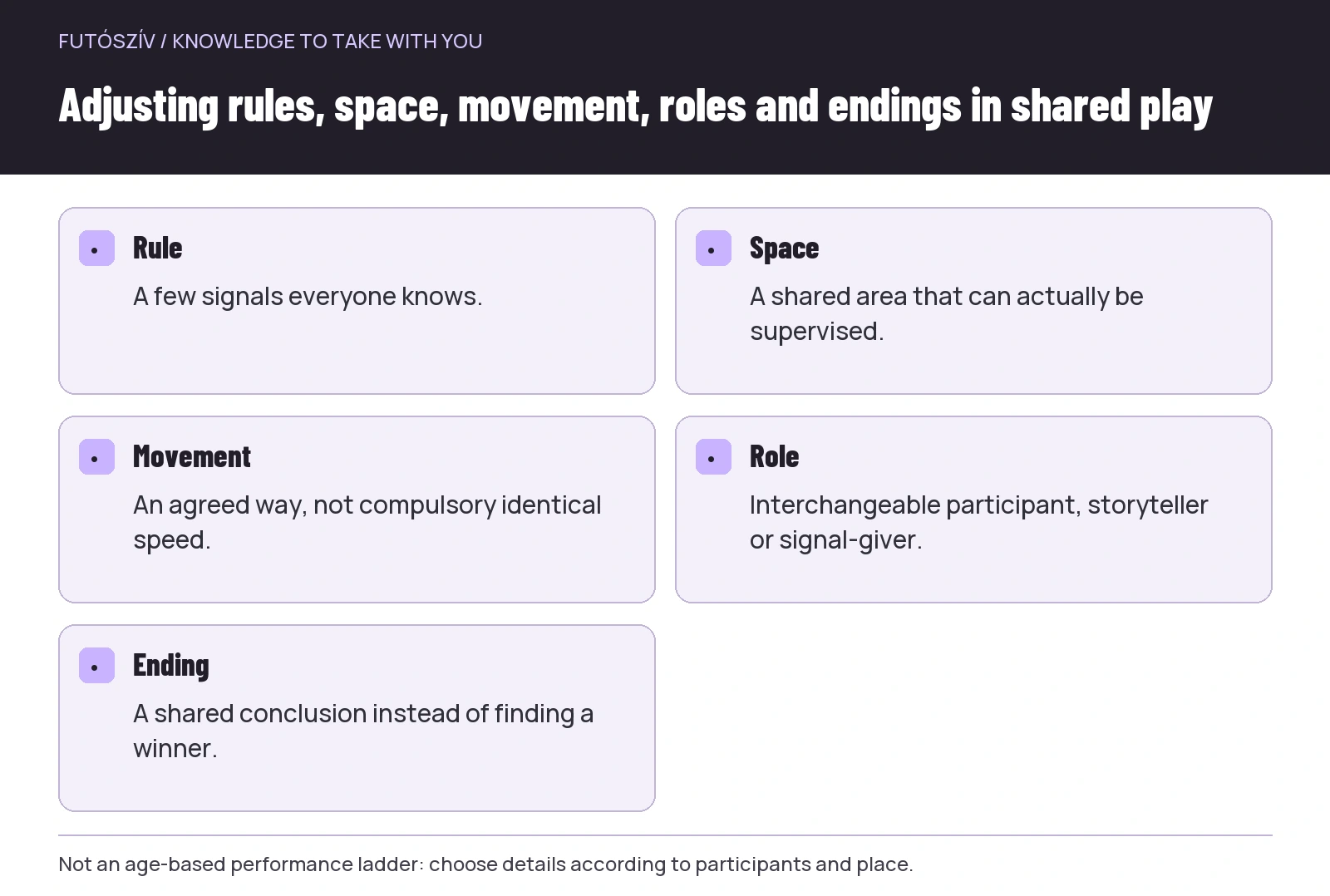 Enlarge diagram
Text version of the diagram
- Rule
- A few signals everyone knows.
- Space
- A shared area that can actually be supervised.
- Movement
- An agreed way, not compulsory identical speed.
- Role
- Interchangeable participant, storyteller or signal-giver.
- Ending
- A shared conclusion instead of finding a winner.
First original game: a moving story
Choose a simple story, such as delivering an imaginary letter together from the starting point to a designated stop. The letter can be purely imagined, requiring no equipment or disposable object. Children take turns saying what happens in the next part, while the adult keeps the programme within real boundaries.
Someone wanting a simpler task can choose one element: moving quietly now, waving together to the imaginary recipient or composing the letter’s text together at the stop. Someone wanting a more complex story can remember several stations, name characters or connect previous details. This does not make them the younger sibling’s supervisor.
The story can continue regardless of movement method. If someone wants to walk, the story does not stop and no new role needs inventing for them. Avoid compulsory escapes, steep terrain or competition inviting people outside the designated area. Imagination can provide variety without dissolving real environmental boundaries.
Second original game: a shared set of signals
Begin by inventing a few easily recognised signals. A word, hand gesture or drawing can indicate a simple change everyone understands. For example, “lantern” might mean stopping together and looking around, while “post” means moving in a chosen way to the next designated point. Choose particular movements for the place and participants.
Siblings can take turns signalling while the adult still watches the area. Being signal-giver should not permit unlimited acceleration of others or punishment tasks. Explain beforehand what signals mean and how to request a break. Rules should support shared play, not catch someone out.
If children want more rules, expand only when everyone understands the basics. Someone not wanting to learn a new signal can retain the shared version. A secret rule invented during play should not put another person in a losing position. Shared signals are interesting when understandable, not because they are increasingly easy to get wrong.
Third original game: one place, several tasks
Designate a few visible stops within the same supervisable area. Each offers a choice: observation, showing an original movement or a brief story element. Agree movement between points together, and do not let speed around the entire circuit determine who succeeded.
One sibling may name something visible from the designated spot while another invents a question about it there. No picking plants, taking objects or hiding is needed. Keep observation within boundaries known to the adult and do not make other people, their clothing or movements point-scoring tasks.
This game is easy to interrupt. You can conclude together after one stop if someone wants another programme. The number of points visited is not a performance requirement. Someone wanting more tasks can discuss continuing separately with the adult if the whole family’s supervision and time remain arranged.
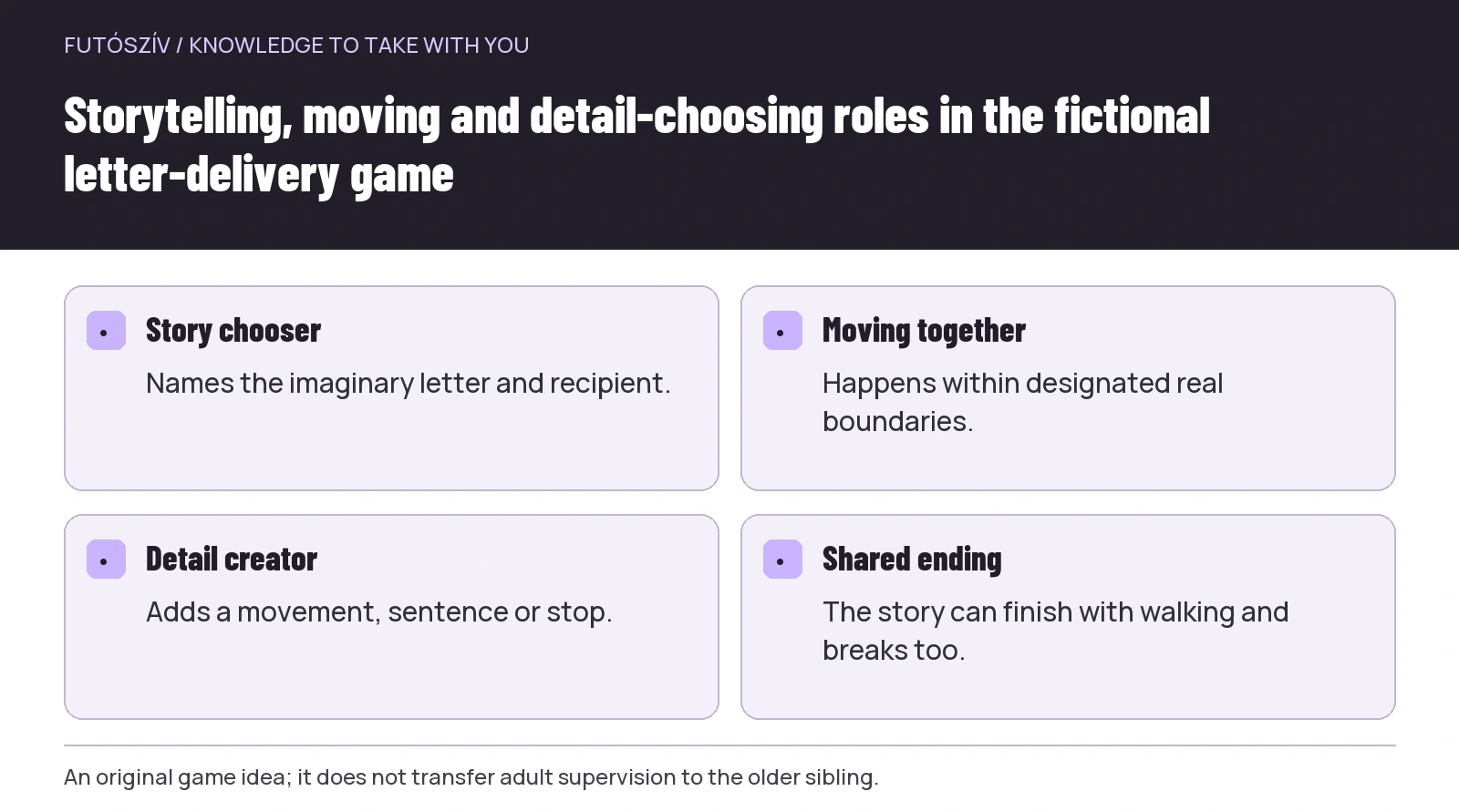 Enlarge diagram
Text version of the diagram
- Story chooser
- Names the imaginary letter and recipient.
- Moving together
- Happens within designated real boundaries.
- Detail creator
- Adds a movement, sentence or stop.
- Shared ending
- The story can finish with walking and breaks too.
Fourth original game: exchanging ideas in pairs
Siblings can choose movement or storytelling ideas for one another from previously approved options. One might choose the imaginary place you arrive at while the other shows how to greet companions there. Exchange roles next round. They are co-creators rather than judges of each other’s performance.
The task should allow modifications: “I would rather walk this now”, “I choose another movement” or “I will skip this part”. The older child should not automatically receive adult authority, and the younger’s requests should not override everyone else’s choices without limit either. The adult helps make participation and boundaries understandable both ways.
If exchanging ideas becomes an argument, there is no need to immediately decide which game is better. Stop, hear separately what is not working and choose a simpler shared version or different activities. Family play does not oblige every child to remain in the same activity every moment.
Fifth original game: a shared map from memory
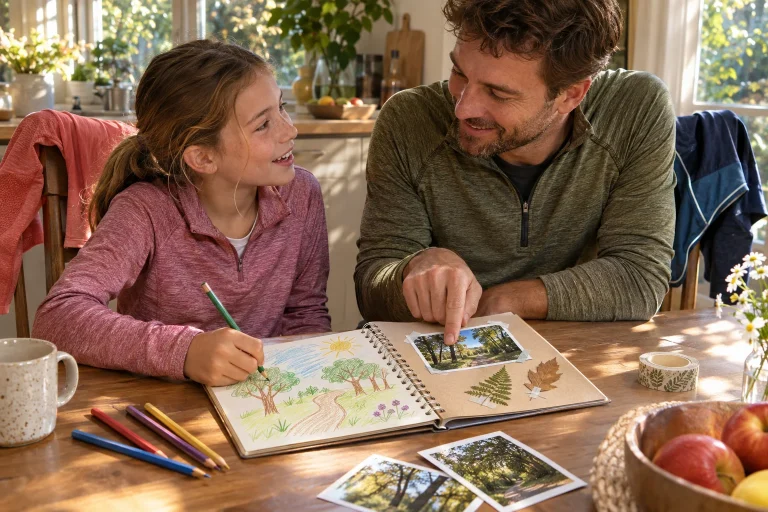
After covering a short area together, children can make an imagined or paper-drawn map of the stops. Focus on story and noticed details, not correct scale. One can name a point, another invent a symbol or connect others’ ideas.
This winding-down game is not an independent navigation task. Do not send children to find a distant station from memory, and the drawing should not replace actual route knowledge. The memory of a place explored together provides the topic. Later, the family can decide whether to retain the picture or consider making it the game’s end.
The task can connect differing interests: one enjoys the running part, another connects more through drawing or story. This is not incomplete participation. Shared value need not be derived from everyone choosing identical amounts of moving and calm sections.
Location rules still apply during play
Inspect the designated area first. Vehicles, cycle links, water, stairs, others’ play space or sections outside view affect what fits. Show children real boundaries simply. The adult assesses the location and provides necessary supervision; a playful name does not transfer this to siblings.
If use of a park or protected area is restricted, adapt play. Do not collect natural objects simply because an idea mentions treasure, or make leaving a usable path to seek hidden objects a task. The same applies to litter: props and packaging leave with the family. Using space should not take over other people’s programmes either.
The NHS Let’s Move page on family activity draws attention to simple, playful shared activities without special equipment too. We use only that general possibility here; the article prescribes no age-specific activity minutes or home training dose. Individual health questions require an answer agreed with an appropriate professional.
How can you tell the rules need changing?
Observe how play works without continually evaluating children. If someone waits a lot because the task gives a role to only one person, change the structure. If one sibling always finishes first, choose a shared ending or different task. The aim should not be publicly punishing the faster child by holding them back but offering more usable participation routes.
If children say they want another game, ask what should be different. The Play Their Way resource on choice and children’s views offers general guidance: alongside listening, consequences of decisions need to be understandable. In family situations, explain which request can be met now and why another waits until next time.
Finally, a simple question may help: which part would you play again, and which would you change? Do not ask siblings to assess one another. They can discuss their choices, shaping the next occasion. A good shared game does not try to remove age differences but creates a framework for being together alongside them.
How Futószív articles are prepared: our editorial guidelines.