A shopping list for runners is not good because it contains many specialist sports foods. It helps when it supports meals that are liked, appropriate and genuinely achievable within your own routine. A well-chosen ingredient can work in several dishes, allowing the plan to change without shopping again for every evening. This article offers a method and illustrative food combinations for healthy adults’ everyday organisation. It is not a personalised diet, portion prescription or allergy-management guide; known individual needs and special diets take priority in every example.
Do not leave the decision until you reach the shelves
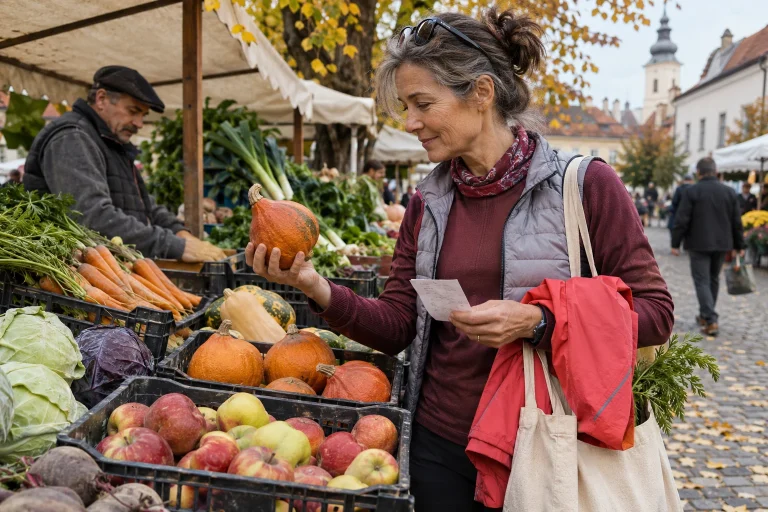
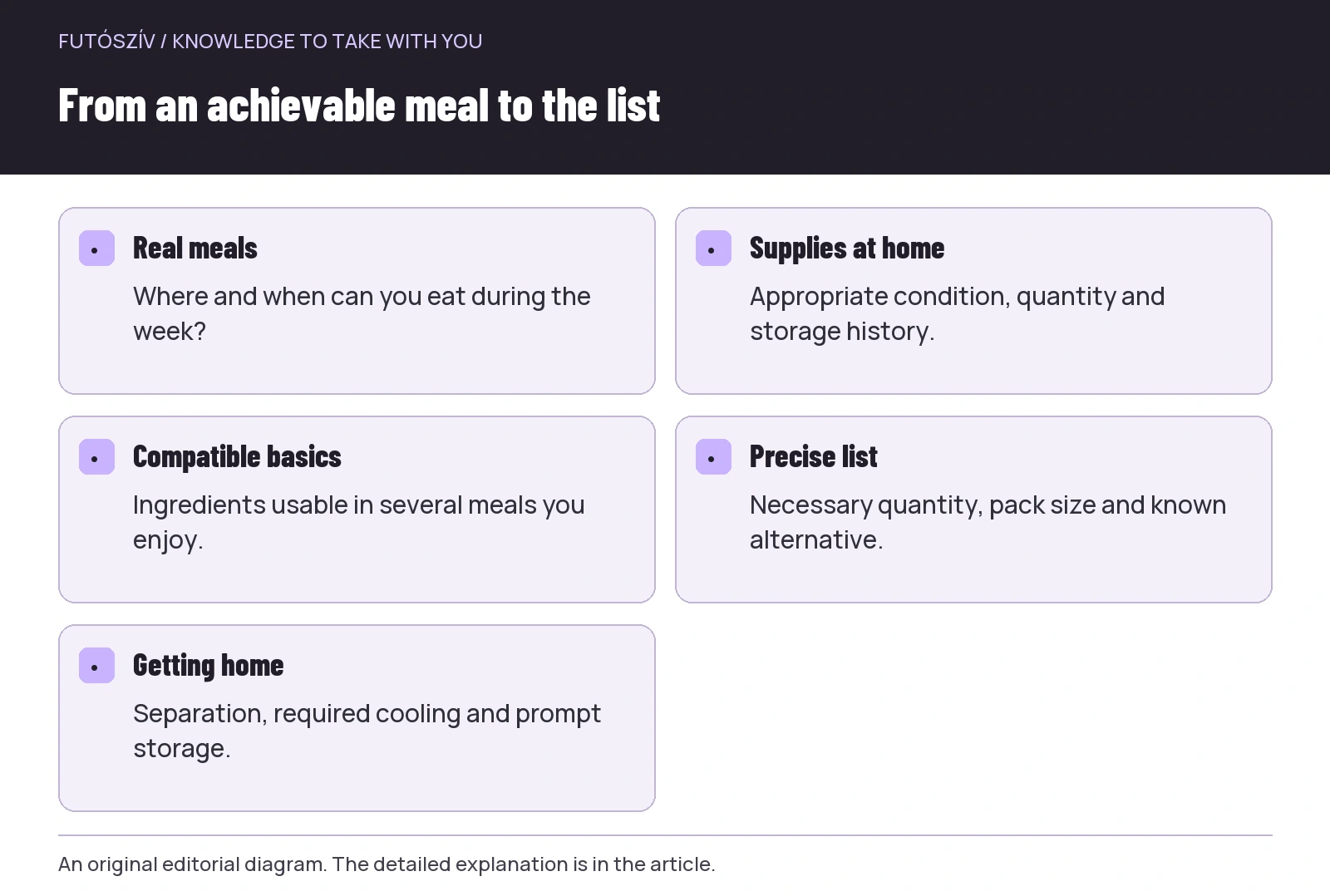
First consider when and where you will eat in the coming period. How many meals do you want to arrange at home, what will you take with you and on which days is cooking ahead not worthwhile? Choose a few real meal solutions based on work, training and family plans. Do not automatically create seven different recipes with many ingredients simply because there are seven days. Shopping should support achievable meals, not stock the pantry for every imaginable possibility. If the week is uncertain, a few versatile basics may offer greater flexibility.
Then check supplies at home. Look through the fridge, pantry and freezer, including packaging condition and usage instructions. Storage time and conditions for an opened product need following separately, not just the date on an unopened package. If an ingredient’s condition or storage history is uncertain, do not count it as definitely usable. Keep the review brief: what is appropriately available, what should be used first and what is missing for the specific meals? Items can then be added to the list more purposefully.
Make room for several elements of eating
The MDOSZ adult OKOSTÁNYÉR guide provides a general Hungarian foundation for varied, balanced eating. In shopping, this can help avoid an entire plan consisting of just one food group. However, energy and other needs associated with your running cannot be calculated simply from the list. An individual sports nutrition plan may require help from an appropriate professional. This article’s examples therefore show relationships between ingredients, not mandatory quantities or an identical plate for everyone.
You can think in simple meal-building roles: something forms the meal’s base, another element provides a protein source, vegetables or fruit complement it, and seasonings, fats or other ingredients suited to your eating complete it. Dietary needs, taste, cost and storage all matter in the particular choice. Do not treat every element in the examples as freely interchangeable, nutritionally identical units. Organisational substitution and nutritional equivalence are different concepts, so a precise substitution for a special diet may be a professional question.
 Enlarge diagram
Text version of the diagram
- Real meals
- Where and when can you eat during the week?
- Supplies at home
- Appropriate condition, quantity and storage history.
- Compatible basics
- Ingredients usable in several meals you enjoy.
- Precise list
- Necessary quantity, pack size and known alternative.
- Getting home
- Separation, required cooling and prompt storage.
Look for two real uses for an ingredient
If you would buy an ingredient only for one complicated recipe, consider whether it has another use you actually enjoy. You need not eat every item twice, but the idea helps filter out unusual ingredients that are later forgotten. For example, an appropriately stored vegetable fitting your diet may appear in a hot meal and in a fresh combination another day, if suitable for that ingredient. A canned pulse can go into a bowl meal or spread with different seasonings, following the label and preparation instructions. The aim is flexible cooking, not rescuing every leftover at all costs.
The two uses should occupy real places in the week. “It will be useful for something” is not the same as naming an ingredient for Tuesday’s and Thursday’s meals. Equally, do not plan one small package for several dishes without considering the quantity needed. Your household’s appetite and number of people are what matter, not the serving label in an online recipe. For a familiar dish, knowing from your own previous experience which pack size can reasonably be used may be enough. Running itself does not determine the household’s package size.
Three editorial meal families
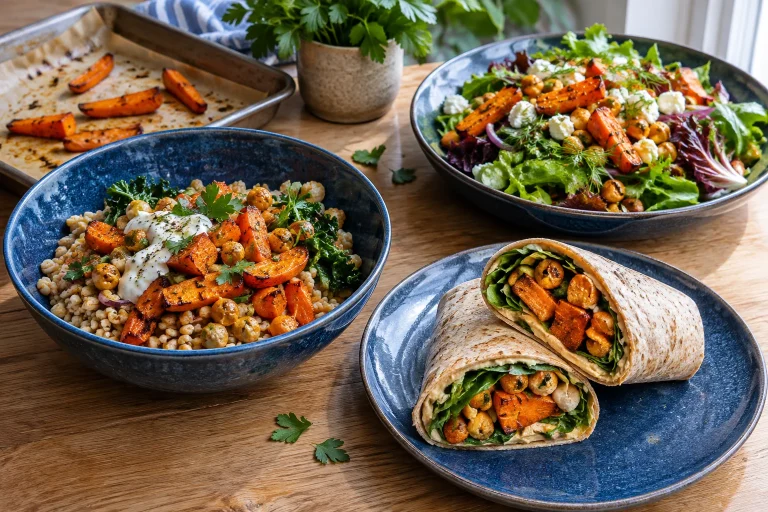
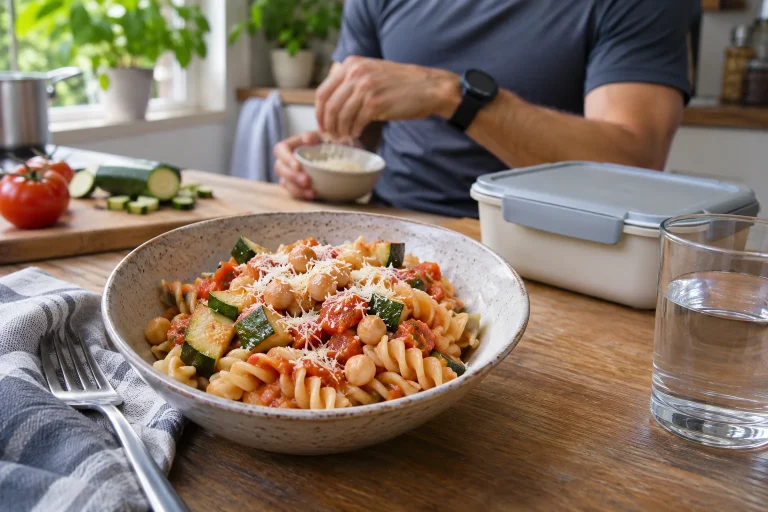
The first illustrative meal family is a hot bowl assembled from separate elements. It can include a side-dish base fitting your diet, an appropriately prepared protein source and vegetables, with varying seasonings. The second is a sandwich or other bread-based meal with toppings and accompaniments suited to your needs. The third is a simple breakfast or snack combination using familiar ingredients you enjoy. These are organising categories, not a complete diet covering every need or an exclusive list of athletes’ foods.
Ingredients can overlap between the three families, but storage requirements must remain intact in every case. A refrigerated ingredient does not become suitable for unlimited travel time because it goes into a sandwich. Transport and reheating of cooked food also need to follow safe handling. Meal families provide ideas for reducing daily decision-making while keeping specific dishes varied. Assess nutritional suitability alongside your own needs, especially with training demands, illness or particular dietary restrictions.
| Ingredient role | Possible use | What should you check? |
|---|---|---|
| Familiar side-dish base | Part of a hot bowl or another favourite main meal. | Preparation, quantity needed and storage. |
| A protein source fitting your diet | A separate topping, spread or main-meal ingredient. | Actual suitability, allergens and safe handling. |
| Vegetables and fruit | Several fresh or cooked meals where appropriate for the ingredient. | Order of use and necessary cleaning. |
| Seasoning elements | The same base with a different flavour profile. | Ingredients, instructions after opening and actual use. |
| Simple backup | An available meal planned for a changing day. | Storage and preparation conditions suited to the location. |
Do not seek variety only through new products
A proven basic dish can change through different appropriately chosen vegetables, seasonings and ingredients. Variety does not necessarily mean opening a new recipe and new packages every day. The NSW Institute of Sport sports nutrition page on meal ideas also addresses variety alongside balanced meal combinations. Adapt examples to your own needs and tastes rather than copying elite-athlete portions. The shared underlying idea is that appropriate eating can also be organised through varied combinations of ordinary foods you enjoy.
Before shopping, mark which ingredients you know will be used and which are new trials. Do not automatically choose the largest package of the latter if you do not yet know how you will use it. For family meals, consider a shared base and separate additions while respecting known restrictions and safe separation. Everyone need not receive the same portion or seasoning merely to simplify cooking. The list helps implementation; shared shopping does not make individual appetite and needs identical.
Substituting when the original item is unavailable
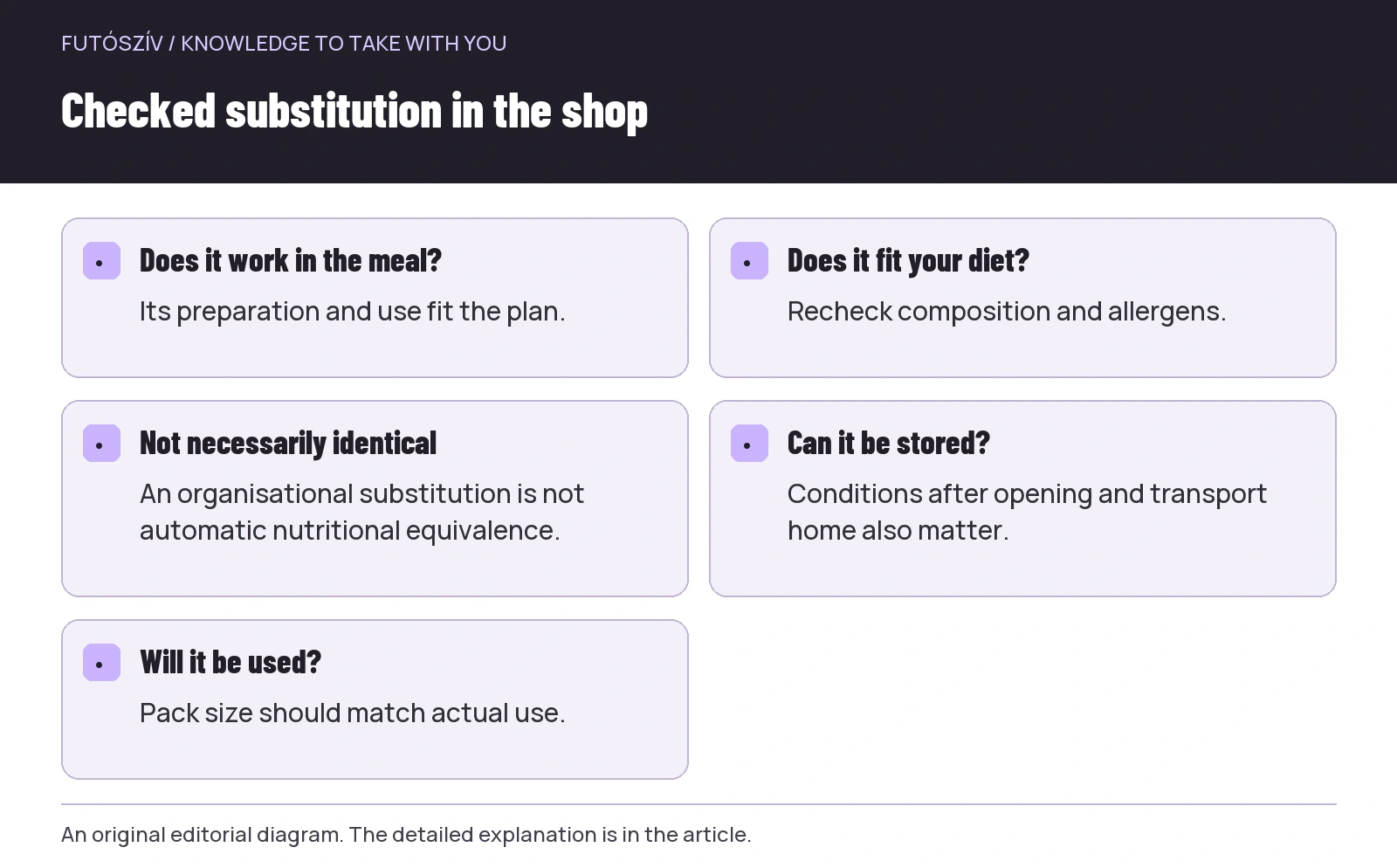
Add an alternative beside the list that you actually use and that works in the dish. A missing shop item then causes less disruption. The alternative should not merely have similar packaging: preparation, composition and storage should fit too. Read the label separately on a substitute thought to be allergen-free and follow the instructions for the known allergy. A different flavour or pack size of a familiar brand may also differ. Quick decisions are helped by choices considered beforehand, not by skipping the label.
An ingredient substitution is not always nutritional sameness. A drink, spread or meat alternative may have a different composition and should therefore be assessed against your dietary needs. For a plan made towards a sports nutrition goal, clarify substitutions with the professional. On an everyday organising list, however, you can clearly mark permitted choices: if this is unavailable, I will choose this already known, suitable version. Make the condition unambiguous. If there is no suitable alternative, you can change the meal rather than preserving the appearance of the original recipe at all costs.
 Enlarge diagram
Text version of the diagram
- Does it work in the meal?
- Its preparation and use fit the plan.
- Does it fit your diet?
- Recheck composition and allergens.
- Not necessarily identical
- An organisational substitution is not automatic nutritional equivalence.
- Can it be stored?
- Conditions after opening and transport home also matter.
- Will it be used?
- Pack size should match actual use.
Pack size: the usable quantity matters
Unit price may be important, but also consider how much you can actually use in your decision. A larger package is advantageous if it can be stored appropriately and used under the relevant conditions. Do not buy more perishable food than the real plan requires for the feeling of saving money. Check package instructions after opening while still in the shop. The original date does not tell you for every product how long it keeps once opened. Nor should freezing be assumed possible for every ingredient.
The Nébih menu-planning guide also stresses coordinating supplies, realistic consumption and shopping. Your list should therefore make room for the actual routine and storage capacity, not just discount labels. Leftover use can be planned ahead but is conditional on safe handling. Food with an unknown history does not become suitable because you feel bad throwing it away. A useful first step in reducing waste is often preventing excessive purchases rather than risky rescue later.
Shop order and the journey home belong to the list too
The Nébih Shop Wisely publication also discusses appropriate separation and taking chilled and frozen products home. Perishable items and those requiring cold storage need suitable transport, while raw ingredients must not contaminate ready-to-eat food. Combining a training trip with shopping is therefore a good idea only if the necessary storage conditions are actually arranged. Refrigerated food waiting in a car after shopping does not receive suitable conditions merely because you left it in the shade.
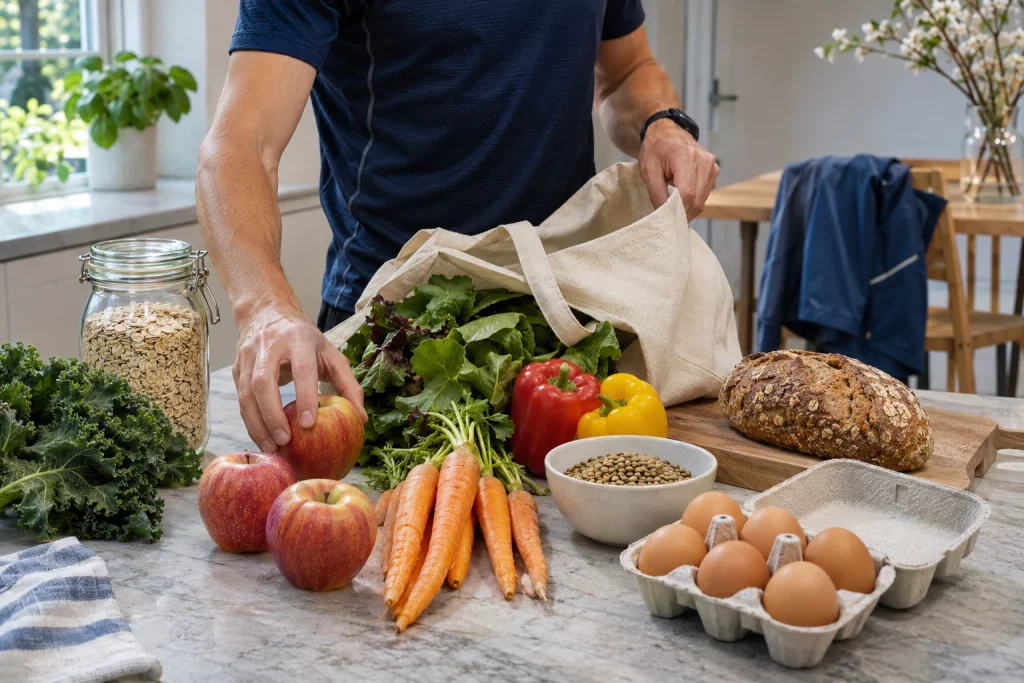
You can group the list in shop order, appropriately leaving chilled and frozen goods until last, then arranging transport home and storage. Before leaving, have a suitable bag and cooling solution for products that need them. Examine packaging damage, labels and storage instructions. This is not separate administration unrelated to sport: purchased food becomes a usable part of the weekly plan when it reaches home and its storage place in suitable condition. The list can therefore include a storage note, not just a product name.
How a flexible list works in practice
In an imaginary example, someone plans hot bowls for two evenings and an easily assembled bread-based meal for one day, with other arrangements already in place for the remaining days. The list includes shared vegetables usable in several dishes, appropriate bases and protein sources fitting their diet. If they arrive home later one day, they can switch to a simpler combination while maintaining safe storage. No specific portion or timing is prescribed here. The example shows organisational flexibility, not a complete nutrition plan or calculation of an athlete’s needs.
At the end of the week, they examine which products were used as planned and which needed a new idea. The latter does not necessarily indicate a poor food choice; it may result from a changed routine or an oversized package. They modify one specific point in the next list. Good shopping thus gradually adapts to your own life. It becomes a supply of ingredients from which you can actually make suitable meals you enjoy alongside work, family and running, rather than a universal list of forbidden and compulsory items for every runner.
Sources and further reading
- MDOSZ: The updated adult OKOSTÁNYÉR
- NSWIS: 38 balanced meal ideas for athletes
- Nébih: Shop wisely
- Nébih: Menu planning without leftovers
How Futószív articles are prepared: our editorial guidelines.