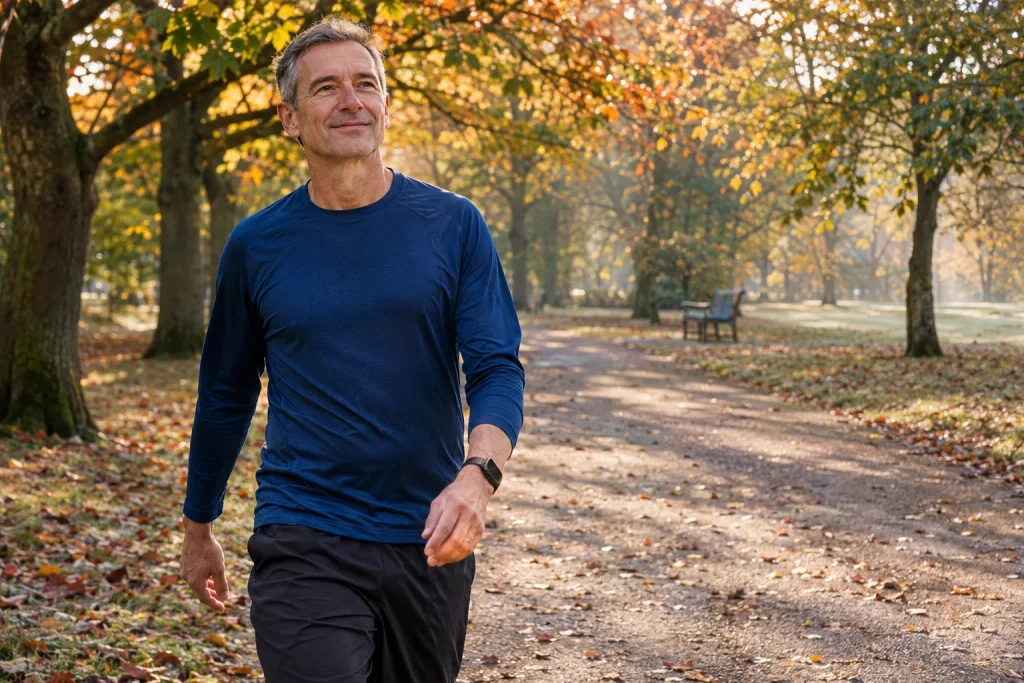
Some runs reach a point when it suddenly feels good simply to be there. Movement feels easier, earlier tension recedes and the whole situation seems unusually pleasant. At other times, what remains at the end is quiet calm rather than intense joy. The runner’s high, often called a running trance or running euphoria in Hungarian, is a researched phenomenon within this world of experience. The term does not name one sensation that switches on identically for everyone.
The interesting question is how a personally experienced good feeling can be placed alongside processes studied in the body. Researchers may use self-reports, behavioural tasks and biological samples, but these reveal different layers of the experience. This article starts with two original human studies and uses our own everyday examples to explore what the joy of running can mean in personal experience.
What can a runner’s high feel like from within?
Research descriptions of the runner’s high emphasise euphoria and reduced anxiety. In everyday language, someone might not describe this as a grand, celebratory outburst. A personal account might say that you feel freer, find it easier to stay with the rhythm of movement, or finish the run with a pleasantly settled mood. These are illustrative descriptions, not quotations from actual research participants.
It is worth leaving room for differences. One person might highlight a pleasant physical lightness; another might say that tensions from earlier in the day have less hold over their thoughts. A third might simply say that walking home felt good. A shared term can help us discuss an experience, but every account need not be squeezed into the same detailed story.
To describe your own feelings, start with simple words: joy, calm, energy, satisfaction, absorption. Then ask which changed and when you noticed. This makes the account more precise than the short label “I got the high.” You do not need to choose a scientific term for a good outing to have real personal value.
Joy, calm and pain can change separately
In the 2026 marathon and ultramarathon study, researchers assessed euphoria, anxiety and pain separately. This distinction matters for everyday interpretation too. A better mood does not necessarily mean every physical sensation changes favourably, and relief after activity is not the same as euphoria throughout the whole run.
In our imagined example, someone is delighted by the company and completing the outing while also feeling tired. Someone else has become calmer but did not find the movement particularly easy. These accounts are not mistaken because they contain several states. Naming mood, effort and physical sensations separately preserves that complexity.
A pleasant experience should therefore not create an expectation that every bodily signal must be set aside. The name runner’s high does not excuse ignoring a symptom. Understanding the experience is better served by being able to name both the good feeling and any difficulty experienced alongside it, without erasing either for the sake of the other.
 Enlarge image
Other signalling systems have joined the endorphin explanation
For a long time, endorphins were the word people associated with the pleasure of running. In more recent human research, endocannabinoids are important players too. Anandamide and 2-AG are the body’s own signalling molecules; their names do not mean that you take an external substance while running. The scientific question is how changes measured during and after activity relate to the experience reported.
A biological term alone does not explain every detail of your own good day. Relationships need to be investigated between a change detected in blood, processes in the brain and a reported feeling. Saying that two phenomena changed together is not the same as saying that one molecule generated the entire experience in everyone. Research makes the picture more interesting precisely by refining these relationships.
The idea a runner can retain is straightforward: a good feeling may have physical and psychological underpinnings, but need not be explained by a single “happiness chemical”. Scientific study of a complex experience remains exciting because it brings together several measurements and possible explanations. Your own account provides information about the experiential side.
What did the treadmill experiment with 63 participants find?
In 2021, Siebers and colleagues investigated the question in a randomised, double-blind experiment using data from 63 participants. They compared moderate-intensity treadmill running with walking and also used pharmacological blockade of opioid signalling. After running, they found greater euphoria, lower anxiety and increased endocannabinoid levels; opioid blockade did not prevent these favourable changes in experience.
This examines a stronger question than a simple observation that “I ran and felt better”: the researchers also tried to distinguish a proposed mechanism. The finding makes endocannabinoids important candidates in human research, but is not direct human proof of every receptor process involved. The medication component belonged to the controlled research design, not an everyday method to try out.
In this case, treadmill running was also associated with a pleasant change in experience. There is no need to declare an indoor-versus-outdoor winner from that. What is clear is that the phenomenon can be studied beyond outdoor runs in forests or cities. Environmental details of the experience are addressed by separate questions and other studies; this experiment should be interpreted within its own design.
Marathon and ultramarathon data add a timescale to the picture
One of the two 2026 field studies compared marathon running and time-matched walking in 19 trained runners; the other followed 36 ultrarunners. During the marathon, euphoria was higher and anxiety lower than during walking, while pain increased in the later phase. After ultrarunning, pain increased and anxiety decreased, but euphoria did not change significantly.
The time course of endocannabinoids measured in blood also differed: anandamide and 2-AG did not follow the same pattern in every phase. The study therefore provided a more complex picture of prolonged exertion and experienced states. Participants were experienced long-distance runners; the findings cannot be turned into a dose of joy applicable to every beginner, every training session and every longer distance.
The lesson to retain personally is that the relationship between distance and a good feeling should not be imagined as a simple staircase. A longer outing also entails different physical and organisational circumstances. Taking a target further does not, by itself, make a beautiful experience greater. Interpreting research data and planning your own running programme remain separate tasks.
A group average and your own story operate on different scales
When you read that mood improved on average in a study, do not picture every participant smiling equally. An average summarises a group’s data; a personal account concerns one person’s experience on a particular occasion. These perspectives can complement each other well, but answer different questions.
Our imagined first runner enjoys a calm loop, the second is satisfied with finishing, and the third notices hardly any change in mood during the activity. There is no need to rank their stories by value. Equally, a day when you experience no special euphoria does not disprove research on the phenomenon. Nor does research prescribe what you must feel at the end of your own outing.
A precise description is interesting because it preserves the circumstances too. What mood were you in when you started, were you alone or with others, and when did you notice the change? These do not need to become a home experiment proving a mechanism. They do, however, offer more insight into your run than the single question of whether it matched a runner’s-high story heard from someone else.
 Enlarge image
Five questions for a short note about the experience
If you are curious about your own enjoyment of running, you can write a brief observation after a few outings. There is no need to introduce another scoring table or personality test. These editorial questions are intended to help your own words show what happened. The note need not become compulsory administration after every session.
- What mood did I start in, and how did I feel at the end?
- Was there a distinctly pleasant phase, and how would I describe it in everyday language?
- Which changed: joy, calm, effort or physical sensation?
- What circumstances belonged to the outing: company, route, time of day or an unexpected event?
- What would I like to preserve from the experience without making it compulsory to repeat the same day?
An original sample sentence might be: “I started out tense, my mood became more pleasant in the second half of the park, and walking home quietly felt good.” This says more about the experience than an invented chemical score. About another outing, you might write that the company was good while the movement did not feel especially easy. Both are meaningful personal notes.
If you place several entries side by side, you can look for recurring descriptions, but name any pattern cautiously. A few good days do not establish that a single route, song or duration will necessarily trigger the experience. They can, however, reveal the language you use for good outings and what makes running personally valuable to you.
A running week has room for several kinds of joy
Runner’s high is a distinctive name, but everyday enjoyment of running can be broader. You may enjoy a good conversation, the sight of a familiar park or finding room in your day for an activity that matters to you. These can be named as sources of experience in their own right. They do not all need to be treated as the same neurochemical state to be valuable.
| Aspect of the experience | Example of a personal description |
|---|---|
| A sense of freedom | “Suddenly, it felt good to stay with the rhythm of movement.” |
| Calm | “By the end, the thoughts I had started the day with held less of my attention.” |
| Satisfaction | “It felt good to finish in the way I had planned the outing.” |
| Social joy | “What stayed with me most was meeting up and sharing the story.” |
The table is an original editorial example, not a research scale. It highlights that even a single good run can contain several layers of experience, coming to the fore in different proportions from day to day. When discussing it with a running companion, “What was it like for you?” often produces a more interesting answer than asking whether everyone is seeking the same high.
Scientific curiosity and personal enjoyment can therefore sit comfortably together. It is interesting to learn what researchers measured, which signalling systems came into view and where questions remain open. Meanwhile, you can continue to experience your own good outing in your own words. This is what makes research on the runner’s high relatable: it connects to measurable processes, while the richness of experience cannot be expressed by a single number.
Sources and the role of the personal examples
The two original human sources are Siebers and colleagues’ 2021 treadmill experiment with opioid blockade, and Siebers and colleagues’ 2026 marathon and ultramarathon field study. The first design examined a proposed signalling role; the second followed biological and experiential changes over time in experienced long-distance runners. The diary questions, imagined running situations and illustrative experience statements in the Hungarian original are our own editorial aids, not participant quotations taken from the studies or diagnostic tools. Sources checked: 21 November 2026.
How Futószív articles are prepared: our editorial guidelines.