Returning to running involves several decisions
After a respiratory illness, it is easy to wait for a single sign: the fever has gone, you cough less or finally want to put running shoes on again. Returning, however, is more than choosing a date. How infectious you are, how you manage everyday activities and when you can resume previous training loads are different questions. They are connected but do not automatically receive a yes on the same day.
The familiar “above-the-neck” rule promises runners they can exercise with mild nose and throat symptoms but not symptoms lower down. This provides too little information for a personal decision. It does not reveal illness severity, underlying conditions, general health or how the situation is changing. A new chest symptom does not become important only according to whether it fits a popular saying.
The IOC consensus on respiratory infections discusses the neck rule as a historical, expert-based approach and describes risk assessment followed by ongoing monitoring of the response to exertion when returning. The IOC recommendation also distinguishes restarting activity from regaining previous performance. One first easy session is not the same as a complete return.
While ill, do not let the training plan set the deadline
With fever, marked weakness or feeling generally unwell, prioritise illness and necessary care over the planned run. The NHS flu information recommends rest and sleep and identifies circumstances predisposing to more serious illness. According to the flu guide , pregnancy, certain long-term conditions or a weakened immune system may mean professional help is needed sooner.
If symptoms may indicate flu or COVID and your risk of severe illness is higher, do not wait to discover how well you tolerate running. The CDC recommends contacting a healthcare provider early because timing matters for certain treatments. The information on managing cold symptoms therefore emphasises this even with a milder beginning.
Your own task at this point can be quite ordinary: cancel group training, make time for rest and arrange access to care if needed. Sporting goals do not disappear because you are not running now. “Ill, resting” is a more accurate log entry than counting a workout walked through in exhaustion as a successful run.
Reducing fever does not certify exercise capacity
Symptom-relieving medication may help you feel better without implying the infection has resolved or hard exercise is appropriate. The CDC explicitly separates temporary symptom relief from recovery. Do not take a preparation to hide a warning condition until the race start. Decide on medication use from the patient leaflet and professional advice.
With combination cold remedies, clarify which active ingredients you are taking too. The NHS warns that some combinations may contain the same ingredient as a separate medicine. Runners need not become pharmacology experts, but discuss simultaneous use with a pharmacist and report other medicines too.
A coach also needs to know if better well-being reflects symptom-relieving medication. The aim is not for them to assess a medication list but to avoid treating a masked condition as certain recovery. If symptoms first need suppressing to carry out the plan, reconsider whether it is truly time for activity.
 Enlarge diagram
Text version of the diagram
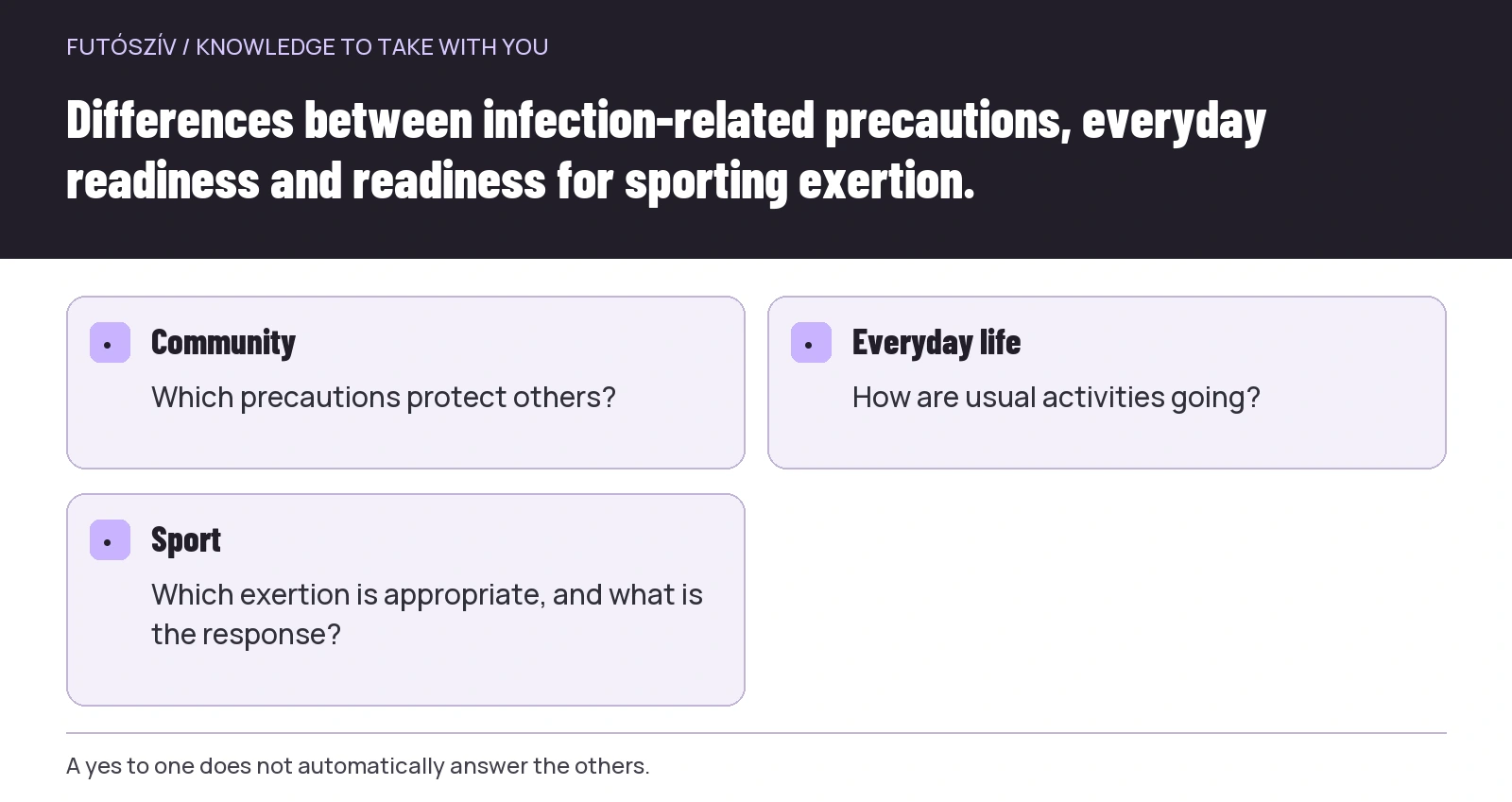
- Community
- Which precautions protect others?
- Everyday life
- How are usual activities going?
- Sport
- Which exertion is appropriate, and what is the response?
Returning to others and being ready to train are different questions
The CDC public guidance for respiratory viruses in general highlights symptoms improving overall and at least 24 hours free of fever without fever-reducing medication before returning to usual activities. It then recommends additional precautions for five days to reduce spread. The public-health information is not, however, a sports-medical fitness test for intense training.
In Hungary, follow current local health and institutional rules, especially in healthcare settings or near vulnerable people. Do not turn US general guidance into a universal law. When organising a running group, shared car journeys, changing rooms and indoor meetings after training matter too, not only the run itself being outdoors.
If you remain uncertain about spreading infection, choose the option protecting others and seek healthcare advice where necessary. Readiness for individual light activity does not imply the same day’s group programme is appropriate. Social experience matters, but recovery need not include attending every group session.
Which symptoms call for care rather than a test loop?
New chest pain, unusual breathing difficulty, fainting or feeling unwell with strong palpitations are not signs to test with an easy run. Severe or sudden illness requires urgent help; in Hungary, call 112. Do not head alone onto a remote route to discover whether symptoms disappear while moving.
The summary of the ACC myocarditis consensus discusses chest pain after a recent viral infection, arrhythmia-related symptoms and signs of heart failure as important warning features. The professional summary does not claim every such symptom is certainly myocarditis. It indicates appropriate investigation cannot be omitted based on a training log.
Illness that persists or worsens again after improvement may also justify medical consultation. The CDC lists returning or worsening fever and cough, breathing difficulty and dehydration among situations needing care. Waiting out one online time limit should not be the aim while health is concerning or deteriorating.
The first session aims to observe, not recover lost fitness
If your condition and, where necessary, clinical assessment indicate it is time to restart, choose a simple format easy to interrupt. Your pre-illness favourite pace is not a compulsory starting point. A short walk or light activity answers a different question from a long run. Choose the appropriate form from your situation, not a calculation based on days missed.
Do not combine a test, group meeting and long journey home in one plan. Have the option to finish in time and remain contactable. If working with a coach, agree beforehand on stopping conditions and what to report afterwards. A simple decision framework helps instead of “I will just go out and see”.
Observe general well-being, perceived effort and new or unusual symptoms. Watch data can add information, but one heart-rate reading should not decide everything. After illness, similarity to an earlier graph does not prove readiness for the old load either. Your condition and medical plan take priority.
The period after activity belongs to assessment too
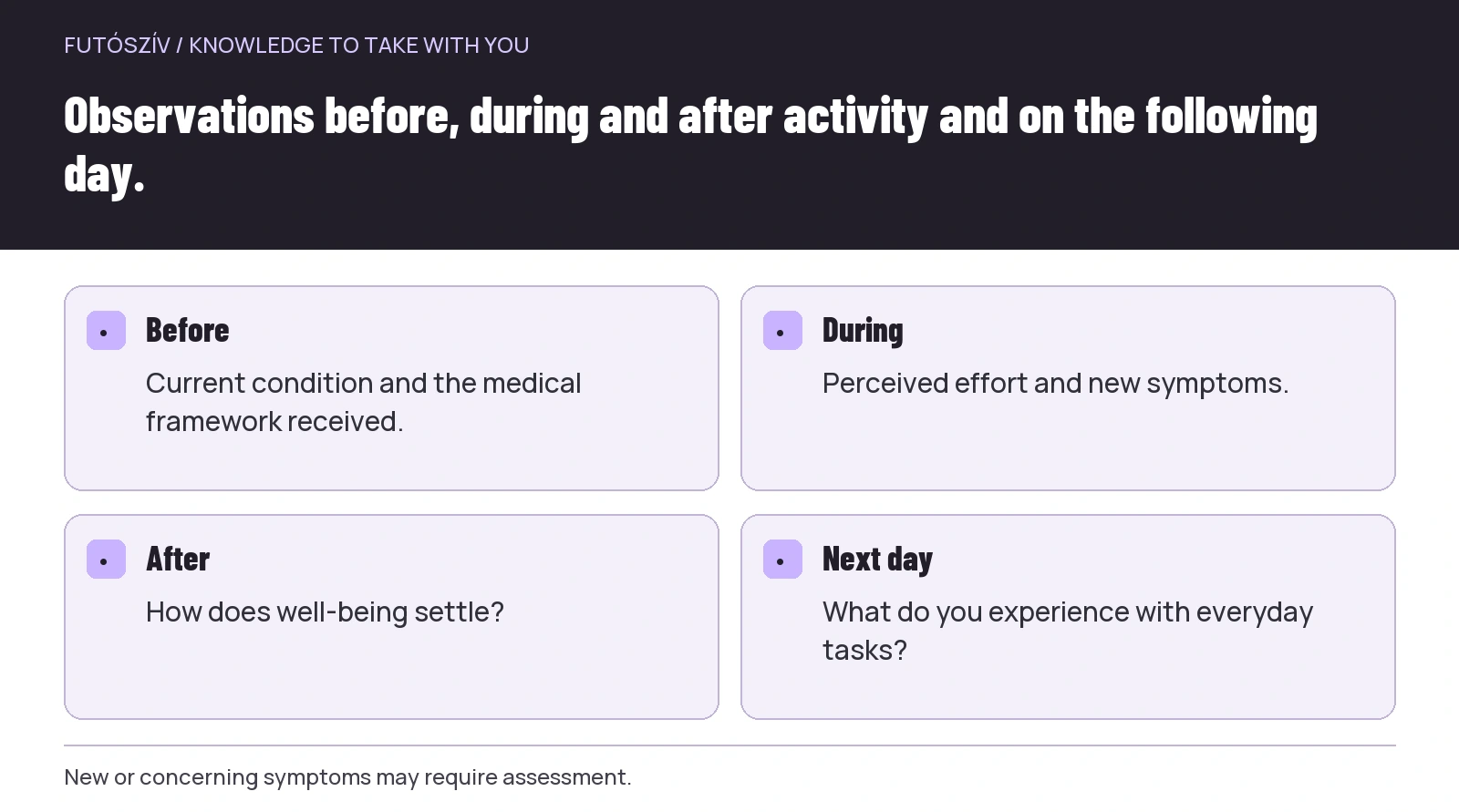
In the IOC return framework, what happens during activity is not the only consideration; later responses to exertion matter too. Follow this practically with a brief note: how was it during, immediately afterwards and the next day? Do not record only that you completed the designated route. Finishing alone provides too little information for deciding to increase the amount.
If disproportionate exhaustion, new symptoms or a return of earlier symptoms follows the first session, do not automatically repeat it harder the next day. Step back in the plan and seek assessment where necessary. For post-COVID condition involving post-exertional symptom exacerbation, the WHO guideline specifically advises against prescribing activity increased in fixed increments.
Observe everyday tasks in the log too. If getting to work or household tasks are unusually difficult the day after evening activity, that is important experience. Activity time is not a separate world from the rest of the day. Returning works when manageable alongside other necessary parts of life, not merely looking good in a workout file.
 Enlarge diagram
Text version of the diagram
- Before
- Current condition and the medical framework received.
- During
- Perceived effort and new symptoms.
- After
- How does well-being settle?
- Next day
- What do you experience with everyday tasks?
Do not make up sessions missed during illness
Several sessions in the old plan were written for days when you would have been healthy. They are not debts to squeeze together. The return week needs to match current capacity. If the long run, intervals and race-pace day were all missed, you still need not move all three to the beginning of next week.
First discuss which goal remains realistic. The next event’s completion goal may change, entry postponement may arise or another race may now be chosen. Work already done does not make starting compulsory. Entry fees and travel may be unpleasant losses, but neither measures current health.
Do not increase training intensity, length and frequency together merely because the calendar urges you on. Adapt how and how quickly changes happen according to your response. No universal formula calculates return time after days missed for every illness and runner. Simplicity here means manageability, not denying uncertainty.
What should you write to a coach or doctor?
In a brief message, separate facts from the question. When did illness begin? Was there fever or another significant symptom? What remains now? Which everyday activities can you do without difficulty? What happened after the first attempted activity? If there was a medical examination and advice, convey its sport-related part precisely too.
Do not write only “I am almost better”. That may mean different things to you and the other person. A specific description helps distinguish questions about permission for activity, planning training and investigating new symptoms. Coaches do not diagnose infection or myocarditis, while doctors should know which exertion you want to return to.
With confirmed myocarditis or another significant complication, returning is a separate specialist process. Do not apply a simple post-cold routine to it. Your clinician determines necessary examinations and reviews. One day of feeling well or one symptom-free walk does not itself override an earlier restriction.
Returning can follow a calm process
Create three separate lines in the plan: recovery and care, first appropriate activity, then rebuilding towards the desired load. You need not assign a certain date to each beforehand. Instead, note which information or condition will guide the next decision and whom to contact if uncertain. This makes the process clearer without promising speed.
Social support may help a great deal: someone can accompany a short walk, take over a task or accept cancellation of a shared run. A good companion does not count the absence but helps you actually carry out the decision. Illness is not a character flaw, and recovery need not be justified through hard training.
Before the next departure, ask not how much you lost but which activity now fits your condition and advice received. The previous routine may become important again later. First gather experience on which the next session can be built calmly too.
Sources
- IOC: Acute respiratory illness in athletes, part 1: acute respiratory infections
- CDC: Preventing spread of respiratory viruses when you are sick
- CDC: Manage common cold
- NHS: Flu
- ACC: Expert consensus decision pathway on myocarditis, key points
- WHO: Clinical management of COVID-19, living guideline, June 2025
How Futószív articles are prepared: our editorial guidelines.