
A broken routine may reflect a real change
Running after work used to feel natural; now weeks pass without a run. It is easy to immediately look for a failure of self-discipline. Yet your job may have changed, you may have new family responsibilities, you may need to travel to another route or you may have stopped for health reasons. The first question in restarting is therefore what disrupted the previous arrangement.
This article concerns organising habits and daily routines. It does not provide a return-to-running plan after illness or injury. If either explains the break, clarify current health-related boundaries with an appropriate professional. Even a working calendar reminder cannot establish which workload is safe for you. Organisational and healthcare questions are separate tasks.
A habit is more than an unbroken streak
Lally and colleagues’ study of everyday habit formation followed repeated behaviour and the development of automaticity. It examined chosen everyday actions; it cannot establish an exact deadline in days applicable to every runner. Treat familiar promises of quickly building a habit cautiously.
A running routine can also have several parts: choosing a time, preparing, getting there and undertaking appropriate activity. They do not all need to become automatic at once. Instead of focusing on the broken streak, examine which part worked before and which now needs a new solution. Earlier experience is not erased by empty weeks in the calendar.
Describe the obstacle in a way that connects to a decision
‘I have no time’ can hide different situations. The usual group’s time may clash with a new responsibility, or the journey home may have become much longer. Specify the day and step that are difficult. A concrete obstacle allows a concrete question: is there a nearer meeting point, another route or a different arrangement?
By contrast, the general judgement ‘I have become lazy’ reveals few solutions. It does not explain what can change or what help is needed. Try describing the situation factually, as though looking at a friend’s schedule. Real circumstances, rather than a judgement about yourself, become the starting point for planning.
Do not copy your previous best week back into the calendar
An old training calendar may remind you what regular movement felt like. The same system may not fit your current week, however. Your own past can be an unrealistic comparison if circumstances and capacity have changed. Understand current possibilities from the current situation.
If you work with a coach, explain the whole change rather than only saying you want to run again. Available time, work, rest and health history may all matter to the programme. This article does not prescribe how much training to return with. Its practical suggestion is to clarify a manageable framework before expecting to repeat past performance.
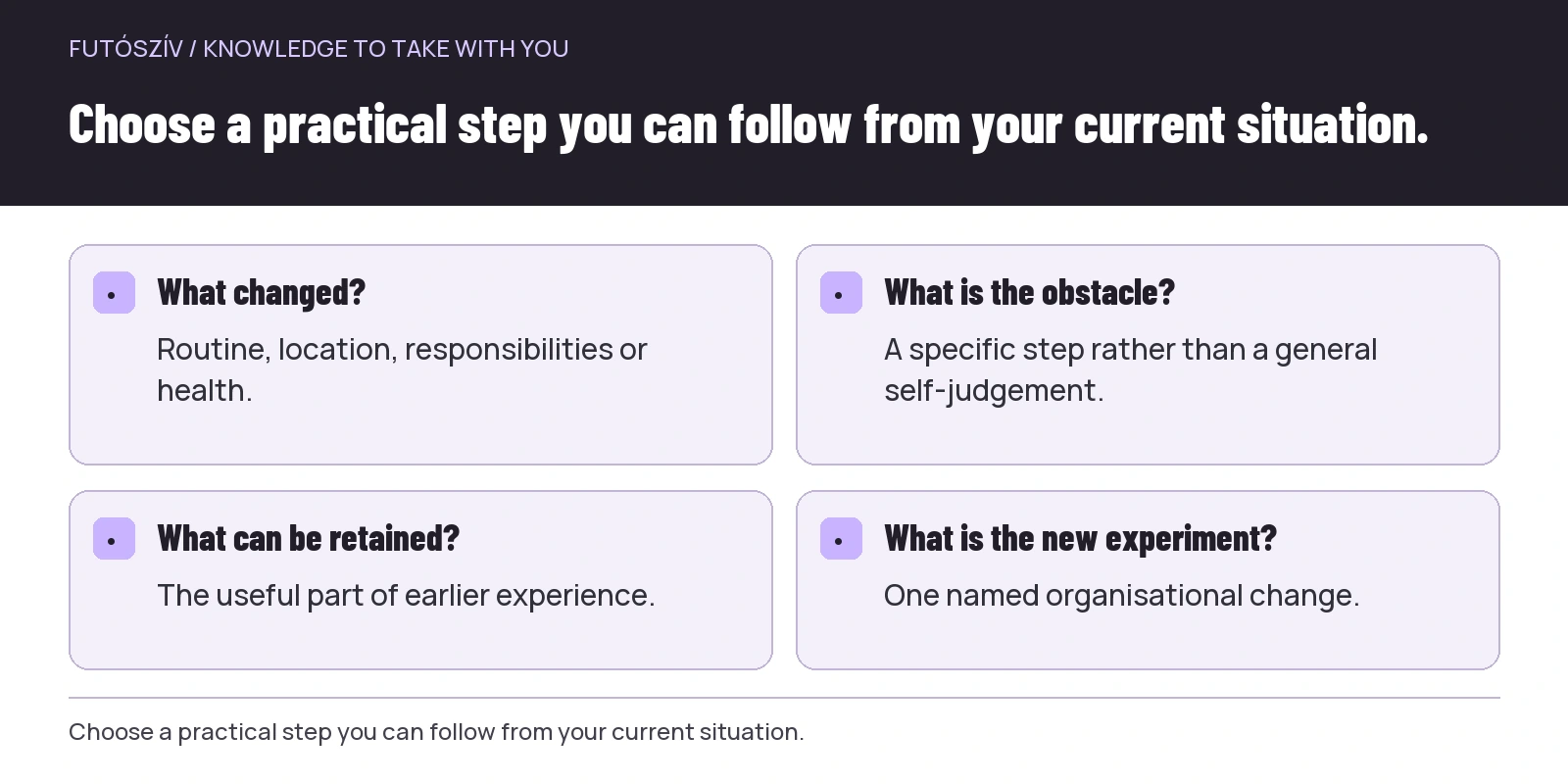 Enlarge diagram
Text version of the illustration
- What changed?
- Routine, location, responsibilities or health.
- What is the obstacle?
- A specific step rather than a general self-judgement.
- What can be retained?
- The useful part of earlier experience.
- What is the new experiment?
- One named organisational change.
Find a recognisable cue for getting started
Instead of rewriting the whole week at once, choose a situation to which the agreed activity can connect. For example, a particular after-work time window or a community meeting arranged in advance. The cue should be recognisable within your actual routine, rather than depend on an event that rarely happens predictably.
If your work varies, another planning point may suit you better than a fixed weekday. You might review opportunities when the next rota arrives. This is different from demanding a run every day. The organisational routine establishes when to decide, while a plan suited to your condition determines the amount of actual activity.
Remove one unnecessary decision from preparation
If many small choices await before leaving, examine which could be prepared at a calmer time. Keeping equipment within reach or choosing a route beforehand may simplify that situation. There is no need to reorganise your entire home. Resolving one recurring obstacle can be a meaningful experiment.
Do not make another large purchase merely to ensure the new system finally starts. First see what can work with the equipment already available. A genuine equipment or access problem can be addressed separately. Habit-building should not become endless preparation in which every occasion waits for one more perfect item.
A backup plan should not be a punishing catch-up
Think ahead about what happens if the chosen time does not work out. The answer may be returning at the next agreed session, adjusting arrangements or asking the coach. There is no need to automatically double the next day’s task. The appropriate continuation depends on the reason for the absence and the health situation.
The NICE behaviour-change guidance also discusses individual action plans, coping plans and support. This is a professional framework, rather than a specific running-load rule. In everyday organisation, it can mean having a feasible response to a difficult situation named in advance, rather than only self-blame afterwards.
Give social support a specific form
A running partner can make a meeting more predictable when their role is genuinely agreed. You might ask for a short message beforehand or a meeting point both can reach easily. You do not need to ask someone to force you out of the door at any cost. Keep support cooperative rather than supervisory.
Mind emphasises considering different personal possibilities and obstacles when starting physical activity. The suitable social arrangement varies too. A small group may help one person, while more independent timing fits another’s life. Your choice does not have to match one supposedly correct model of a serious runner.
Do not let the diary become another task that cannot be interrupted
If you want to see what works, note after a few occasions which arrangement helped. It might be a venue agreed in advance or an easier-to-reach route. The diary’s value lies in recognising recurring circumstances, rather than explaining every empty day. Restarting does not need to become a public challenge.
If recording creates tension or turns into constant monitoring, simplify it and discuss it with a professional if needed. Understanding how things work for you does not require a perfect dataset. Precisely recognising one real obstacle may offer more than a striking streak that is constantly policed. A planning tool is meant to support decisions.
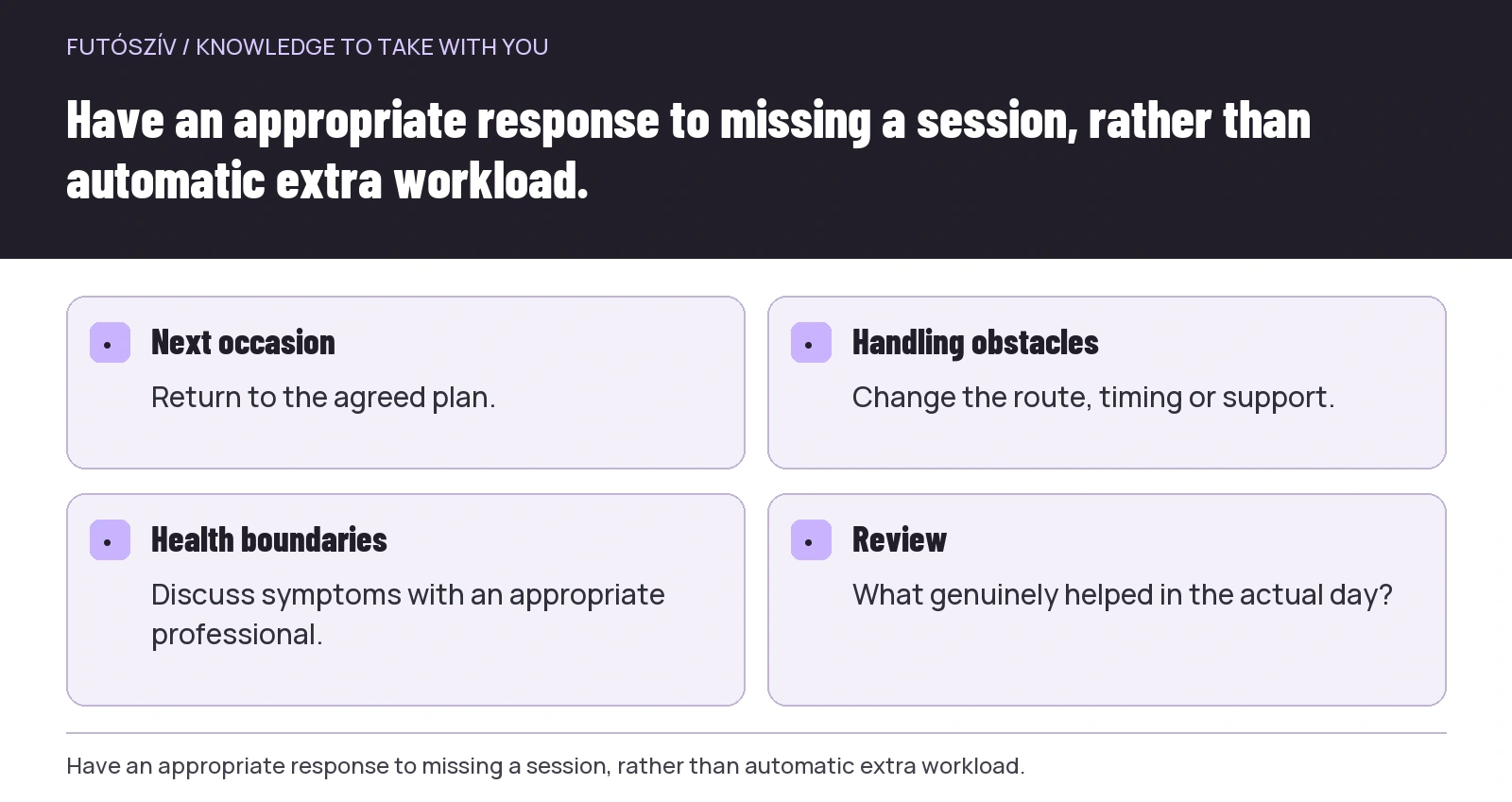 Enlarge diagram
Text version of the illustration
- Next occasion
- Return to the agreed plan.
- Handling obstacles
- Change the route, timing or support.
- Health boundaries
- Discuss symptoms with an appropriate professional.
- Review
- What genuinely helped in the actual day?
Distinguish a practical obstacle from persistent symptoms
If timing or travel is the main difficulty, look for organisational solutions. If the underlying issue is general loss of interest, persistent low mood, substantial anxiety or unusual exhaustion, do not try to resolve it only with a new calendar. These symptoms are also worth discussing with an appropriate healthcare or mental health professional.
When returning after illness or injury, symptoms and professional boundaries take precedence over routine. The habit of setting off must not override necessary restrictions. If the idea of missing a session creates disproportionate guilt or you cannot maintain rest, mention this too. A stronger reminder cannot resolve every obstacle.
Make the next experiment small but meaningful
Choose one practical element to test: prepare the necessary kit the evening before the next appropriate session, or contact your partner when your rota arrives. The experiment is not a recommendation about training volume. It tests whether one specific step reduces the difficulty previously identified.
Then ask what actually happened. If equipment was ready but the meeting remained impossibly far away, another obstacle remained in the system. More willpower is not necessarily needed. Choose the next experiment from what you have learned. Change then stays a learning process rather than repeated self-judgement.
An example involving changed working hours
A runner used to go to the club directly after work, but a new job means returning home later and somewhere else. Initially, they try to reach the same meeting, constantly rushing. Describing the difficulty precisely reveals that the wish to move has not disappeared; the former starting situation has. The next discussion therefore concerns accessible opportunities.
This story does not explain every restart. It shows that the environment supporting a working habit is part of the system too. When it changes, another solution may be needed. Rather than loyalty to the old routine, examine what current arrangement can last and which professional, social or practical support it needs.
Explain which feedback helps
If you rejoin a previous group, you can ask not to be greeted with demands to account for your absence. Saying that you are looking for participation suited to your current circumstances may be enough. Returning does not require a public explanation of recent months. Factual support agreed in advance is more useful than speculation about why you stayed away and what you must immediately make up.
Continuing does not begin by erasing the past
Your earlier experience remains: you may know which environment suited you, what helped you get started and which signs called for change. You do not have to rebuild everything identically, however. Restarting can be partly familiar and partly new. Choosing what to retain is as deliberate a decision as letting go of a framework that no longer works.
Choose the next step from your present possibilities. Make clear what you are trying, within which boundaries and when you will review the experience. A broken streak does not end your relationship with running. A useful routine does not demand that nothing ever change; it allows you to continue in a way that fits real life.
Sources and further reading
- Lally et al.: How are habits formed, original study
- NICE PH49: Behaviour change, individual approaches
- Mind: Tips for getting physically active
How Futószív articles are prepared: our editorial guidelines.