
Race information becomes useful when you can extract specific answers needed for your own start from a long webpage. Remembering date, distance and entry fee is insufficient. Bib collection, starting zone, cut-offs, equipment and change procedures together define what you undertake. A few precise questions can produce a clear personal information sheet.
The following ten questions work across events of different sizes and types. Answers must always come from the particular race’s current official material. Another organiser’s rules or last year’s experience may suggest good questions, but not certain answers for today. If an important point is missing or contradictory, ask the organiser for clarification.
1. Are you definitely reading the right year and race category?
An event’s web address may stay the same across years. Header, downloadable document, fee table and detailed starting time may not update together. Check which edition each concerns. If years differ, mark an open question instead of trying to correct them through your own calculation.
The same weekend may include several distances, individual entries and relays. The central date does not automatically establish your own starting day and time. Write the full name of the chosen race category. This helps select the correct line in entry lists, collection and detailed information.
A practical example is the Budapest Half Marathon pairs race page, which provides separate team details. Reading such a page requires identifying the season and category together. The method shown here does not transfer dates or fees from one edition into the next.
2. What exactly do the chosen distance and route mean?
Alongside the name, check detailed distance, terrain, elevation and basic course shape. A rounded race name may have more precise route data. Trail and road variants may differ even within the same event. Select the appropriate version on the entry platform.
Find maps of start, finish, important points and relay exchanges where necessary. You may not finish where you begin. Onward travel from the finish and clothing access therefore need separate questions. A site plan may matter alongside the route line: it shows connections between race centre, changing facilities and assembly area.
Race information does not assess your preparedness for you. Distance and route data support a decision but are not personalised loading recommendations. If unsure whether the undertaking suits you, clarify with appropriate professional help. “Fun” or “experience” in the name does not remove the need to read details.
3. When and through what steps does your entry become valid?
Submitting a form and having a final, completed entry are not the same step at every event. Check payment method, deadline and confirmation procedures. If interrupted, check status on the official platform. Your calendar entry does not prove everything is settled in the organiser’s system.
In the fee table, find the correct period, category and eligibility. Price per person and price per team have different meanings. For a discount, check proof and usage conditions too. The smallest visible amount is not automatically your fee. Read the final summary before approval.
The official Tajga Trail race information , for example, separately explains registration and successful payment. Specific conditions vary by event. The lesson is to find the point at which entry becomes valid and check your own status against it.
 Enlarge diagram
Text version of the diagram
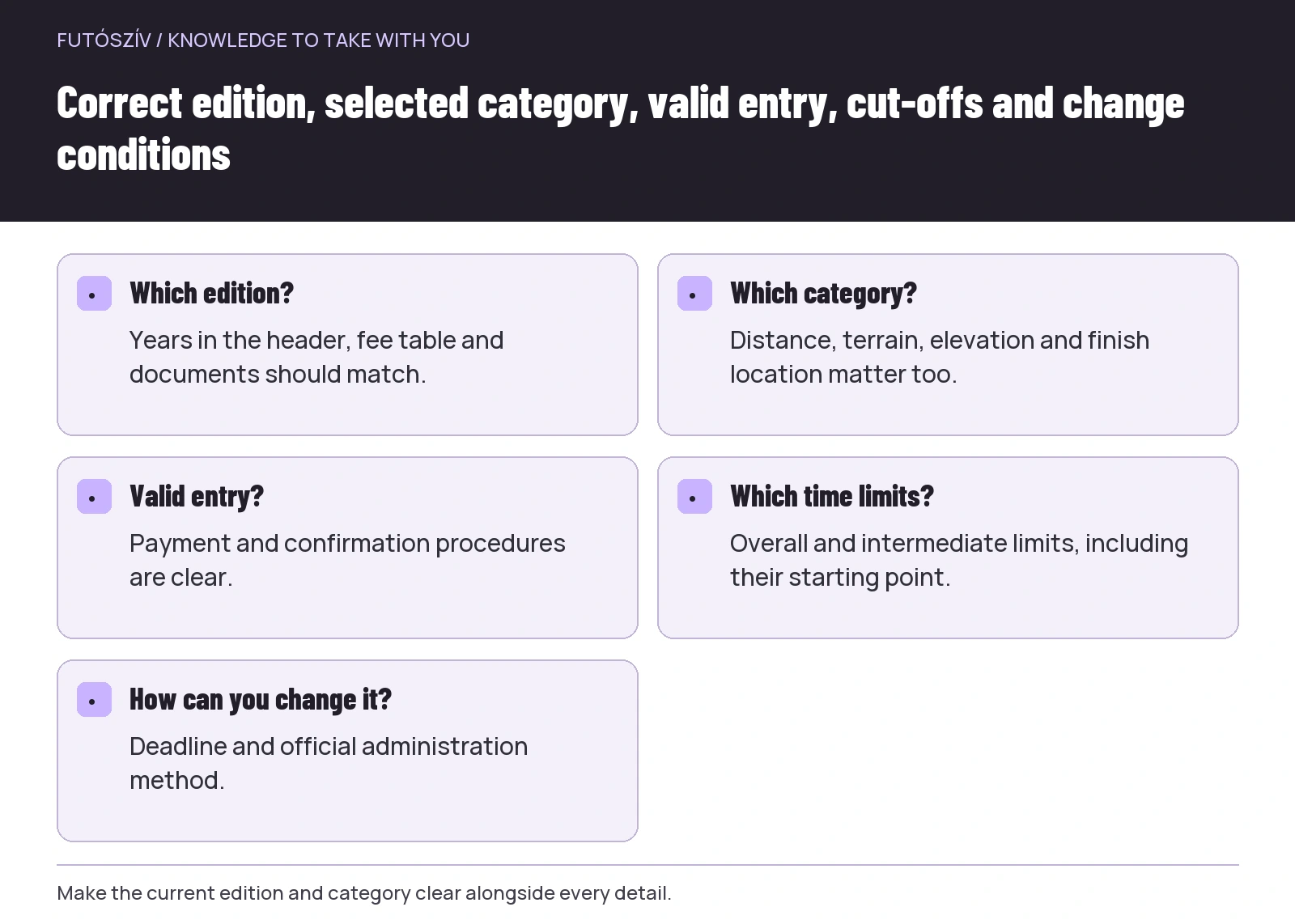
- Which edition?
- Years in the header, fee table and documents should match.
- Which category?
- Distance, terrain, elevation and finish location matter too.
- Valid entry?
- Payment and confirmation procedures are clear.
- Which time limits?
- Overall and intermediate limits, including their starting point.
- How can you change it?
- Deadline and official administration method.
4. Where and how do you receive the bib?
Collection hours do not necessarily match the race centre’s all-day opening. Check the place, day and deadline for your distance. If previous-day collection is possible or required, that affects travel too. Do not plan arrival only for the starting time.
Record which details, documents or confirmation are required. Collection by another person may have separate conditions; do not assume them from another race. For a team, clarify who handles collection and how necessary items reach the correct member.
Your personal sheet for on-site administration can include race number, entry identifier and where to find official confirmation. You do not need to share everything publicly. The aim is to avoid searching through several messages at collection. Choose document format according to organiser guidance.
5. Which times actually apply to you?
Distinguish venue opening, end of bib collection, baggage deadline, assembly and start. If several waves or zones start, identify your own. Turn the central timetable into your own sequence. Pre-start tasks do not all happen at one moment.
Include the approach in your timetable too. The start gate may be farther from the race centre, or on-site traffic arrangements may require a detour. The point accessible by car can differ from the actual pedestrian entrance. Check city closures and transport changes for the day too.
Do not calculate every task against the latest official deadline. Queuing, finding your way and clarifying a question can take time. There is no universal number of arrival minutes for every event, so start from your own task list. Give spare time a real role.
6. How do the starting zone and timing work?
Check whether there are zones, what data determined them and how you are identified. Information may also explain changing your selected zone. The particular event defines the zone’s purpose and rules. Do not stand elsewhere simply to find the shortest wait.
For timing, find where the chip is, how to wear it and what happens after finishing. A device built into a bib and one to hand over may need different use. In a relay, knowing which object must be passed is especially important. Prepare according to your own event’s instructions.
Check chip/net and gun/gross time definitions and the basis of results order separately. Not every race uses the same format. Starting your watch does not replace official timing. For later results questions, use the organiser’s stated process and deadline.
7. What does the cut-off mean, and are there intermediate limits?
There may be checkpoint limits alongside an overall cut-off. Check where timing begins and how that affects a later start. Keep the precise wording on your own sheet. Not every “three hours” has the same starting point.
With trails or relays, intermediate points and conditions for the team as a whole can be particularly important. Simply dividing the total distance does not necessarily produce a suitable plan. Route, elevation and point-specific rules define the framework together. A cut-off is an organiser condition, not a recommended training intensity.
Read what happens after reaching a limit or withdrawing. Where and to whom must you report, is return transport organised, and what must you arrange independently? These are easier to find beforehand than for the first time on the course. Knowing options in advance makes the whole day’s plan more accurate.
 Enlarge diagram
Text version of the diagram
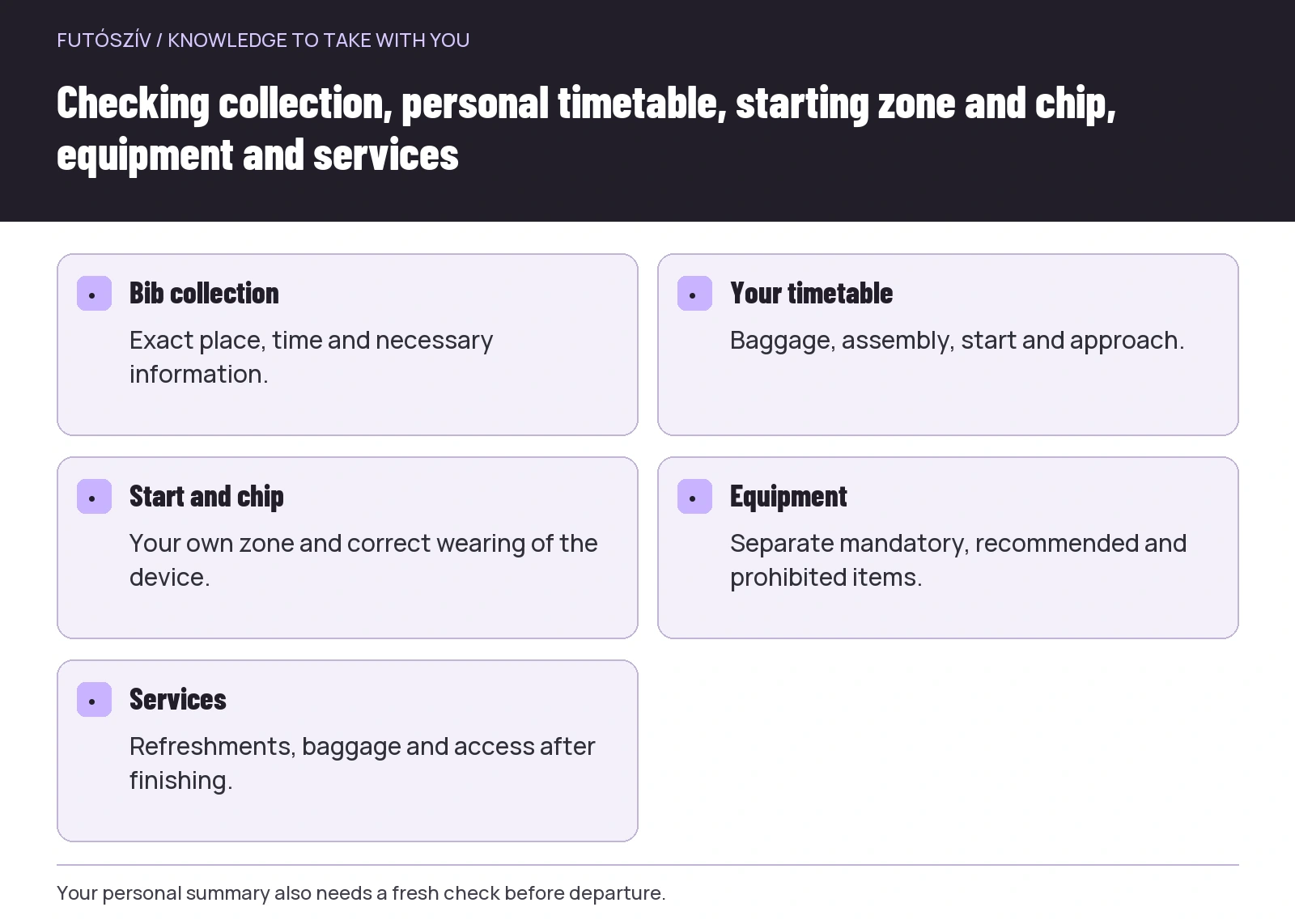
- Bib collection
- Exact place, time and necessary information.
- Your timetable
- Baggage, assembly, start and approach.
- Start and chip
- Your own zone and correct wearing of the device.
- Equipment
- Separate mandatory, recommended and prohibited items.
- Services
- Refreshments, baggage and access after finishing.
8. What is mandatory, recommended or prohibited?
Copy mandatory equipment into a separate list in your own words while preserving exact requirements. Do not mix it with recommended pieces. Functioning condition, charge, size or wearing method may be conditions too. Check inspection procedures and test equipment beforehand.
The official WTF COLD page , for example, describes basic equipment and additional requirements depending on conditions. Always check the actual current list at the event. A pack prepared for another race does not prove you have every necessary item for this start.
Check rules about animals, companions, headphones and other devices. Do not assume what is familiar in everyday running is permitted at an organised event. Participation conditions belong to the specific programme. If something matters for a personal need, request precise organiser information beforehand.
9. What do you receive on course and at the finish, and what remains your task?
Check aid-station locations, provision descriptions and whether you need your own cup or container. A station’s existence alone does not establish available products or services. Relate your own tested fuelling plan to the particular provision. Clarify health or nutritional needs separately and appropriately.
Baggage storage, luggage keeping, changing facilities and valuables storage may be different services. Read size, timing and collection conditions. Post-finish clothing helps only if genuinely accessible. At relay exchanges or a separate finish, this may involve your own transport task too.
Plan the meeting point after finishing as well. Rather than searching by phone, a specific place recognisable on the site plan can simplify meeting. Spectator access may differ from competitor areas. Anyone accompanying you needs to understand site arrangements too.
10. What happens if you need a change?
Entry transfer, distance change, team-member modification and withdrawal may be separate processes. Find current deadlines, fees and administration methods. Do not assume physically handing over a bib settles every detail and entitlement. Follow the official process.
Read conditions for organiser changes or cancellation too. This article offers no general legal interpretation or uniform refund promise. Consult the particular event’s announcements and terms applying to you. Important disputed questions may require appropriate customer-service or professional help.
Finally, identify where to check the last update. Your sheet is a useful summary but does not replace newer organiser announcements. Checking start time, route and significant changes before departure should be part of the programme. Put the saving date on your sheet too so you know the age of its information.
Ten answers can become a short race-day sheet
Event name and edition, category, settled entry status, collection, personal timetable, start and timing, cut-offs, mandatory equipment, services and change channel can fit into one clear note. Keep unresolved questions on separate visible lines. Reading race information then produces a manageable personal programme in which you know where answers came from and what still needs checking before departure.
How Futószív articles are prepared: our editorial guidelines.