
If you can no longer take part in a race as planned, first clarify what change you want and what the event permits. Transferring an entry, changing distance, replacing a team member and withdrawing may be separate matters. Physically handing over a bib does not by itself update participant details or complete the process required by the organiser.
A workable procedure always starts with the current conditions applying to your own entry. Practice at another race, an old comment or a friend’s experience does not replace them. The guide below provides an administrative workflow for gathering information and using official channels. An individual legal dispute or interpretation of a contract may require appropriate professional assistance.
First name the change you want
Would you cancel your own participation? Choose a different distance? Would somebody else take your place? Would a relay team member or running order change? These may affect different fields and procedures. Precise wording helps you find the relevant part of the rules.
If you have not decided on the type of change, describe the situation without immediately promising somebody a solution. For example: “I need to resolve my individual entry because I cannot take part; I am checking the official options.” This avoids committing in advance to a transfer or refund that the organiser does not offer.
The health reason and the administrative option are separate questions. Resolving your entry does not decide which movement is appropriate for you. Symptoms or uncertainty need clarification with a suitable professional. A fee already paid or an approaching deadline is not personal clearance to participate.
Look for the rule for your own event
Use the registration confirmation to reach the event’s official website and its amendment, withdrawal or cancellation conditions. Check the season and race category. If several documents apply together, read every relevant section. An organiser’s general page may be supplemented by event-specific conditions.
Organisers can genuinely differ. The Budapest Half Marathon registration information page treats withdrawal, distance changes and team-member changes separately, for example, and does not allow individual bibs to be transferred between people. It is therefore incorrect to say generally that every entry can simply be sold to somebody else. Check the precise current condition on the page.
The RUNaway cancellation policy describes different options for carrying entries over and changing names at its listed events, subject to specified conditions. This likewise does not mean the same option applies to every event or at every time. Examine the document’s scope together with the reference from your own event.
Do not confuse four separate matters
| Desired change | Basic question | What should you find in the official information? |
|---|---|---|
| Another person would participate | Are transfers between people permitted? | Conditions, deadline, required details and approval |
| You would choose another distance | Is a distance change available? | Availability, procedure and handling of any fee difference |
| You would change something within a team | Who is authorised to amend it? | Team member, order, category and deadline |
| You would not participate | What withdrawal procedure exists? | How to cancel and what may happen to the payment |
The table organises questions; it does not promise entitlement. Your event may offer no option for a particular row. Treat that as a definite answer too. Look for alternatives among the remaining official options, rather than an informal workaround that bypasses the rule.
 Enlarge diagram
Text version of the illustration
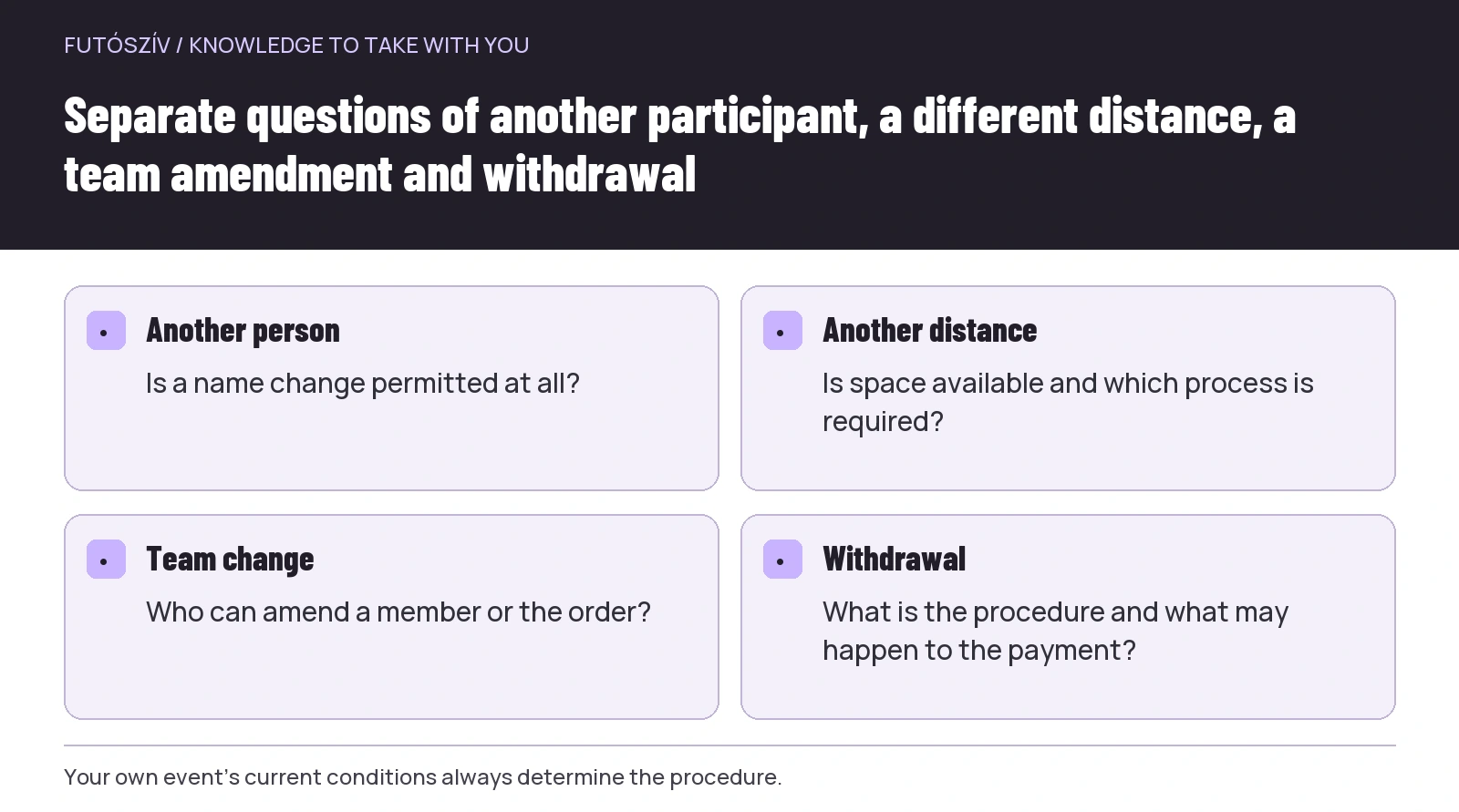
- Another person
- Is a name change permitted at all?
- Another distance
- Is space available and which process is required?
- Team change
- Who can amend a member or the order?
- Withdrawal
- What is the procedure and what may happen to the payment?
A deadline involves more than a date
Check the year, day and, where necessary, exact time. If the rule mentions calendar days or a period before the event, read the wording precisely. Do not automatically assume working days and calendar days are the same. Ask in good time if the wording is unclear.
The deadline for submitting a request may differ from the deadline for completing the process. Further details, payment or confirmation by another party may be required. Leaving this until the last moment can leave no time to supply missing information. On your own sheet, mark not only the closing day but also the next action.
The contact channel’s processing time may matter too. If the process uses email, do not assume an evening message will receive an immediate reply. Use the contact details and procedure published by the organiser. A social-media comment or private message is not an official application at every event.
Read precise wording about what happens to the money
A repayment, online balance, credit, voucher and transfer to another event can be different options. Do not automatically call them cash refunds. Check how much remains, whether there is a deduction, what it can be used for and until when. Billing or payment questions may require separate administration.
The BSI registration information also discusses crediting an online balance and using it in its withdrawal process, for example. Check the specific current deadline and deduction for your own event. This article does not set an amount applicable every year. Verify the outcome in your own account and in the confirmation received.
If you purchased a separate service associated with changes, find its conditions too. Its name alone is not enough to understand what it includes. RUNaway’s document mentioned above separately explains the nature of its extra cancellation service, for example. Do not infer a general insurance or refund promise from the name.
Gather the identifiers for your own entry
Prepare the event name, season, race category, entry or runner ID and the name used for registration. For a team, its name and the person authorised to make changes may matter too. Use these in official administration rather than posting them unnecessarily in a public comment.
Collect another person’s details only for the agreed purpose and within the scope requested by the organiser. You do not need to share account passwords to learn about an official transfer process. Participant accounts must be handled according to the system’s own procedures. The organiser’s guidance determines the actual data fields.
If somebody else paid for or arranged the entry, speak to them first. The change may be possible only from their account. Avoid several people sending requests with different content at the same time. One designated contact and shared information can reduce misunderstanding while keeping those affected informed.
Write a short question that can be answered
A useful message starts by identifying the event and entry, followed by the desired change. Then state which rule needs clarification. For example: “I found distance changes in the registration information. I would like to confirm whether that process is still available for my race category at this time.” Supply the necessary identifier through the official channel.
If asking about another person taking part, do not write as though the transfer has already certainly happened. First clarify whether it is permitted and what the process is. Agree this sequence with the new participant too. A financial agreement between two people does not prove that a valid entry exists in the organiser’s system.
Do not send unnecessary health details if the procedure does not request them. Find out which information and evidence are necessary from the relevant conditions. If sensitive information is needed, use the appropriate channel specified by the organiser. Keep the request factual and related to the particular matter.
 Enlarge diagram
Text version of the illustration
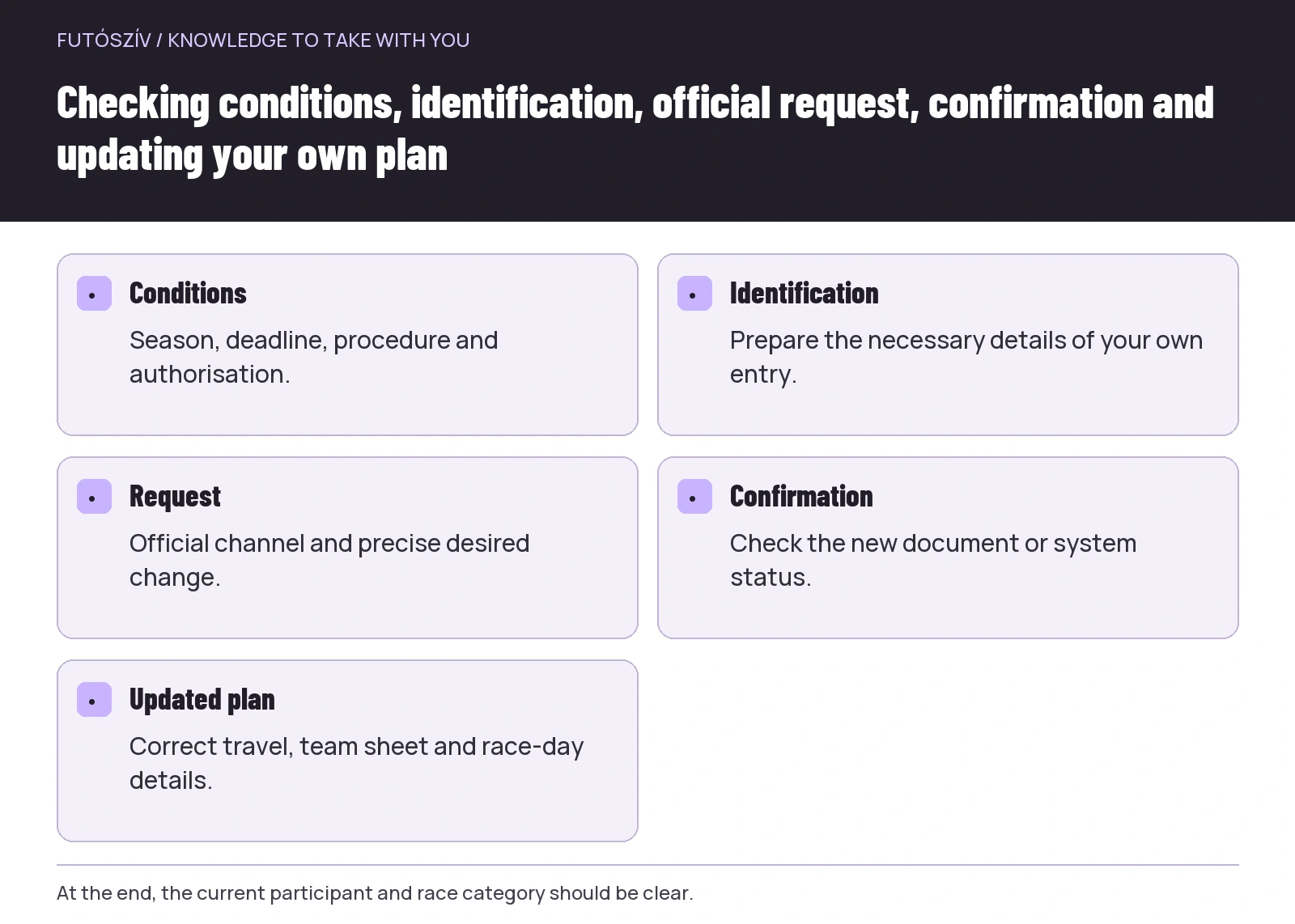
- Conditions
- Season, deadline, procedure and authorisation.
- Identification
- Prepare the necessary details of your own entry.
- Request
- Official channel and precise desired change.
- Confirmation
- Check the new document or system status.
- Updated plan
- Correct travel, team sheet and race-day details.
Treat the request and approval as separate states
A sent message proves that you initiated something. It does not necessarily mean the amendment has happened. Check what response or system status the process promises. Your own records might show “sent”, “further details required” and “confirmed”. This simply reveals what remains open.
If making the change through an interface, read the summary before finalising it. The correct event, person and distance should appear. If payment or a new registration is needed, verify completion separately. An abandoned page does not automatically produce participation that is in order.
At the end, examine the new confirmation and current entry status. The old bib, email or team list can mislead if circumstances have changed. You may retain earlier documents as the case history, but the race-day plan should clearly show current details. Pass the updated version to the companions concerned too.
For a team, the change affects further fields
A member replacement may change leg allocation, expected arrival, travel and communication. Update the internal plan alongside the official amendment. The new member should be more than a name replacing an old row: they need to understand their commitment and the on-site arrangements. Others should know whom to contact and with what information.
Check whether the change affects the category or another participation condition. The race rules determine these. The team’s internal agreement does not replace an official check. If uncertain, the person handling registration should request precise information, then share the outcome with those affected.
Adjust the logistics of passing on the relay device and bib if necessary too. The collection location agreed with the previous member may not suit the new one. The aim is to complete the whole process: official data, personal commitment and on-site equipment should all relate to the same current participant.
Three illustrative administrative situations
A runner wants to give their place to somebody else. First, they check their own event’s rules and discover that such a name change is unavailable. They do not advertise the bib as though it were allowed. They check the official withdrawal conditions and resolve their own entry accordingly.
Another runner wants a shorter distance. They check whether an amendment is allowed, whether space remains in the new race category and what process is required. Only after the result is confirmed do they finalise their own race-day sheet. The confirmation for the old distance no longer underpins the current programme.
A team wants to replace a member. Its designated contact gathers the required details, checks the deadline and amendment authorisation, then completes the official process. The team’s travel and leg sheets are updated too. The new member personally confirms that they understand and accept the task.
The matter is closed when the current status is clear
Be able to say what happened to the entry, who the valid participant is, which race category the confirmation covers and whether usable credit or further tasks remain. Adjust transport, accommodation and group meetings to the actual outcome too. Race administration and associated travel may be separate bookings with separate conditions.
Finally, make the current status and official answer easy to identify among retained documents. For the next event, read its own current conditions again. The administrative method you have learned remains useful: a precise question, an authoritative source, the right channel, a confirmed outcome and an updated personal plan.
How Futószív articles are prepared: our editorial guidelines.