We often regard the drive to a running race outside the capital as arranged once the race-centre address is in the navigation system. Parking, however, is a separate task. The designated or recommended area, vehicle access, the onward walk and later exit together form a workable arrival. A P marker on a map may show only one of these details.
The checking method below draws on specific official examples from 2026 but gives no on-site parking instructions for the following year. Sources were checked on 18 November 2026. The Tihany and Debrecen races among the examples had already taken place; their details help identify the kinds of questions to answer in current information for your own event.
First identify what kind of claim you are reading
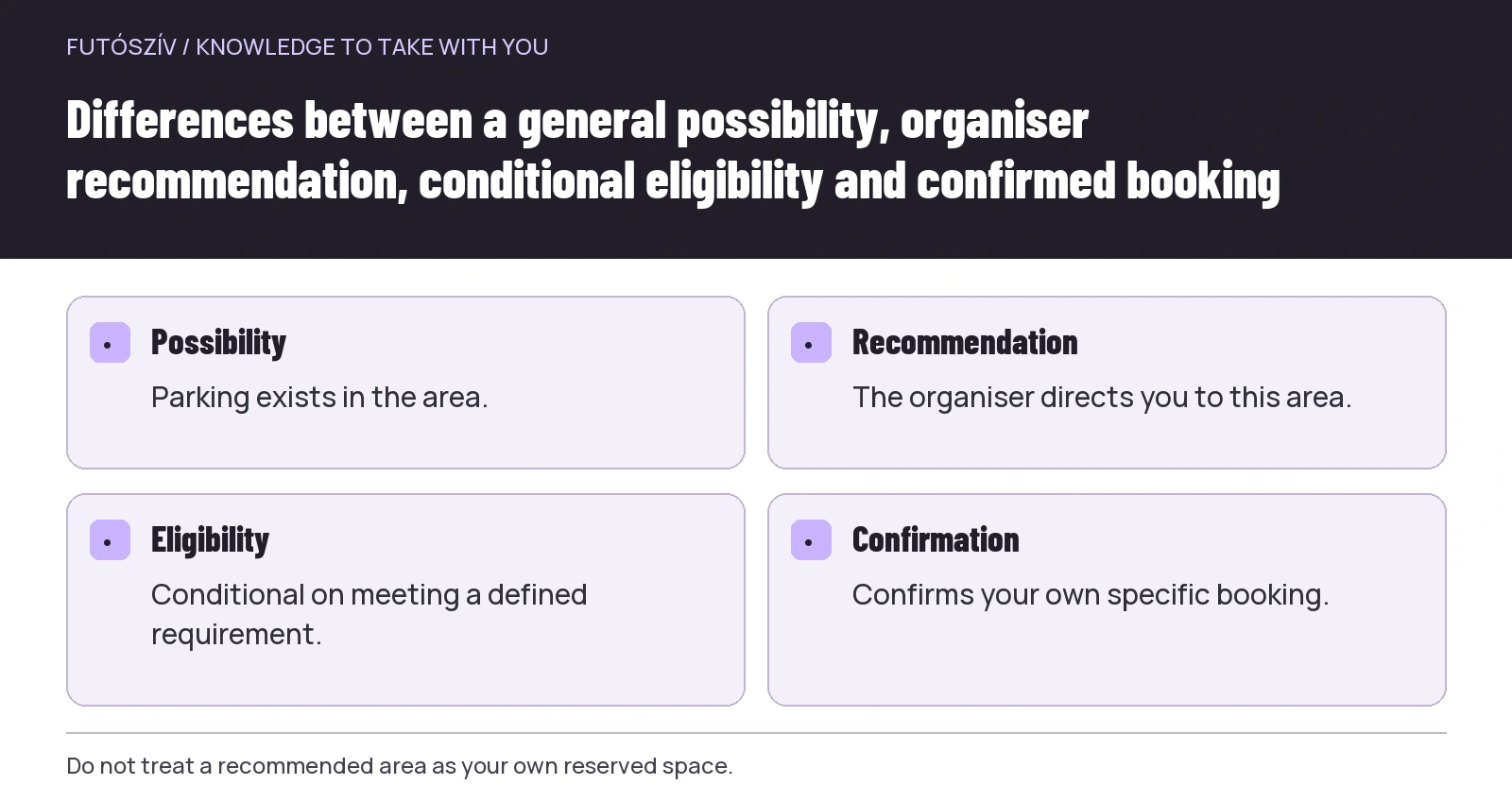
Parking nearby is a general possibility. Area recommended for parking is organiser guidance. Parking reserved for participants may involve eligibility. Booking confirmed concerns your own specific arrangement. These are not interchangeable statements, so do not rely on them with equal certainty.
The 2026 Tihany Half Marathon information pack distinguished access to the race-centre site from parking, for example: parking on site depended on an accommodation booking, while others were directed to external options and the race map. The lesson is that the event address is not necessarily the destination for a participant’s car.
Transfer a source’s statement into your notes with its precise meaning. If you read only a recommendation, do not turn it into a guaranteed space. If a condition applies, record that too. Wording matters in a short message shared with companions: there is a parking recommendation does not promise the same as there will be space there for all of us.
The event year and document date matter together
An organiser may use the same web address for many years. A map or downloadable file on it may nevertheless be older. Check the race year, the date on the document and recent notices. Starting only from a short search-result excerpt can easily omit an important year or restriction.
In the 2026 Tihany example, the information pack also indicated an entrance different from the earlier one. This must not be passed on as unchanged guidance for 2027. It does usefully show that a gate that worked last year can change. Arriving from memory still requires checking current information, just as a first visit does.
Make it identifiable when and for which edition you downloaded a saved map. If the organiser updates the file, tell the group which earlier version to replace. Several screenshots in a group can easily become parallel truths: everyone sees an apparently authoritative marker on their phone, but for a different period.
 Enlarge diagram
Text version of the diagram
- Possibility
- Parking exists in the area.
- Recommendation
- The organiser directs you to this area.
- Eligibility
- Conditional on meeting a defined requirement.
- Confirmation
- Confirms your own specific booking.
Four separate sources may answer four kinds of question
The organiser provides information about its own event’s operation. The parking operator explains conditions for using the area it manages. A municipal or police notice may describe temporary traffic arrangements. On-site signage shows what you must actually take into account on arrival. Read them together, because none necessarily contains all the others’ details.
The Szekszárdi Vagyonkezelő parking page provides information on differing zones and payment periods, for example. Alongside an organiser’s map recommendation, investigate the selected area’s charging arrangements separately. Do not assume a single general statement about a town’s weekend parking applies to every location.
| Question | Primary starting point | What is it insufficient for by itself? |
|---|---|---|
| Where does the event recommend cars go? | Organiser information for your event year. | Does not necessarily establish available spaces. |
| Under what conditions can the chosen area be used? | Current operator information and on-site signage. | Does not identify every race-day road closure. |
| Where can traffic travel at that time? | Official traffic notice and on-site direction. | Does not replace your race-pack collection arrangements. |
| Which gate should I use to enter the event? | Current site plan and organiser information. | Not necessarily the same as vehicle entry. |
If the appropriate source does not answer a question, do not infer certainty from other details. A short, targeted enquiry may help more than a map-based plan apparently familiar with every street but directing you onto an unusable route during the event.
Examine entry and exit separately
A car park may be usable on arrival yet have different exit arrangements during the race. The police notice about a Debrecen running race in March 2026 separately detailed restrictions on leaving an underground car park. This is a historical example applying only to that event, not a current traffic rule. The planning conclusion is broadly useful, however: knowing how to get there is insufficient for leaving later.
If companions join you, their intended onward departure time is particularly important. Do not promise they can definitely drive away immediately after the shorter race until you know the conditions for leaving the area. A runner finishing later and a companion departing earlier may have differing needs that already influence parking choice.
In the route planner, examine not just the car park’s name but the side from which it is approached. A larger area may have several entrances, not all usable on event day. Vehicle and pedestrian entrances may differ too. Final arrival instructions should be more precise than navigation will take us in.
The final walking leg is part of arrival too
The route from parking to the race centre affects when you need to arrive. Map distance is not the only factor: you may need to find the correct exit, bypass a closed section and follow separate arrangements at the event entrance. In your plan, parking the car should not automatically mean beginning race-number collection.
Consider what you carry on this leg. With larger bags, children or differing access needs, understanding the walking connection is even more important. Do not rely on another participant’s general statement that it is a few minutes’ walk. Your group needs a route actually usable in its circumstances, with necessary on-site services and access checked.
The starting point should be identifiable on the return too. Remember the parking area’s name, your space and the route to it so you can identify them from the other direction after finishing. A general photograph of many similar cars may not help. An internal area marker and a precise landmark understood by companions are more useful.
Parking fees and availability are separate questions
A paid parking space is not a guaranteed available space. The capacity of a larger area marked on a map does not promise room when you arrive either. Without confirmation for your own space, include another option that you also understand and can use lawfully. Check this alternative’s entry route and walking connection too.
When paying, check the specific zone, your vehicle and local conditions. A nearby zone displayed in an app does not replace on-site information. Check service confirmation too; intending to pay and having an active parking session are separate states. This article does not give a payment procedure valid for every town, because these differ by provider.
If managing parking requires attention during the race, resolve beforehand who can handle it and under what conditions. Do not assume you can read messages or extend a time limit at any moment on the course. A usable parking arrangement fits your programme throughout the wait, not merely the first hour.
 Enlarge diagram
Text version of the diagram
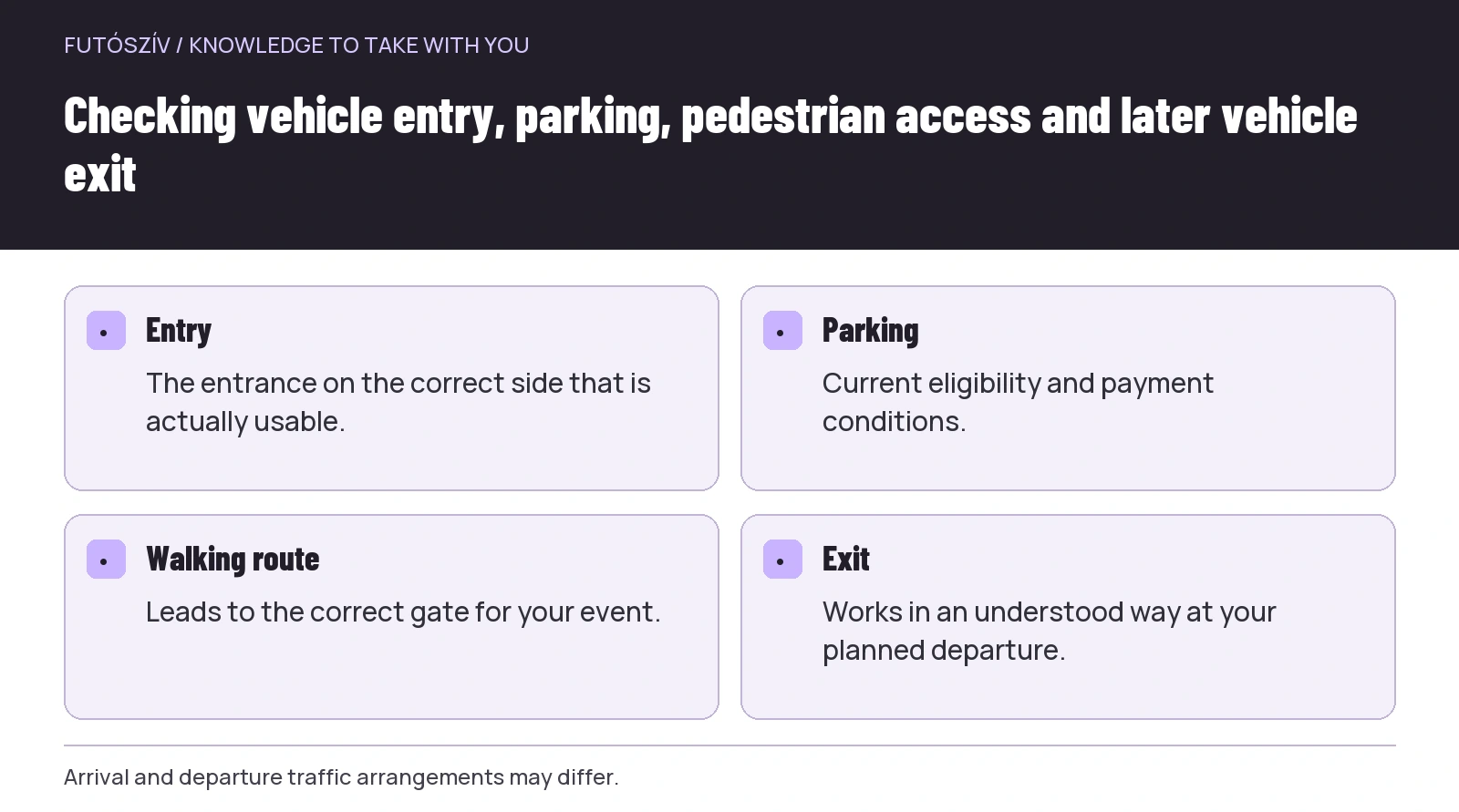
- Entry
- The entrance on the correct side that is actually usable.
- Parking
- Current eligibility and payment conditions.
- Walking route
- Leads to the correct gate for your event.
- Exit
- Works in an understood way at your planned departure.
What does an event discount actually mean?
If the organiser mentions free or discounted parking, read exactly whom, when and where it covers. Advance registration, separate eligibility or use of a particular area may be required. The general event name and your race number do not automatically provide a discount in every situation. Ask for clarification if conditions are missing.
Pay particular attention when a document is only an application or draft. An organiser’s request submitted to a municipality is not the same as approved final arrangements communicated to participants. Judge an apparently official PDF found through search by its content. A letterhead and stamp alone do not mean every proposed condition actually took effect.
Do not forward an abbreviation to companions that removes the condition. Available to accommodation guests cannot become available to runners. If an option covers only certain vehicles or people, everyone must check their own situation. This accuracy reduces on-site misunderstanding rather than creating needless administration.
A fictional example: nearby parking or simpler onward departure?
A runner examines two options for a race outside the capital. A is closer to the event, but departure arrangements and some local access remain unclear. B is further away, but current information explains its approach and walking connection. Neither is an actual car park in this example, and we give no general advice on how many metres of walking are appropriate.
The runner arrives with a companion who wants to move independently for part of the programme. A’s proximity is less valuable if they do not know when the companion could leave. B’s longer walk is acceptable only if the route is usable in their circumstances and fits collection arrangements. Choosing therefore requires comparing two whole arrival-and-departure chains rather than a single distance number.
If A’s missing detail can be confirmed, the assessment may change. If not, uncertainty need not become an invented advantage. They may choose another arrival solution if genuinely verified for their journey. A good outcome is a manageable plan, not using the first car park selected at any cost.
For group arrival, the car park should not be a vague meeting point
If arriving in several cars, you may not use the same entrance or arrive together. Tie the meeting to a precise point identifiable on foot rather than a large car park’s name. Someone finding a place in another lawful area should still have a workable connection to the shared programme.
Do not send a later-arriving companion a message saying they will definitely fit here without reliable information about their own space. You can send organiser parking recommendations and your own observation at that moment, but explain the two separately. A currently visible empty space may disappear meanwhile; that is not a reservation.
When distributing keys and bags, consider different departure needs too. If someone wants to leave earlier, all their options should not depend on a still-racing companion carrying the only key, unless you have consciously agreed this. A parking plan also concerns the group’s movements.
A short checking sheet before departure
Your sheet should answer six questions: which event year the information belongs to, under what eligibility you use the space, how you enter, what payment conditions apply, how you walk to the correct entrance, and when and how you leave? If any remains open, mark it rather than hiding it behind a map link.
Review current organiser and official traffic notices before travelling, and follow on-site arrangements on arrival. Last year’s successful parking is a good memory, not current eligibility. Useful preparation means having not just coordinates for a car park, but understanding your entire arrival, parking and departure situation.
How Futószív articles are prepared: our editorial guidelines.