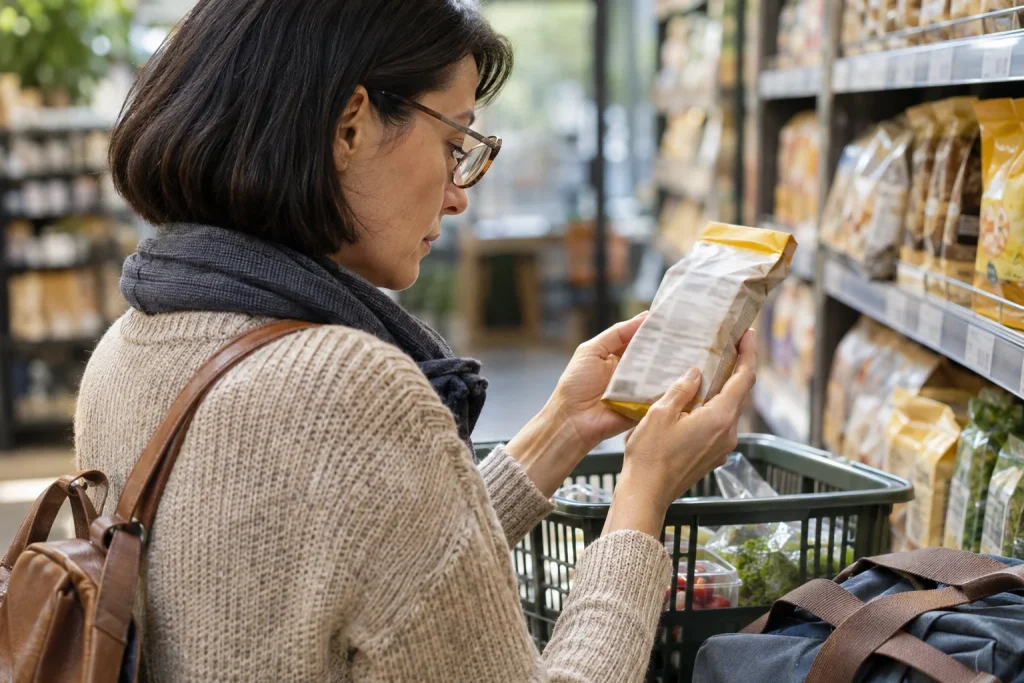
Before travelling, reread the label even on a food that looks familiar. Its brand, package colour or a previous good experience does not necessarily describe the product bought now. You may be holding another flavour, a new recipe or a version made for another country. Useful allergen checks relate to the specific package. Alongside the food’s name, ingredients, warnings and your personal healthcare guidance matter together.
This guide helps adult runners prepare for travel. It does not diagnose allergy, establish a personal risk threshold or change medical instructions. With a known allergy, follow your own allergy plan, including how to handle uncertain products. The fictional label excerpts are teaching examples only: they are not complete legally compliant packages, real products or recommendations that a food is safe to consume.
First identify what you are holding
Check the exact product name, flavour, pack size and market. Ingredients can differ within one product family, and a smaller sachet need not have the same recipe as a larger pack. General names such as sports drink, biscuit or bar are insufficient. If looking for a previously checked product, compare the current package with the variant you actually know. Similarity is not a complete match.
Make sure complete, intact information is available to read. A label printed over a crease, cut off or unreadable does not become clear because you roughly recognise the product. If necessary details cannot be read reliably, seek appropriate help or choose a verifiable alternative. Uncertainty in a decision about a dangerous allergen should not be filled with well-intentioned guesses.
Read the ingredient list and highlighting together
The European Commission information on mandatory food information explains ingredients in prepacked products and the labelling of specified allergens. As a consumer, look beyond the front of the package. You need the detailed list and allergen information too. A nutrition claim or sporty graphic does not replace the composition.
Allergen highlighting can support a quick check, but your own health requirements do not necessarily stop at the groups highlighted by law. Check your personal allergen or ingredient to avoid according to your instructions. If you do not understand a term, do not infer safety from the absence of highlighting. The full list and, where necessary, reliable manufacturer information may provide more detail.
A warning answers a different question
The European Commission’s 2026 allergen information discusses warnings about unintended presence alongside allergens present as ingredients. A statement such as ‘may contain traces’ does not mean the same thing as the ingredient list. Assess it according to your medical guidance rather than creating a personal permitted amount from the internet. The warning is not a home dose calculation.
An ingredient’s absence from the recipe list does not necessarily answer every production or handling question. Do not turn the absence of a warning into a general guarantee covering all circumstances either. If your plan needs more information, ask the specific product’s manufacturer or an appropriate professional. Different package statements can provide different information; none should be interpreted outside the full situation.
| Part of the package | Which question does it help answer? | What is it insufficient for on its own? |
|---|---|---|
| Front description. | Which product family and variant is this? | Confirming the full composition. |
| Ingredient list. | What went into the recipe? | Describing every on-site serving process. |
| Allergen highlighting. | Recognising specified ingredients. | Automatically covering all your personal health requirements. |
| Precautionary warning. | May indicate a risk of unintended presence. | Calculating a personally safe portion. |
| Storage instructions. | Handling the product appropriately. | Proving the absence of allergens. |
 Enlarge diagram
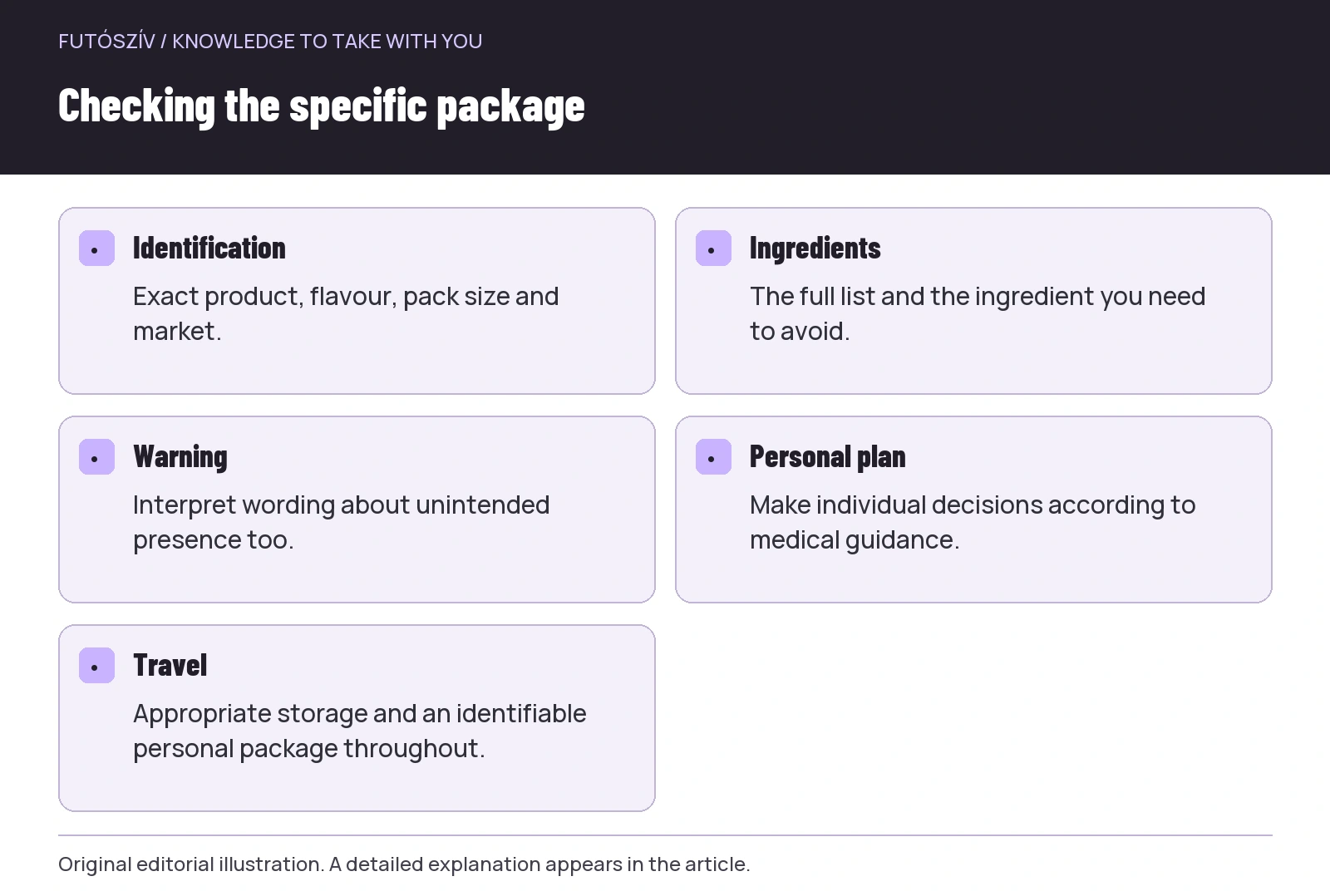
Text version of the illustration
- Identification
- Exact product, flavour, pack size and market.
- Ingredients
- The full list and the ingredient you need to avoid.
- Warning
- Interpret wording about unintended presence too.
- Personal plan
- Make individual decisions according to medical guidance.
- Travel
- Appropriate storage and an identifiable personal package throughout.
First fictional example: a plant-based label and another allergen
Imagine a nonexistent bar A with a plant-based description on the front and peanuts in its fictional ingredient excerpt. Plant-based does not say the product suits someone with a peanut allergy. This is neither a full label nor a recommendation to eat it. The lesson is that a dietary description is not a claim covering every allergen. Check your own specific requirement.
The same reasoning error can occur with other terms. A description saying free from one ingredient does not automatically establish everything about other allergens. Products intended for athletes are not a special health exception either. A front-of-pack claim has a specific subject. Understand that first, then examine whether the whole label fits your personal guidance. Packaging style cannot replace information.
Second fictional example: the same brand, a different variant
Suppose you previously checked one flavour of a nonexistent biscuit B. For the trip, you buy another version with a similar appearance. In this fictional example, its ingredient excerpt lists milk, while the familiar version’s composition was different. The earlier check does not automatically cover the new product. Having the same brand and the same recipe are separate properties.
Name the necessary variant on your shopping list too. If someone shops for you or an online order is substituted, make requirements clear. Equal price and pack size are not a sufficient substitution rule. Recheck the package received before eating. If the prescribed condition cannot be confirmed, do not infer suitability from a familiar brand name.
Another country may have a different regulatory system
The US FDA information on allergens describes nine major allergens for the foods it regulates, while the EU information lists fourteen groups requiring declaration. This shows that the highlighting system familiar at home is not identical in every destination. Check current official information for your destination before travel. This example is not a complete country comparison or legal guidance applying to every product.
Learn key local-language terms using a guide prepared from reliable sources. The exact name of your allergen and the distinction between an ingredient and a warning may be important. Automated photographic translation can help orientation, but do not treat an unreadable, incomplete or uncertain result as confirmation of safety. If doubt remains, seek appropriate help or choose a previously checked alternative.
Connect online information with the package in your hand
You can find official information for a specific product before travelling, but check that the website and package match. Are the flavour, pack size and market the same? Is the information current and does the composition describe the version now purchased? An online shop photograph may be old or illustrative only. Do not rely solely on a generic image of a similar product in your plan.
When requesting manufacturer information, identify the product precisely and provide package identifiers if necessary. Direct your question towards your relevant requirement and specific uncertainty. Do not generalise the answer to every food from that manufacturer. Keep a record of which version was discussed and when. A later recipe change or another package may need checking again.
 Enlarge diagram
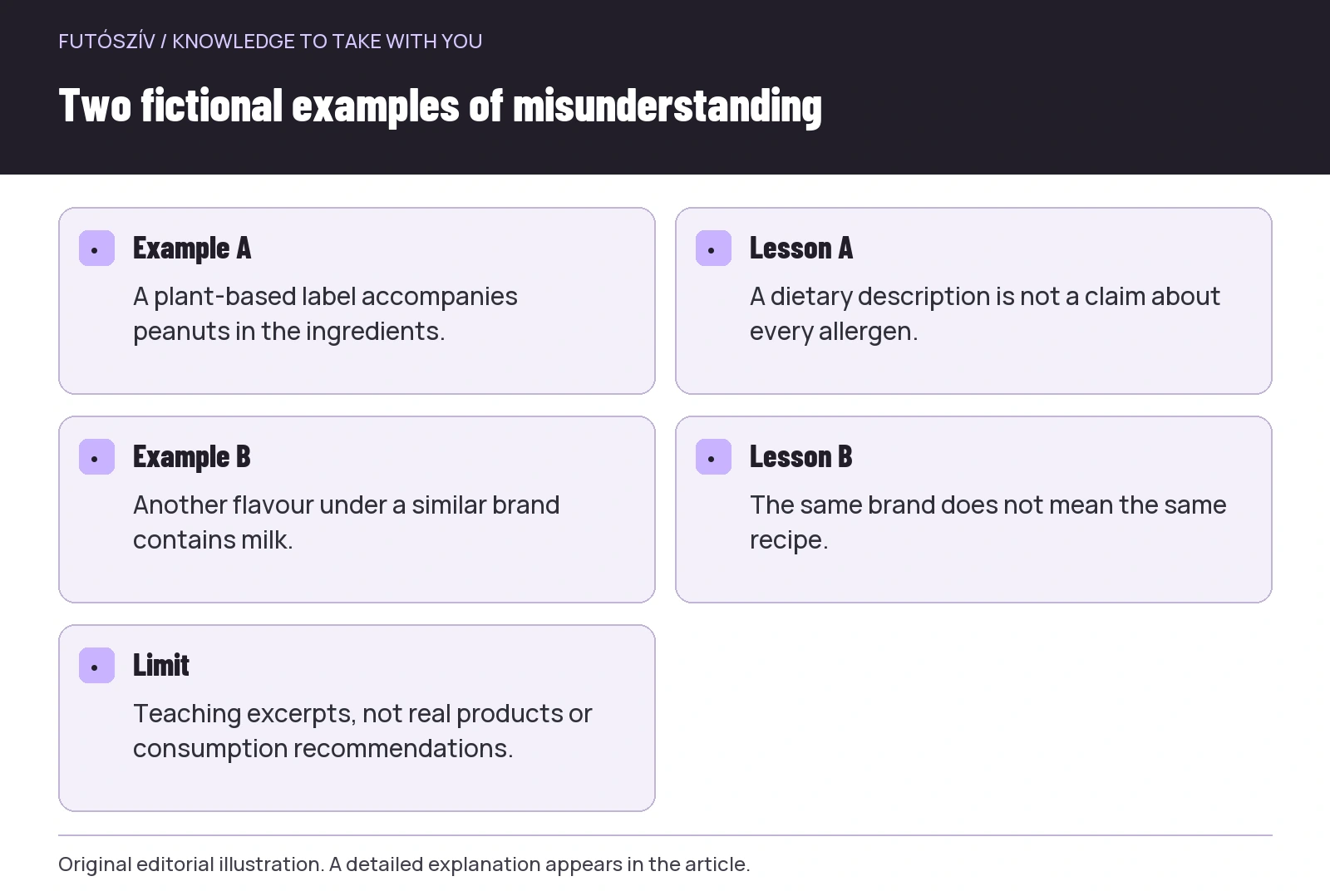
Text version of the illustration
- Example A
- A plant-based label accompanies peanuts in the ingredients.
- Lesson A
- A dietary description is not a claim about every allergen.
- Example B
- Another flavour under a similar brand contains milk.
- Lesson B
- The same brand does not mean the same recipe.
- Limit
- Teaching excerpts, not real products or consumption recommendations.
Let the information travel with your own packaging
If you put food into your own container, retain its label or important ingredient information. A small identifiable note or readable photograph can help if the product needs checking later. Do not mix several similar bars or biscuits in an anonymous shared bag. Packaging should keep your suitable food identifiable throughout, as well as making it portable.
Appropriate food storage is needed alongside allergen requirements. Carry and handle chilled food according to its instructions. Checked composition does not make a product suitable for unlimited time in the heat. Equally, an appropriate cool bag does not change allergen content. Keep these two levels separate on your travel checklist so neither disappears behind the other.
Identification matters especially in a shared team package
When several people share food, label your package with your name and a clear description. Do not place your suitable food in a shared bowl or beside another product in a way that makes it unidentifiable later. At handover, check the actual package, rather than only someone’s promise of an identical item. A precise task is easier for a helper when they know which product is yours and how to keep it.
For homemade food, the recipe and preparation conditions provide information, but an attractive personal sticker is not manufacturer confirmation. If someone else makes it for you, clarify individual requirements beforehand. Know the ingredients alongside the name and colour. Avoid a general safety ranking between homemade and shop-bought foods; decisions depend on specific information and appropriate handling.
Serving food out of the package begins a new question
Once a product is cut on a shared surface or placed in a bowl with other food, the original label no longer describes the whole on-site process. At restaurants, accommodation or aid stations, ask about preparation and serving alongside ingredients. The connection between a product checked in the shop and a bite served on the table should remain traceable. Original information is useful but not an all-encompassing answer.
If staff cannot identify the food or original package, do not infer its identity from appearance. Choose an alternative that fits your medical plan. In a rushed race situation, it is especially valuable if this alternative is already known and permitted. A suitable food plan covers not only favourable conditions but what happens when necessary information is missing on site.
A label-checking sequence to save
Start with product identity, then the complete ingredient list, followed by allergen and unintended-presence information. Next check your health-related requirements, storage instructions and identification during travel. The sequence does not replace individual professional guidance, but can prevent a front-of-pack claim from ending the check too soon.
A useful label-reading routine preserves both the specific product and uncertainty. It does not promise complete safety from one word or base decisions on unreadable information or another version’s data. Food packed for travel then reaches your eating plan not merely looking familiar, but accompanied by the necessary information in a traceable way.
Sources and further reading
- European Commission: Mandatory food information
- European Commission: Allergies
- U.S. Food and Drug Administration: Food Allergies
How Futószív articles are prepared: our editorial guidelines.