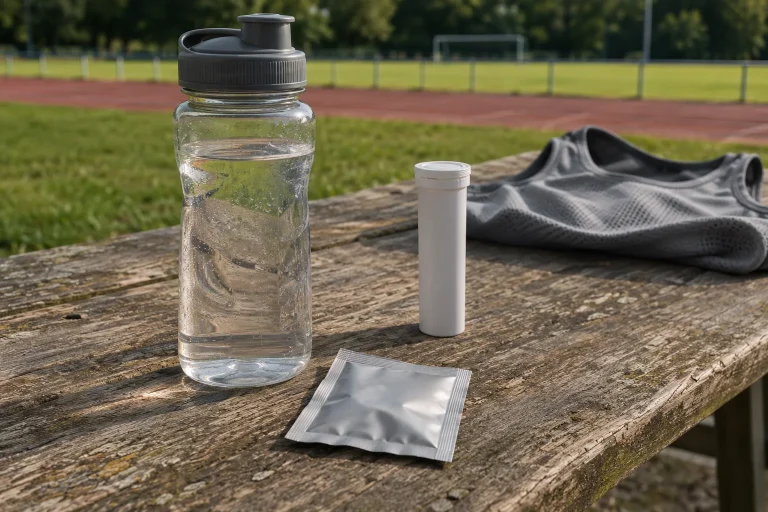
Markings on a running bottle can help you estimate quantities, but understand what you read and how before using them. Nominal capacity, a quantity marked on its side and the volume of drink currently inside are three different things. A simple home comparison may reveal a misreading or uncertainty in your method. It does not turn either the bottle or kitchen measuring jug into certified laboratory equipment.
This guide is a household demonstration, not a metrological calibration procedure or manufacturer compliance test. It determines no drinking dose, drink-powder recipe or clinical fluid measurement. A task requiring verified accuracy or compliance with a personal medical instruction needs appropriate equipment and professional directions. The figures here are fictional examples; we did not personally test any bottle.
Read the unit first
The NIST page on volume units states that one litre is one thousand millilitres and one decilitre is one hundred millilitres. A bottle may have several scales, so look beyond the number. Another side may show a different unit. Do not confuse millilitres with grams: one measures volume, the other mass. Always record a number from a display or label together with its unit.
If kitchen scales offer a millilitre mode, understand its operation from their own instructions. The device may primarily measure mass, with displayed volume depending on an assumption. Do not automatically equate the two quantities for every drink and temperature. Keep this household comparison to volume scales rather than complicating it through unknown conversion conditions.
Name the question you are checking
Ask one thing at a time. For example: with the same water and placement, where does an amount read in the jug reach on the bottle? Or: do repeated attempts to reach the same mark produce similar results? Total bottle capacity is another question, and the amount consumed while drinking another again. Combining these in one trial makes discrepancies harder to explain.
Describe the home trial’s outcome narrowly. You can observe agreement between your two devices and reading method in that situation. A difference does not establish which scale differs from the true value or by how much. A kitchen jug is not a flawless reference merely because it came from a kitchen drawer. Comparison can produce good questions, but does not replace a proven reference value.
Prepare a simple, orderly workspace
Use clean, food-safe equipment and respect manufacturer limits. There is no need to bring a vessel used for laboratory chemicals into drink preparation. Keep the bottle and household jug in an appropriate condition according to their own instructions. Leave room for safe filling and reading instead of balancing on a sink edge to spot a scale line. Good light and a calm task help more than yet another rushed repetition.
Inspect the jug’s divisions: what is the difference between two clearly marked lines? Do you read the same value after turning the jug and returning it to the appropriate view? Can you see the liquid surface through coloured or thick walls? If reading is difficult from the outset, do not write an extremely precise figure beside it afterwards. Scale spacing and the limits of your own observation matter from the beginning.
 Enlarge diagram
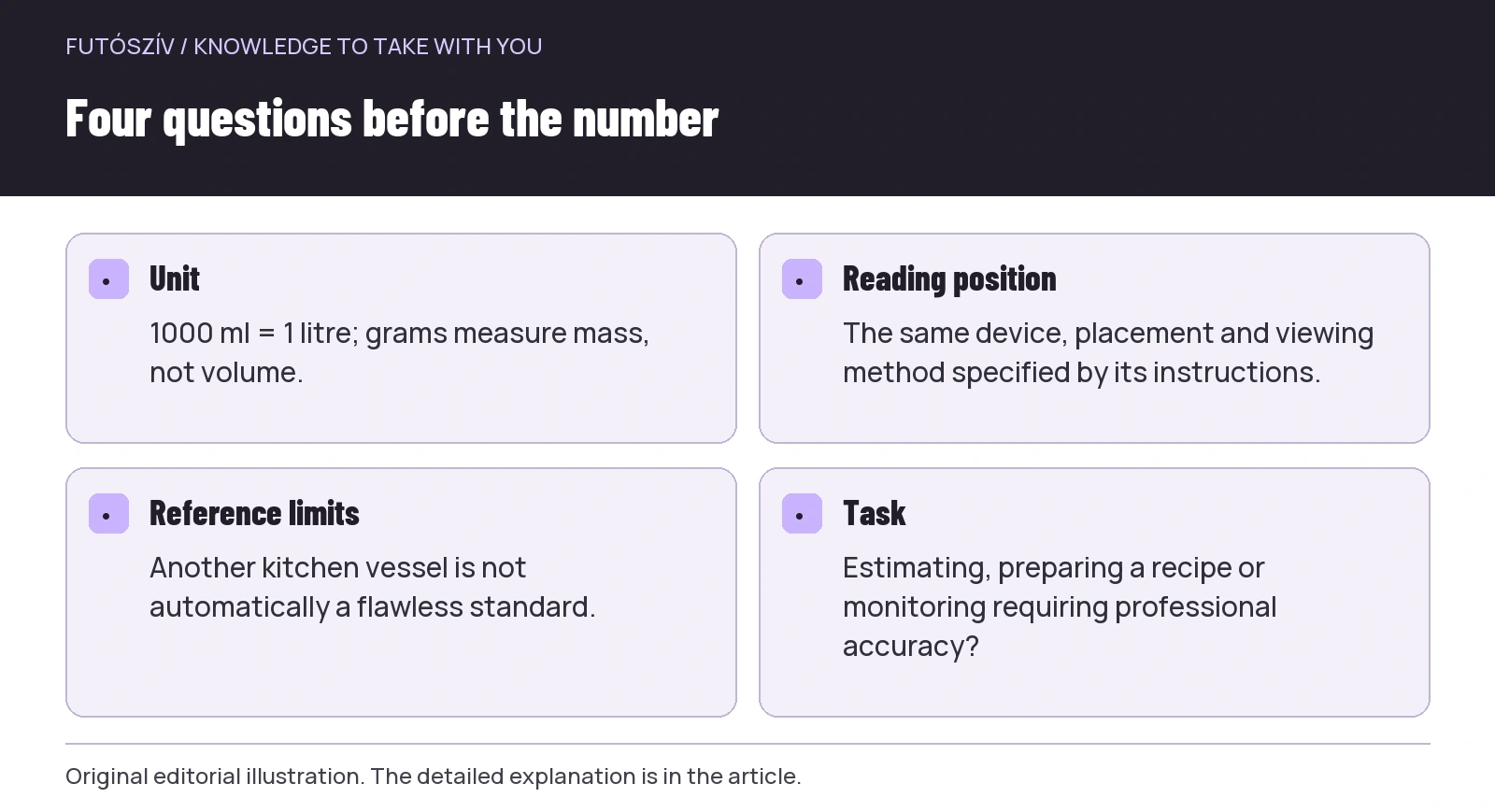
Text version of the illustration
- Unit
- 1000 ml = 1 litre; grams measure mass, not volume.
- Reading position
- The same device, placement and viewing method specified by its instructions.
- Reference limits
- Another kitchen vessel is not automatically a flawless standard.
- Task
- Estimating, preparing a recipe or monitoring requiring professional accuracy?
Eye level is part of taking a reading
The NIST technical guidance on reading a meniscus shows the role of liquid surfaces and viewing direction in reading volume. Procedures for professional glassware cannot be applied unchanged to every running bottle. The principle does help explain why a level looks different from above or at an angle. Follow your own vessel’s reading instructions and use the same viewing method for repetitions.
Wait for the liquid to settle. Ripples, foam and bubbles do not necessarily show the boundary you should read. A demonstration with clear water may therefore be simpler than examining a strongly coloured or foaming drink where container instructions allow. Do not assign one universal reading rule to different substances. The precise procedure depends on equipment and task too.
Do not let a soft bottle’s shape become a hidden variable
You may hold a compressible container differently while filling and reading. Squeezing, stretching, tilting or pressing it into a vest pocket can change its visible shape and the liquid’s position. Record placement during comparison. If it will not stand securely, do not force a rigid measuring-cylinder method onto it. Finding that its markings are difficult to read under these conditions is a useful result in itself.
Drawing new supposedly precise lines from an accidentally compressed position is unhelpful. You may hold the container differently next time and the mark may suggest something else. If the aim is following a particular recipe, it may be easier to prepare the drink with appropriate measuring equipment first, then transfer it to a bottle used as intended. Side markings need not solve every task where another tool performs the necessary operation more reliably.
A fictional comparison with three repetitions
In this example, a nominal four hundred millilitres based on the jug’s scale is repeatedly transferred. Notes for the imaginary bottle record a level near four hundred on the first attempt, slightly lower on the second and slightly higher on the third. These are not actual measurements or a manufacturer assessment. The example shows variation in readings; it cannot justify inventing a correction to a tenth of a millilitre.
To illustrate numerically, let the three fictional readings be three hundred and ninety-five, four hundred and four hundred and five millilitres. The smallest-to-largest difference is ten millilitres. This is the range of these three results, not a proven error limit for the equipment. The mean is four hundred millilitres, but its agreement does not prove that the actual volume transferred was exactly that. All starting conditions still matter.
| Fictional result | A justified description | An exaggerated conclusion |
|---|---|---|
| 395, 400 and 405 ml | The three example readings are not identical. | The bottle’s official accuracy is ±5 ml. |
| The mean is 400 ml | This is the arithmetic mean of the example figures. | The actual volume is proven to be 400 ml. |
| A comparison with another vessel shows a discrepancy | The two methods produced different results. | Only one named product must definitely be faulty. |
| An angled position changes the reading | The reading conditions changed. | The difference indicates personal fluid needs. |
Repeatability is not proven accuracy
The NIST explanation of measurement terminology discusses repeatability and measurement accuracy separately. Close results under the same conditions provide different information from closeness to an accepted reference value. Do not call equipment ‘certified’ because a household trial produced a similar number three times. An error made consistently can also yield closely grouped values.
Repetition here helps you understand your process. If you held the bottle once, rested it on the table next time and read while water still moved on the third attempt, resolve these differences first. The aim is not unlimited repetition. If the task rests on equipment difficult to read, choose a measuring approach better suited to the intended use. Many uncertain readings are not automatically better than one clearly chosen simple method.
 Enlarge diagram
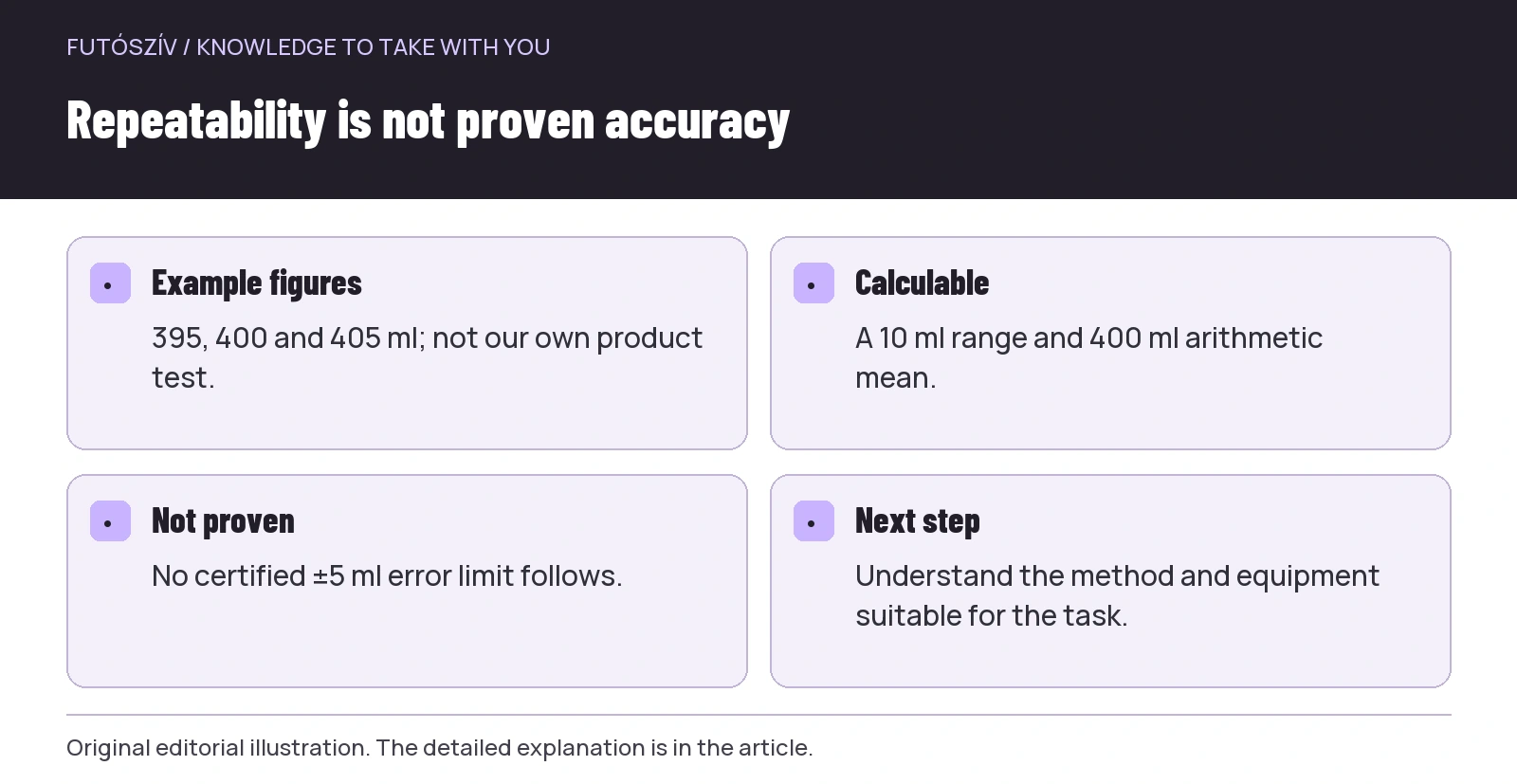
Text version of the illustration
- Example figures
- 395, 400 and 405 ml; not our own product test.
- Calculable
- A 10 ml range and 400 ml arithmetic mean.
- Not proven
- No certified ±5 ml error limit follows.
- Next step
- Understand the method and equipment suitable for the task.
Several transfers mean several separate operations
If you fill a bottle several times from a smaller vessel, every reading and transfer belongs to the process. Water may remain in the vessel, a few drops may spill or one fill may not reach the same mark. Do not assume repeated operations become more accurate merely through multiplication. Know the vessel’s intended task and method of use too. Follow instructions for the appropriate household equipment.
The volume poured and the volume contained up to a given level may be different questions because of handling. Making a simple running drink does not require improvising laboratory flow or delivery methods. What matters is using the selected equipment as intended and preserving what happened in your notes. If every step could not be followed, do not call the outcome a verified volume.
Drink disappearing from a bottle was not necessarily consumed
A falling scale level during a run does not establish exactly how much you drank. Refilling, spilling or another use may have occurred. Record these as separate events in a diary. Two levels seen between start and finish cannot reconstruct every circumstance. The visible volume change is neither diagnostic information nor an independent determination of personal needs.
If the aim is approximate supply tracking, say so in the note’s title. For a precise recipe, use measurement appropriate to the task and follow product instructions. If precise fluid tracking matters for a personal medical instruction, use the prescribed professional method. You need not solve every task with the same running bottle. The consequences of the decision determine the certainty required.
What is worth retaining after the trial?
A short note is enough: which bottle and measuring vessel, which unit, placement and reading method, and the result. Add open questions, such as difficulty reproducing a soft bottle’s shape or seeing the scale. These specific observations help next time more than invented decimal places. Measurement aims to improve decisions, not create an appearance of science.
Checking bottle markings at home helps when conclusions remain no larger than the trial. Understand units, read under consistent conditions and recognise limits in the reference and method. If the scale does not work well enough for your task, choose another suitable measuring device. The number can then guide you while uncertainty is handled honestly.
Sources and further reading
- NIST: SI Units – Volume
- NIST: Good Measurement Practice – Method of Reading a Meniscus, 2019
- NIST Technical Note 1297: Appendix D1 – Terminology
How Futószív articles are prepared: our editorial guidelines.