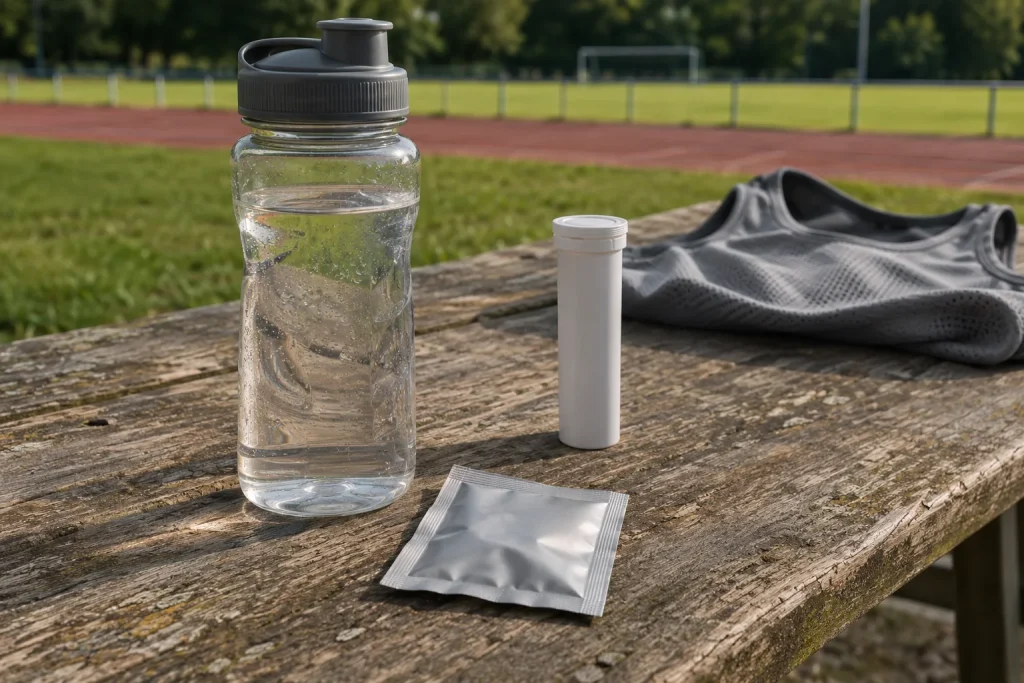
The word ‘electrolyte’ can help indicate what information to seek next on packaging, but does not establish the product’s full composition alone. It does not say how much of each ingredient is in the dry product or prepared drink, or whether your run needs it. Continue label reading with the individual substances, quantity basis and instructions.
This article is an information-interpretation guide for adult recreational runners. It is not a personal electrolyte replacement plan, salt-dosing recommendation or home treatment for cramps or illness. With illness, medication, a prescribed diet or fluid intake, clarify suitability with a professional. Products and numbers below are fictional educational examples, not analyses or recommendations for actual products. Legal sources support label interpretation, not assessment of one product’s legality.
Which electrolyte appears, and how much?
The Australian Institute of Sport overview of electrolyte supplements describes powders, tablets and ready-made drinks with differing compositions. Products may contain other named ingredients alongside sodium and potassium. A shared label therefore does not mean the same recipe or role. Check each substance’s name and amount separately. Different product forms are not automatically substitutes either.
Make a short note of substances actually listed. Do not enter zero merely because you cannot find a value sought; note instead that you did not identify it on the label. Ingredient lists and nutrition information can serve different purposes: one shows recipe components, the other also numerical quantities. Read the whole label together for accurate understanding.
Do not confuse mass and volume bases
The European Commission nutrition-labelling information separately explains values per hundred grams or millilitres and additional per-portion labelling. Product form makes the basis particularly important: powder, tablet or drink prepared as instructed? Do not directly compare an amount in a hundred grams of powder with the entire contents of half a litre of drink. First bring values to a common basis.
Your bottle’s full capacity is not the volume currently inside it. A per-tablet value does not automatically establish drink concentration without knowing the preparation’s fluid quantity. Follow the particular product’s mixing amounts. Do not alter them to produce a more impressive number in your table. Organising units is arithmetic, not recipe development.
A fictional example: different labels, identical concentration
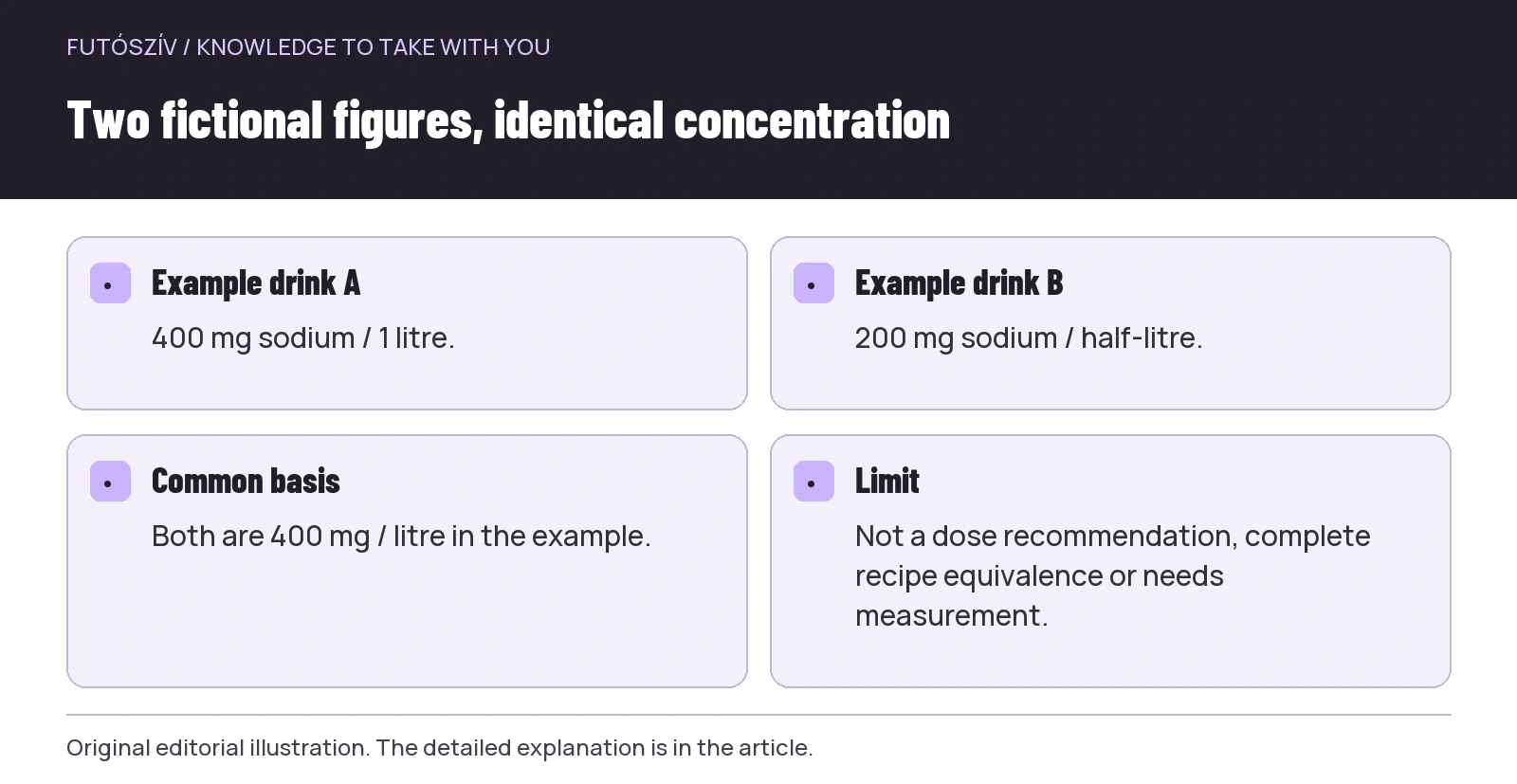
Imaginary drink A lists four hundred milligrams of sodium per litre. Imaginary drink B lists two hundred per half-litre. On the same volume basis, both example figures give the same sodium concentration: half a litre is half of one litre, so half of four hundred is two hundred. The larger number alone does not make A more concentrated. Neither value is a recommended intake; they illustrate checking the quantity basis only.
If carrying seven and a half decilitres of A in the example, the label-based sodium amount would be three hundred milligrams. This does not mean you drink all of it or that it suits you. Refilling or spilling makes actual consumption a separate question. Keep concentration, carried supplies and consumed amounts as three different facts, preventing a label figure from quietly becoming a personal-needs claim.
| Fictional information | Interpretation on the same basis | What it does not establish |
|---|---|---|
| A: 400 mg sodium / litre | 200 mg / half-litre | Not a personal replacement dose. |
| B: 200 mg sodium / half-litre | 400 mg / litre | Does not prove an identical complete recipe to A. |
| 750 ml of A | 300 mg sodium under the example label | Not a measurement of consumption or losses. |
| Identical sodium figures | One shared comparison point | Other ingredients and personal suitability may still differ. |
 Enlarge diagram
Text version of the illustration
- Example drink A
- 400 mg sodium / 1 litre.
- Example drink B
- 200 mg sodium / half-litre.
- Common basis
- Both are 400 mg / litre in the example.
- Limit
- Not a dose recommendation, complete recipe equivalence or needs measurement.
Do not add salt and sodium label values together
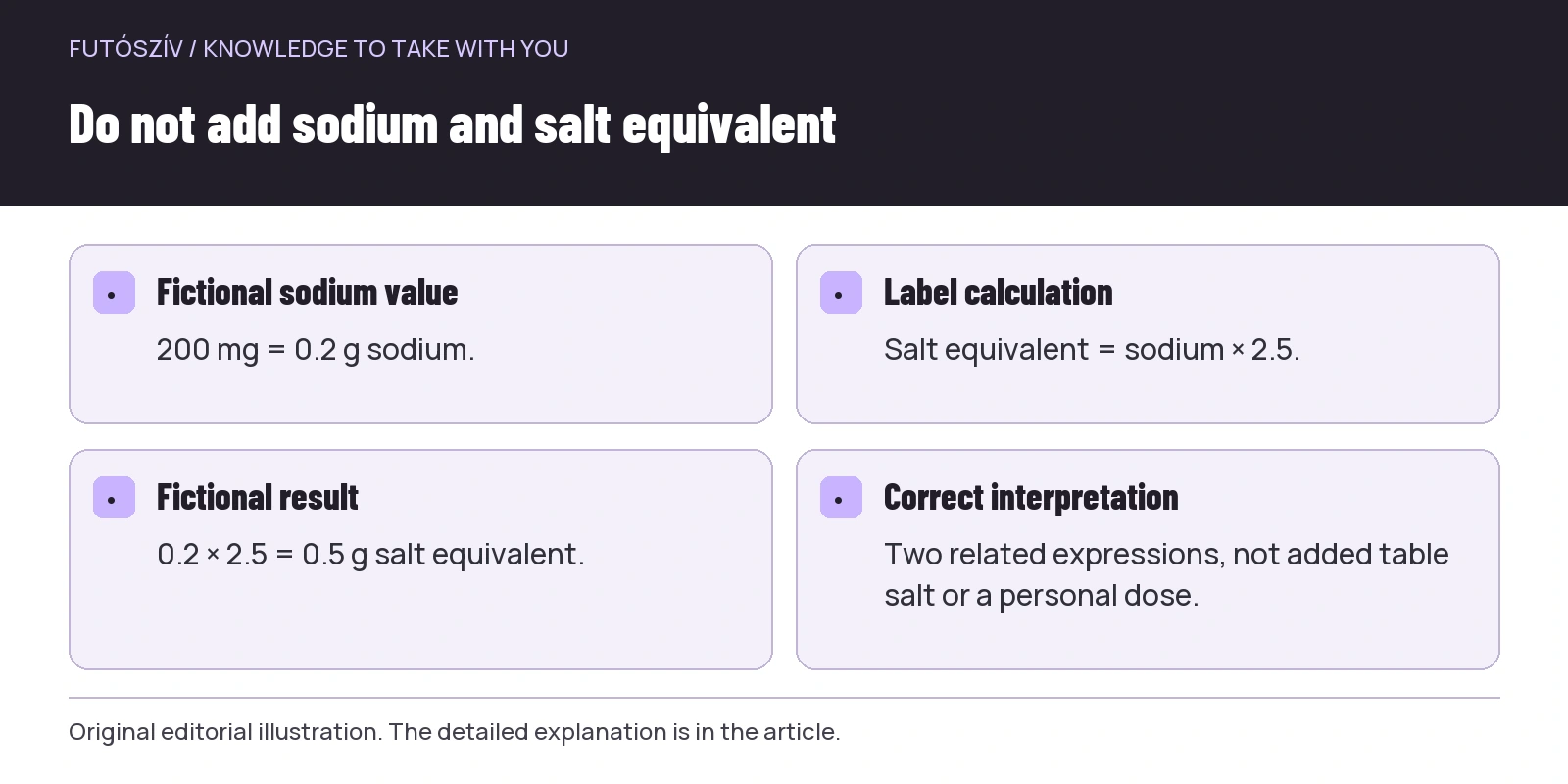
The European Commission food-labelling questions and answers notice links label salt-equivalent calculation to total sodium: salt equals sodium multiplied by 2.5. Salt and sodium figures therefore represent different quantities. When both exist for the same product and basis, do not treat them as two separate supplies to add.
A fictional calculation: two hundred milligrams of sodium corresponds to half a gram of salt equivalent under that calculation. Convert milligrams to grams correctly first: two hundred milligrams is 0.2 grams, multiplied by two and a half gives half a gram. This does not mean adding another half gram of table salt. The example interprets a label; it is not a homemade mixture recipe or a permitted or necessary daily amount.
If a source gives sodium while your label lists salt, check units and basis before calculating. Enter the number in the appropriate app field too. Copying salt into a sodium field is not corrected by an attractive graph. If unsure what information concerns, leave it open and clarify with the manufacturer or dietitian instead of labelling an estimate precise intake.
Examine carbohydrate separately
An electrolyte-containing product does not automatically have a particular carbohydrate content. It may serve another task from a sports drink containing both carbohydrate and electrolytes. AIS also distinguishes these forms. If both figures matter in your plan, track them separately. One ingredient’s presence does not prove an appropriate amount of another, and sporty packaging does not replace the actual table.
Do not interpret ‘sugar-free’ or another front label as complete sports nutrition advice either. It may highlight one property while your task needs several ingredients and the whole use considered. Personal role is not determined by which pack has more appealing words. If matching product and needs is uncertain, gathering label information provides a useful starting point for professional discussion.
Read health-claim wording and conditions together
The European Commission nutrition and health claims page describes the regulatory framework and access to the EU register. Do not extend an ingredient-related statement into your own conclusion about universal product effects. Interpret the stated text with its use conditions, not only a few highlighted words.
A statement about a substance’s physiological role, for example, does not mean you are deficient or need an additional product for every run. An appealing product claim is not a personal diagnosis. A label describes claims about the product; your health and needs are separate. Connecting them requires appropriate professional assessment, not merely recognising front-label wording.
Do not calculate a deficiency from cramps at home
AIS describes exercise-associated muscle cramps as involving several factors. A cramp alone does not tell you which electrolyte to take or how much. Record circumstances alongside experience without turning it into automatic salt or magnesium dosing. Recurring, unusual symptoms or those accompanying illness may require medical assessment. Label reading cannot distinguish causes.
A product a companion calls successful is not a personal measurement of your needs either. Activity, surroundings or health background may differ. Discuss actual product composition, but do not derive individual amounts from group averages or a social post. Ask what needs clarifying in your plan, rather than which sachet supposedly solved everyone else’s every problem.
 Enlarge diagram
Text version of the illustration
- Fictional sodium value
- 200 mg = 0.2 g sodium.
- Label calculation
- Salt equivalent = sodium × 2.5.
- Fictional result
- 0.2 × 2.5 = 0.5 g salt equivalent.
- Correct interpretation
- Two related expressions, not added table salt or a personal dose.
Electrolytes do not make unlimited drinking safe
AIS specifically warns that sodium replacement does not resolve the serious risk from excessive fluid intake and may give false reassurance. Do not turn this principle into independent treatment or diagnostic calculation. Having the product does not justify unlimited expansion of your drinking plan. Health questions or illness require appropriate professional help; another tablet does not replace assessment.
Consider pack instructions and your individual plan together. Combining products requires reviewing all ingredients consumed, not only one highlighted on the front. Do not assemble a complete mixture or replacement plan from unknown combinations of powders and tablets. Gathering information aims for clarity, not adding more of every ingredient found.
A useful product card can have six fields
Record precise product name and variant, form, required preparation, numerical values with units and bases, ingredients and warnings, and remaining questions. Update the card when labels change. A date helps reveal information belonging to an older recipe or pack size. Preserve the manufacturer’s serving definition accurately on the card too.
Do not automatically put a personal dose on the final line. It might instead state that sodium and salt values need reconciling or the prepared drink’s volume basis is unclear. These are specific answerable questions. Good label interpretation helps by showing what is known and unknown. Missing personal decisions need not be hidden behind apparently precise numbers.
Several suitable options may remain after comparison
Even after bringing two products to a common basis, taste, handling, ingredients and storage may differ. Name these separately; one aggregate electrolyte score does not necessarily produce a meaningful ranking. Choose for personal needs within the whole plan. Label reading need not end with a winner while important individual conditions remain unresolved.
You can then obtain real information from the wording: which substances, how much and for which state, with sodium, salt equivalent, concentration and total amount distinguished. Keep personal needs, causes of symptoms and appropriate intake planning separate. That boundary makes label information useful while preserving the questions packaging alone cannot answer.
Sources and further reading
- Australian Institute of Sport: Electrolyte supplement
- European Commission: Nutrition labelling
- European Commission: Questions and answers on Regulation 1169/2011, 2018/C 196/01 – salt and sodium
- European Commission: Nutrition and Health Claims
How Futószív articles are prepared: our editorial guidelines.