
The term plant-based diet does not, by itself, describe a whole day’s eating. It can mean a mixed diet with more plant foods, vegetarian eating or an entirely vegan pattern. As a runner, start by describing what you actually do: which foods you eat, which you avoid, and the training demands you want your eating to support. A workable plan consists of specific foods and reliable information, rather than a single label or fashionable ingredient.
This guide helps adult recreational runners find information and prepare for a professional consultation. It is not a personalised diet, treatment for a deficiency or a source of individual supplement doses. Illness, pregnancy, breastfeeding or a prescribed diet require separate, individual professional planning; approaches used by adult runners cannot automatically be applied to children’s diets. Choosing a plant-based diet is no reason to forgo necessary medical care or monitoring.
Do not let a label replace a description of your food
The British Dietetic Association information on plant-based diets distinguishes several dietary patterns. Instead of, or alongside, these labels, write down what actually goes on your plate. Vegetarian and vegan approaches, for example, allow different options for including eggs or dairy. A label alone cannot establish the quantity, variety or personal suitability of the food either.
Make a simple record of the types of meals you regularly eat. What do you usually have for breakfast? Which main meals work on working days? What suitable food can you access after a longer run? Describe the whole dish, rather than listing only its vegetables. The composition of a salad can vary considerably depending on what is served in it and alongside it. An accurate picture of your eating makes it possible to ask meaningful planning questions.
You do not need to justify your ethical or environmental choices with promises about performance. Personal values and suitability for sports nutrition are separate questions. A dietary label does not automatically imply better race results, and one well-known athlete’s example is not personal evidence. Your aim can be to eat adequately and practically within your chosen framework. This requires looking at your overall diet and training demands together.
Replace an omission with a genuinely complete new meal
If you remove an animal-derived ingredient from a familiar meal, look at the dish that remains. A few extra pieces of vegetables will not necessarily fill the role that has been left empty. The next question is how the overall quantity and composition of the meal meet your needs. Do not start by randomly replacing the missing ingredient with an equal weight of something else. Planning a new dish is often a better starting point than simply cutting down the old one.
You might think in terms of familiar meals: a suitable pulse-based dish with a side, a tofu bowl, a varied sandwich or a breakfast assembled from several components. These are possibilities, rather than equivalent or compulsory choices for everyone. The composition of the ingredients, your portion and preparation all matter. If you have an allergy or another restriction, even an apparently plant-based product is not automatically suitable; always check the specific label and any handling requirements.
| Planning question | Useful personal information | What not to assume |
|---|---|---|
| What dietary framework have you chosen? | The foods you actually eat and need to avoid. | That a single label explains everything. |
| What will make up the main meal? | A specific dish and suitable accompaniments. | That removing an ingredient creates a complete new meal. |
| Which product is fortified? | The nutrition and ingredient information on the actual package. | That every similarly named drink contains the same things. |
| What is your question for the professional? | Your routine, training demands and an identifiable uncertainty. | That a generic online menu can serve as a personal plan. |
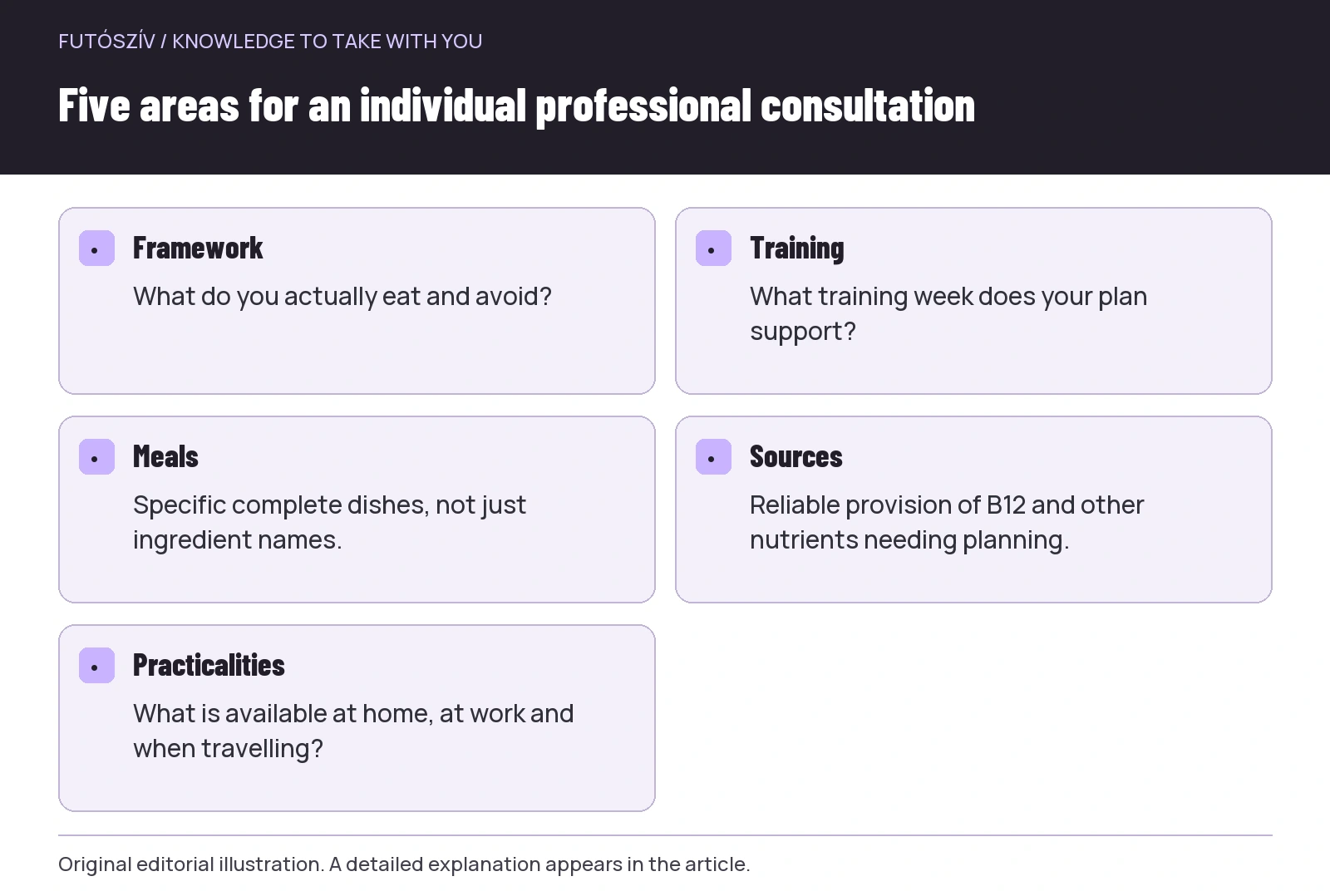 Enlarge diagram
Text version of the illustration
- Framework
- What do you actually eat and avoid?
- Training
- What training week does your plan support?
- Meals
- Specific complete dishes, not just ingredient names.
- Sources
- Reliable provision of B12 and other nutrients needing planning.
- Practicalities
- What is available at home, at work and when travelling?
Fortification is a specific product feature, not a packaging impression
The NHS guide to a vegan diet mentions several nutrients requiring deliberate planning, including vitamin B12, calcium, iron and iodine. It also discusses fortified products. Check the information on the actual packages you use: which added nutrients are listed, the quantity basis used, and how the product fits into what you actually consume.
Two plant-based drinks can have similar names but different ingredients and fortification. Do not automatically treat different versions within one brand as identical either. Plain, flavoured or differently packaged products have their own labels. If you replace a familiar product with another, do not carry over the old information without checking. This is particularly important if that product is included in your plan as a reliable source of a specific nutrient.
The value per hundred millilitres or hundred grams on the label is different from the amount in your portion. A claim on the front of a package does not describe your whole day. If a professional plan requires more detailed calculations, make them using the actual products and quantities involved. Even an apparently precise figure can mislead if your record uses information for another product or an ingredient in a different state.
Make your B12 source reliable and clear
An entirely vegan diet requires a deliberate, adequate source of vitamin B12. The NHS guide discusses fortified foods and supplements when needed; clarify the personal details of your choice and its use with a suitable professional. Do not treat an ingredient simply described as natural, or an unverified social-media claim, as an established B12 solution. The composition actually stated on the label and your individual professional plan are what matter.
Take the names and labels of regularly used products to your consultation, along with how often and how much you consume. If you take a supplement, its exact identity and your current use should also be known. This article does not add an individual dose or change an existing medical instruction. Preventive dietary planning and treating a confirmed deficiency are different tasks.
Do not wait for a suspected deficiency to become unmistakably noticeable. Discuss appropriate professional monitoring with your own healthcare provider. Fatigue while running or one poor training session does not, on its own, establish the status of any particular nutrient. Reliable sources and transparent individual follow-up matter more in plant-based dietary planning than guessing from symptoms or choosing supplements at random.
Connect training demands with the whole day
The BDA guide to sport and exercise nutrition highlights matching intake to activity and the importance of sufficient energy. Within a plant-based framework, the question remains how your daily eating supports the training you actually do. A longer run, a rest day and several successive training days are not necessarily the same planning situation. Determining individual quantities also requires a description of the workload.
Draw a simple daily map of your eating opportunities. When can you access suitable food, what can you safely carry, and where are reliable choices unavailable? This map describes practical arrangements; it does not replace determining your individual nutrient needs. If an important meal is regularly missed, limited availability or a lack of cooking plans may be part of the reason. Arranging a specific suitable backup may then be more useful than collecting more general dietary rules.
A practical map of variety
Do not build your food repertoire solely as a list of salads and unusual ingredients. Include suitable breakfasts, hot main meals, sandwiches or other portable options, and simple dinners that you can actually make. Different formats help your chosen diet work beyond quiet days at home. Everyday circumstances matter at least as much as whether a recipe contains theoretically suitable ingredients.
Choose two different suitable flavour combinations or main components for a favourite type of meal. When making the change, consider the suitability and preparation of the whole dish. Variety does not require an unfamiliar ingredient every day. Familiar, manageable dishes can have several versions too. The aim is to give yourself real choices and avoid narrowing your diet to a few foods that happen to be available.
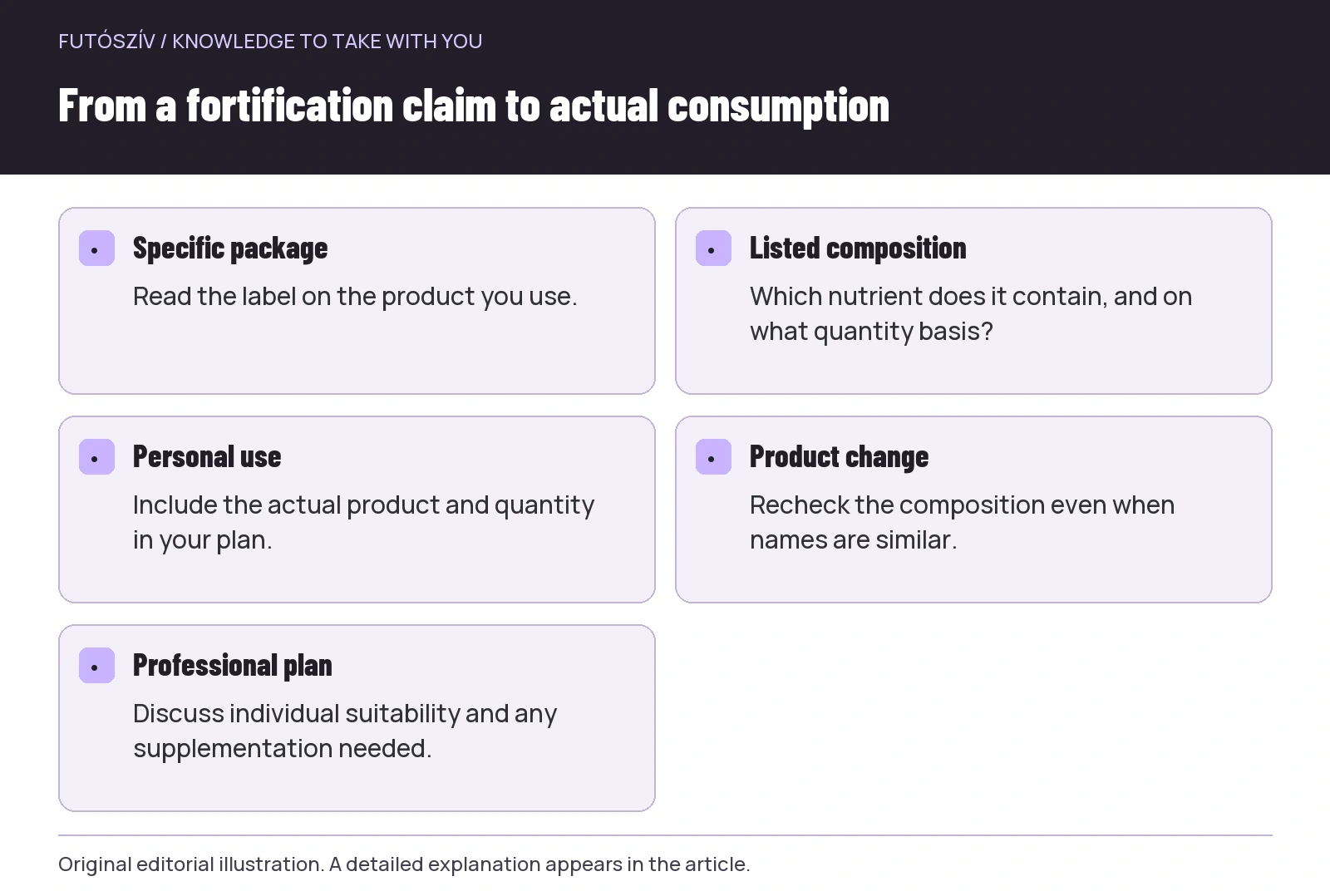 Enlarge diagram
Text version of the illustration
- Specific package
- Read the label on the product you use.
- Listed composition
- Which nutrient does it contain, and on what quantity basis?
- Personal use
- Include the actual product and quantity in your plan.
- Product change
- Recheck the composition even when names are similar.
- Professional plan
- Discuss individual suitability and any supplementation needed.
A plant-based label may tell you too little when travelling
A hotel’s or restaurant’s plant-based option may be a dish designed in its own right, or it may be the usual meal with a few ingredients removed. Ask in advance about the specific food and its composition. If local choices do not meet your individual needs, arrange a suitable alternative. You do not have to turn the whole trip into a complicated food-transport operation, but it is worth identifying uncertain access before leaving.
If you have an allergy, a vegan label is not confirmation that a food is free from your allergens. Plant-based products may still contain ingredients that are unsuitable for you, and preparation conditions need clarifying too. When speaking with a provider, describe both your dietary preference and your health-related risk precisely. The two can coexist while requiring different information and preparation.
Prepare specific questions for your consultation
Bring your dietary framework, a description of a typical training week and your regular meals. Identify where you are uncertain: is the total amount of food adequate, how can you establish a reliable B12 source, or what should you choose on a difficult working day? A specific question helps the professional respond more directly. A general statement that you want to eat healthily says less about the actual obstacles.
Also ask when and how to review whether the plan works. Follow-up does not necessarily require constant detailed calculations, but the chosen arrangements need to be assessable. Your appropriate healthcare professionals’ guidance takes precedence on supplements, possible tests and individual restrictions. Do not try to assemble a personal treatment by combining several online protocols written for different purposes.
A good plan has an everyday version
A useful plant-based running diet is reflected in shopping, cooking and access to meals. Alongside the professional plan, have some familiar dishes you can prepare properly and products you can obtain. Evaluate changes specifically: is the new breakfast actually available, does the chosen main meal get made, and do reliable nutrient sources really feature in your day? A framework that sounds good on paper only becomes a diet through putting it into practice.
Planning plant-based eating brings together accurate descriptions, complete dishes, reliable nutrient sources and professional support suited to your training demands. The aim is a varied, individually appropriate system you can follow in real everyday life. A checked label and a concrete solution in the kitchen contribute more to this than a single sweeping dietary promise.
Sources and further reading
- British Dietetic Association: Vegetarian, vegan and plant-based diet
- NHS: The vegan diet
- British Dietetic Association: Sport and exercise
How Futószív articles are prepared: our editorial guidelines.