Many runners attach their race bib in the final minutes before the start. A few pins, a quick adjustment, and it is done. But the number is not simply a souvenir or an identifier for photographs: it may also relate to registration, the starting zone, timing and checks by the organisers. Wearing it is therefore not a matter of decorating your clothing however you like. A well-prepared starting setup both follows the organiser’s current requirements and works with your own outfit. It does not block a necessary pocket or damage the chip, and changing layers does not immediately become an impossible task.
Your own race information comes first
One event may require the number to be worn on the front, another sport may use a different arrangement, and a separate timing chip may need different attachment. Do not automatically copy your routine from the previous race. Read the current organiser’s guide and the instructions supplied in your pack. Check where the number belongs, what must not be changed, whether a timing device is included, and whether anything must be returned at the finish. If anything is unclear, ask the organiser before the pre-start rush. Without knowing the particular product and event, general online advice can easily lead you in the wrong direction.
A good example of how specific rules can be is the archived 2024 New York City Marathon runner guide, which discusses bib position and prohibitions on modifying it. Read this as a historical example, not a current rule or one applying to another race. The lesson is that organisers may regulate the details of bib wearing. An attractive outfit photograph or another runner’s previous solution does not prove that the same arrangement is allowed and appropriate at your event.
Timing chips are not in the same place at every race
The chip may be on the back of the bib, in a separately attached device or in another form specified by the organiser. Follow the instructions for the system you receive. The official MYLAPS wearing page , for example, separately describes use of the bib-mounted ThinTag and another tag worn around the ankle. This illustrates why you should not transfer one system’s positioning to another. Even within the same manufacturer, there can be different tasks and fastenings. Do not invent your own wearing rule from the chip’s shape or from memory.
Check which parts must not be pierced, removed, folded or covered. MYLAPS gives such specific instructions for its own bib system. Do not remove foam or another spacer on the back simply because it looks like unnecessary packaging. Clothing attachment and electronics can have separate functions on the same sheet. If the number or chip seems damaged, the appropriate next step is help from the organiser. Do not try to “repair” an unfamiliar timing device with your own adhesive or modifications.
Plan its position on your clothing
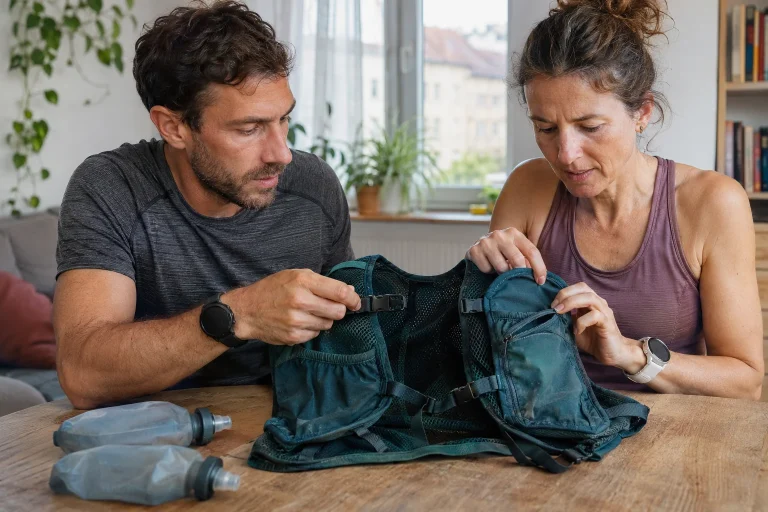
Within the position allowed by the rules, consider the bib together with your whole setup. Zips, pockets, vest buckles and trouser waistbands may all interact with it. If you expect to take a jacket off, think through what happens to the number. If you will wear a vest throughout, check whether it obscures readability. The aim is not simply to fit the number somewhere on your body, but to keep it worn as required throughout the run. Adapt convenient access to that requirement, rather than adapting the rule to your current favourite pocket.
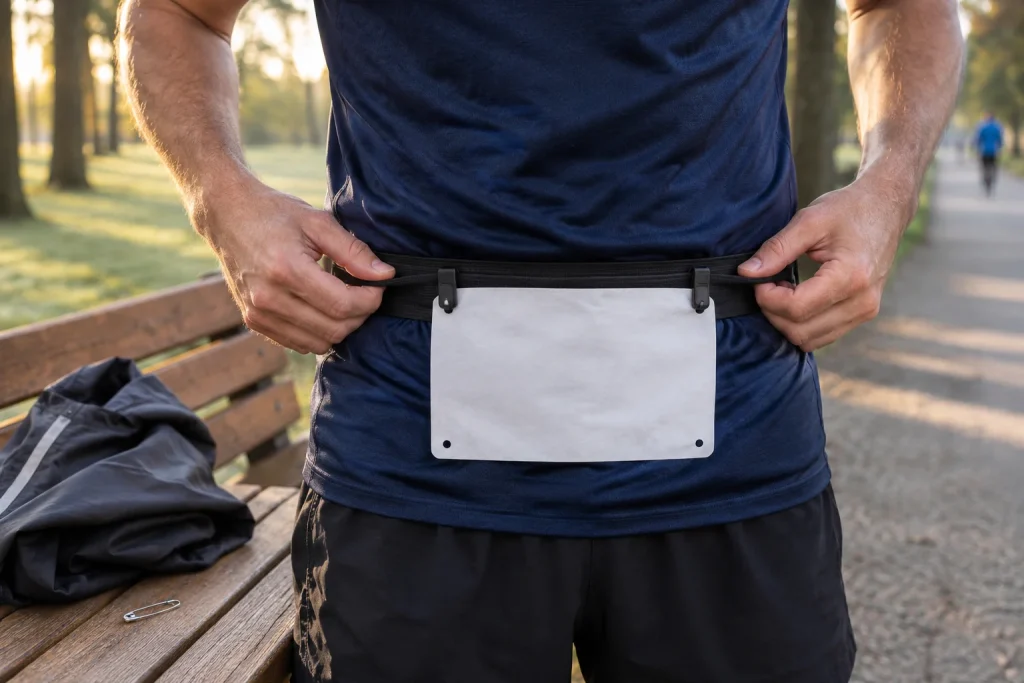
At home, a plain piece of paper similar to the actual size lets you rehearse where the system might clash. You do not need to crumple or pierce the real bib to do this. Put on your intended clothing and loaded vest or belt, then check whether zips and pockets remain usable. Turn sideways, lean forwards slightly and swing your arms naturally. You can see in advance if a fastening point would press into your skin. The trial does not replace the organiser’s instructions, but helps you choose a usable arrangement among the permitted options.
 Enlarge diagram
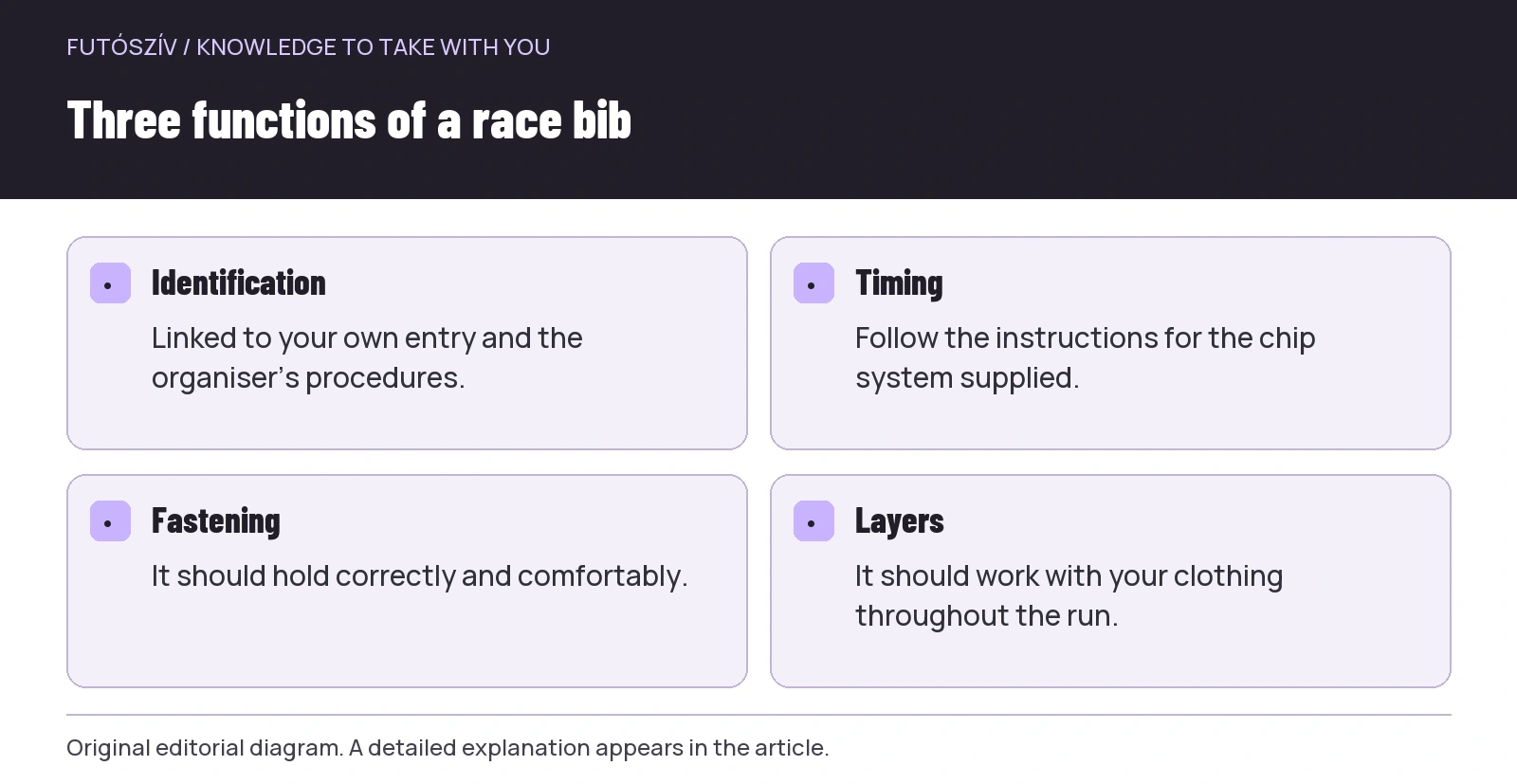
Text version of the diagram
- Identification
- Linked to your own entry and the organiser’s procedures.
- Timing
- Follow the instructions for the chip system supplied.
- Fastening
- It should hold correctly and comfortably.
- Layers
- It should work with your clothing throughout the run.
Safety pins: a simple tool used thoughtfully
If the organiser describes pin attachment, the important points are using the designated positions and avoiding the chip. Pins should be in good condition and close properly, with no exposed sharp part to catch skin or other clothing. Attach them in a calm place, not while running or balancing in the starting zone. Consider the clothing fabric too. Do not pierce a special membrane or delicate garment at random if this may affect its function; find a suitable way to reconcile race rules and the clothing system in advance.
Pin positions should not stretch the bib and the clothing underneath too tightly. Fabric and body position change during movement, so a fully stretched sheet may behave differently than when standing. However, a loosely flapping or folding number is not suitable either if it loses the required readability. Attach it at the points specified by the organiser and follow the system instructions. If anything seems unusual, ask for help at collection. A simple tool does not mean the same action is right for every garment and chip.
Bib belts and other fastenings: check permission first
A bib belt can be convenient for certain tasks, but is not suitable for every event or system. Before buying or testing one, check that the organiser accepts it and the number will stay in the required place and orientation. Evaluate attachment buttons, clips and other options against the particular product and bib too. Not piercing clothing does not mean it meets every other requirement. Chip position, readability and stability while moving still matter. Judge the convenience benefit together with these considerations.
Try the belt with your actual clothing and load. If you also use another running belt, bottle holder or trouser drawcord in the same place, check how they interact. The buckle should not sit on an uncomfortable pressure point, and the number should not twist sideways or turn inwards. You do not want to rearrange a poorly chosen system before every checkpoint during the race. The fastening has a simple purpose: keeping a correctly worn number comfortably and reliably in place. If that would require a complicated trick you have never used, a familiar, simpler solution may be better.
Layer changes and weather
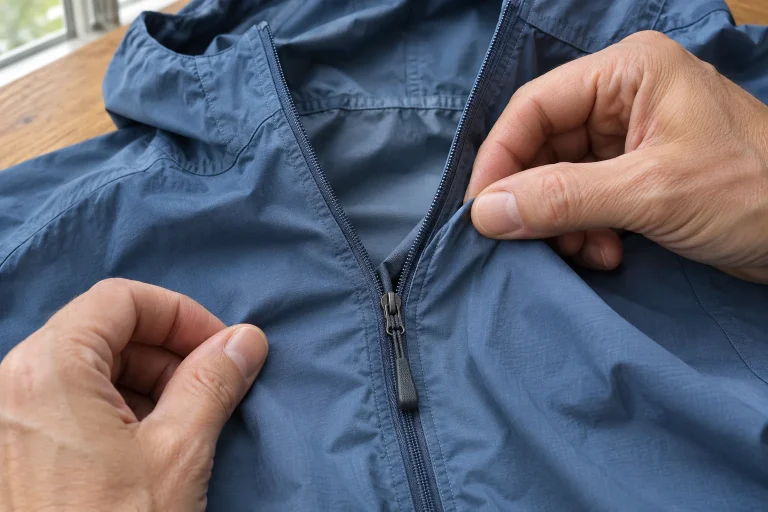
At a cool start, you may wear a layer that you remove while running. Plan number visibility and the required chip position across that whole process. Do not assume a system hidden under a jacket will definitely function in the same way. The MYLAPS technical usage information also explains how its own tags must not be worn. The precise restriction depends on the system supplied. The best solution follows the current rules and is one with which you have rehearsed changing clothing.
Do not iron, cut or fold the bib on your own initiative to make it suit your outfit better. If it was creased or faulty in the pack, contact the organiser. Wet weather and movement also make it worth inspecting the fastening in your pre-run check. Use the equipment supplied according to its instructions rather than switching at the last moment to a completely unfamiliar fastening. The plan also includes getting the number from preparation at home to the start without damage. A sheet stored in an appropriate place is less likely to become crumpled at the bottom of your bag.
| Check | Specific question | Where to find the answer |
|---|---|---|
| Position | Where and how must it be worn? | In your own race’s current information |
| Chip | Which part must not be modified? | In the supplied system’s instructions |
| Fastening | Is a belt or another device permitted? | From the organiser and product description |
| Layers | Will it remain correctly visible and worn throughout? | In a rehearsal wearing the complete outfit |
| After the finish | Must a separate device be returned? | In the organiser’s finish procedures |
Small items: do not crowd them around the bib
Keys, phone, documents and refreshments should be in suitable carrying places you have tested. An item tucked under the number or an unfamiliar accessory hanging from it can interfere with wearing and readability. Small items need a system too: keys kept separate, frequently used items accessible, and spares secure. If the running belt is full, do not immediately turn the number fastening into storage. Carrying and identification are separate tasks. In the whole setup, they need to work together without obstructing each other.
A spare fastener can be useful if justified by the organiser’s arrangements and your own pack, but do not carry an unchecked heap of small objects. Keep a pin or other sharp item properly closed and separate. The aim is predictable access, not a hard-to-organise load that merely looks prepared for everything. If a problem arises at the pre-start location, seek organiser assistance rather than inventing a quick modification from how another runner’s equipment works. In a rush, it is easy to turn a simple situation into a damaged number or uncomfortable fastening.
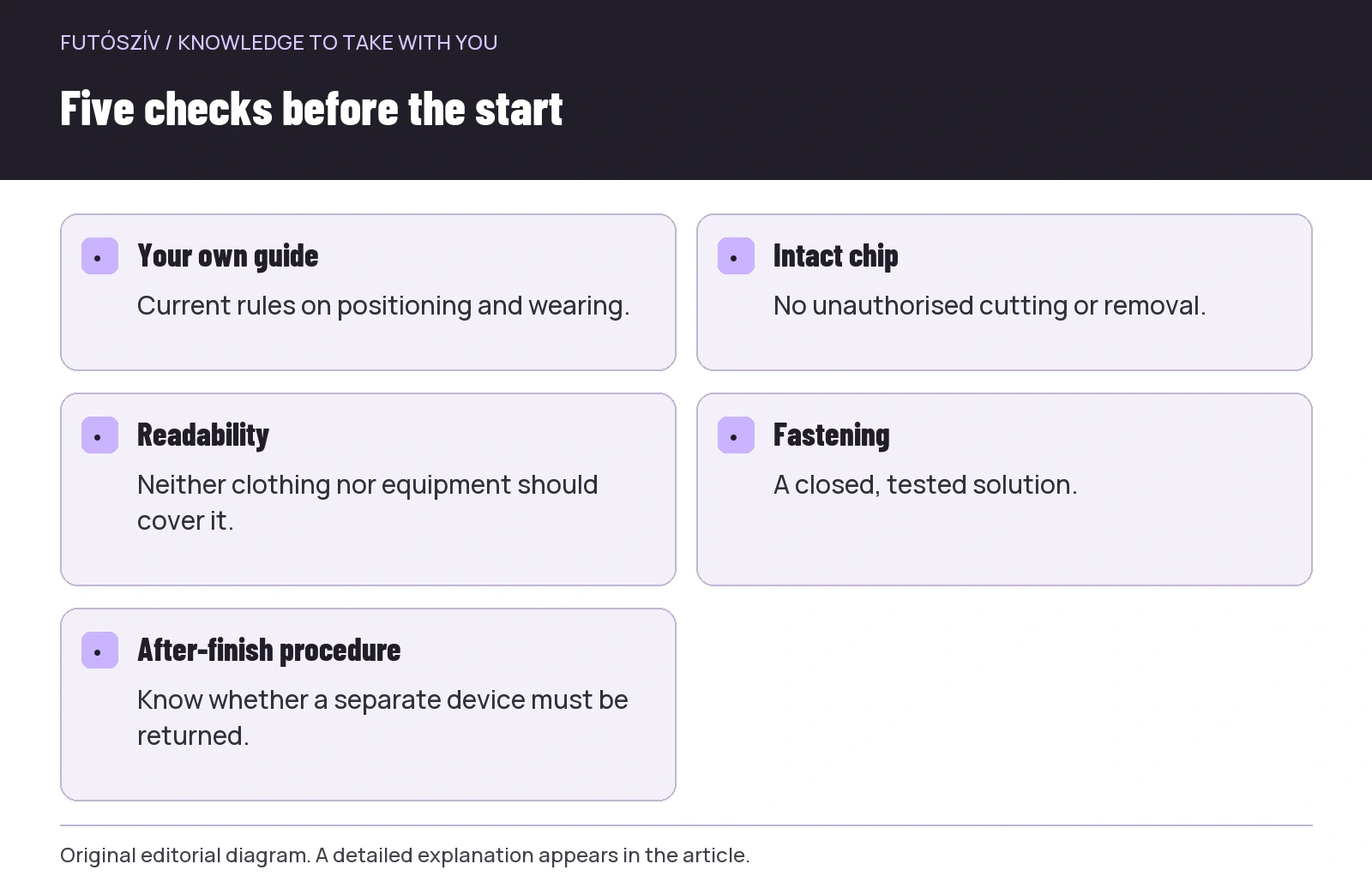 Enlarge diagram
Text version of the diagram
- Your own guide
- Current rules on positioning and wearing.
- Intact chip
- No unauthorised cutting or removal.
- Readability
- Neither clothing nor equipment should cover it.
- Fastening
- A closed, tested solution.
- After-finish procedure
- Know whether a separate device must be returned.
Check registration details at collection
Check that you received the correct number and pack and that the important details identified by the organiser are correct. A mistaken or uncertain situation is easier to resolve at collection than after finishing. If a separate chip or returnable device is included, be clear how it is linked to your entry. Do not exchange numbers with another runner by private arrangement instead of following the organiser’s authorised process. Timing and identification may rely on the organiser’s records. The event always determines the permitted method of transfer or modification.
If there is a field to fill in on the back, follow the organiser’s instructions, and do not automatically make personal information public in a photograph. A picture of the front of the bib and information on its back can involve different privacy considerations. Check what is visible before sharing. This does not mean you should not record a memory of the race; it means knowing what information reaches the audience. Preparing equipment also includes handling the documents and identifiers you receive thoughtfully.
Race timing and your own watch are separate systems
The official result comes from the race’s own system and rules, while your watch creates a personal running record. They may not show the same starting moment, route or handling of time. The MYLAPS introduction to running race timing presents some basic elements of such a system. Plan starting your watch so that it does not interfere with approaching the start and finish safely. While looking at the display, remain aware of nearby runners and organiser instructions.
If a result is missing or appears incorrect, report it through the organiser’s official procedure. Accurate entry and event details can help, but do not post unnecessary personal information publicly. A sports-watch file may provide useful background if the organiser requests it, but does not independently override official timing. Rather than a technical argument, describe the specific issue: which race, which number and what absence or discrepancy is visible. A correctly worn number and intact chip are a good starting point, but a problem still needs to follow the appropriate process.
A final check before the start
As you approach the start, check that the number is appropriately visible, fastenings are closed, and you have not damaged or covered the chip-related part during the final layer change. Keys and phone should remain in their own places, and unnecessary baggage should be dealt with as the organiser specifies. This is not the time to invent a new technical system. Well-prepared details work quietly: the number identifies, the fastening holds and equipment is accessible. This leaves more attention for running and your surroundings. A bib is a small object, but part of a larger system.
Sources and further reading
- MYLAPS: wearing tags correctly
- MYLAPS: Time Tags technical usage information
- MYLAPS: basics of running race timing
- NYRR: archived 2024 runner guide, an example of organiser requirements
How Futószív articles are prepared: our editorial guidelines.