A running photograph involves decisions on site and when sharing
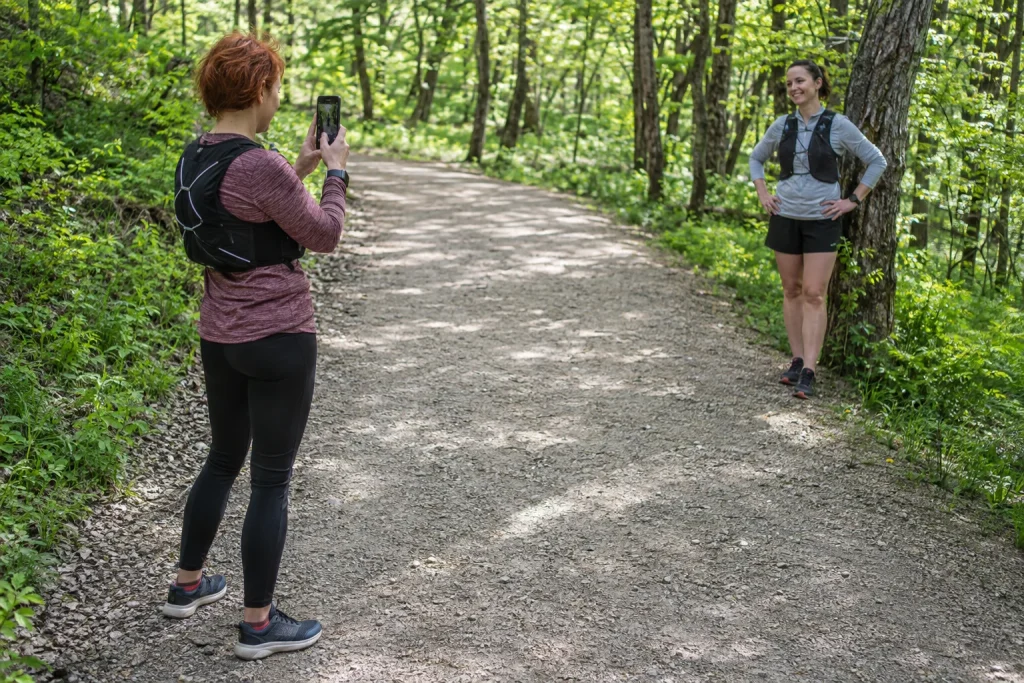
A forest photograph can be a good memory of a shared run, showing landscape, team or special light. But it does not exist only on the phone: taking it means choosing a place, perhaps stopping the group and later giving others an example of how the area can be used. Nature-conscious photography therefore begins before the shot and continues beyond its caption.
You need no professional equipment to photograph considerately. The main questions are simple: are you standing somewhere appropriate, disturbing wildlife or another visitor, and what does the shared image claim? A running photograph becomes a considerate memory when it respects use of the place too.
Begin the viewpoint from the permitted route
On screen, a few steps can seem to improve composition. On the ground, they may lead into vegetation, sensitive soil or inaccessible land. Do not reinterpret the designated route’s boundary for a photograph. Seek your viewpoint within local rules.
The Duna–Ipoly National Park visitor guide emphasises remaining on designated paths and avoiding wildlife disturbance. Photography can be observation, but provides no special reason to leave the path or move natural features.
If the desired picture cannot be taken appropriately there, choose another composition: simpler, farther away or less spectacular. A keepsake image is not a compulsory performance task requiring alteration of environmental conditions.
Seemingly empty ground may not be empty
Conservation value is not always an obvious flower or large tree. Open rocky ground can also be sensitive habitat. Do not infer from appearance that leaving the path or arranging the group there must be harmless.
The national park’s information about Tarnai-pihenő gives a specific example of vulnerable dolomite grassland and thin soil and asks visitors to follow marked paths. This site-specific notice does not give identical details for every landscape; it illustrates why apparently bare ground is not necessarily valueless.
Group photographs can accumulate effects. A step one person regards as insignificant may be repeated by several others. Choose a photo location appropriate to the whole group and site, rather than only whether the first person fits.
 Enlarge diagram
Text version of the illustration
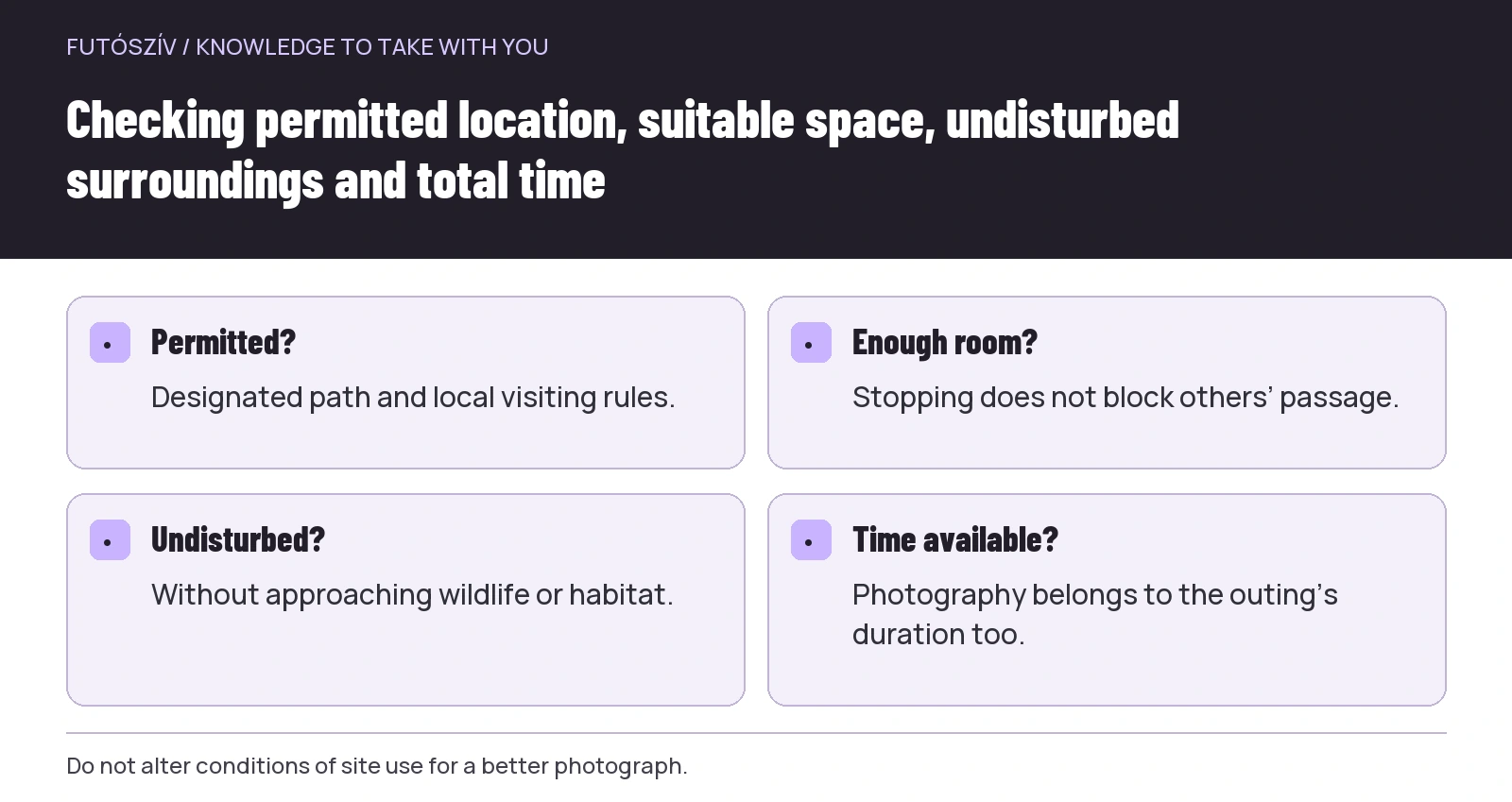
- Permitted?
- Designated path and local visiting rules.
- Enough room?
- Stopping does not block others’ passage.
- Undisturbed?
- Without approaching wildlife or habitat.
- Time available?
- Photography belongs to the outing’s duration too.
Four questions before stopping the group
| Question | What should you check? | If it does not work |
|---|---|---|
| Is the place permitted? | Designated path, local sign and visitor conditions | Choose another viewpoint |
| Does the group fit? | Path width and other visitors’ movement | Do not occupy the passage |
| Will surroundings remain undisturbed? | Wildlife, noise and repeated approaches | Abandon the photograph idea |
| Does it fit the outing? | Stopping, return and shared commitment | Shorten photography or plan it separately |
The table is our decision framework, not a replacement for local rules or a ready-made sequence for every environment. It prevents a photograph automatically interrupting everyone’s outing without considering the situation.
Do not rearrange nature for the image
A branch, flower or stone may seem inconvenient to composition. This does not require moving, breaking or collecting it. Adapt the image to the place, not the place to the image. Moving the phone or changing view within permitted limits often suffices.
Do not create temporary scenery at the route edge for someone else to find later. Putting away race numbers, packaging and props belongs to photography too. Running content does not justify objects left behind.
The same principle applies to conservation photography. When documenting a problem, aim at precise observation rather than heightening drama. Do not move objects or wildlife to make a situation appear clearer. Factual documentation gains value from preserving actual condition.
Photographing animals should not become an approach task
An animal seen while running does not require approaching or following for a photograph. Consider the environment and avoiding disturbance. A distant image or no image can be appropriate outcomes.
Do not lure, feed or direct the animal for the composition. The national park guide asks visitors to avoid disturbance too. Preserving an experience does not require turning every encounter into a close portrait.
Treat nesting or other sensitive situations carefully when sharing as well. The Audubon article on responsible nature-photography sharing highlights potential disturbance from publishing exact locations of rare and nesting birds. Report an observation to an appropriate specialist organisation when needed, rather than automatically creating a public visiting destination.
Your running companion’s participation should be a separate choice
A shared outing and appearing publicly in an image are different commitments. Ask companions whether they want to appear and be shared in that way. Someone outside the photograph remains equally part of the group.
Do not repeatedly stop everyone for images without agreeing separate time. A run and content-creation outing can require different organisation. If you want several posed shots, say so before departure and choose matching location and timing.
Treat other visitors appearing in images considerately too. This article offers no legal ruling on every image-use situation. Clear agreement and avoiding unnecessary publicity can form simple practical foundations for your community.
Keep site-use context in the caption
A photograph can suggest anyone may visit in the same way at any time. If it was actually taken from a designated path under particular visitor conditions, mention that briefly. It then supplies useful orientation as well as atmosphere.
The Leave No Trace social-media guide does not impose a general rule against location tags. It emphasises what is shared and the example shown. Appropriate place-related information can help others prepare, while an unexplained image may encourage misunderstood behaviour.
Do not claim more in the caption than you know. Today’s route does not guarantee next week’s access. Conditions at one point do not describe the entire region. Date and limits of personal experience make recommendations more precise.
 Enlarge diagram
Text version of the illustration
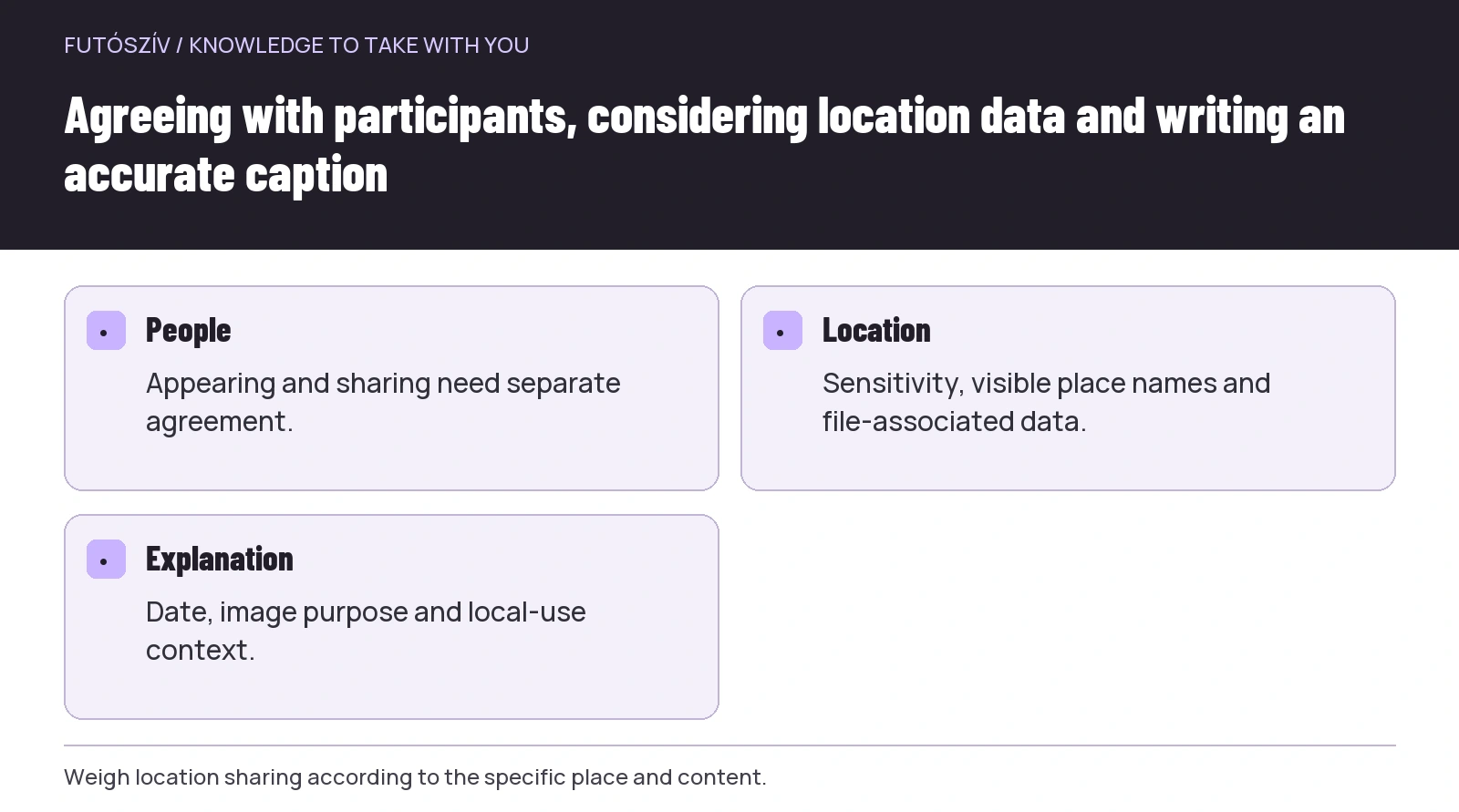
- People
- Appearing and sharing need separate agreement.
- Location
- Sensitivity, visible place names and file-associated data.
- Explanation
- Date, image purpose and local-use context.
Sharing the exact location is a separate decision
A publicly accessible, officially described destination and a sensitive wildlife observation can raise different sharing questions. Do not automatically use identical detail for every photograph. Clarify purpose and possible consequences.
Audubon also highlights location data associated with image files. Before sharing, examine more than the place name in a caption. Check actual device and service settings to learn which data accompanies the image or forwarded file. Exact operations depend on the system.
Do not use omitted location data to imply any method of taking the image becomes appropriate. On-site conduct and sharing are separate tasks. Understand environmental and participant considerations in both.
An illustrative caption improvement
The first version says only: secret running paradise, come wherever you see a path. Although taken from a suitable point on a designated route, the wording may imply unrestricted exploration. This is not what the creator wants to convey.
The revised version says the photograph was taken from a waymarked route, ties experience to the visit date and directs readers to check current visitor information. It gives no precise access instructions to sensitive habitat and does not promise the whole loop is easy for everyone.
The example uses invented wording. Its point is accuracy: the same image with another explanation conveys a different example. Creative atmosphere can remain while conditions for visiting stay visible.
Include photography stops in the time plan
Sunset, a group portrait or several stops changes the whole outing’s duration. Do not calculate the journey home from moving time as though photography never happened. Return and communication agreements belong to the complete programme too.
Especially on a new route, do not automatically extend finishing for a good image. Actual conditions, experience and access still matter. A photograph needing another time frame can become a separately organised occasion.
Agree photography’s role with the group beforehand: brief keepsake or detailed content creation? Both can be meaningful but create different expectations. Discussion prevents everyone else’s run becoming background for one person’s framing attempts.
Preserve truth when editing images
When changing brightness or crop, consider what the image will claim about the site. In a route recommendation, do not remove a relevant restriction or information sign so readers infer different conditions of use. An atmospheric photograph and an information graphic have different roles.
If an illustrative image comes from another place or time, label it appropriately. A summer image alongside a winter-route account does not document current ground condition. Naming date and image role supports interpretation.
A special moment need not become implausibly perfect to remain a memory. An accurately described image of the actual situation may be more useful to the running community too. Visual appeal and information together create its value.
When responding to mistakes, support the next decision
If an image seems to show problematic behaviour, do not automatically assume every background detail. A factual report or relevant manager’s involvement may be needed, but public shaming differs from conservation information. Leave No Trace also emphasises respectful communication.
For your own mistake, name the next step: choose another stopping place, clarify the caption or agree photography before the next shared outing. A concrete change helps more than a general promise to be careful about everything.
Nature-conscious running photography can therefore involve three connected decisions: appropriate on-site behaviour, images agreed with participants and accurate sharing. Your photograph shows not only where you ran, but how you think about the natural environment shared with others.
How Futószív articles are prepared: our editorial guidelines.