
In a progression run, a later part is deliberately brisker than an earlier one. This may be a very slight increase within an easy run, or a separately planned session with a harder finish. Distinguish the two: being faster at the end of a graph does not yet tell us the load completed.
Regulation is the core task. You start restrained enough to leave a meaningful place for a later increase, then raise effort to a boundary chosen beforehand. Every outing does not need to reach maximum speed, and the finish does not have to become a sprint.
Three different things can be called a progression run
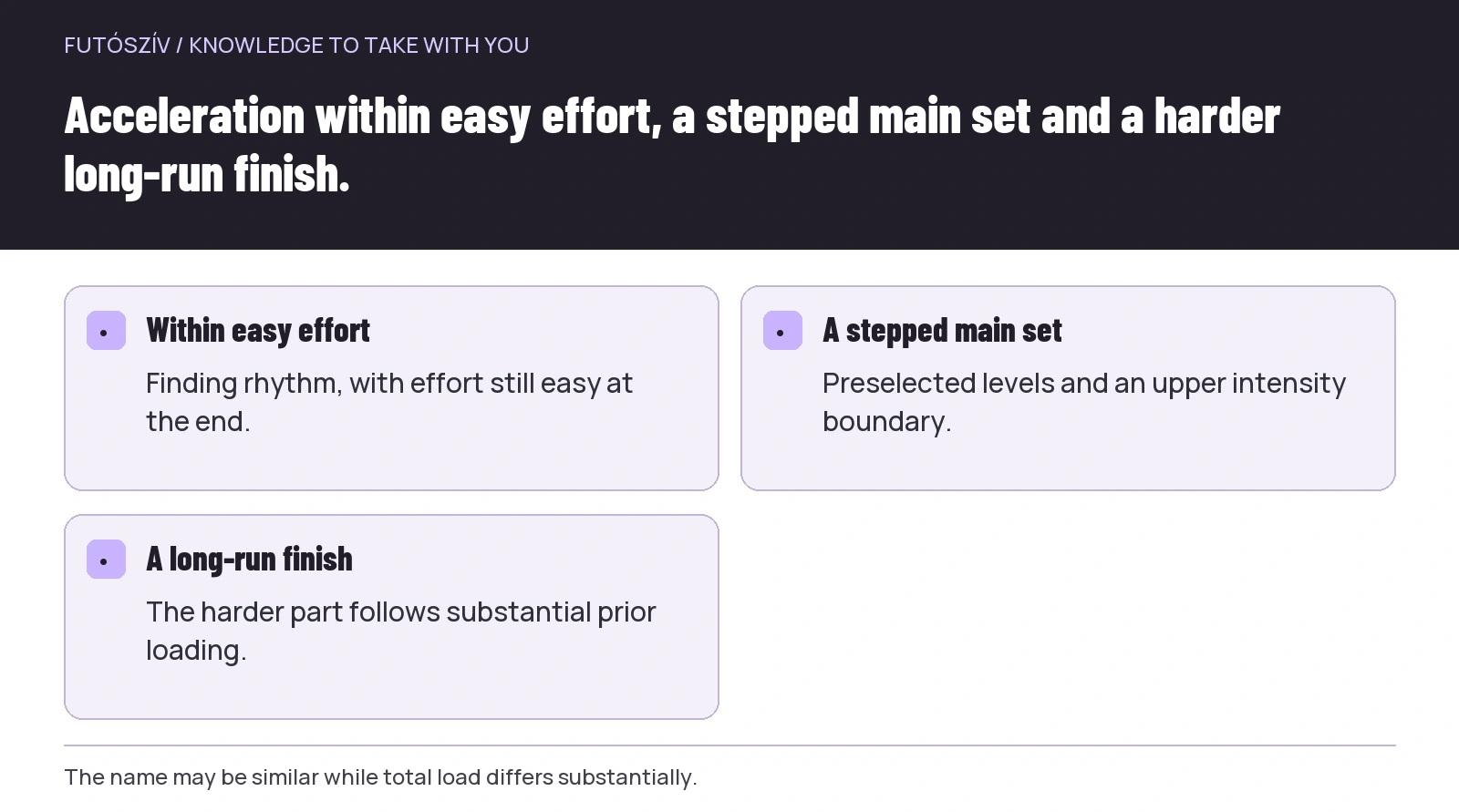
The first starts comfortably and stays in the easy range later too. Change here is more about settling in and finding rhythm. The second has a main set built through several stages, with the last deliberately harder. The third places a faster block at the end of a long run, potentially creating substantial total load because of its duration.
The same label is therefore insufficient in a weekly plan. Describe where you want to start and finish, how long you remain at each level and the highest intended effort. Moving from easy to moderately brisk differs from moving from easy to race-like struggle.
If the plan only says “speed up towards the end”, ask for or make a clarification. What is needed is not necessarily kilometre pace, but a clear intention. For example: I want controlled breathing and composed movement at the end too, without aiming for a record on the final section.
Progression is not the same as a negative split
A negative split generally means completing an event’s second half faster than its first. The pace within those halves may still vary: it does not mean every successive kilometre was faster. A progression session deliberately plans increasing pace or effort within the run.
Another distinction is that racing may aim for the best appropriately paced performance, while training aims for a specific stimulus with manageable after-effects. Race strategy and training structure may relate, but are not automatically interchangeable.
A successful faster second half in one race does not imply every run should accelerate. An easy day may have another task, and maintaining even pace is a learnable skill too. A session format’s value comes from fitting the aim.
Plan the endpoint first
For progression running, beginning your thinking with the highest planned intensity is particularly helpful. Where do you want to arrive: still easy running, a sustained hard section or perhaps brief race-pace practice? This determines how much reserve to preserve early.
The endpoint also needs a duration. A few minutes of harder running differ from the same effort over a substantial proportion of the main set. Recording only the fastest target pace leaves much of the total work undefined.
Have an upper boundary even when you feel good. Execution that is easier than expected is useful experience, but does not oblige another increase. A planned session does not need to become a fitness-test race by the day’s end.
 Enlarge diagram
Text version of the diagram
- Within easy effort
- Finding rhythm, with effort still easy at the end.
- A stepped main set
- Preselected levels and an upper intensity boundary.
- A long-run finish
- The harder part follows substantial prior loading.
Steps or continuous increase?
In a stepped structure, you change at specified times. This makes orientation simpler: restrained now, brisker later, then the selected upper range. Changes should not mean sudden sprints; a few steps or a short gradual transition can be natural.
A continuous increase has no sharp section boundary. This may feel more pleasant if you regulate well by sensation, but makes reaching final intensity too early easier. Once pace is already too hard in the first third, increasing further while preserving the aim becomes difficult.
Neither version is necessarily better. When learning pace choice, a few clear steps may be more useful than a curve that must rise every minute. Training does not need a mathematically elegant line to be meaningful.
What should the first part mean?
Do not treat a restrained start as irritating waiting. It prepares the later task while letting you observe the day’s condition. If a part intended to be easy feels unusually hard, this is important information about further increases.
Do not try to gain time early. A faster start does not add value to the same session duration: it changes distribution and may remove control later. If the first level already resembles the middle, room for progression narrows.
Initial-section length and warming up can relate but are not always identical. A harder main set may need separate preparation. A brisk first block from complete rest does not become a warm-up simply because faster running follows.
Preserve your choice in the middle
After increasing, allow time to settle into the new rhythm. Do not accelerate again immediately because the watch shows change with a short delay. Sensations and data can be interpreted together, but display fluctuation is not a new coaching instruction.
A useful question is: if progression stopped here, could I continue with composed movement? If the answer is clearly no already in the middle section, you may have gone too high. The next step does not then have to happen automatically.
The intended load does not always require a faster external pace. In a headwind or uphill, maintaining the same speed may already require more effort. Plan progression with the route, not just split times drawn on flat paper.
A faster finish needs a brake too
At the intended upper level, do not start another race with yourself. If the task was sustained control, a maximum sprint in the last minute is a different stimulus. A faster ending and complete exhaustion are not equivalent.
In the final section, notice whether running remains composed. Increasing fatigue may be natural, but marked movement deterioration or effort disproportionate to the aim suggests ending the increase. Exceeding an arbitrary boundary should not define success.
After the main set, allow a comfortable ending and safe slowing. Do not place the route’s end where fast running leads immediately onto a busy pavement or sharp bend. Planning the closing section includes where you slow down.
What can race pacing teach us?
A study examining a ten-kilometre trial analysed pacing in runners at different performance levels. The pattern highlights that pace choice and runners’ abilities may be related. It does not supply a minute-by-minute progression session for everyone.
An analysis of a larger race-results database examined the relationship between pacing patterns and distance-running performance. Such observation does not automatically establish that a particular session format causes better results; preparedness and circumstances may play a role too.
The valuable practical question is how to learn to distribute reserves. A progression run is one possible setting for practising this, but not the only one. Even-paced running, race experience and reviewing sessions afterwards can also contribute to pace judgement.
 Enlarge diagram
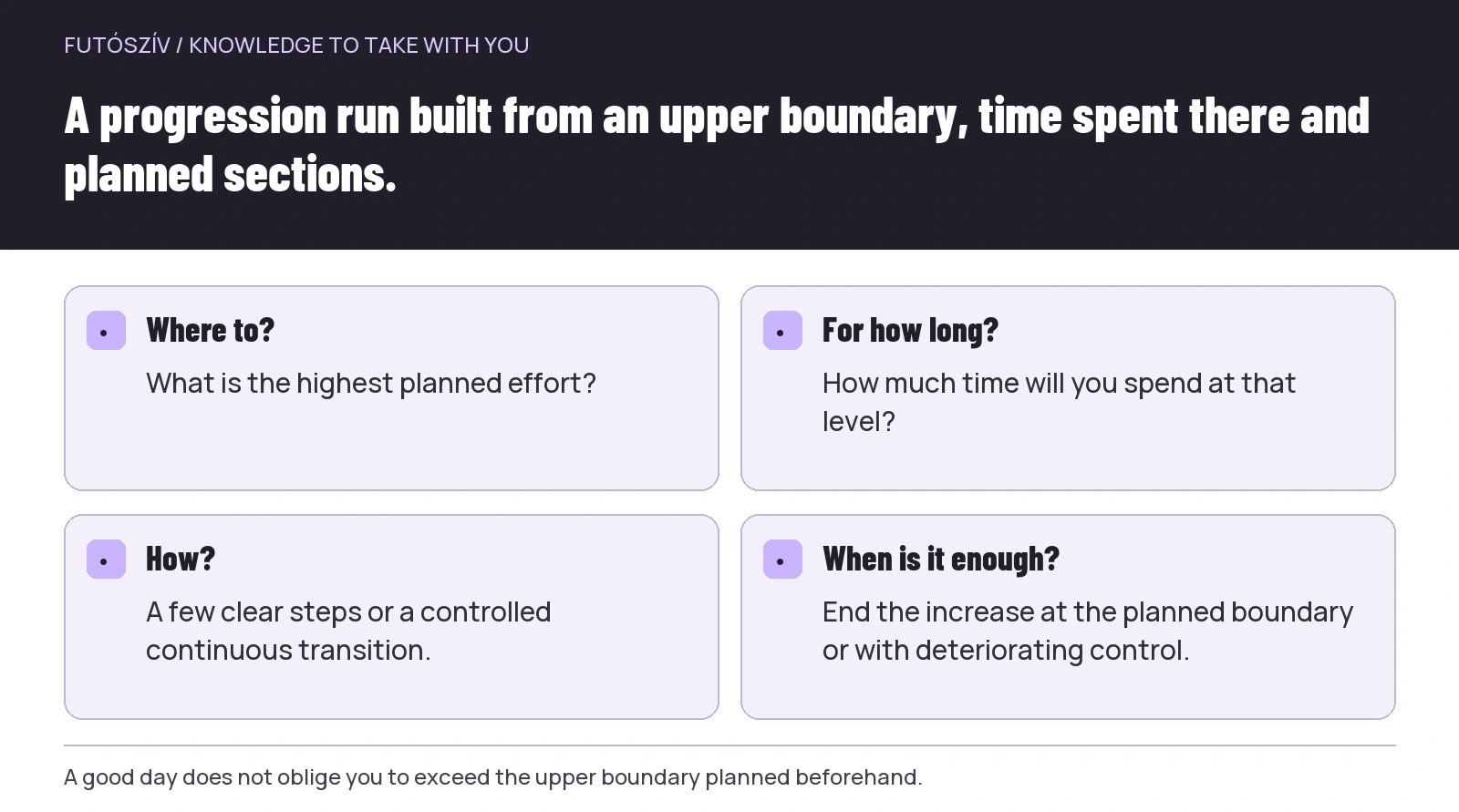
Text version of the diagram
- Where to?
- What is the highest planned effort?
- For how long?
- How much time will you spend at that level?
- How?
- A few clear steps or a controlled continuous transition.
- When is it enough?
- End the increase at the planned boundary or with deteriorating control.
The final part counts in the weekly plan too
A day can remain labelled easy in the log despite a substantial hard section at its end. The label then hides the real load. Record the whole run and the harder section’s duration separately too.
The World Athletics training-planning guide emphasises linking loading and recovery. Apply this to progression runs as well: evaluate a harder finish’s effects together with what is possible the next day.
If the week already contains hard hills, intervals and a long run, a spontaneous fast finish is not necessarily a missing link. It may be another hard section in an already full programme. Feeling good can support controlled execution; every good day does not have to yield more loading.
The end of a long run is a particularly different task
You have already been moving for a substantial time before the harder closing block. Fatigue, energy supply, weather and ground all add to speed. Twenty minutes at the end are not necessarily equivalent to the same twenty minutes while fresh.
Do not therefore treat a fast long-run finish as merely extending a short progression run. Increasing duration and adding intensity are two variables. If both are new, identifying what was excessive becomes particularly difficult.
Seeking confidence before a race should not lead to full race simulations every weekend. Manageable recovery after a long run is as much part of preparation as a successful last kilometre. A session supporting the whole week can be worth more than a striking graph ending.
Three situations, three sensible corrections
If a strong headwind begins on the planned route, retain the upper effort boundary and let go of target pace. If the middle feels harder than expected, omit the final increase. If the route becomes crowded, switch to easy running or finish the main set.
These are different problems, so record the reason too. A slower pace because of wind differs from an unsustainable task in calm conditions. Precise observation helps avoid excessive conclusions about preparedness.
Increasing pain, limping or unusual illness, however, is not simply a pace-correction situation. Stop the task and seek healthcare help as needed. Severe chest symptoms or fainting may justify urgent care.
How can you recognise progress?
On similar routes and under similar conditions, observe whether restraining the start becomes easier, transitions smoother and the final part less of a struggle. Progress does not require a faster finishing pace every time.
Beside splits, add a sentence about control: when did you deliberately accelerate, and when were you carried along by surroundings or company? Even a neatly accelerating data series can conceal a poor decision if descent or tailwind caused the change while effort did not follow the plan.
A useful lesson from progression running may also be recognising an increase you can omit. Regulating load means not only accelerating, but choosing an appropriate endpoint. You can take that skill into the next session and race.
Sources
- Effect of performance level on pacing strategy during a 10-km running race.
- Effects of Pacing Properties on Performance in Long-Distance Running.
- World Athletics: Be your own coach.
Race observations do not prove a training method applicable to every runner. This article’s decision-making and logging examples help explain loading and do not replace a personal training programme.
How Futószív articles are prepared: our editorial guidelines.