Your finish time is an outcome, but it is not the whole task
A target finish time is easy to remember: you know the number you would like to see at the finish. In everyday running, however, that number is rarely what you actually carry out. You choose a meeting point, find a suitable route, follow the agreed session and report when something has changed. These actions can have their own, more immediate goals.
A process goal directs attention towards part of the execution. It is not a magic phrase, and it does not make every outcome completely controllable. It can give you something to do now alongside a longer-term ambition. This article offers general planning considerations and editorial examples, rather than an individual training plan or sport psychology treatment.
Different types of goals answer different questions
ESSA’s 2026 position statement on goal setting discusses different goal types and choosing ones that fit individual circumstances. A placing in a race also depends on other people’s performances. A goal based on your own finish time can be compared with your previous results. A process goal, meanwhile, might concern carrying out a chosen strategy or task.
A learning goal can involve exploring a situation that is new to you and describing what you learned afterwards. The distinction is not a ranking of value. An outcome goal can be important and motivating, while the next session’s task may be easier to follow in another form. Goals do not have to compress your entire running life into one number.
Connect the goal to your own situation
Before defining a task, consider the issue you want to address. Is the difficult part finding time after work? An unfamiliar route? A training diary that lacks useful feedback? An organisational obstacle calls for a different goal from carrying out training agreed with a professional. A sentence that sounds good is not enough on its own.
For example, behind the wish to ‘be more consistent’ may be a meeting point that is too far away. Instead of another rule about self-discipline, the task may be to rethink accessible times and routes. Not every obstacle is a lack of motivation. A goal relates to the real situation when it addresses the point at which you can actually make a decision or change.
Replace a general judgement with an action
Instead of ‘I will become a better runner’, you might specify the feedback you want to give your coach after the agreed session. Instead of ‘I will be braver on trails’, a learning question might concern which types of route you still need to explore with professional help. Being specific should not push you into danger: a goal must not involve ignoring physical warning signs or environmental risks.
Make the actionable part of the sentence clear. For example: after training, I will record the task and where changes were needed. This differs from demanding that you feel satisfied after every session. A feeling cannot simply be required as an achievement to tick off. An action, however, can be discussed later and the goal adapted if necessary.
 Enlarge diagram
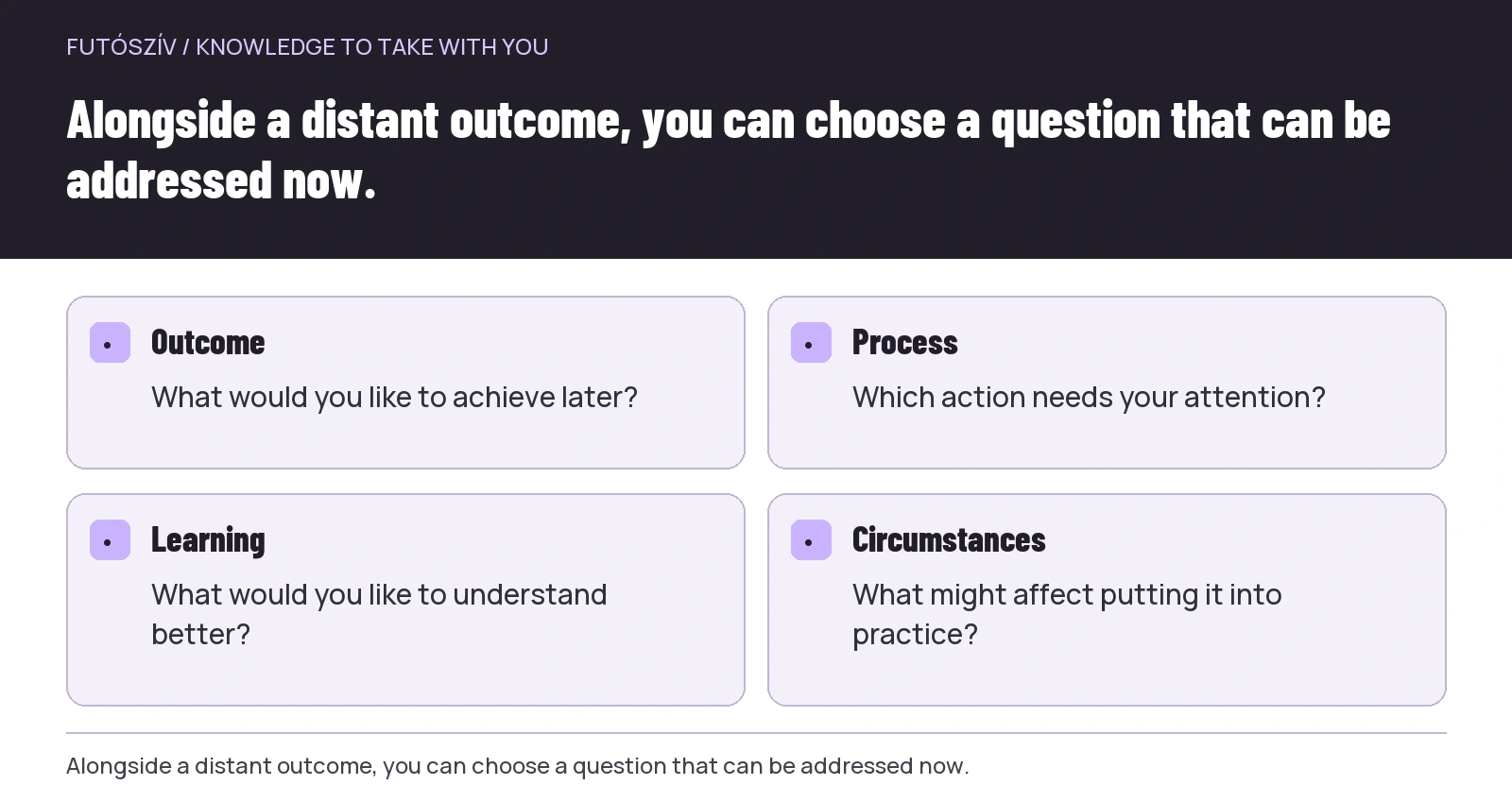
Text version of the illustration
- Outcome
- What would you like to achieve later?
- Process
- Which action needs your attention?
- Learning
- What would you like to understand better?
- Circumstances
- What might affect putting it into practice?
A learning goal does not demand an immediately good result
In a new situation, asking what you want to understand can be useful. For example, after an organised, appropriately chosen first event, can you identify which practical arrangements helped and what you would change? The first occasion is then remembered as more than a good or bad finish time. Experience can produce information useful for a later decision.
A learning goal is not permission to try something unprepared or disregard health-related limits. Distance, workload and surroundings still need to suit your condition. Here, learning means the perspective used in evaluation: rather than necessarily proving an established level, you seek a better understanding of a named question.
Having influence does not mean having complete control
Advice about process goals often says to focus only on what you can control. Interpret this flexibly. Traffic or family circumstances can disrupt even an agreed meeting, and a chosen task cannot always be carried out unchanged. Recognising an obstacle and making a reasonable adjustment can therefore be part of a good goal.
Avoid creating a system in which every deviation counts as a personal failure. If a park closure requires another route, solving that situation may become the actual task. If a health symptom means stopping, that may be the right decision even though the original plan was not completed. A goal should support independent judgement rather than reward ignoring reality.
Numbers are not equally useful in every situation
The ESSA statement cautions against oversimplifying goal setting and allowing one popular acronym to replace individual consideration. There can be a place for precisely defined goals and for more open learning intentions. Prior knowledge, the task and personal needs all affect the choice. Adding another number does not improve every goal.
For example, when attending an unfamiliar community session, ‘I will find out which group arrangement suits me’ may be a more useful starting point than demanding a particular pace in advance. For a familiar task planned with professional guidance, a specific execution framework may help. The two approaches are not mutually exclusive; they serve different functions in different situations.
Choose a small number of goals you can actually attend to
If you give one run technical, social, pace, logging and mental goals all at once, it becomes hard to say what the session was about. Instead, discuss which question has priority now. The others can become later tasks or simply remain part of the context. Coaching instructions and your own notes should not create competing demands.
A process goal does not necessarily involve technical self-monitoring on every step. There is no need to continually examine movement details while running, particularly if a professional has not asked you to do so. The task can concern preparation, communication or reflection afterwards. Place it where it will not interfere with safety or the activity already agreed.
Let the record inform a decision rather than become another report card
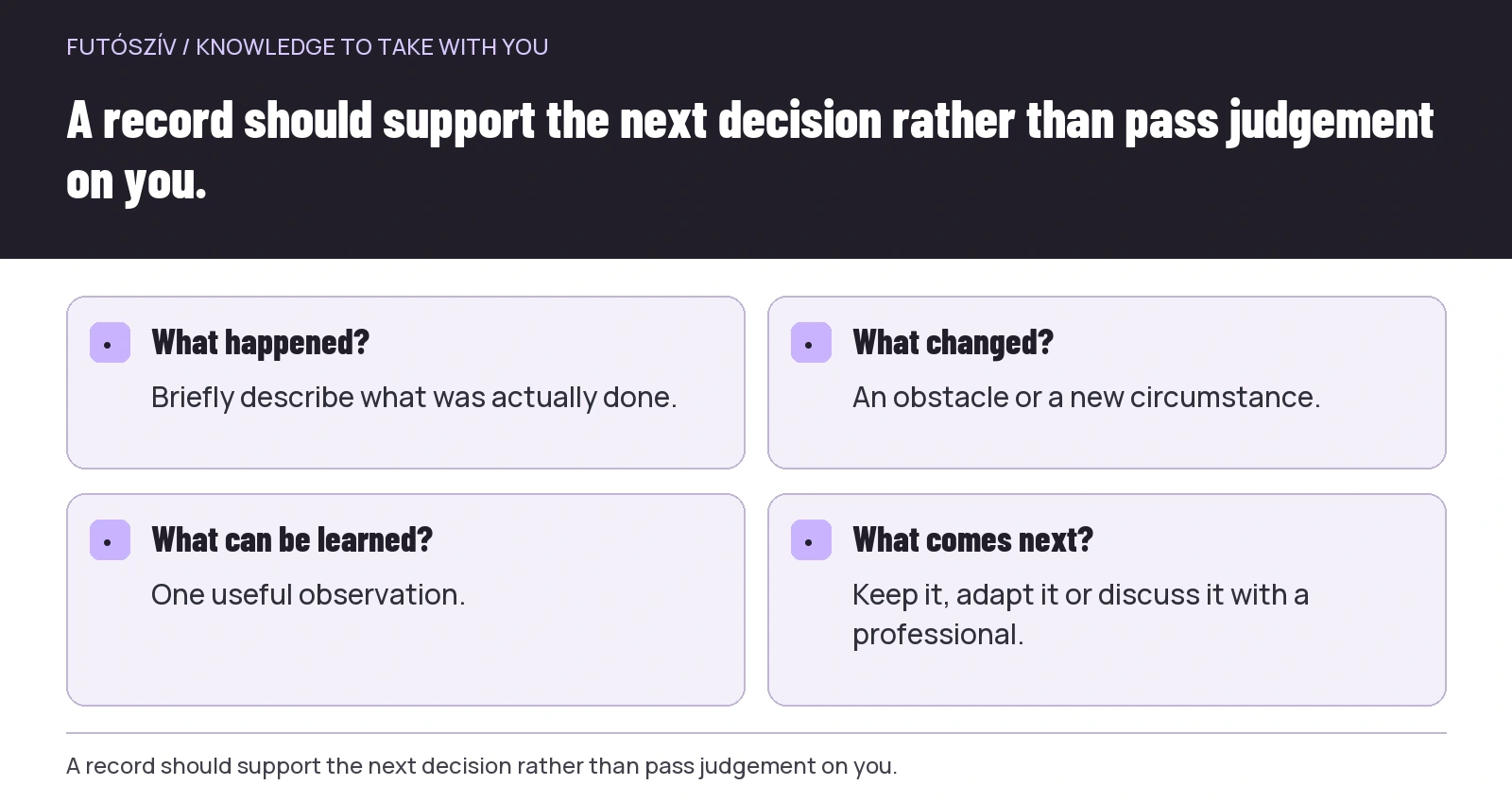
After the session, briefly note what happened to the chosen task. Was it completed? Modified? Were suitable conditions unavailable? Add a sentence or two of explanation if useful. There is no need to calculate a percentage success rate for every situation. The value of the record is that it makes the experience understandable at the next discussion.
If route choice was the question, for instance, the entry should show what helped or got in the way. ‘It did not go well enough’ gives little information. Noting that travelling to the meeting point took too long and made the start rushed is already useful. This can lead to a specific organisational change without judging yourself.
 Enlarge diagram
Text version of the illustration
- What happened?
- Briefly describe what was actually done.
- What changed?
- An obstacle or a new circumstance.
- What can be learned?
- One useful observation.
- What comes next?
- Keep it, adapt it or discuss it with a professional.
A shared goal should be a genuinely shared agreement
When working with a coach or running partner, explain what you want from the task. A 2024 study of practitioners’ goal-setting work in sport psychology also highlights personal and environmental factors and follow-up. This does not establish one compulsory method. Rather, it suggests that choosing and subsequently adapting a goal requires conversation.
If you do not understand why you have been given a goal, ask about its purpose. If another question matters more to you, say so. Cooperation involves more than accepting a sentence supplied in advance. A good agreement makes clear what you are focusing on, what information will inform the evaluation and what happens if real circumstances require a change.
The outcome goal can still matter
Focusing on processes does not require giving up a target time or the enjoyment of racing. The difference is that a more immediate task accompanies the longer-term outcome. If the result does not happen, you can still meaningfully review what happened during execution, which conditions changed and what is worth keeping.
ESSA’s position statement on performance under pressure also discusses goal type and applying it appropriately to the setting. Not every situation calls for the same precision or focus. Your sporting ambition can retain its value even when learning, a manageable routine or following health-related limits takes priority for a while.
When a goal becomes pressure, review the system too
A possible concern is intense guilt after a small change of plan, wanting to override health advice because of a goal, or repeatedly displacing important responsibilities outside running. An article cannot diagnose a condition from these signs. They may, however, be sufficient reason to review the situation with your coach and, if needed, an appropriate healthcare professional.
Changing a goal does not necessarily mean setting another one. You may need an individual discussion about overall workload, expectations within a community or mental wellbeing. Training that feels compulsive, or persistent anxiety, is not automatically resolved by a more skilfully worded sentence. A planning tool has its place and its limits.
An example of developing an everyday process goal
Suppose your after-work run often starts in a rush. Your longer-term goal remains a future race, but the immediate task is organising your departure. You identify a nearby route that fits the agreed time window and prepare the necessary kit in advance. Afterwards, assess whether fewer decisions were needed on the spot and what remained difficult.
There is no compulsory distance or guaranteed performance improvement in this example. The task addresses a real obstacle. If your working hours change the following week, the route and preparation can be reconsidered. A process goal is thus an action linked to your chosen direction and adaptable through experience, rather than a rule carved into the calendar.
The next question can be simple
Which single decision would you like to make easier or clearer next time? An answer gives you a starting point for a personal goal. If you cannot answer yet, understanding the situation may be the first task. Every run does not need its own psychological programme, and every enjoyable loop does not require a review afterwards.
Keep a goal when it supports the real task. When another question becomes important, it can change. Learning, sound decisions, cooperation and practical organisation can then sit alongside the finish time. They do not need to become substitute report cards for sporting results: they can be meaningful parts of running in their own right.
Sources and further reading
- ESSA 2026: Goal Setting in Exercise and Physical Activity
- Goal-setting practices in sport psychology: practitioner experiences, 2024
- ESSA 2026: Performance Under Pressure in Sport
How Futószív articles are prepared: our editorial guidelines.