After birth, it is easy to think of pregnancy complications as a chapter that has already closed. Your baby has arrived, you have gone home, and sleep, feeding and finding a daily rhythm now fill your time. Yet pre-eclampsia can first develop in the days or weeks after birth. A new, severe headache, a change in vision or another warning symptom must therefore not automatically be labelled sleep deprivation, a breastfeeding difficulty or a lack of fitness.
If you have recently given birth and have a severe or persistent headache, disturbed vision, pain below the ribs, suddenly increasing swelling or an unusual feeling of being unwell, seek medical help immediately and state straight away when you gave birth. For severe difficulty breathing, chest pain, fainting, a seizure or a life-threatening illness, call 112 in Hungary. Do not set off on a test run or postpone seeking help until your next scheduled check-up.
Why can the date of birth matter for an apparently general symptom?
According to ACOG’s information about postpartum conditions, pre-eclampsia can develop after birth in someone whose blood pressure was normal throughout pregnancy. It most often appears within a few days, but it can also occur in the weeks after birth. A previous normal result is therefore no reason to ignore a new symptom.
During a telephone conversation, the clinician may not immediately have your whole history in front of them. “I have a very bad headache” is an important sentence, but “I gave birth ten days ago and now have a new, severe headache” describes the situation more precisely. You do not need specialist vocabulary or a diagnosis named in advance. The date of birth is a circumstance to mention at the start of describing the problem, rather than adding it as an aside at the end of the conversation.
The postpartum period is not simply a single point on a calendar. Even if you have already managed a short period of activity, or your family thinks you have “got your strength back nicely”, you may still be in the early period after childbirth. Your sporting background and your good days are real parts of the story, but they do not change the basic principle: a new warning symptom needs medical assessment.
What does pre-eclampsia mean?
Pre-eclampsia is a pregnancy-related condition involving high blood pressure and signs that other organs are affected. According to RCOG’s patient information, protein is often present in the urine, but in some cases other organs can be affected without this. This is another reason why it is inappropriate to conclude at home that a single apparently reassuring sign can definitely rule out the problem.
Learning the name is not an invitation to diagnose every headache as pre-eclampsia. It helps you understand that there can be a serious cause in the postpartum period that cannot be dealt with by adjusting training. Assessment brings together more information than a running watch, a phone questionnaire or an acquaintance’s account can provide.
The NHS information also mentions the possibility of serious complications and therefore calls for warning symptoms to be checked immediately. Seeking help promptly is not overreacting, nor an admission that your body “cannot cope” with the postpartum period. You are bringing a new symptom to someone who can decide what examination and care are needed.
Which changes should you describe explicitly?
For a headache, explain whether it is new, severe or unusual compared with previous headaches, when it started and how it has changed. For a change in vision, use your own experience: things look more blurred, you see flashing lights, it is difficult to focus, or another change has appeared. You do not first need to look up eye-care terminology. Sharing precisely what you have noticed is more valuable than quickly trying to work out the cause.
The NHS also lists pain below the ribs, suddenly increasing swelling of the face, hands or feet, and feeling very unwell among signs requiring urgent assessment. You do not need to have all of these symptoms at once to seek help. Do not wait until you have collected an entire internet checklist, or judge your own situation against another mother’s symptoms.
The CDC page on maternal warning signs also highlights difficulty breathing, chest pain, fainting and other serious changes. Emergency warning signs are not diagnoses: several different causes may require immediate care. The practical distinction is that we do not try to resolve them with a rest day planned for tomorrow or a lighter training session.
| What you notice | What to report | What must not be a prerequisite |
|---|---|---|
| A new, severe headache | When it started, how it is different and when you recently gave birth. | You should not have to try resting for a whole day first. |
| A change in vision | The specific experience and when it began. | You should not have to check it by looking at a screen or going for a run. |
| Sudden swelling or pain below the ribs | Where it appeared, what changed and whether there are other symptoms. | It does not have to be identical to symptoms you had during pregnancy. |
| Feeling seriously unwell | Your current condition and exact location. | You should not have to find old paperwork or a home monitoring device before making the emergency call. |
 Enlarge image
Blood pressure monitoring can help, but must not delay seeking help
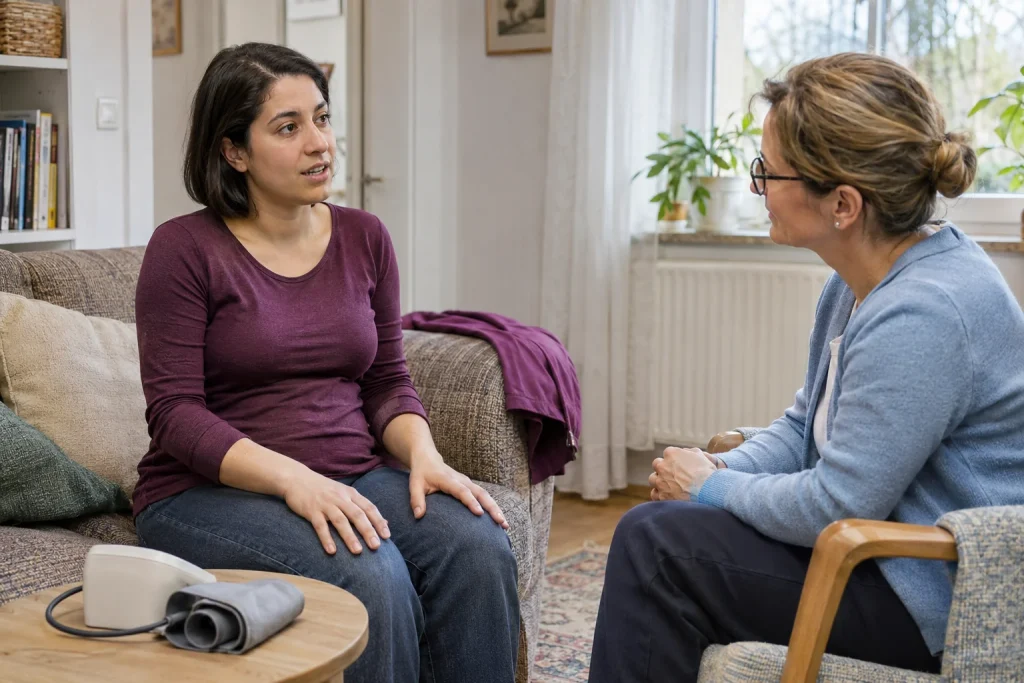
If your individual care plan includes checking blood pressure at home, know how to measure it, when to record the result, and which reading or symptom means you should contact the care team. ACOG describes the role of home monitoring, while the NHS mentions the need for regular checks after birth. How to use the device and what to do with the results must be made clear with your clinician.
Report the reading together with its time, following your individual instructions. Do not record only the result that seems more reassuring, or replace it with a different type of data from a sports watch. If you are unsure how to use the device or cuff, ask for help with the correct procedure. Many uncertain measurements do not necessarily provide more useful information.
With a new warning symptom, do not wait because you do not yet have a monitor at home or because you first want reassurance from a repeat reading. The CDC information on high blood pressure emphasises reporting postpartum pre-eclampsia symptoms immediately. You can describe the symptom alongside any available measurement; the absence of a number must not prevent you from making contact.
“I have hardly slept” is a circumstance, not a result that rules anything out
Days with a young child bring many circumstances that can easily seem to explain feeling unwell. Sleep is interrupted, you may miss an unhurried meal, and your daily routine can fall apart. These things are worth telling your clinician, but they should not take the place of assessment by leading you to decide that they must be the only cause. Events occurring together in time do not establish the cause.
The same applies if you have just been for a walk, done a few gentle exercises or felt that the day was overcrowded. “I must have taken on too much” is your interpretation; “I developed a severe headache and a change in vision this afternoon” is an observation. Start the conversation with the latter. Then describe the activity as a circumstance, rather than a ready-made explanation.
You do not have to prove that you are sufficiently unwell by still carrying the pushchair upstairs or finishing your planned loop. Tolerating discomfort may have mattered in your previous sporting life, but the task here is different. Assessment is not determined by how well you can pull yourself together; it depends on the symptom that has appeared and the professional care required.
Family help now creates room for prompt care
The first thing a partner or nearby helper needs to understand is that a new medical symptom means the programme changes immediately. They can take over childcare tasks, make a call if you ask them to, and prepare necessary documents. If you are seriously unwell, however, the emergency call cannot wait until every household detail has been sorted out.
A helpful sentence might be: “Tell me what you are feeling; meanwhile, I will make sure you do not have to deal with the other tasks right now.” “Every new parent is tired” is less helpful. General experience does not replace listening to the person’s new symptom. A partner should not talk down the description of the problem, but help ensure that it reaches the clinician accurately.
If you are alone with your child, mention this when seeking help too. You do not have to pretend that your own illness can wait because of it. Organising care includes understanding the real circumstances. You can involve reliable family help if it is available, but do not postpone reporting a serious symptom until they arrive.
Do not let your individual care plan disappear when you come home
If you already had high blood pressure or pre-eclampsia during pregnancy, checks and any treatment after discharge may need particular attention. RCOG explains that blood pressure monitoring and medication can still be needed after birth. The exact arrangements are individual: do not decide how long your own responsibilities last from the name of another mother’s medicine or a duration you have seen online.
It helps to keep your current medication list, the timing of prescribed checks and the contact details to use if something changes in one place. Your discharge summary should not simply be filed away; you need to understand it too. Ask if an instruction is unclear. “We will discuss it at the check-up” is no substitute for knowing what to do if a new symptom appears.
Do not stop prescribed treatment because you feel like being active again, or try to adapt your dosing to a running plan. Take questions about breastfeeding, side effects or daily scheduling back to the treating clinician. Care should take your whole real-life situation into account, rather than leaving you to reconcile apparently conflicting advice on your own.
 Enlarge image
A future running plan is separate from today’s urgent decision
With a new warning symptom, the next question is not how much to shorten your training week. Your condition needs to be assessed first. If you discuss activity after receiving care, clarify separately which activities may be appropriate, under what conditions, which symptoms mean stopping, and when the next review will take place. Even a familiar easy loop does not automatically remain suitable when a new condition develops.
You only need to tell your coach what you wish to share: the plan is paused for health reasons, and information about the conditions for continuing will come later. You do not have to assign a replacement week immediately or find a backup race. If the calendar feels like a burden now, the aim may be to stop it demanding decisions until the medical situation has been clarified.
Nor do you need to define your relationship with running permanently on the basis of this period. There may be a new routine and new enjoyment later, but these are not earned by overcoming today’s symptom. Sometimes the decision most supportive of sport is to spend that day organising access to the help you need, rather than arranging how to complete an exercise session.
This history remains part of your health story later
According to RCOG, the risk of later high blood pressure and cardiovascular disease may also be higher after pre-eclampsia. This is not an individual prediction; it is a reason to mention the history in future care and discuss the follow-up you need. A previous diagnosis should not remain only in a bundle of pregnancy paperwork that nobody sees in the years ahead.
At a later appointment, it is useful to distinguish the history of the acute period from your current question. When did the problem appear, what follow-up took place, what treatment are you having now, and what activity would you like to return to? A clear account can make discussion easier. You do not need to attach every training session or reduce the condition to a label of sporty or not sporty.
The point of reporting symptoms after birth is simple: a new problem can be taken seriously even if you felt strong beforehand, previous measurements were normal, or everyone is focused on tasks involving the baby. The precise onset, the specific experience and the date of birth help explain what happened. The next run can be discussed later; do not lose the opportunity to seek help now in an explanation drawn too quickly from everyday life.
Sources
- NHS: pre-eclampsia, symptoms and care after birth
- CDC: urgent maternal warning signs
- ACOG: conditions requiring attention after birth
- RCOG: pre-eclampsia and later follow-up
- CDC: high blood pressure during and after pregnancy
How Futószív articles are prepared: our editorial guidelines.