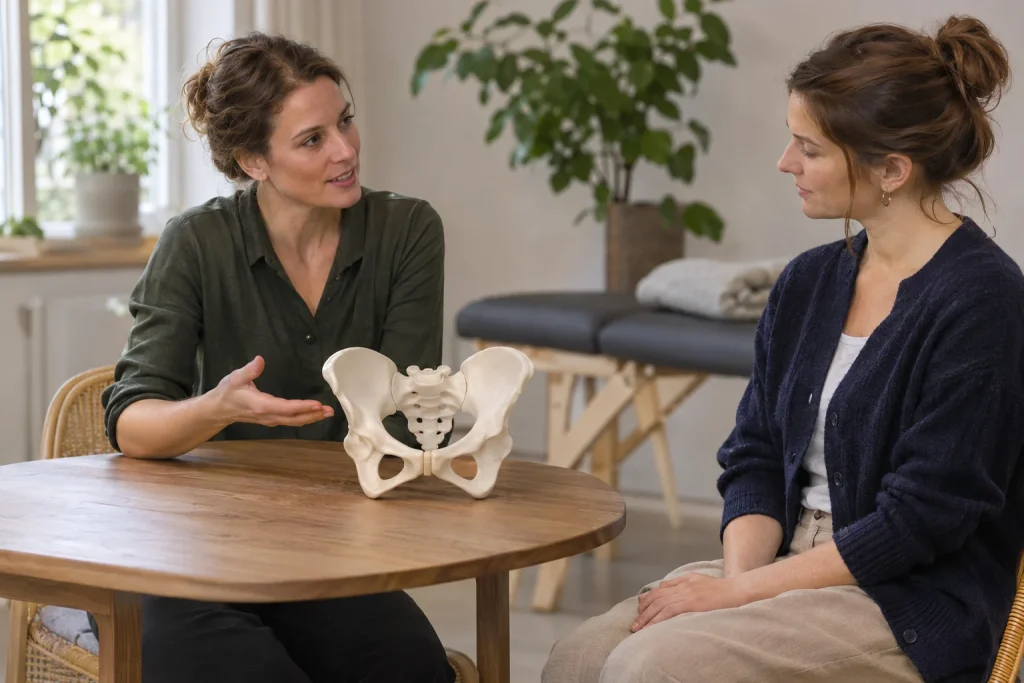
‘Do pelvic floor exercises’ can leave many questions unanswered. How do you know you are performing the muscle action the professional wants to see? Is releasing part of the task too? What should happen if a movement is uncomfortable, or the description and your own sensation do not match? After childbirth, the discussion can involve more than repetition counts: individual assessment also clarifies the relationship between symptoms, muscle function and everyday goals.
As a runner, wanting measurable feedback is understandable. A watch shows pace and distance, but these do not examine pelvic floor function. The following questions help you understand what an appropriately trained professional may assess, how to request understandable feedback and which information to bring to the next appointment. This article is not a home assessment or training protocol.
Function involves more than how hard you can squeeze
The NICE guideline on pelvic floor dysfunction includes assessing the ability to contract and relax as part of supervised muscle training. Programmes should be tailored to individual ability, any discomfort, needs and goals. Beyond strength, training can also involve developing endurance, power or relaxation, or a combination of these. The NICE NG210 recommendation therefore treats this work as more than a simple number of repetitions.
Releasing is not getting the task wrong; it is a function about which you can request separate feedback. For example: ‘I feel that I tightened something, but I am unsure when I released it. Can we check this?’ That is more precise than asking whether you have been diligent enough. You do not need to conclude from your sensations that the muscle is too weak, too tense or functioning incorrectly.
Patient information from the UK professional organisation POGP describes assessing strength, coordination and function. The purpose of possible assessment is that not everyone benefits from the same programme. This does not mean every athlete needs every examination, but that the basis and purpose of a recommendation can be discussed. The POGP assessment information presents the process of individually tailored care.
Symptoms in the story: what happens outside the consulting room?
Information for assessment extends beyond the training diary. Describe urine leakage, difficulty controlling wind or stools, problems emptying the bladder or bowel, pain or vaginal heaviness. NICE treats these as different symptom areas worth asking about. Listing them does not mean you must search for every one in yourself; it makes room in the discussion for experiences you have already noticed.
Try describing two everyday scenes. One can be when the symptom occurs, such as standing in a shop at the end of the day. The other can be when the same activity feels more comfortable under different circumstances. You do not need to prove a cause. Such an account can help refine questions without repeatedly provoking the symptom at home.
Describe your sporting goal in everyday language too. Instead of ‘I want to return’, you might say: ‘I would like to join club activities again, but I currently have questions around standing and walking too.’ Running then becomes visible as part of a wider routine. Childcare tasks, returning to work and travel need not be treated as background noise independent of sport.
 Enlarge image
What can discussion reveal, and what needs another assessment?
Your personal history can reveal when symptoms began, how they changed and what happened during previous investigation or treatment. NHS Greater Glasgow and Clyde describes detailed history-taking and symptom discussion as part of a pelvic floor physiotherapy appointment. The need for an individual examination is considered in the particular situation. The NHS GGC information specifically addresses opportunities to ask questions and consent.
Discussion and movement observation do not always answer every question. You can ask: ‘Do we know this from my symptom description, or have we observed it too? What cannot be decided at this appointment?’ This helps avoid taking an explanatory analogy home as a definite examination finding. A video appointment can help with certain questions, but movement seen through a screen has limits of interpretation too.
If further medical assessment is raised, clarify its purpose and how results reach the next healthcare professional. Previous reports brought to the physiotherapist may reduce detours caused by missing information, but an old report does not automatically override a current symptom. With new or changed symptoms, explain what differs from the previous situation.
You can ask about an intimate assessment beforehand
For certain symptoms, a vaginal or rectal examination may be offered to check muscle function. Both POGP and NHS GGC emphasise explanation and consent. You can say you do not want such an examination now, request time to decide or ask what other information can be gathered. Saying no is not a measure of your commitment to sport.
Three brief questions can help: ‘Exactly what do we want to learn from this? How does it happen? How can I signal that I want to stop?’ Answers should be understandable to you. If previous birth or examination experiences make this a difficult subject, you can say so without describing the entire history in detail. You can request a slower explanation or another discussion.
Discuss a companion or another person being present beforehand too. Your comfort and examination arrangements both matter. Do not try to imitate an internal examination you read about at home: articles and anatomical illustrations do not replace expertise or assessment of your individual situation. Asking about assessment helps; it does not create a task to examine yourself.
When learning an exercise, feedback should be specific
If given a home task, ask whether you can show how you understood it. Rather than ‘Is that all right?’, a more answerable question is: ‘Is this what you want me to do, and is this the relaxation part afterwards?’ Observing can allow the professional to refine teaching. Your task is not a faultless anatomical explanation, but communicating what you understand and what feels uncertain.
| Uncertainty | Question for teaching | What should you take home? |
|---|---|---|
| I do not know when I am releasing. | ‘What shows you that this part of the task happens too?’ | Your individual feedback, not the sensation of an unfamiliar person exercising in a video. |
| The description can be understood in several ways. | ‘Can we repeat the instruction in different words?’ | A brief instruction that is clear to you. |
| Discomfort appears. | ‘What should I do then, and when should I report it?’ | Actions agreed beforehand rather than increasing the exercise. |
Repetition count, hold duration and frequency become meaningful once the task itself is clear. A general number online does not establish that your own programme is too little or too much. If two professionals gave different advice, bring both and ask for an explanation of the difference. Do not try to be certain by adding all the programmes together.
Discuss the relationship between everyday and running goals separately
Right now, the most pressing aim may be not worrying during shopping or a longer phone conversation. At another time, starting running again may be the main question. State these separately, since it is hard to build a shared goal from a general ‘get stronger’. A goal can also be understandable function, better symptom management or clarification of individual conditions for an activity.
As a runner, ask what the current assessment means for planned activity. Ask not only how many weeks remain, but also: ‘Which question still needs clarification? Which changes should I report? Whom should I discuss a new symptom with during the next type of movement?’ This is not an identical return test for everyone, but clarification of the framework for individual decisions.
Do not treat a muscle task observed in the consulting room as a copy of a full running session. The situations have different purposes and environments. Ask the professional to interpret the assessment’s result: what can it be used for, and which conclusions should you not draw? A successful exercise then does not become automatic permission to race, nor a task difficult to learn a final judgement on sport.
 Enlarge image
The home plan should fit life and allow adjustments
Personalisation can include whether you can actually carry out the plan. Discuss when you have calmer time, how you follow instructions and what makes practice difficult. If full-day infant care leaves only very fragmented time, say so while developing the plan rather than recording it afterwards as failure.
Feedback does not require another performance app. A short line may be enough on which instruction remained uncertain, whether there was discomfort and which circumstances meant a task was missed. These are not disciplinary records. They help ensure the next appointment discusses not only how much was completed, but whether the programme was understandable and feasible.
If written guidance and spoken instructions differ, ask for clarification. Do not correct the present plan from an earlier internet video or buy additional equipment merely because the task seems too small. NICE also links device-based additions to specified situations and professional consideration; owning equipment alone does not show correct exercise execution.
Follow-up questions: what changed, what did not and what comes next?
NICE recommends review both during and at the end of supervised training. This allows symptoms, completed tasks and individual goals to be brought together again. Do not look for the next appointment’s value only in remeasuring a strength value. It may also help to ask whether you still understand home instructions the same way or have begun performing them differently for some reason.
If symptoms are unchanged, do not rewrite a more favourable account because you put much energy into practice. If improved, describe the situation in which you noticed that too. If a new symptom appeared, do not automatically call it a simple continuation of the old one. The next step can adapt to actual experience rather than what you think the professional wants to hear.
At the end of the appointment, be clear what you continue practising, what changes now and when you should make contact sooner. Understanding pelvic floor function is not a compulsory terminology examination. Information is useful when you can explain in your own words what your task is, what remains uncertain and how it connects to the life and activity you want to return to.
Sources
- NICE NG210: Pelvic floor dysfunction – recommendations
- NHS GGC: Pelvic floor physiotherapy
- POGP: Physiotherapy Assessment
How Futószív articles are prepared: our editorial guidelines.