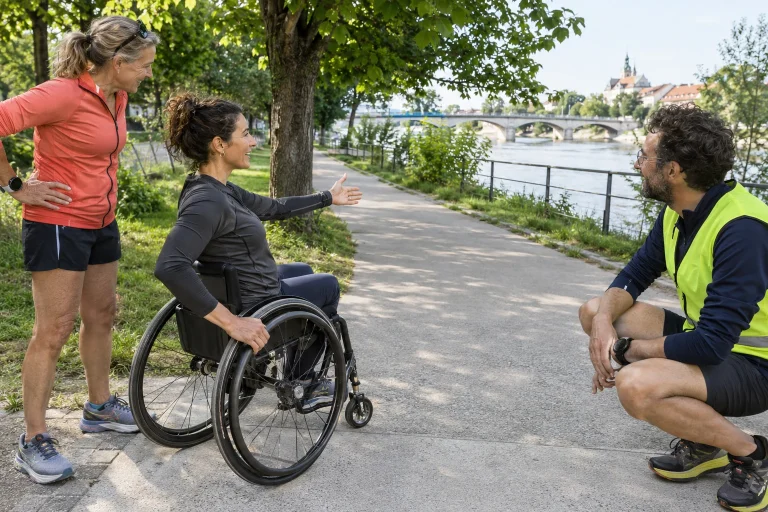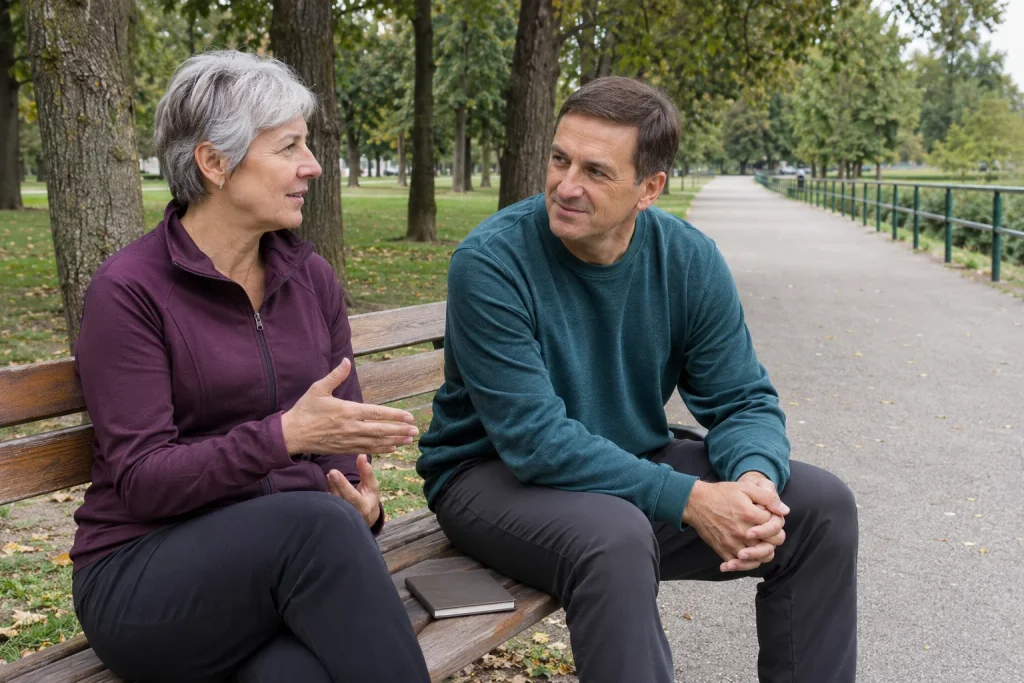
A formerly familiar park path can become a different task when the world seems to spin around you. The route’s beauty or planned distance is not then the first question. New, recurring or changing dizziness needs its cause clarified, and even an established condition may call for reconsidering the activity setting. A level path is not clearance for sport by itself, but choosing a location suited to the care plan can be an important practical detail.
If vertigo accompanies new double vision or vision loss, speech difficulty, limb weakness or numbness, immediate help is needed: call 112. Seek immediate medical care for sudden hearing loss too, and do not drive yourself. The following supports consultation about known symptoms and planning activity permitted later; it offers no home balance challenge, dizziness-provoking test or running programme for everyone.
Put your own experience behind the word ‘dizzy’
Vertigo means a spinning sensation: it can feel as if you are moving or your surroundings are turning. The NHS distinguishes this from general unsteadiness or feeling faint. The distinction is not for independent diagnosis, but clearer description. ‘I almost fainted’ and ‘I saw the room spinning’ are different accounts, and both belong in assessment.
Describe onset, situation and course in your own words. Did it happen while running, after stopping, bending down or getting up in the morning? Approximately how long did it last, and what followed? If you do not know which movement came first, say so. The history does not require provoking illness again; you are gathering events that already occurred.
Report loss of consciousness separately. NHS information on fainting says its cause needs medical assessment, and fainting during exertion is urgent. If someone faints while running, a companion should call 112 and follow the emergency operator’s instructions. An earlier ‘I am a dizzy type’ description must not conceal a new event. Accurate reporting helps reach appropriate assistance.
Balance involves several systems working together
NIDCD explains that the inner ear’s balance system, vision and signals from muscles and sensory receptors work together to maintain balance. This helps preserve posture and a stable gaze during movement. Disturbance in a system or processing of signals can cause unsteadiness and dizziness. Good endurance alone does not measure every part of this cooperation.
Causes can differ: an inner-ear condition, a medicine’s effect or another health problem may be involved. Naming the symptom therefore does not identify treatment. An exercise or head movement that helped another runner may not fit your situation. Assessment and personal rehabilitation exist precisely to avoid treating every dizziness history as identical.
With an established diagnosis, ask what it explains about current symptoms and which new developments require contact again. Earlier advice may not cover an episode with a different onset, greater intensity or new associated symptom. You need not infer the worst from every change, but should not automatically close new information with the old label.
 Enlarge image
A rehabilitation exercise is not a roadside courage test
Individual vestibular rehabilitation may be considered for certain balance disorders. The professional guideline on peripheral vestibular hypofunction discusses physiotherapy and supervision for the specified condition. Its scope does not automatically cover every central nervous system problem or every positional vertigo. Its title therefore does not justify adopting an arbitrary online routine.
The clinician’s selected task may have a different purpose from running training. Developing balance, gaze stability and everyday function are separate professional tasks. If symptoms may occur during an exercise, personal instruction and a safety framework are particularly important. Do not independently intensify it in the park with harder terrain, closed eyes or rapid head turns.
Clarify with the physiotherapist exactly which task to do, under what conditions, how to assess symptoms and what warrants a change. Ask about running separately: taught rehabilitation and returning to sport are different. Explain your activity goal, but do not redesign the current task around a race date. Feedback and reassessment need places in the plan too.
Consider the location with the entire outward and return journey
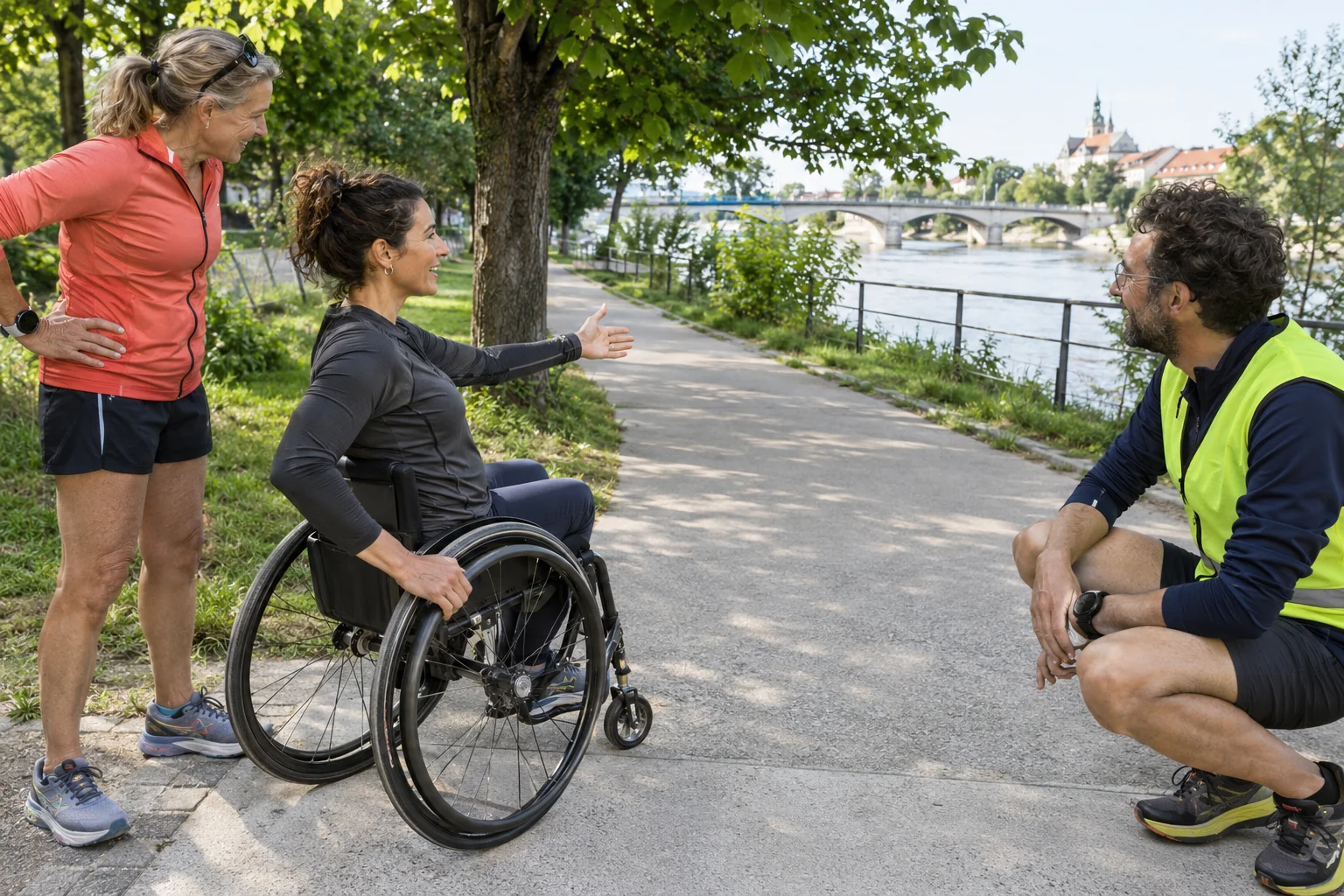
If outdoor activity is possible under the care plan, inspect more than the mapped loop. Steps to the start, crossings, a narrow gate and getting home afterwards all belong to the situation. Reaching a seemingly smooth route can be more complicated than the route itself. Plan from your known difficulties and professional guidance.
A clearly visible surface, awareness of steps and sudden level changes, somewhere safe to stop and accessible help are practical considerations. They do not make movement risk-free. They prevent discovering while symptomatic that returning requires a narrow ledge or crossing a busy road. An old route photograph may not show current construction either.
Darkness and poorly visible surroundings need particular attention with balance difficulties. NIDCD specifically advises avoiding walking in darkness when reducing injury risk. Do not therefore treat headlamp performance as the whole solution. Agreeing an appropriate time, setting and individual plan matters more than assuming equipment automatically neutralises difficult conditions.
| Route consideration | What should you clarify beforehand? | Why is a general label insufficient? |
|---|---|---|
| Access | Steps, crossings, gates and distance to the starting point. | ‘A level park’ does not describe getting there. |
| Surface and width | Local defects, obstacles, narrow sections and construction. | The condition of a mapped route can change. |
| Stopping and help | A safe place to step aside and an available companion. | A short distance does not automatically imply independence. |
| Getting home | Who helps if the activity ends differently from the plan? | Returning to the start must not become a compulsory test. |
Agree a realistic role for the companion
A companion does not remove the need for medical assessment. Their presence helps most when you know the agreed framework and what should happen with symptoms. You do not need to tell every acquaintance the full diagnosis, but should share information needed for the outing. For example, you will stop for a new symptom and finishing the distance is not an aim at any cost.
Do not invent the form of help while you feel unwell either. Ask the clinician which support or aid suits your situation. A companion may not be able to hold you safely and should not unexpectedly pull or turn you. Stopping together, describing the location and seeking help when needed differ from professionally taught movement assistance.
A phone and positioning can help communication, but should not be your sole safeguard. Choose a meeting point easy to describe and an identifiable place. With a group, do not fall behind unnoticed on an unfamiliar section. Clarifying arrangements beforehand is not excessive caution; it adapts participation to actual function.
When symptoms start, completing the original route is not the task
NHS vertigo information advises sitting down immediately when dizzy. Continuing a run or hurrying home over uneven ground is not a good solution. Stop somewhere safe, follow your care guidance and seek help when needed. Report new or changed symptoms separately rather than simply treating them as another known episode.
Vertigo with severe headache, marked nausea, vomiting or fever calls for urgent medical advice. Vision loss, double vision, speech difficulty, new weakness or numbness require immediate care. Call 112 for these and do not drive yourself. Assessing an acute situation matters more than whether dizziness previously occurred on the route.
After an episode passes, record a brief account later: location, sensations, approximate duration and help received. You need not set off again immediately to check improvement. Discuss the next activity using current symptoms, known diagnosis and advice received. An interrupted outing implies neither a permanent activity ban nor immediate permission to resume.
 Enlarge image
Let the route plan be a tool alongside care
Bring specific questions to the next consultation. Can you currently go outdoors independently, is a companion needed, which movement is appropriate and how can you get home if symptoms occur? Ask for more detail behind ‘exercise cautiously’. Using your familiar location and transport situation makes the guidance’s application easier to clarify.
Suitable surroundings can support participation, but a good route does not treat every possible cause. Medicines, hearing, vision and previous investigations remain part of care. If the personal plan changes, reconsider location and social arrangements too. Every difficulty need not be answered by buying equipment, nor should rehabilitation become a competition.
A usable plan links accurate symptom descriptions, professional assessment and environmental decisions. A level path, an informed companion or easier travel home can then offer genuine practical help while running suitability remains personal. With vertigo, success is not completing a route at any cost, but reaching an understandable activity decision suited to your present condition.
Sources
- NHS: vertigo
- NHS: fainting, 2026
- NHS: different experiences of dizziness
- NIDCD: balance disorders
- APTA: rehabilitation guideline for peripheral vestibular hypofunction
How Futószív articles are prepared: our editorial guidelines.