Choosing a hot-weather route is not simply adding another bottle to your usual long loop. Consider when to start, where you will be in sun, where suitable drinking water is available and how to finish early. These three aspects work together: water access does not automatically make a long unshaded section appropriate, while a tree’s shade does not replace missing access or a safe return.
This article helps adult recreational runners choose routes beforehand. It is not a heat-training programme, personal fluid prescription or checklist that makes running safe in every heat once completed. Individual health, pregnancy, medication or previous heat illness may require separate professional advice. Postponing, changing time or choosing another appropriate activity is a fully valid planning outcome.
First consider changing the time and programme
The CDC information on athletes exercising in heat emphasises choosing cooler times and limiting outdoor exertion. Heat increases risks of heat illness and dehydration. The opening question should therefore not be how to fit in a predetermined workout at any cost. First decide whether outdoor activity suits the situation at all and what can change.
Having an hour free only in the hottest period does not make completing the unchanged long run necessary. Available calendar time and suitable surroundings are separate conditions. Discuss with whoever designs your training plan, if applicable, and choose a workable alternative. Explicitly include postponement in planning. You then need not abandon a plan requiring too many compromises at the last minute before setting off.
A weather warning is not personal clearance
The HungaroMet description of its hazard-warning system distinguishes advance warnings from alerts. Its special warning for high daily mean temperature does not have the same associated alert stage; the description assigns declaration of heat alerts to the public health authority. Daily mean temperature also differs from conditions at one point and hour of your run. Read the message, time and geographical scope too.
No warning colour does not establish suitability of your planned workout. An older screenshot likewise does not replace checking current forecasts and official advice. Decisions need the current area, time of day and weather description alongside your circumstances. Do not turn colour codes into a homemade pace table or universal departure threshold. Personal responses to exertion cannot be derived from one map symbol.
Assess shade for the time of the run
‘Tree-lined route’ is insufficient on its own. Tree positions and sunlight direction may leave long sunny stretches, and reaching the park may require an exposed approach. Consider the whole route: start, approach, loop, refill detour and return. A long open asphalt approach to a pleasant woodland section is still part of the outdoor activity. Do not focus only on the favourite middle stretch.
If you know the setting at another time, mark this as uncertain. An earlier observation helps, but shade may differ during today’s run. Where the full programme is otherwise appropriate, plan a version allowing a sunny section to be omitted or shortened. Shade does not remove the need to consider heat stress; one favourable environmental feature does not solve every condition.
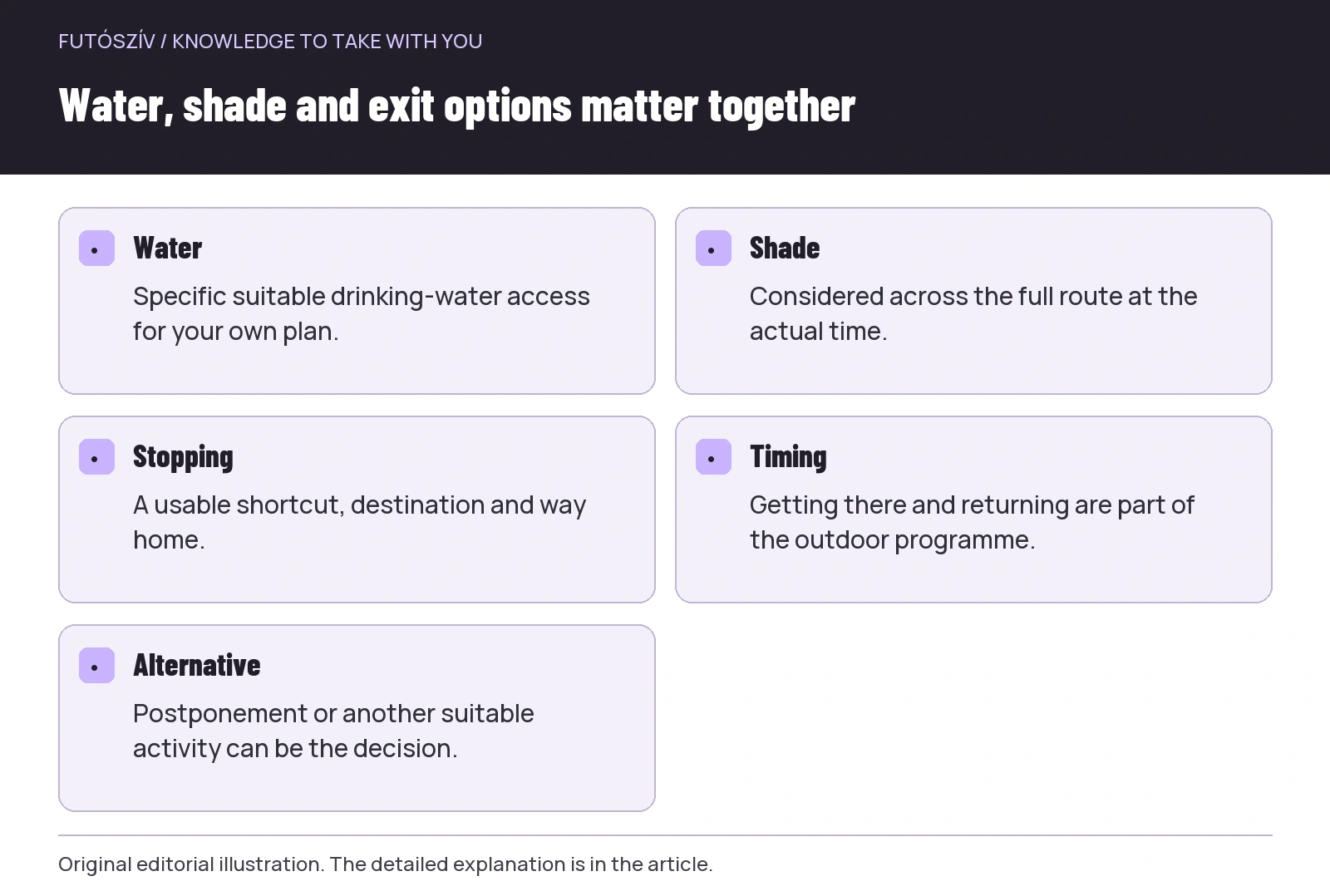 Enlarge diagram
Text version of the illustration
- Water
- Specific suitable drinking-water access for your own plan.
- Shade
- Considered across the full route at the actual time.
- Stopping
- A usable shortcut, destination and way home.
- Timing
- Getting there and returning are part of the outdoor programme.
- Alternative
- Postponement or another suitable activity can be the decision.
Base drinking-water access on checked locations
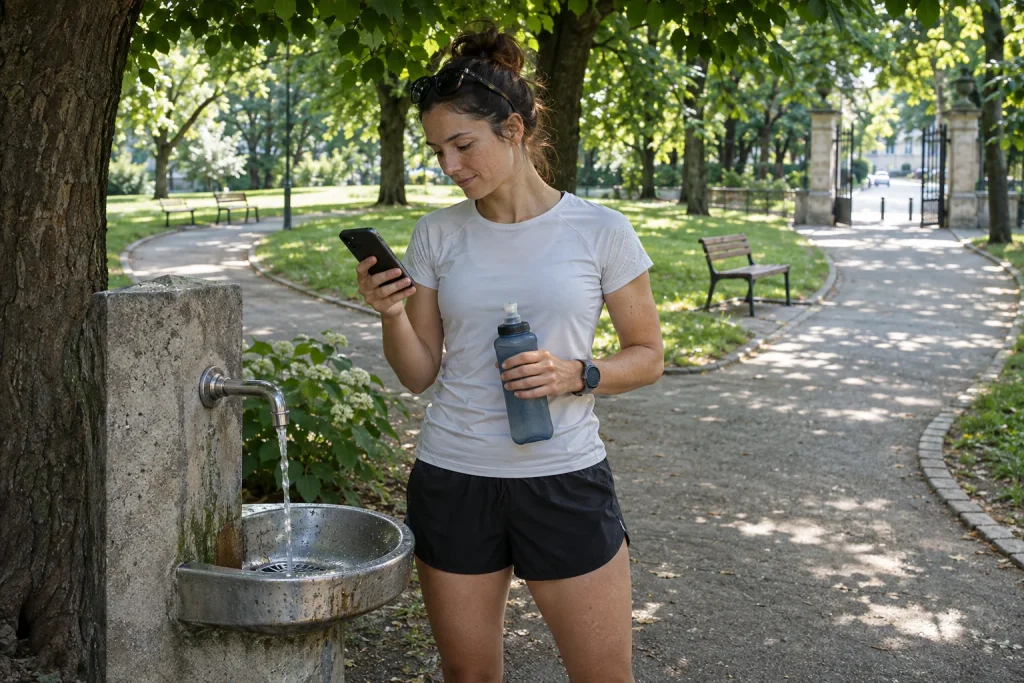
Identify facilities specifically intended for drinking water and their access conditions beforehand. Check operation and approach separately for a mapped fountain. With a shop, actual opening and the ability to buy matter. Do not automatically put ponds, ornamental fountains, misting arches or unknown irrigation taps in the same category. Seeing water and having appropriate drinking-water access are different facts.
Do not force an individual drinking plan around uncertain points. If necessary access is unresolved, change distance, route or time. Carrying extra fluid may be one part of the plan, but does not solve every heat-stress question or oblige you to consume every available sip. This article specifies no intake amount. Supplies and access serve an individually appropriate plan.
A shortcut should actually reach suitable conditions sooner
A shortcut on a map may be shorter while involving steps, a locked gate or a long sunny overpass. Assess an exit route as a route in its own right. Where do you arrive? Is the chosen place accessible? Is further help or transport home arranged? A car nearby in a straight line may not be quickly reachable from the other side of a river or fence.
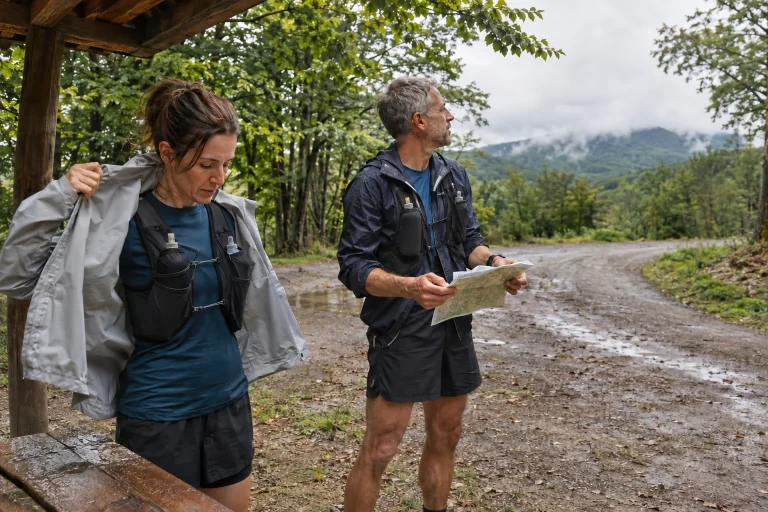
Where possible, put a decision point before the longer, harder-to-leave section. Reassess before a distant bridge, long embankment or narrow trail reduces options. This need not be automated through a smartwatch notification. A familiar junction and a choice agreed beforehand may suffice. Continuing the original plan should not become the only imaginable direction.
A fictional choice between three routes
Plan A is one large loop ending with an exposed return. Plan B uses shorter loops returning to the same appropriately arranged starting place. Plan C omits that day’s outdoor run or replaces it with another appropriate setting. The example is not a ranking and does not claim B suits every hot day. Choose between them from current surroundings and personal circumstances.
| Aspect considered | A: one large loop | B: shorter returning loops | C: changed programme |
|---|---|---|---|
| Finishing early | A usable return route needs separate identification. | The next loop can be omitted when warranted. | The decision already changes outdoor exposure. |
| Shade | Every part of the whole loop matters. | The same loop changes with time of day. | Conditions in the new setting need checking too. |
| Water access | Clarify operation of distant points. | Real access is needed at the return point. | Arrange it within the alternative too. |
| Important limit | Familiarity does not make it appropriate. | Loops do not guarantee protection from heat illness. | Another programme is not automatically suitable for everyone either. |
Getting there and home are part of exposure
If you first walk or wait in sun for a long time, the run starts from a different situation than when you left home. Include the post-finish walk, bus wait and journey to the car too. ‘An hour’s run’ does not describe the entire outdoor programme. Consider the whole window and leave real opportunities for rest and reaching appropriate conditions.
A stop or endpoint should be more than a geographical point. Check any facility opening or service you depend on. A shaded bench does not itself provide water, help or a suitable way home. Separate functions within the plan: where can you stop, obtain drinking water and seek help? They need not all be assigned to one location, but know where each is possible.
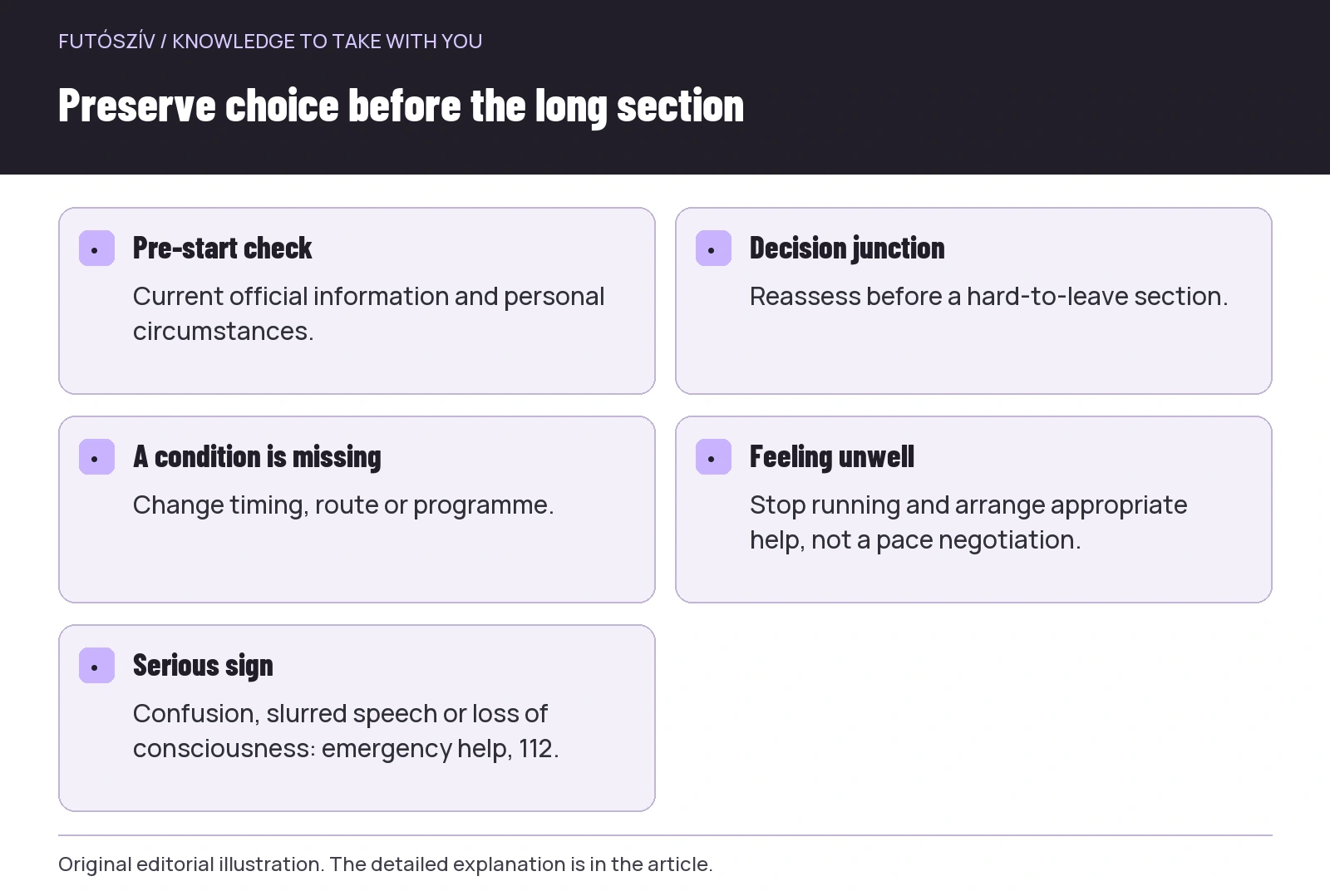 Enlarge diagram
Text version of the illustration
- Pre-start check
- Current official information and personal circumstances.
- Decision junction
- Reassess before a hard-to-leave section.
- A condition is missing
- Change timing, route or programme.
- Feeling unwell
- Stop running and arrange appropriate help, not a pace negotiation.
- Serious sign
- Confusion, slurred speech or loss of consciousness: emergency help, 112.
State the stopping decision before setting off
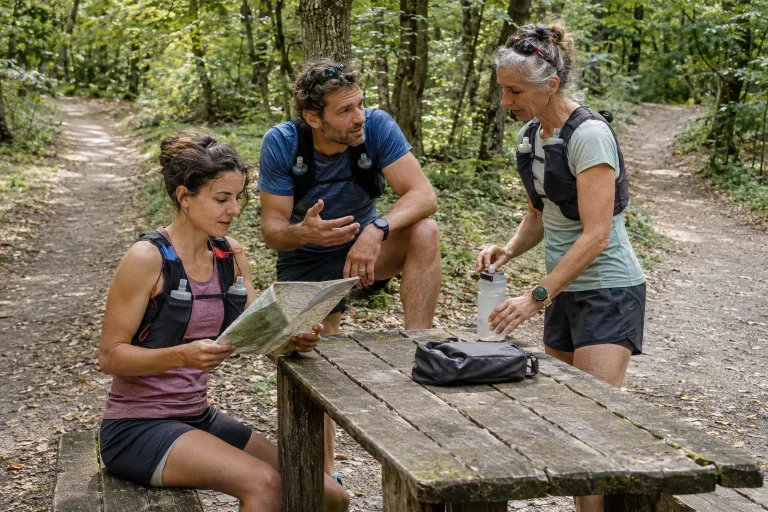
A common organisational error is agreeing only distance and meeting time while treating shortening as a later individual choice. Discuss who signals changed conditions and how, where you turn back and who stays with someone needing help. The CDC also recommends companions watching one another. This is not medical supervision, but noticing changes and taking them seriously.
If someone says they do not feel right, do not bargain over the next kilometre. The route plan exists precisely to make early completion workable. No runner must ignore their condition for the group’s distance. Orderly completion does not mean everyone reaches the original endpoint at any cost.
Feeling unwell is not a route-optimisation task
The CDC athlete information emphasises stopping activity and reaching a cool place when feeling faint or weak, and recommends immediate medical help for heat-illness symptoms. Do not focus then on calculating a suitable pace or remaining distance. Stop the run and arrange help appropriate to the condition. Phone navigation cannot establish that illness is harmless.
The CDC/NIOSH heat-illness guide lists confusion, slurred speech and loss of consciousness among serious heatstroke warning signs; profuse sweating can also occur. Such a condition in heat needs immediate emergency help; in Hungary, call 112. Do not wait for a home temperature reading before seeking help. Do not leave the person alone, and follow the emergency dispatcher’s instructions for cooling and first aid.
Precise location information supports reaching help
Carry a working, adequately charged phone and know how to state your location. In a park, a junction name, entrance or known facility may help identify it. Save necessary route sections, but check what the app actually does offline. A downloaded picture is not always live positioning. Agree descriptions with companions too, so you mean the same point.
Reaching help should not require forcing yourself through the entire remaining run. The stopping plan should name an appropriately accessible place and the next step. If a closure cuts off the original option, decide differently before reaching it. A marked shortcut helps only while actually usable. Changed conditions need considering across the whole run, not merely redrawing a few metres of GPS track.
Review the decision afterwards, not just the watch
After the run or programme changes, note which information helped and what was uncertain: shade timing, water-point access, the stop’s usability or getting home. Your notes do not establish personal heat tolerance or justify increasingly demanding activity under similar conditions. The aim is identifying route-planning mistakes. Stopping can be a good decision even with less distance on the watch.
A thoughtful hot-day route keeps the full programme adaptable, drinking-water access arranged, shade assessed at the actual time and help or early completion genuinely reachable. Together these still do not guarantee safety everywhere. They support clear choices before and during the run, so attachment to a planned workout does not remove necessary options to change.
Sources and further reading
- CDC: Heat and Athletes
- HungaroMet: How the hazard-warning system works and high daily mean temperature warnings
- CDC/NIOSH: Heat-related Illnesses
How Futószív articles are prepared: our editorial guidelines.