Hotel breakfast can make pre-race preparations easier if it genuinely fits your own schedule and eating plan. However, a service listed in a booking does not tell you when the kitchen opens, the precise ingredients of the food or how early collection works. Clarify those in advance. The aim is to avoid trying to reconcile leaving for the start with eating for the first time at reception that morning.
This guide concerns practical arrangements with your accommodation. It does not recommend the same race breakfast for everyone, prescribe an exact interval before the start or replace personal sports-nutrition or healthcare advice. It connects the amounts, composition and timing established in your individual plan with what the venue can provide. With an allergy or prescribed diet, appropriate ingredients and preparation conditions are separately important. The enquiry and examples below are original editorial templates.
Work backwards from when you need to leave for the start
First write down when you must leave your accommodation. Alongside reaching the start, allow for entry, bag drop and your own preparations where relevant. Fit eating around this according to your appropriately established personal plan. Only then compare it with the hotel’s breakfast arrangements. ‘Breakfast from seven’ does not, by itself, solve the problem if you need to be on your way at seven.
The British Dietetic Association’s sports-nutrition information relates eating to sporting demands and individual needs. The hotel can provide information about its own service, but determining your personal race-breakfast requirements is not the receptionist’s job. Ask questions the accommodation can answer specifically: when, what food, in what form and with what preparation can you access? Base your assessment on those details.
Clarify five things about the service
The first is opening hours on the particular date. Weekends, public holidays or an event may change the usual schedule. The second is actual access: does opening the room also mean the full food selection is available? The third is which familiar foods or ingredients are offered. The fourth is whether an individual request can be met. The fifth is exactly how an early or takeaway option works, if needed. Do not let these collapse into a general ‘it’s suitable for athletes too’ response.
Give your booking dates and the day concerned, but do not send unnecessary medical details. State the dietary condition precisely if there is one. A preference and avoiding an ingredient for safety reasons are not the same. Staff need to know which you mean. If the accommodation cannot give an adequate answer, that is useful information for planning your own alternative; asking for another general reassurance is not necessarily helpful.
An original enquiry template that asks for specific answers
Adapt the following to your circumstances: ‘I am taking part in a running race on the specified day and need to leave the accommodation at the planned time. Please let me know when breakfast will actually be available that morning and which foods can be arranged in advance. If an early pack is available, I would like to know its contents, the collection time and place, and the ordering deadline. The following specific condition matters for my own eating plan: … Please also tell me if you cannot reliably meet this requirement.’
This is a request for information, not a general complaint template. Check whether the response covers the time, specific contents and collection. ‘Of course we’ll help’ may be a kind reply, but does not explain what will happen that morning. If an essential detail is missing, clarify it in a short follow-up question. Keep the arrangement accessible alongside your booking so that you do not have to recall it from memory on arrival.
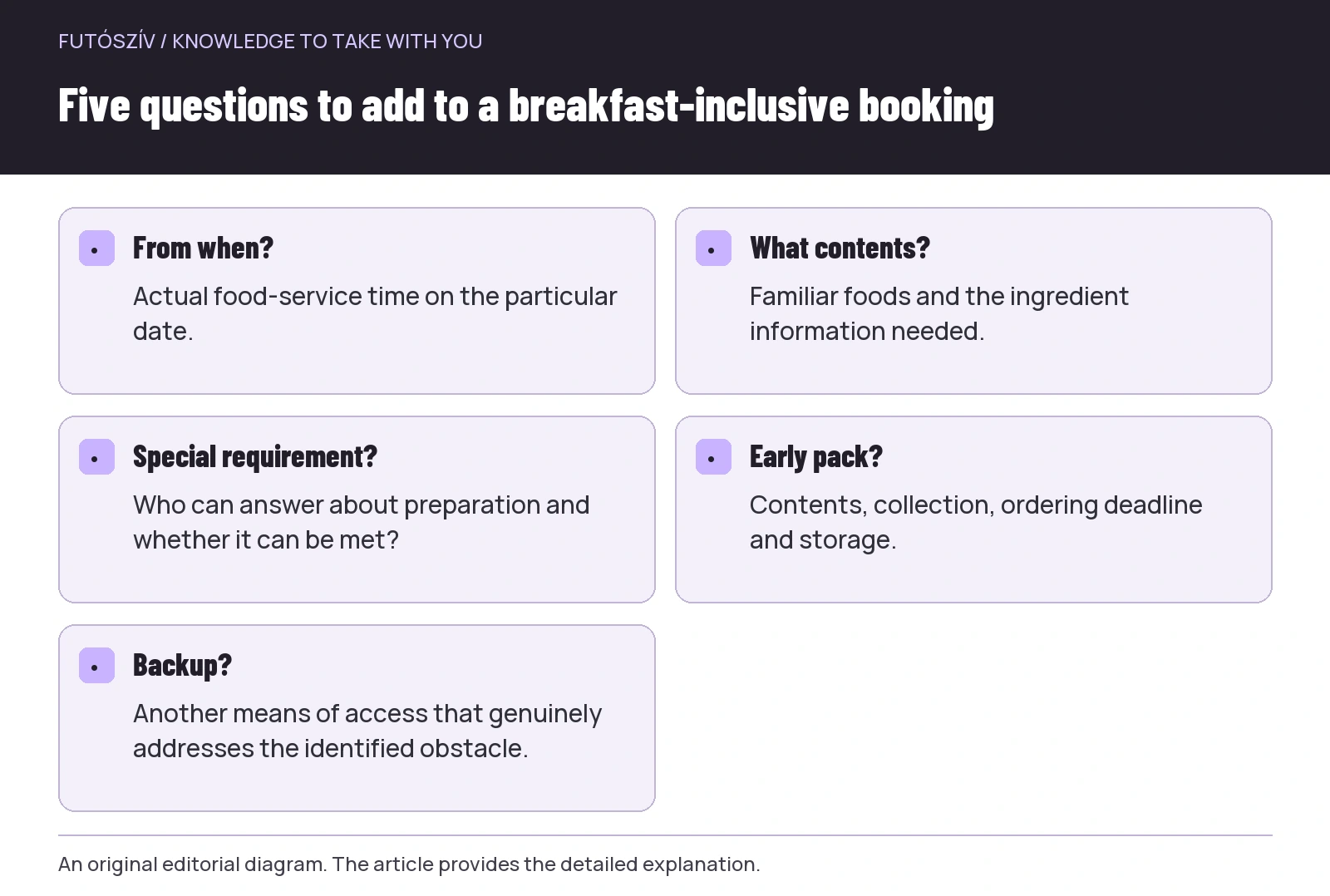 Enlarge diagram
Text version of the diagram
- From when?
- Actual food-service time on the particular date.
- What contents?
- Familiar foods and the ingredient information needed.
- Special requirement?
- Who can answer about preparation and whether it can be met?
- Early pack?
- Contents, collection, ordering deadline and storage.
- Backup?
- Another means of access that genuinely addresses the identified obstacle.
An early pack is a separate product, not a smaller version of the buffet
Do not assume an early breakfast pack contains the same things as the breakfast buffet. Ask about the individual items, packaging and collection arrangements. It can fit your own plan only if its contents are appropriate and storage until you eat it is also arranged. A surprise pack is not a sound basis for abandoning every other option. Find out what food you will actually receive rather than relying on the name.
Clarify the collection point and the person responsible too. Will reception hand it over, will you find it in the dining room, or will it be delivered to the room the previous evening? These create different access and storage situations. If the food requires refrigeration, appropriate handling becomes your responsibility after collection the night before. The price and ordering deadline also need clarification, but neither replaces ingredient information. Keep financial and practical conditions on separate lines.
Confirm allergen information through a conversation too
The Food Standards Agency’s guidance on non-prepacked foods describes using written allergen information together with discussion with staff. For pre-ordered food, it also considers confirmation on the day important because ingredients can change or information can be missed. This is UK best practice; it is not cited here as legal guidance for Hungarian hotels. Accurate, current information is what matters for your own eating decision.
If you need to avoid an ingredient for medical reasons, say so clearly and ask about possible contact during preparation too. The absence of an ingredient from a dish’s name is not enough. Removing a garnish may not resolve contact that occurred during preparation either. If staff are uncertain, do not try to declare the food appropriate through your own guesswork. Making a decision under your personal healthcare plan requires conditions you have clearly understood.
Focus on your own selection rather than the buffet’s range
If breakfast is available at an appropriate time and with suitable ingredients, choose familiar elements that fit your own plan. You do not need to try the entire selection merely because it is included in the price. At the same time, do not arbitrarily narrow the plan so much that the meal you need does not happen. Buffet variety is an opportunity, not a personalised meal plan. Clarify ingredients for the particular dish rather than inferring them from the dining room’s general quality.
Even the name of a familiar food does not prove that the hotel uses the same recipe as at home. Porridge, baked goods, toppings and drinks can come in different versions. If a particular detail matters to you, ask about the specific product. Elegant presentation cannot establish whether a selection fits your personal plan or whether you tolerate it. Calm, informed breakfast choices help more than a last-minute search around the buffet.
Allow time between opening and actually eating
Several runners staying at the same place may easily arrive for breakfast together. Entry, finding your way and service can take time between opening and actually eating. Do not count that as zero in your schedule. You do not need to predict the precise queue, but leave room to manoeuvre and know the early alternative if breakfast on site does not fit. Your plan should not require every requested food to be in your hands at the instant the doors open.
If you arrange a shared table reservation or group breakfast, individual requirements must still be identifiable. A group leader’s general order may not communicate every participant’s necessary details. Ask how individual requests are handled and handed over. Labelling your own pack or collecting it by name as instructed by staff can prevent accidental swaps. Good group organisation makes differing requirements traceable too.
| Response received | What still needs clarifying | Why does it matter? |
|---|---|---|
| ‘Breakfast is available.’ | From when and in what form on the particular day? | The existence of a service does not prove timely access. |
| ‘We provide an early pack.’ | Exact contents, collection and storage conditions | The name of the pack does not tell you whether it fits your own plan. |
| ‘We can meet the special request.’ | Who can give a precise answer about ingredients and preparation? | The necessary dietary condition must actually be met at that time. |
| ‘There is a fridge in the room.’ | Can that particular appliance appropriately store the food you need? | Its name does not establish the correct temperature. |
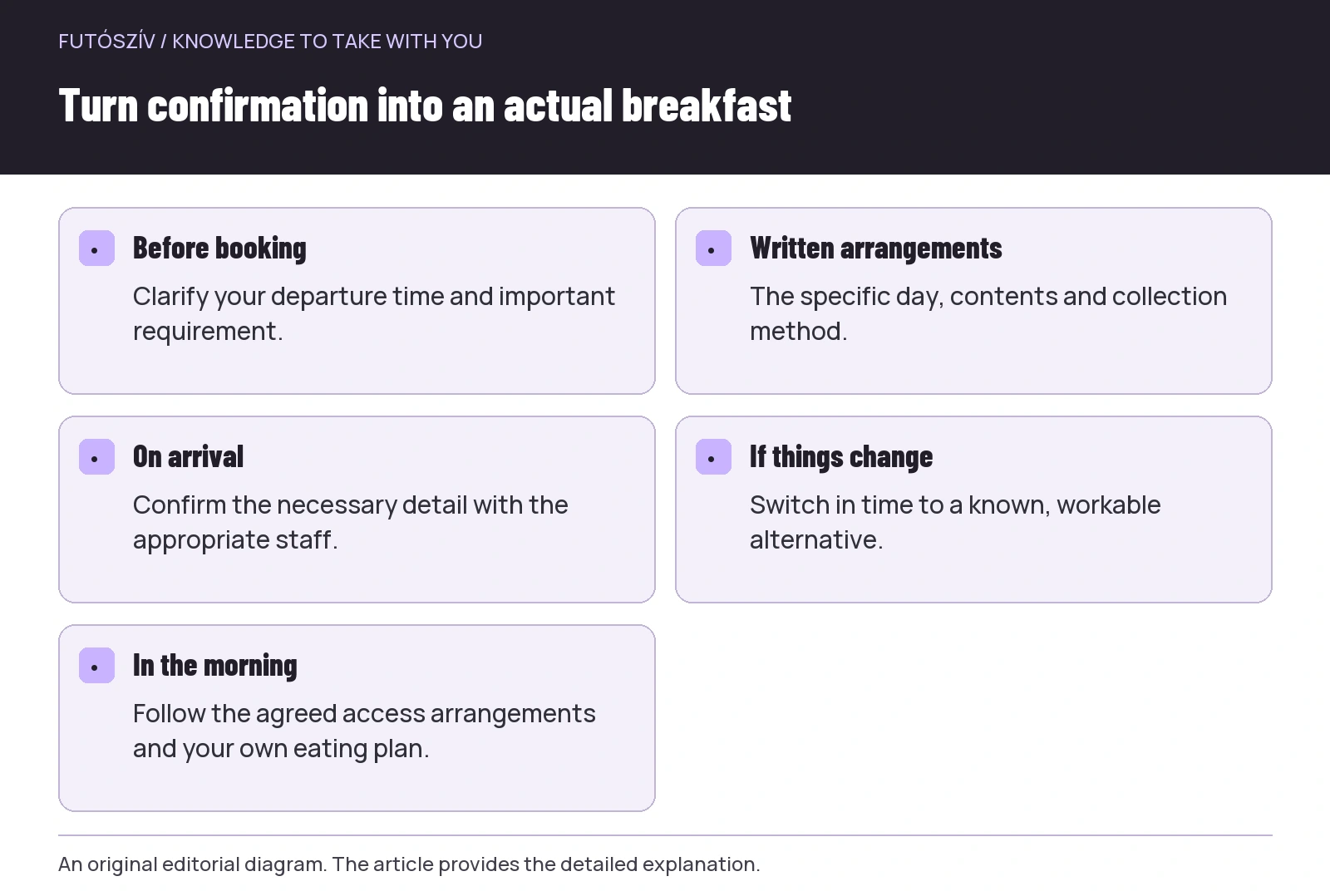 Enlarge diagram
Text version of the diagram
- Before booking
- Clarify your departure time and important requirement.
- Written arrangements
- The specific day, contents and collection method.
- On arrival
- Confirm the necessary detail with the appropriate staff.
- If things change
- Switch in time to a known, workable alternative.
- In the morning
- Follow the agreed access arrangements and your own eating plan.
Room facilities for your own breakfast are separate questions
If you bring your own food, do not ask only whether food is permitted. Clarify appropriate storage, the equipment needed for preparation and the accommodation’s rules too. Use a kettle only as its manufacturer intends; it is not a general cooking pot. Rather than relying on the label minibar or fridge, check whether the food’s required storage conditions can actually be met. If they cannot, choose another appropriate backup.
The food-safety guide from Nébih also stresses an appropriate refrigerator temperature checked with a thermometer and protecting prepared food from contamination. The specific requirements of a packed breakfast still apply at your accommodation. Food that needs refrigeration is not appropriately stored merely because you leave it in a bag intending to eat it early the next day. You need to know the conditions throughout transport and waiting, not just whether the breakfast box is clean.
Briefly check the arrangements on arrival
Tell reception about the agreed early breakfast or special request and ask where, when and from whom to collect it. If another staff member handles the task, confirm the necessary detail with the appropriate person too. You do not need to restart the entire correspondence: you are checking that the specific agreement will work. Notice any change to contents or timing that evening, while another appropriate option may still be available.
Keep the dates of both the advance response and the arrival confirmation in your own notes. You are not compiling a file of evidence; you are retaining current information. If the accommodation ultimately cannot meet the necessary condition, do not try to negotiate an agreement at any cost in the last minutes of race morning. Switching to your own suitable alternative is part of the plan in that situation. Name the uncertainty precisely to make the decision clear.
Make the backup breakfast genuinely accessible too
A backup is not necessarily a large or complicated pack. It is a solution to the identified uncertainty that fits your personal plan. If the problem is a late opening, you need access to the backup earlier. If the ingredients are unclear, the alternative must be identifiable. If refrigeration is missing, you need a solution whose own appropriate storage can actually be ensured. Choosing a backup should therefore address the particular obstacle rather than become general stockpiling.
Keep the information for food packed for travel or bought the previous evening. Do not leave handling after opening, necessary utensils or where you will eat unresolved. Keep the bag prepared for departure within your own reach rather than deep inside an already locked car or shared luggage. A comfortable race morning comes from having few new decisions left and having clarified the important conditions the day before.
Look for the missing information when making your next booking
After the weekend, note what was insufficiently precise: dining-room opening, pack contents, communication between staff or storage in the room? Ask about that earlier when searching for your next accommodation. The star rating, a dining-room photograph or the promise of a lavish buffet may not answer your particular race-morning question. Practical usability comes from appropriate timing, contents and access working together.
A well-arranged hotel breakfast provides a clear agreement: you know what is available, when, under which conditions and what happens next if something changes. Your individual eating plan retains its own role, while the accommodation has a specific service task. Breakfast then becomes a calmly organised part of preparation rather than an unresolved question before the start.
Sources and further reading
- British Dietetic Association: Sport and exercise
- Food Standards Agency: Allergen Information for Non-Prepacked Foods Best Practice
- Nébih: Preventing foodborne illness
How Futószív articles are prepared: our editorial guidelines.