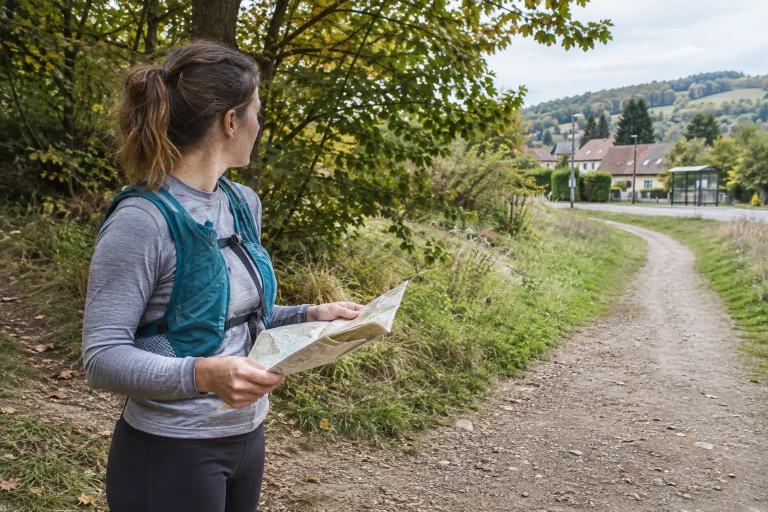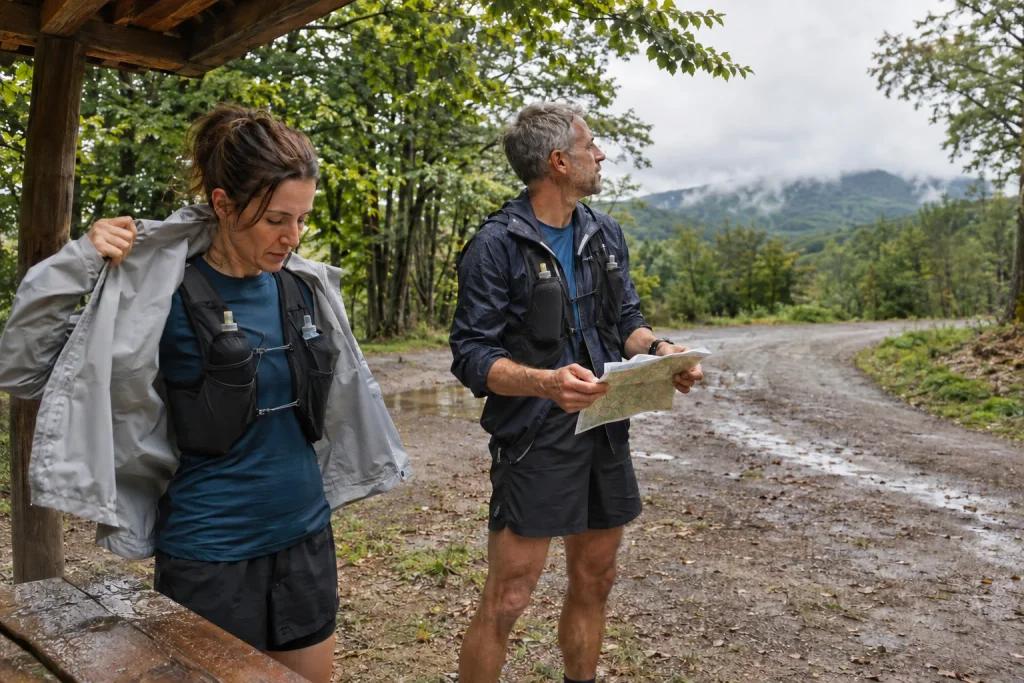
A flexible trail day means choices understood beforehand
In changeable weather, it is tempting to set out intending to decide the route along the way. This can easily become improvisation on unchecked paths. A genuinely flexible plan works differently: it contains a few reviewed options and identifies where, and using which information, you will choose between them.
The aim is not preserving a whole day or planned kilometres at all costs. Abandoning the outing belongs among the choices too. Routes are real alternatives only when access, navigability and finishing are understood. A shortcut drawn on a map is not a completed backup plan.
Begin with the people and task
First consider who would go and what kind of outing you want. An introductory trail loop, repeating a familiar route and a personal training task need different preparation. The group’s experience and today’s goal together determine possible versions.
The Mountaineering Scotland winter-planning guide emphasises considering people, conditions, route and alternatives together. It concerns Scottish mountain environments; adapt a Hungarian outing to local information and personal knowledge. The methodological principle here is examining the whole task rather than one attractive destination.
If a proposed loop requires new knowledge, do not make it the backup in the name of weather flexibility. An alternative must not automatically be more complex or less familiar than the original. Judge its backup role against your preparation.
Keep options few but genuinely different
Three nearly identical mountain-loop drawings may not offer a real choice. If all enter the same uncertain section and rely on the same tight return, different filenames do not resolve the shared problem. Examine how options differ in the actual task.
| Version | Possible role | Independent check |
|---|---|---|
| Main loop | The original outing accepted under appropriate conditions | Complete route, access, time and finish |
| Simpler loop | Fewer new tasks or another geographical structure | No hidden unfamiliar connection |
| Another location | Another form of the outing’s organisational purpose | Separate access and local conditions |
| Not setting out | When personal or environmental requirements do not align | Organise agreements, travel and notifications |
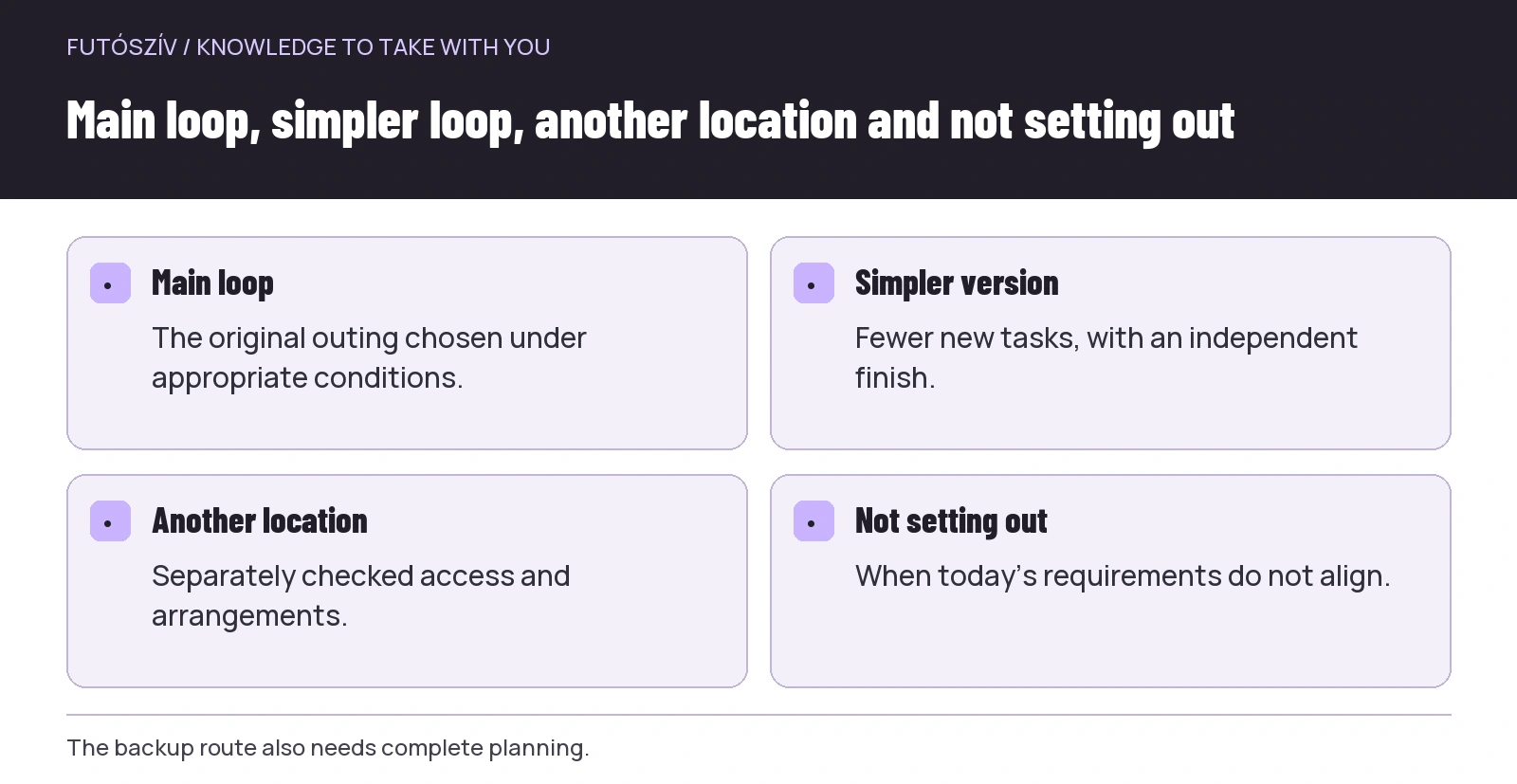
These roles form our planning framework. You need not write four complete programmes for every day. Keep as many checked options as you can genuinely understand and manage within that specific day.
 Enlarge diagram
Text version of the illustration
- Main loop
- The original outing chosen under appropriate conditions.
- Simpler version
- Fewer new tasks, with an independent finish.
- Another location
- Separately checked access and arrangements.
- Not setting out
- When today’s requirements do not align.
Give each version its own conditions sheet
Include starting place, main route line, sources for distance and elevation, navigability and finish. Identify current information to check again before departure too. The sheet should explain not only why you want the loop, but what you still need to know.
Unknown information should remain a question: access to the short return still needs clarification, for example. This is better than a reassuring “backup route” label beside a connection never traced through. Plan quality comes from understandable real conditions, not filled boxes.
Summarise differences briefly too. One stays near base; another reaches farther away. One has fewer waymark changes; another creates a new navigation task. These are concrete distinctions. “For good weather” and “for bad weather” alone are too vague.
Put the decision point before the choice
Mark recognisable places where you can still genuinely choose between understood options. If reaching an alternative first requires completing the loop’s most complex section, that point may not fulfil the intended role. Consider decision location alongside the consequences of continuing.
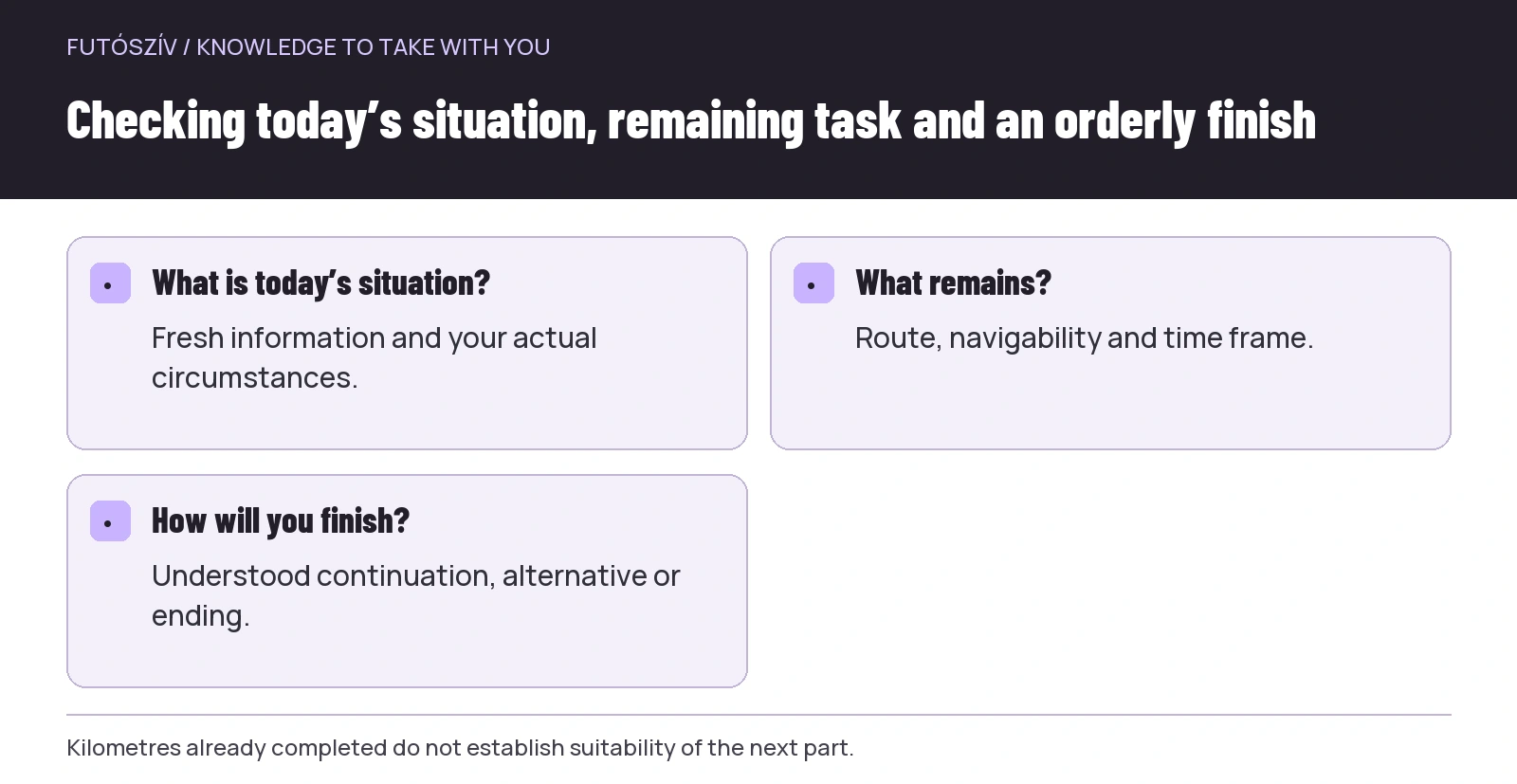
The question there is not whether you can add a few more kilometres. Review today’s situation, remaining task and an orderly finish. The choice should concern the whole outing, not only the next line segment’s length.
The Mountaineering Scotland route-following guide illustrates recognisable terrain points and considering the full route. Use its more complex navigation techniques only with appropriate knowledge. Choosing points in your own outline supports understanding the next step.
Do not turn weather information into rigid automation
The HungaroMet explanation of its hazard-warning system states that information concerns periods and regions, with forecasting limitations. Interpret the phenomenon, validity and written content together for your plan.
You need not assign another GPX file to every colour. A shorter route is not necessarily an appropriate response to every hazardous situation. Changing or cancelling depends on actual conditions, and official, land-manager or organiser instructions must be followed.
Give updates appropriate timing: during main planning, before departure and when a new situation warrants it. Frequent screen viewing does not necessarily improve decisions. When reading new information, create a situation in which you can also attend appropriately to surroundings and others.
Check access separately for every version
The MTSZ warnings and relevant manager’s notices apply beyond the main loop. If an alternative enters another area, check its own conditions. One open section does not automatically settle the neighbouring area.
Examine access and return too. A supposedly simpler loop may be usable while its connecting approach is not. The whole outing works only when beginning and end are understood.
A new restriction on site is not overridden by a saved file. Following a backup line is an option only if appropriate to your situation and clearly accessible. An unchecked detour does not become a preplanned alternative because a phone draws it with a few taps.
 Enlarge diagram
Text version of the illustration
- What is today’s situation?
- Fresh information and your actual circumstances.
- What remains?
- Route, navigability and time frame.
- How will you finish?
- Understood continuation, alternative or ending.
An illustrative two-loop example
A runner reviews two loops from a shared base. The first stays closer to the start on familiar paths. The second reaches farther away with more waymark changes. The plan treats the first as a complete orderly outing and the second as a separate choice under suitable conditions.
Before leaving, the runner does more than save two files. They understand access, main points and finish for each. Returning to base, they reassess the day and remaining task. The second loop is not compulsory merely because it appeared in the original total distance.
The example gives no automatic weather threshold or geographical recommendation. The choice structure matters: the shorter version is genuinely complete, and continuing is a new deliberate decision. If even the first part’s conditions are unsuitable, the plan can handle not setting out.
In a group, share the meaning of each version
On your own, it is enough that you understand the sheet. In a group, every participant should know the outing and how it may change. Someone joining an introductory loop should not discover on site that others regard a more complex route as backup.
Agree the decision process and communication beforehand. If several groups form, each needs an independently workable plan. Faster runners going ahead while others search for the route afterwards is not organised splitting. Actual experience and equipment belong to the choice.
Produce one current summary of changes. Include route, access and finish together. If someone declines the new version, resolve participation through the agreed process. Flexibility does not imply an unspoken social obligation to accept every change.
At the decision point, consider the future task
Already-completed distance can make you cling to a longer continuation. Yet remaining-section conditions matter. The programme being suitable so far does not prove the next part appropriate. New terrain or changing conditions can create another question.
Examine what is certain and what assumed. Is the return known? Does timing hold? Is local information clear? Does continuing fit your situation today? These are the foundations of choice, not exam questions. Previously completed kilometres must not conceal an important missing element.
Ending is not necessarily a worse result than continuing. Planning aims to choose an appropriate outing, not use every possible branch. A timely finish can be genuine execution of flexible planning too.
Do not let alternatives be separate only in name on one device
Several saved files can help, but learn opening and switching between them too. On your actual device, check which line appears, under which name and with which map background. Practise technical operations in familiar surroundings rather than for the first time as weather changes.
Give each option a short written outline too. Start, main waymarks, decision point and finish already support interpretation. A backup information format is usable only when you understand how to handle it.
Account for device and connection limits in communication plans too. A location dot on your phone does not prove the person at home receives fresh data. Report changes and orderly completion in the agreed way.
Review the choice process afterwards
Record which version you chose and the information guiding it. Check whether the alternative truly worked independently and the decision point was appropriately placed. Alongside distance, decision quality becomes interpretable experience.
If an option failed, name the reason precisely. Incomplete access information, a hard-to-recognise junction and unsuitable timing require different improvements. Choose one concrete task for next time rather than rewriting the whole route collection at once.
A flexible trail day consists of prepared options and fresh, understood information. Freedom comes not from having no plan, but from several properly understood finishes. If conditions do not align, abandoning the outing remains part of the same deliberate choice.
How Futószív articles are prepared: our editorial guidelines.