Breakfast before an early race journey is about more than choosing a single food. The time before the start includes waking up, leaving home, travelling, parking or changing services, collecting your race number and getting ready at the venue. If you leave these out, a breakfast that looks comfortable on paper can easily remain in a closed container in the boot. The aim is to have familiar food that suits you available at a time and place where you can eat it calmly.
The following method provides a framework for travel preparations by adult recreational runners. It does not prescribe the same race diet for every distance or replace a personal sports nutrition plan. For a longer event, work out your food and drink during and after the race separately as well. Breakfast fits the day well when it is consistent with your overall eating and hydration plan, while also taking account of practical storage, allergen and transport requirements.
Start with the organiser’s actual information
Check the start time, race-number collection arrangements, exact venue address and travel information. The gate-opening time on the event website is not necessarily the start of your race. If there are several distances or waves, write down the details of your own start. Also check where you can park, how far you must walk from there and what baggage arrangements to expect. These details are just as important to food access as the journey time shown on a map.
Keep verified information separate from assumptions. If a report from a previous year mentions a breakfast stall, that does not mean it will open at the same time or offer the same food this year. Even if your entry includes a meal, clarify its exact timing and contents. A free sample, a product in the race pack or a food outlet opening later should not be your only reliable breakfast source until you know what to expect.
Build a reasonable margin into the transport plan for your particular route. You do not need to model every possibility minute by minute, but do not count transfers, finding parking and reaching the start area as taking no time. If you travel with a companion or team, discuss where you will stop and what kind of delay would make you change the route. An agreed break is more useful than everyone wanting to eat somewhere different at the last moment before the start.
Make two separate timelines
The first timeline is for transport: waking up, walking out of the door, the main travel stages, arrival and tasks at the venue. The second is for food: where it is prepared, when it will be in front of you, where you will store it until then, and when you will next have an opportunity to eat or drink. Put the two lines side by side and you will immediately see whether your planned breakfast falls during a crowded transfer or halfway along a motorway stretch.
The Sports Dietitians Australia guide to pre-exercise eating discusses timing together with individual tolerance. Do not turn its general framework into a rigid wake-up time that is the same for everyone. Plan your solution around your own rehearsal and the demands of the event. An early departure does not, by itself, establish that you should simply skip eating, or that a dinner twice as large the evening before will solve every problem.
Also mark when you close your bag and how long you will have access to it. If the food is in a kit bag you have handed in, you may be unable to reach it precisely when you need it. The same applies to a car left in the car park if the walk back becomes long once you have reached the start area. Consider actual access, rather than the fact that breakfast is theoretically somewhere nearby.
| Stage of the journey | Food question | Detail you can decide in advance |
|---|---|---|
| Getting ready at home | Is there a calm place and enough time? | Preparing utensils and familiar ingredients |
| Travelling | Can you eat safely? | A stop or an appropriate stage of the journey |
| Arrival | Can you access your bag? | Where to put breakfast supplies and clothing |
| Preparing for the start | Which familiar option will fit? | Your own plan alongside the organiser’s timetable |
 Enlarge diagram
Text version of the diagram
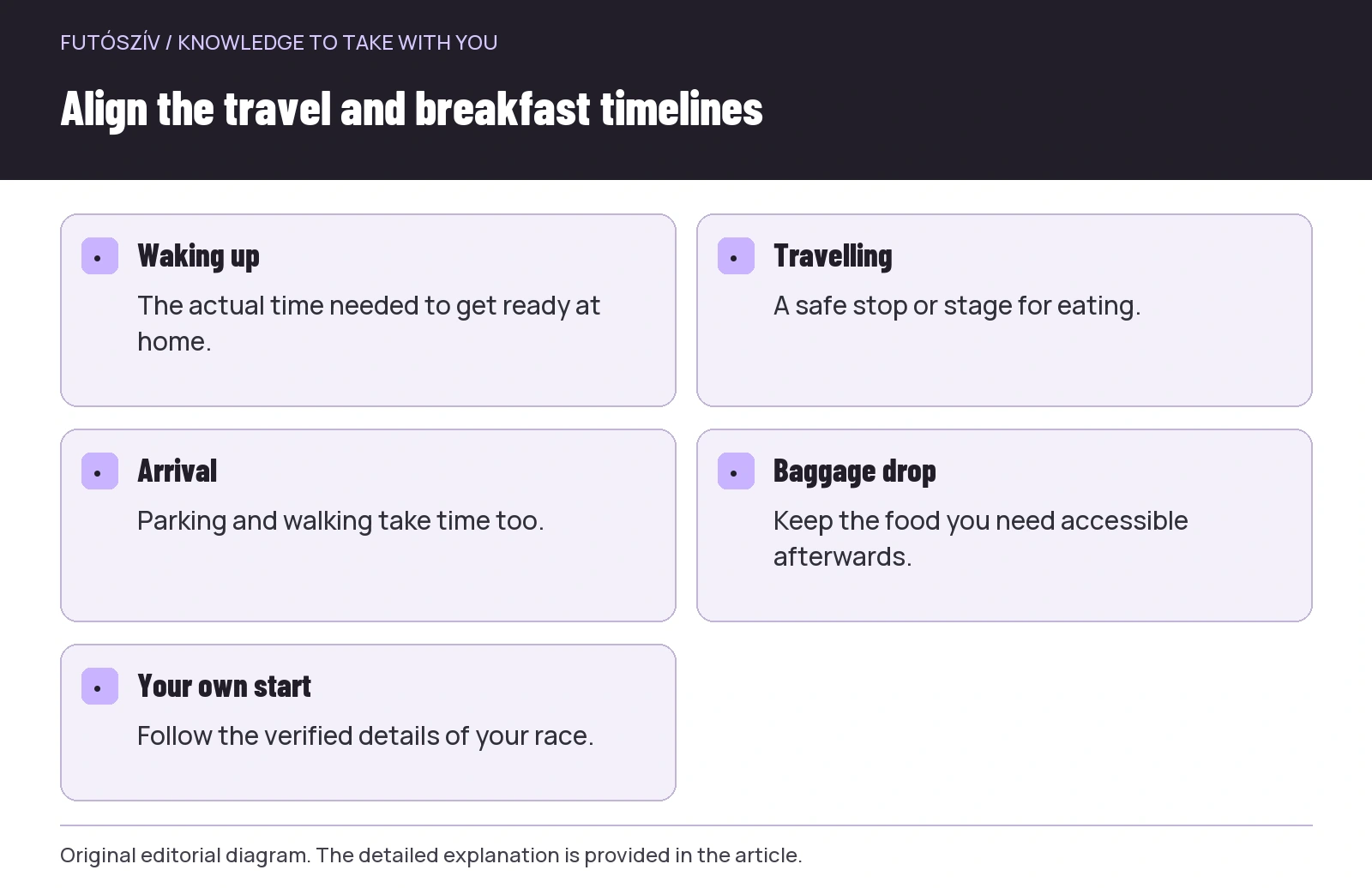
- Waking up
- The actual time needed to get ready at home.
- Travelling
- A safe stop or stage for eating.
- Arrival
- Parking and walking take time too.
- Baggage drop
- Keep the food you need accessible afterwards.
- Your own start
- Follow the verified details of your race.
When travelling by car, where to eat is part of the plan
If you are driving, arrange to eat during a stop or before departure. Opening containers and looking for a spoon should not happen while driving. Even as a passenger, think through your own travel comfort: a wobbling, overflowing bowl is a different experience from the same food at your kitchen table. You can choose a less awkward, previously tested combination, or include a stop where you can eat calmly.
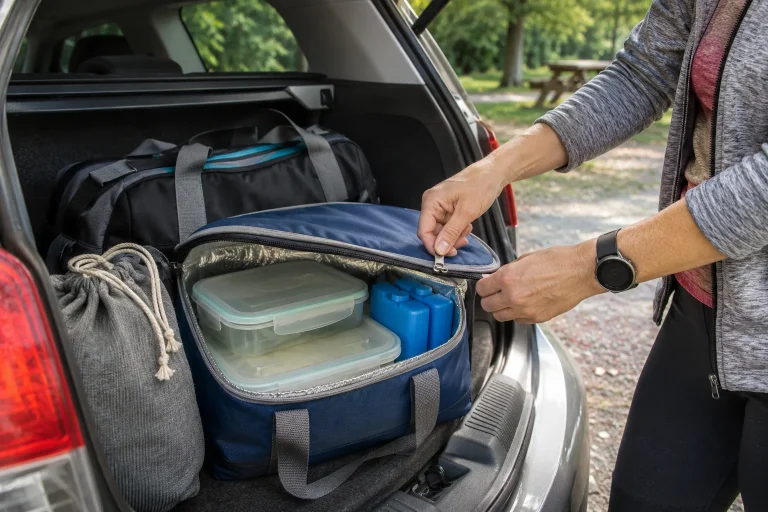
Do not put the breakfast bag underneath all your equipment. Include the utensils you need, a napkin and a separate place for the used container. Put drinks in a bottle you can genuinely transport with a secure closure. If several people bring identical-looking containers, label them. This is particularly important with different allergens or special diets; two sandwiches looking the same from the outside is not enough to identify them.
Do not judge the temperature of food left in a car by the air temperature outside. Food requiring refrigeration needs a suitable way to stay cold during the journey, including the wait after arrival. The Nébih shopping guide calls for thoughtful preparation when transporting products requiring refrigeration as well. Plan cool-bag use around the particular food and the whole journey, following the instructions on the packaging.
Trains and buses have different bottlenecks
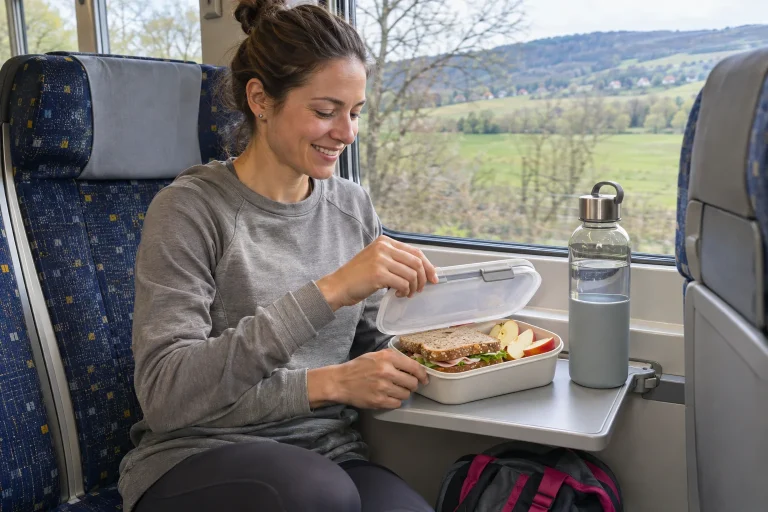
On public transport, the main questions may be a manageable bag, clean hands and a calm place to sit. A large bowl or packaging that is difficult to open is not practical on every service. Put food in a container you can use comfortably in the space available. Keep clean utensils separate from running shoes and used clothing in your luggage. You do not need to turn the journey into an improvised kitchen.
Do not plan to eat your entire meal in the few minutes between connections. Changing platforms and finding your service can easily fill that time. If you want to eat on a longer leg, make the food accessible without unpacking every bag in a crowded carriage. A short packing list on the outside of the bag can help: food, drink, utensils and somewhere for rubbish. Adapt the list to the journey; you do not need to copy it unchanged for every race.
If a service is delayed, look at the revised timetable first. Do not try to make up for everything at once in a rush because you are anxious about the delay. Use the parts of your familiar plan that remain feasible in the circumstances. Storage conditions still matter. If eating safely and preparing for the race no longer fit together, you can reconsider participation as well; reaching the start does not take priority over acknowledging that you feel unwell.
At accommodation, breakfast opening time is not the only question
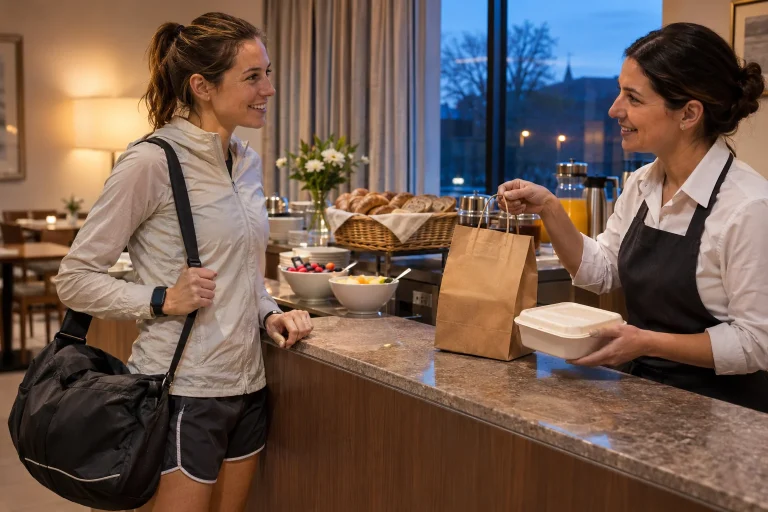
When booking, or in the days before travelling, clarify when breakfast is available, what food to expect and whether there is suitable storage for your own food. Do not automatically call an appliance in the room a fridge suitable for food storage. If refrigeration matters, check the appliance’s suitability and how to use it as well. For a special diet, a specific discussion with staff is worth more than a general icon on the booking page.
If the breakfast room opens later than the time that suits you, ask about an agreed arrangement and have a familiar alternative of your own. Even on race day, it is easy to collect far more unfamiliar foods than usual at a breakfast buffet. You do not have to put the whole wide selection onto one plate. Choose a familiar combination that fits your plan; there can be a later, calmer occasion for trying local specialities.
The Johns Hopkins Medicine sports nutrition information also emphasises familiar, well-tolerated foods and checking available options in advance when travelling. This does not mean you must carry every meal from home. Rather, you can organise local food purchases specifically: know where you will go, when it opens and what suitable food you can choose there.
 Enlarge diagram
Text version of the diagram
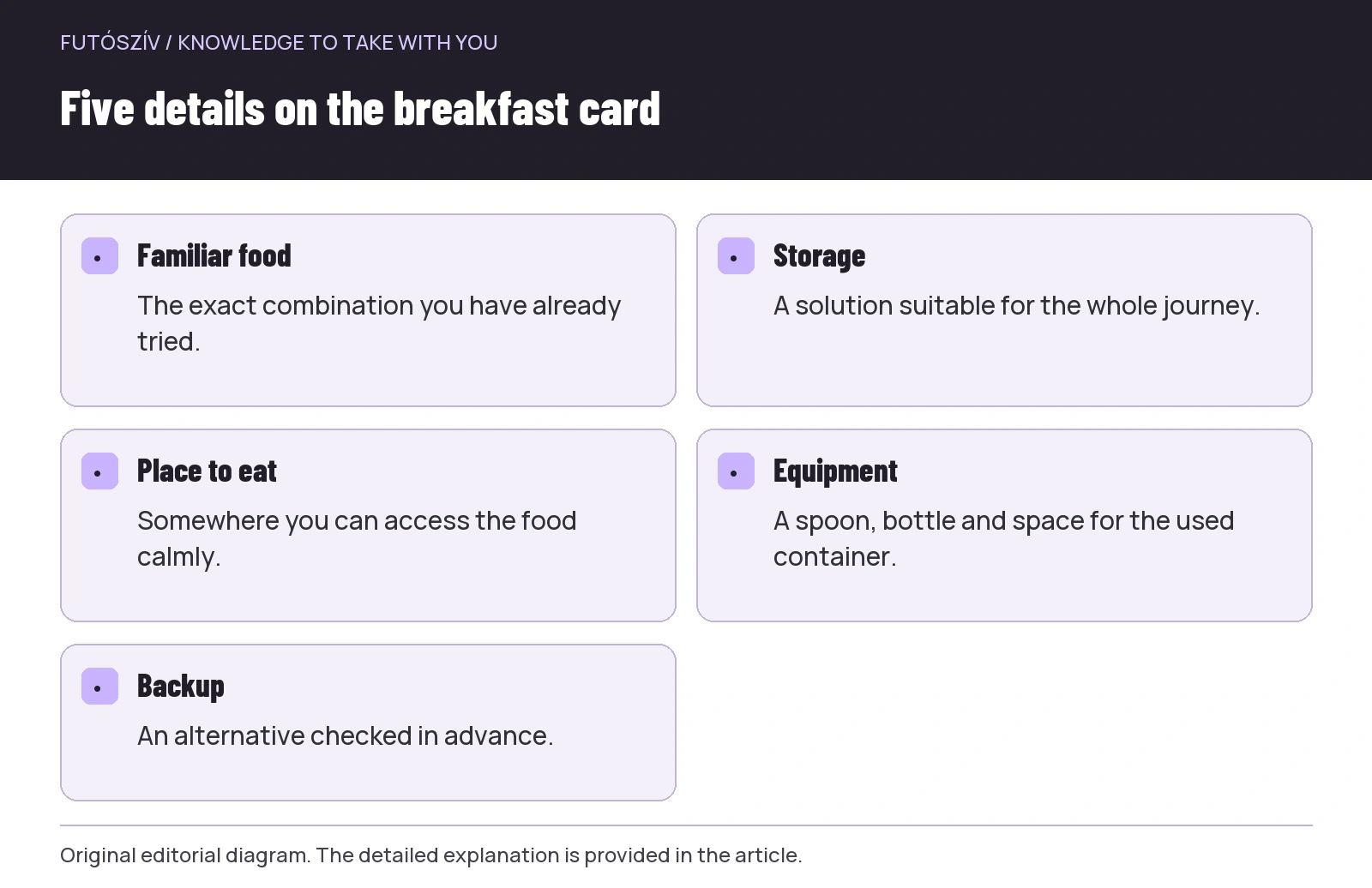
- Familiar food
- The exact combination you have already tried.
- Storage
- A solution suitable for the whole journey.
- Place to eat
- Somewhere you can access the food calmly.
- Equipment
- A spoon, bottle and space for the used container.
- Backup
- An alternative checked in advance.
What should your breakfast card contain?
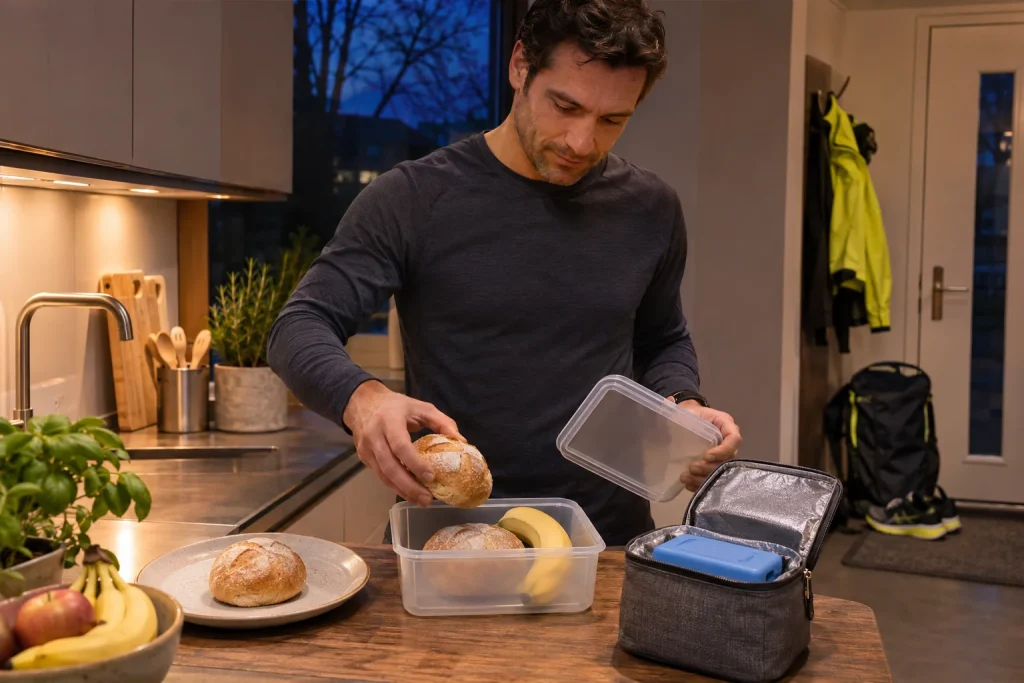
Write down the precise version of the food you have already tried. “Sandwich” alone may be insufficient if the actual filling and bread are quite different from those you usually eat before training. Note the quantity you need on the basis of your own experience or dietitian’s plan, how to store it and where you intend to eat. Include the drink and its bottle as well. The card is not a nutrient-calculation exercise; it is a way to prevent an important detail being left at home.
Describe the backup just as specifically. Options might include a previously tested version suitable for transport instead of eating at home, or buying food at a location checked beforehand. The backup should fit your usual diet and be safe to handle under the journey’s conditions. An unfamiliar sports product at the bottom of a race pack is not really a worked-out alternative if you do not yet know its label or your own tolerance of it.
After packing the food, test access. Close the bag, then take out breakfast as you would during the journey. Can you reach the utensil? Can you find the drink? Does the part that needs refrigeration stay in the right place? Can you put the used container away without leaks? This half-minute test often reveals more practical problems than looking at everything neatly arranged on the kitchen counter.
Three different mornings, three organisational solutions
For a nearby race starting later in the morning, breakfast at home and your familiar departure routine may work. Include any long wait caused by arriving too early in your plan for the day. For a distant, early-morning start, however, more food-related details may move into the journey, making stops, keeping food cold and access important. When starting from accommodation, coordinate local breakfast timing with getting to the start area. None of these situations automatically prescribes the same food.
If you travel with others, leave room for individual eating plans alongside the shared departure. Not everyone tolerates the same food, and you do not need to copy the breakfast of the driver or the fastest runner on the team. In your discussion, make timing and logistics the common ground: when to leave, where to stop and when to drop off bags. Your own food, quantities and special requirements can remain personal.
Afterwards, assess how workable the plan was
After the race, briefly note what worked. Could you get the food out in time? Did the container seal well? Was the eating location comfortable? Did you get the breakfast you expected? These observations can genuinely improve the next travel plan. Your finish time alone does not prove that the breakfast was perfect or flawed: many other circumstances affect a running result.
A good race-breakfast plan ultimately consists of a few verified pieces of information: the timetable of your own race, familiar food, reliable storage, a real opportunity to eat and a usable backup. When these fit together, fewer decisions remain for the more stressful stages of travel. You can use that freed-up attention for finding your way, getting ready comfortably and running. Breakfast then becomes a planned part of the day rather than another obstacle before the start.
Sources and further reading
- Sports Dietitians Australia: Pre-exercise fuelling
- Johns Hopkins Medicine: Nutrition for Athletes: What to Eat Before a Competition
- Nébih: Vásároljunk okosan!
How Futószív articles are prepared: our editorial guidelines.