A category code is not a diagnosis
In a para sport broadcast, we see short combinations of letters and numbers beside athletes’ names. It is easy to assume these simply represent illnesses or general severity levels. Classification, however, is a sport-specific competition system. It examines how an impairment recognised in that sport affects performing the sport’s fundamental tasks and organises competition accordingly.
A diagnosis therefore cannot be used to assign a sport class at home. The category is not a score of a person’s worth, quality of life, independence or effort. Nor is it medical clearance to run. Sport classification, medical capacity for exertion and a particular event’s entry conditions are three separate questions.
What is classification for?
The IPC Classification Code sets out the system’s foundations within competitive para sport. The code that came into force in 2025 is not simply a list of diagnoses: the impact on activities required in the sport matters too. Read the detailed procedure together with the sport-specific rules.
The aim is not to make every athlete identical in every respect. Fitness, technique, tactics, preparation and many other factors can still differ. Classification does not guarantee identical results or an identical competitive chance at every start.
In everyday language, ‘category’ can also mean an age group, results group or a community event’s own entry option. Do not confuse these with official para sport classification. Always ask exactly which system is being discussed.
Eligibility and sport class are separate steps
The official World Para Athletics page explains that eligibility in para athletics requires both an eligible impairment and meeting the prescribed minimum impairment criteria. Not every health condition or significant everyday difficulty automatically leads to eligibility in this competition system.
This is a sensitive distinction. Someone being ineligible under a particular sport’s rules does not mean they have no disability, no real barriers or no place in sport. The rule addresses a defined competition system, not their entire life.
Even after eligibility is established, assigning the appropriate sport class is a separate task. The particular sport’s rules and official assessment determine how that happens. An online overview cannot promise a certain outcome in advance.
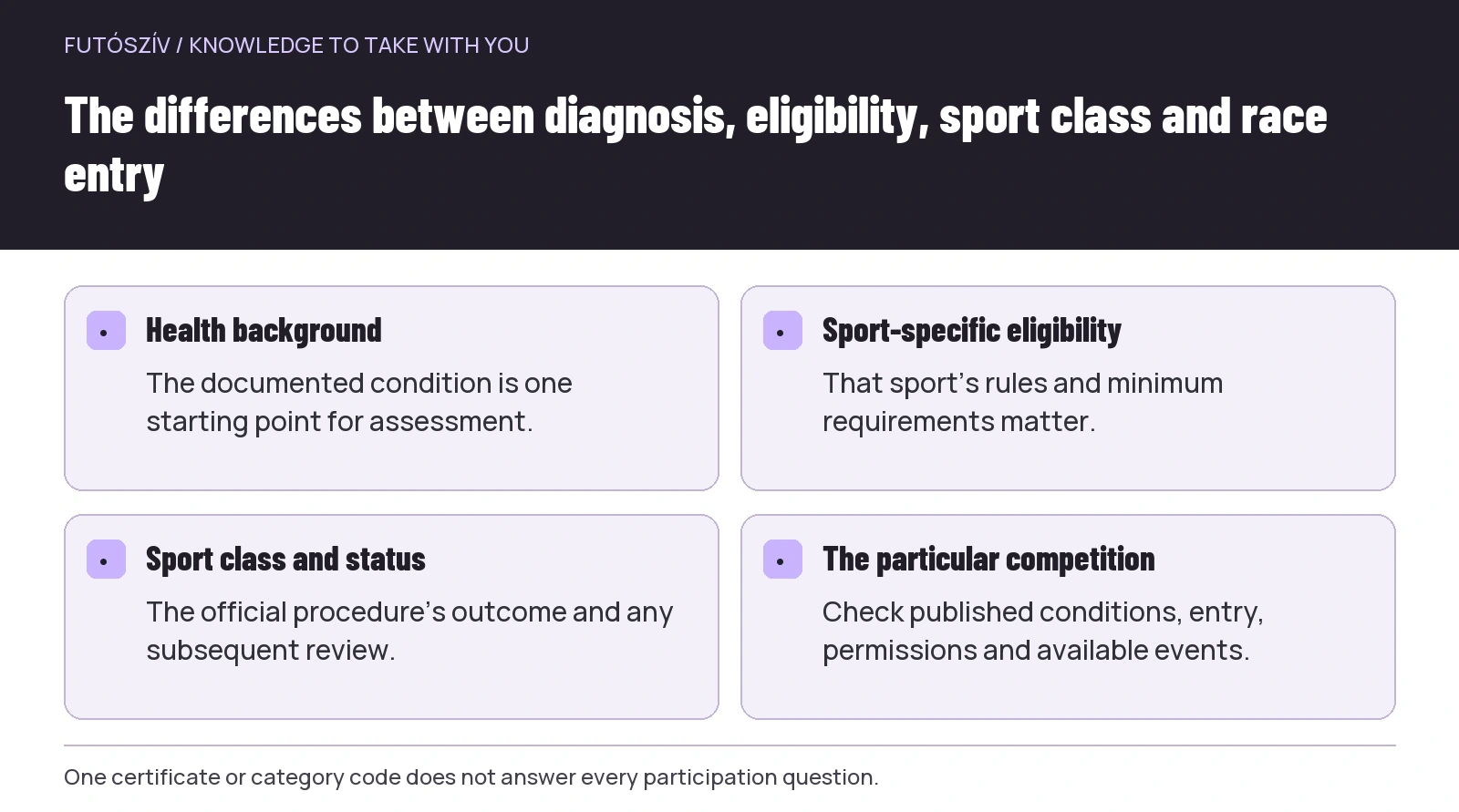 Enlarge diagram
Text version of the diagram
- Health background
- The documented condition is one starting point for assessment.
- Sport-specific eligibility
- That sport’s rules and minimum requirements matter.
- Sport class and status
- The official procedure’s outcome and any subsequent review.
- The particular competition
- Check published conditions, entry, permissions and available events.
Why can classification not be transferred between sports?
Running, swimming, throwing and ball sports involve different tasks. An impairment can affect each differently. A class assigned in one sport therefore cannot be converted into another sport’s class using a simple table. Similar letters or numbers do not establish identical meaning either.
This may matter to a runner who previously competed in another sport or tries to start from a friend’s experience. Earlier procedure documents can be useful, but check the new sport’s own requirements separately. Look for the appropriate contact within the sport’s governing organisation.
Athletics itself also includes different events and equipment situations. Do not infer classification details from one broadcast or another athlete’s public profile. Official rules and the personal procedure govern.
How should we read a category code?
A code is primarily understood within its own sport-specific system. It is not a general scale on which a higher number always means better function or less support needed. Ranking numbers across different class groups is misleading.
As spectators seeking to understand a competition better, read the official sport-specific explanation. Knowing which event it is and what tasks athletes face may be enough. There is no need to observe competitors’ bodies or movement as an amateur diagnostic exercise.
Athletic performance can be discussed technically: the start, pacing, technique and race situation. A category code is no reason for every interview to focus exclusively on disability. Athletes should decide how much of their personal story to share.
Domestic and international procedures
The Hungarian Paralympic Committee’s classification page leads to domestic information, documents and application details. The Hungarian classification guide sets out specific requirements. Conditions and dates can change; always check the current official description when applying.
A domestic classification and status accepted in an international competition are not necessarily the same. Do not assume an earlier domestic document is sufficient for every international entry. Before the target competition, clarify the procedure and documents needed with the sport’s organisation.
Preparation can take time: gathering information, finding an assessment opportunity, travelling and learning the result. Do not leave that until the last days before entry. The competition calendar and procedure timeline are separate organisational tasks.
What should we ask in advance?
A useful first message names the sport and intended competition level, then asks about the required steps. Which document is current? Which preliminary records are needed? Is there a deadline? What equipment should be brought? Can support for communication or access at the venue be arranged?
Send sensitive medical documents only through the officially specified, appropriate channel. There is no need to upload them to a running group’s public platform for someone to give an opinion on a possible category. Helpers should not treat documents they hold as freely shareable information either.
The athlete should understand what will happen. If the description is too technical, ask for an explanation. Requesting support does not suggest the person is unsuitable as a competitor. Predictable information is a condition of participation.
Cooperate honestly in assessment
Classification is not an exam in which an athlete aims to secure a preselected result. Provide necessary information accurately and honestly and follow official instructions. Deliberately changing movement or withholding information to obtain a supposedly more favourable class is not appropriate preparation.
Coaches can help explain documents and the process but cannot promise a category. Personal support should not mean answering on an athlete’s behalf when they can provide the information themselves. If interpreting or other communication support is needed, arrange it in accordance with procedural rules.
The assessment outcome is neither a reward nor a punishment. If athletes are unsure what it means, they should request an official explanation. Guesswork and community comparisons can easily lead to misunderstanding.
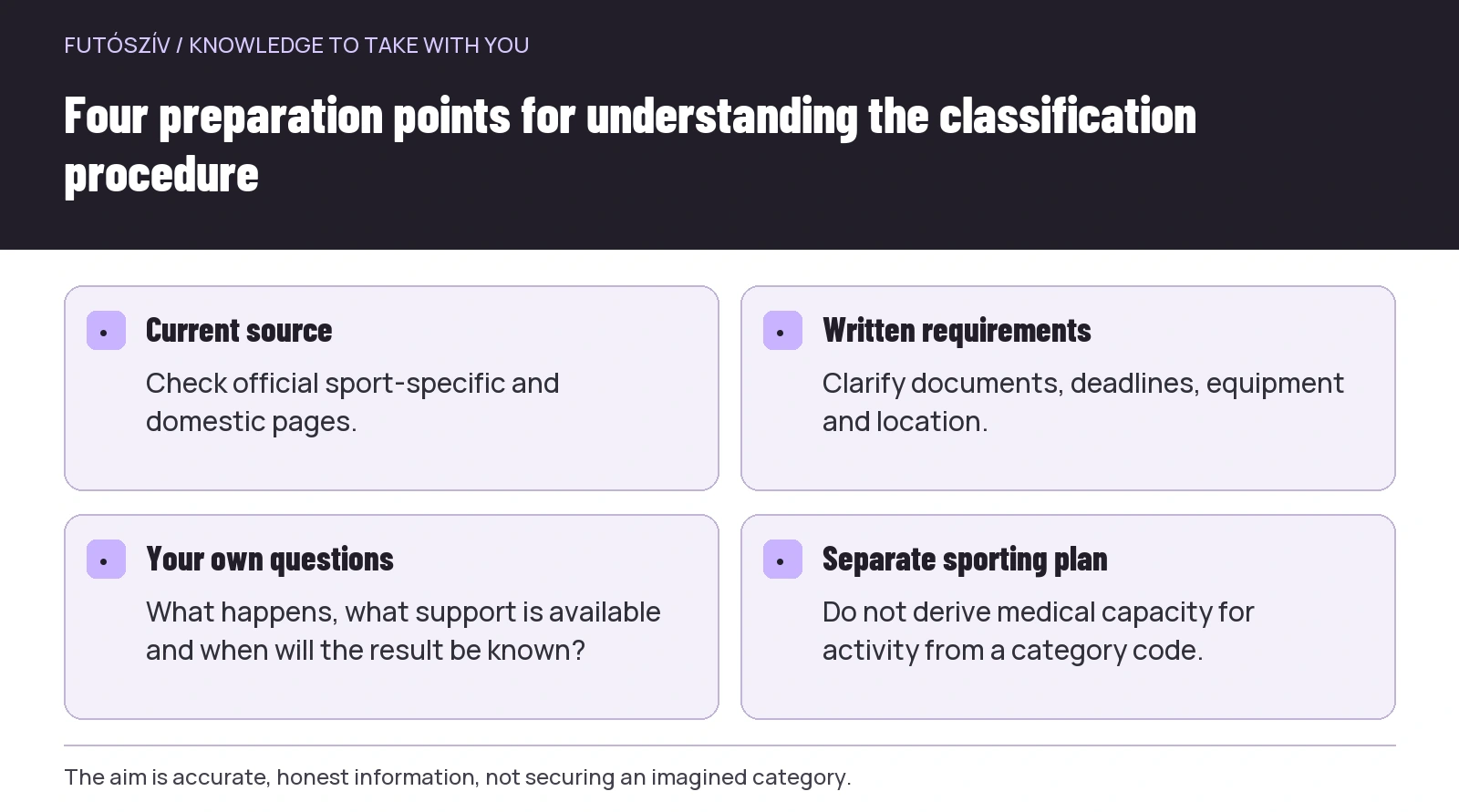 Enlarge diagram
Text version of the diagram
- Current source
- Check official sport-specific and domestic pages.
- Written requirements
- Clarify documents, deadlines, equipment and location.
- Your own questions
- What happens, what support is available and when will the result be known?
- Separate sporting plan
- Do not derive medical capacity for activity from a category code.
Sport class and status are not the same
Alongside the sport class, status and possible later review may matter in the procedure. Check precise names and conditions in the current rules document. Earlier classification does not permanently close every further question in every situation.
If the condition, documentation or competition aim changes, ask the appropriate organisation what to do. A coach or another athlete should not decide whether an official further step is necessary. Review under the rules and daily changes to a sporting plan are separate processes.
Questions about the outcome, review or a procedural objection may have a prescribed route. Learn its conditions and deadlines in time. An objection expressed in a social-media post does not replace the official procedure.
Current rules: dates matter too
The World Para Athletics rules page lists documents on different subjects. When checked in November 2026, the competition rules included a September 2026 edition, while the classification document appeared under a separate title. The latest competition rules are not necessarily the same document as the detailed classification rules.
For a saved PDF, record where and when it came from. Start from the official collection page rather than an old article or screenshot. If two sources appear to conflict, ask the responsible organisation; do not automatically select the one promising the desired outcome.
A general portal article therefore does not aim to list every threshold for every category. Athletes need an accurate, current procedure relevant to their own circumstances, not a homemade classification table that soon becomes outdated.
Classification is not training clearance
A classification does not establish what heart rate, distance or frequency should be used in training. Those depend on individual health, current function, sporting history and appropriate professional assessment. Two people in the same sport class can still have different activity needs and goals.
Equally, a sports-medical or other health certificate does not automatically replace classification. The two documents answer different questions. Before entering, check separately which is required and in what form it is accepted.
Assistive-device use, a companion’s presence and access to the particular course may also need separate discussion. A category code does not tell you whether someone can get through the venue gate, access a toilet or what information they need.
Recreational running and open events
Someone not seeking an official para sport competition may have other entry opportunities. An open community run operates under its own rules; check participation conditions there. Do not automatically demand an official category for every sporting gathering.
If an event announces separate prizes or an adapted category, ask exactly what that means. Who can enter, using what equipment, with which documentation and under what scoring? The word ‘para sport’ alone does not standardise event procedures.
Belonging in sport is not defined only by the Paralympic pathway. Eligibility within a competition system may matter for a particular goal, but a category code does not determine the value of community participation or a personal sporting experience.
Sources
- IPC: classification code and scope.
- World Para Athletics: classification basics.
- World Para Athletics: rules documents.
- Hungarian Paralympic Committee: domestic information.
- Hungarian Paralympic Committee: classification guide.
How Futószív articles are prepared: our editorial guidelines.