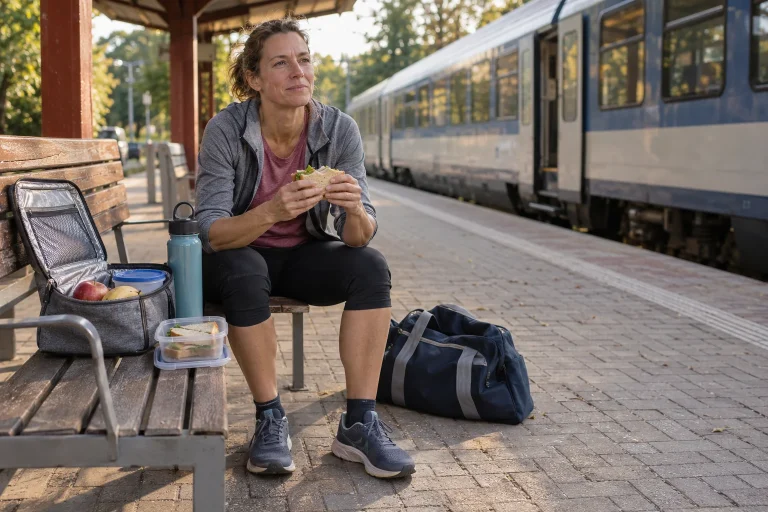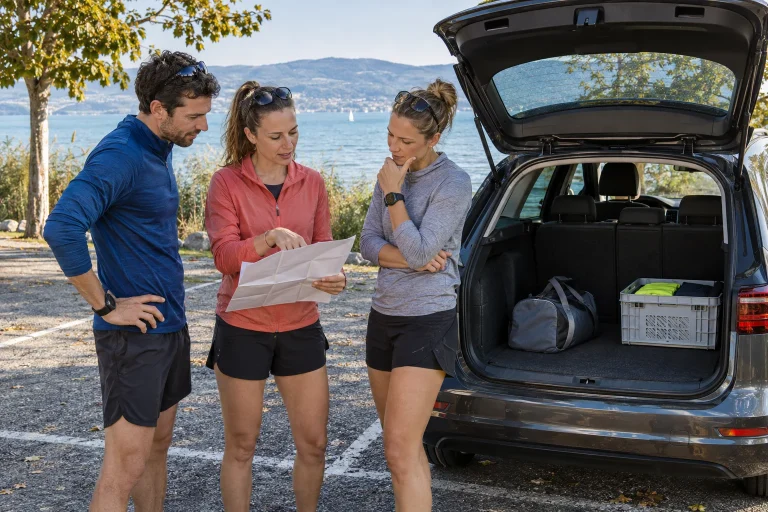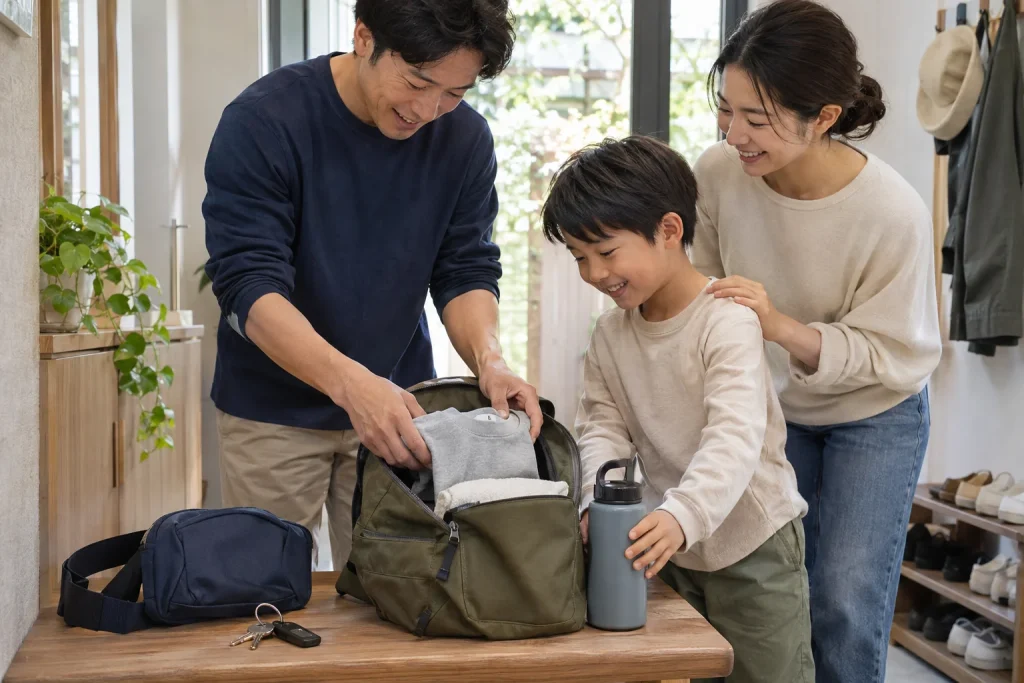
When packing for a family running programme, it is easy to add another object for every possible situation. In the end, someone must carry the bag, reach necessary items and know who kept the key. A good bag is neither the smallest nor largest: it serves the actual day and is with the right person at the right time.
First examine the schedule and roles, then objects. A short shared programme in a nearby park, a race day involving travel and a day when one adult runs while another waits with children require different things. The method below is an original organising suggestion, not a compulsory equipment list, childcare guide or product recommendation.
The day’s tasks begin the list
Briefly describe when you leave, who joins the active part, where others remain and when you go home. If splitting up during the day, adapt bags accordingly. Before counting objects, know who needs them and when. Clothing left in a car, for example, is not an accessible on-site change if returning to the car does not fit the agreed programme.
Begin with things without which this programme cannot work: required entry documents, equipment mandated by the event, travel entitlements actually used and personal family essentials. Do not infer these from a general online packing list. Event rules and the family’s own circumstances determine necessities.
Necessary, optional and leave-at-home items can form separate groups. The grouping is not a value judgement: a toy one family can omit may be important familiar support for another during waiting. The aim is a specific use situation for every object rather than merely “it might be useful for something”.
Divide belongings into four parts by use
The first group comprises items needed on the journey and arrival. This may include information actually required for transport, entry or number collection. Keep it accessible without emptying the whole bag. Contacts in the shared family plan should know who has it too.
The second is the active participant’s belongings. During their distance, they should carry only what the event permits or requires and what they actually need. The third remains with waiting family members. The fourth serves finishing and travel home and needs to become accessible again at the appropriate time.
| Group | When is it needed? | Who should have it? |
|---|---|---|
| Arrival items | During travel, entry and administration | The adult carrying out the task |
| Participant’s own kit | During the active part | The participant, according to rules |
| Waiting items | During the family’s on-site programme | The adult staying with children and spectators |
| Finishing items | When changing and leaving | In actually accessible storage or with an accessible person |
You do not need to buy four separate bags. Functions can be separated within an existing bag or belongings divided into two parts for the day. Access is the method’s essence. If two parts of the family leave at different times, at least items needed for their own departure should be independently available.
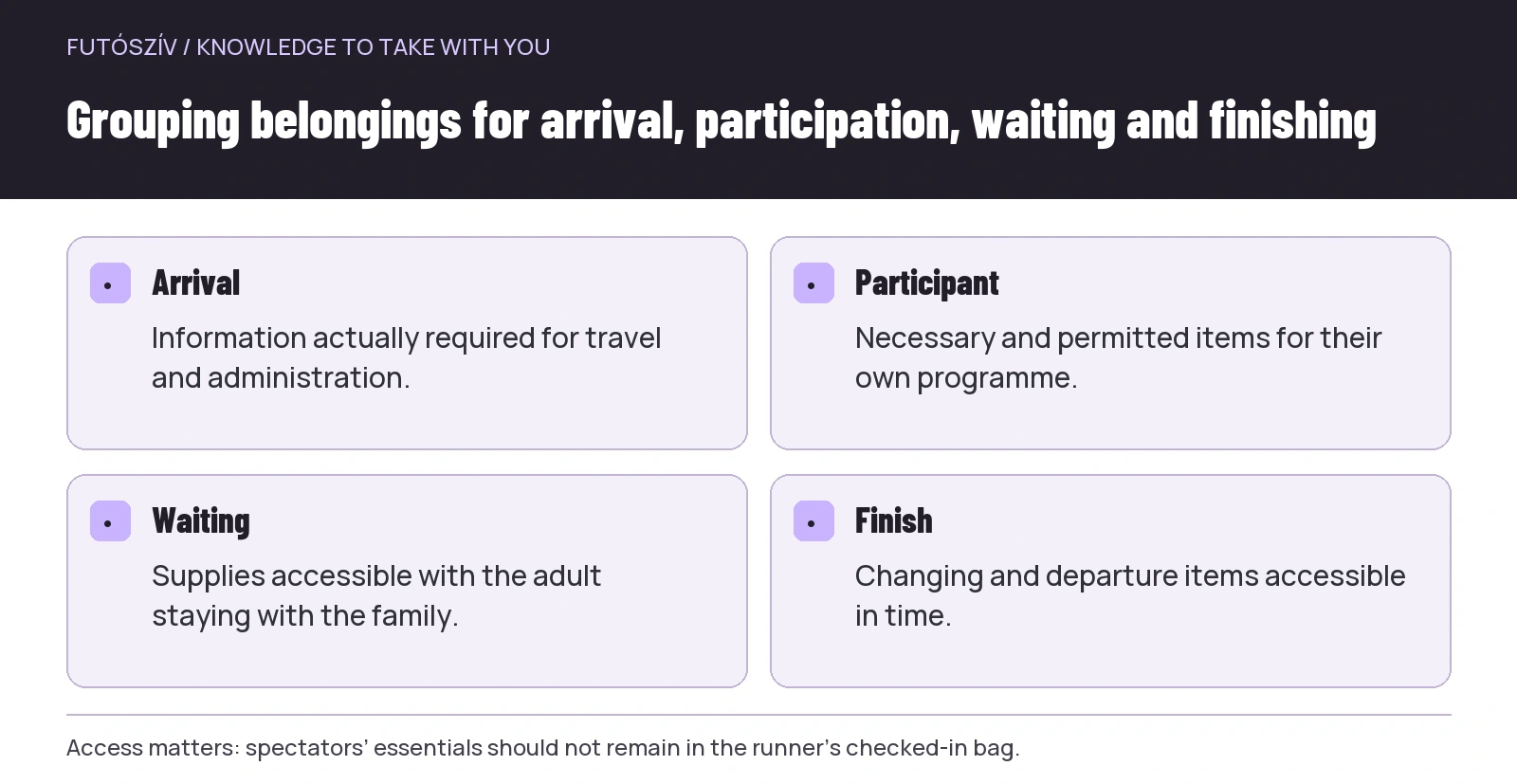 Enlarge diagram
Text version of the diagram
- Arrival
- Information actually required for travel and administration.
- Participant
- Necessary and permitted items for their own programme.
- Waiting
- Supplies accessible with the adult staying with the family.
- Finish
- Changing and departure items accessible in time.
Bag storage is not a universal provision
An event may have bag storage, limited storage or an admission system restricting which bags enter each area. Check who can use it, accepted bags, collection identification and hours. A bag linked to another family member’s race number may not be released without them.
The official 2026 Mini London Marathon event guide , for example, offered no general bag storage. The Bath Miles 2025 organiser guide instead described storage under its own conditions. These are differing examples from past UK events; neither establishes the same provision at a Hungarian race chosen now.
Without appropriate storage, someone must carry everything. Reassessing the original list then belongs to planning. Do not automatically place difficult equipment on another family member’s shoulders because they are not running anyway. Ask what they accept and consider the bag alongside their whole on-site programme.
Assign clothing to people and situations
Finding someone’s change quickly is difficult within a shared clothing pile. Separate personal sets and mark what belongs to running, waiting or returning home. Choose from the programme and current conditions rather than following an event photo from another season.
A spare garment helps when accessible and actually wearable. Before leaving, check size, zip, pockets and usable condition. This avoids discovering an outgrown or damp item on site. You need not buy new running clothes merely for a family programme.
After the programme, separate damp or dirty items from clean ones and care for them at home according to actual instructions. The GINETEX information on care symbols supports interpreting symbols on garments. A specialised technical jacket and everyday T-shirt need not share one universal washing rule.
Waiting supplies should stay with those waiting
If one adult is on the course, essentials inside their stored bag do not help the others. Consider what the spectator period needs and leave it with the adult actually staying with the family. Access matters more than fitting everything into one large bag.
Food and drink planning should follow known family needs and actual venue possibilities. Do not assume runners’ refreshment stations also supply spectators or that every family member will definitely find suitable options. This article does not determine children’s nutritional portions. Individual dietary or health conditions need appropriate advance arrangements.
A few small activities easy to pack away may suffice. A simple sketchbook or familiar game is a good choice when actually usable there. Avoid collecting tiny components amid pedestrian traffic or blocking an exit with play. An object chosen by a child should not become a compulsory all-day task either.
Keys, tickets and phones: check before splitting up
One misplaced key often complicates a family day more than a missing shirt. Anyone going home earlier should have access needed for entry and travel. Do not check the only car key into the later finisher’s bag if others need belongings in the car meanwhile.
Current provider conditions govern transport tickets and digital entitlements. The BKK BudapestGO information provides an official starting point for app use. Do not assume a screenshot or a product on another person’s phone suffices in every situation. Before the family divides, check that both journeys actually work.
The phone plan concerns more than battery charge too. Save contacts, location and the agreed meeting description where needed. Information should not exist exclusively on the runner’s device, unavailable while on the course. Children need not manage all communication between adults.
 Enlarge diagram
Text version of the diagram
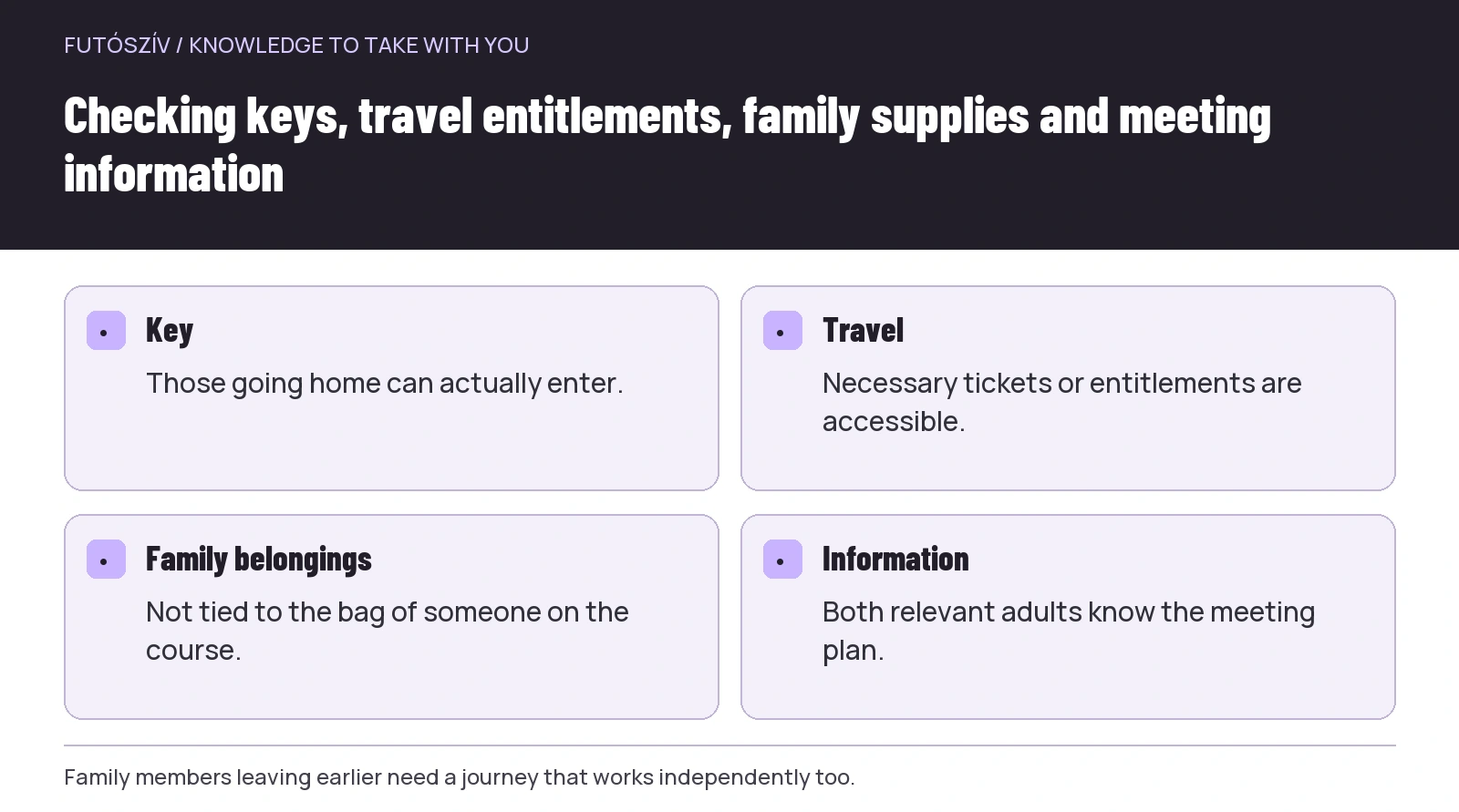
- Key
- Those going home can actually enter.
- Travel
- Necessary tickets or entitlements are accessible.
- Family belongings
- Not tied to the bag of someone on the course.
- Information
- Both relevant adults know the meeting plan.
An original sample packing arrangement for a divided family
The following example is fictional. One adult prepares for their own race, while another accepts a shorter spectator programme with the children and leaves earlier. Participants’ actual needs and event conditions may differ. The example shows item placement, not a complete equipment list.
The runner’s part contains equipment required for that event and belongings accessed after finishing. The spectator part retains children’s waiting supplies, actual entitlements for returning home and the entry key. Relevant information from shared documents is available to both adults according to their tasks.
Now change the situation: the children decide to wait for the runner after all. This does not automatically require putting everything back into one bag. Reassess waiting duration and the meeting instead. A packing system helps when it follows the real programme rather than forcing one route because of original bag allocation.
Five questions help remove unnecessary objects
For every uncertain item, ask when it would be used, who would use it, who will hold it, whether another suitable item already does that job and what happens without it. Seek specific answers. “It might help somehow” is insufficient, but a personal essential is a clear reason even if absent from another family’s list.
For duplicate items, reducing numbers is not necessarily best. Family groups leaving separately may need their own keys or information. Three large games nobody chose might be omitted, however. Considering function works better than competing over who leaves with fewest belongings.
A missing item is not always a shopping task either. Existing clothing, a simple container or shortening the day may resolve the situation. Before buying, check whether the function is genuinely needed for the planned programme. Organising family running need not become a compulsory sequence of equipment purchases.
Test access before leaving
At the end of packing, check more than whether everything is inside. The adult accepting a task should find entry information, spectator belongings and their own travel items. If this means emptying everything, rearrange. A brief home check may prevent more queues or on-site searching than another spare object.
Children can learn where their own section is with necessary adult help too. This does not mean responsibility for all bags. If choosing a small personal bag, contents and carrying should actually be manageable, not a hidden transfer of shared equipment. Important documents and supervision remain adults’ tasks.
Consider handling the bag together with transport. Stairs, transfers, a longer walk or moving with children may require different luggage from a short trip to a car boot. Do not see daily demands only in the running part: belongings move with you along the whole family journey.
Close the system after returning home
Return necessary documents, keys and borrowed items to their places. Care for used clothing according to its label, clean reusable containers and equipment according to manufacturer instructions and store them ready for use. Do not leave the family bag partly unpacked with damp items for days.
Two brief notes may suffice for the list: what was actually missing and what you carried unused. An unused object is not automatically unnecessary if needed as a spare for a real condition, but distinguish deliberate backups from accidental leftovers in the bag. This can make the next list more precise.
A well-packed family running programme is about working access rather than a list of objects. Everyone knows what they hold, what to expect from others and how to continue. The day becomes easier to manage: essentials are close, optional things have real purposes and the bag does not take over directing the programme.
How Futószív articles are prepared: our editorial guidelines.