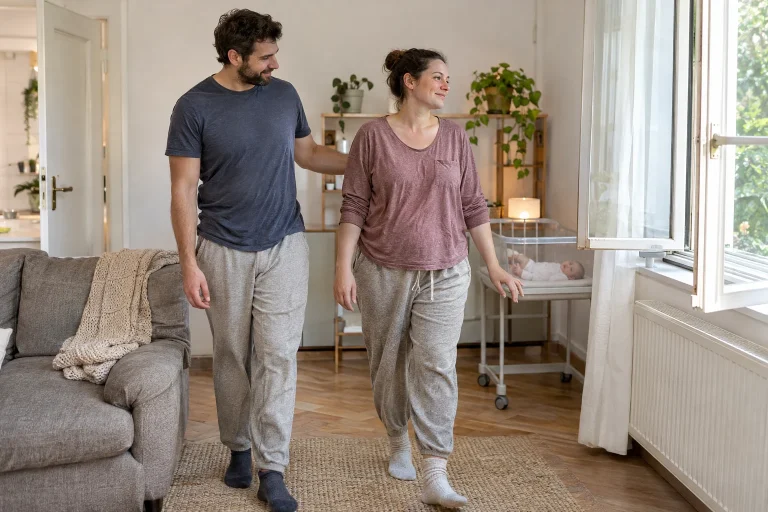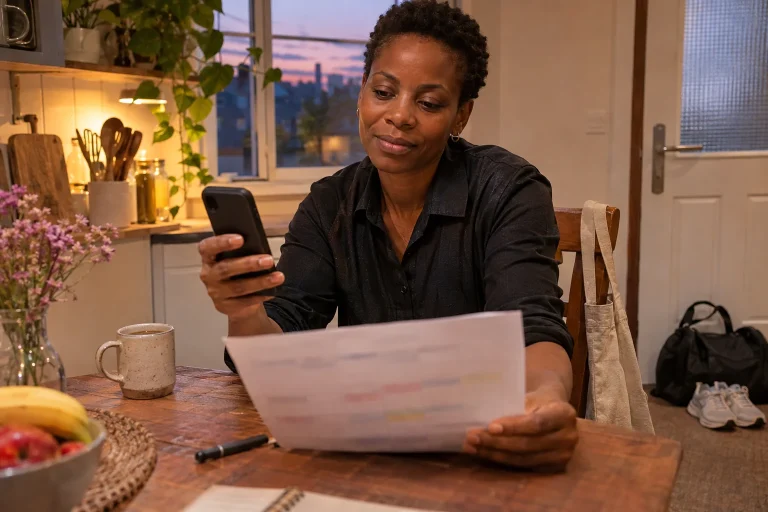
Your old sports watch sits in the same place on your wrist, and the app welcomes you with the same colours and graphs. Yet your life has changed: nights may fragment, childcare fills the day and you have new experiences of physical recovery. The familiar interface may still be useful, but does not automatically contain your whole postnatal story.
The question is not whether every digital datum must be set aside. It is how to add what you know about your day and condition. A sleep summary, an old pace graph and a new symptom provide different information. Keeping them from merging into one good or bad score can make your data more understandable and give a professional a more accurate picture.
App data and your own experience are different things
First check exactly what your device shows. Is it measured data, an estimate, an event you entered or a summary calculated from these? Their roles differ. Watches do not all offer the same capabilities, and apparently identical field names do not prove identical calculations. Use your own device’s official description to understand a particular feature.
Alongside this, personal experience may concern being awake several times overnight, discomfort with an ordinary movement or a newly noticed symptom. You need not translate it into an algorithm’s language to describe it in healthcare. A displayed summary cannot itself explain what you know about your day.
A useful first question is: What does this field cover, and what does it not? An activity duration, for example, may have a clear purpose without answering how your wound is healing. Data need not be called bad because they do not answer every question. Understand their role precisely and add the missing context.
The actual night belongs beside the sleep graph
The National Sleep Foundation’s 2026 position statement emphasises understanding consumer sleep technologies’ capabilities and limits. Appropriately used, scientifically supported technology may aid understanding of sleep, but the particular product and purpose matter. The National Sleep Foundation’s 2026 position statement is not general validation of every display on every device.
After childbirth, total duration alone may not describe the night. Regular short tasks interrupting it, being awake for one longer caring period, and being unable to rest after the child is asleep are different situations. You can explain these in your own words without an app supplying a suitable category.
If the device reports a favourable night while you feel distinctly exhausted, do not use the display to decide which of you is right. Record data and experience alongside each other and seek professional help when needed. Conversely, a poorer score alone need not pass judgement on the day. The whole story matters more than one summary.
 Enlarge image
Recorded workouts do not make childcare fully visible
A day can be full of tasks without an app containing a workout. Feeding, preparation, lifting, administration and attentive care may follow one another. You need not assign each to a heart-rate zone or training-load unit. What matters is keeping the day into which movement must fit within the individual discussion.
The guidance accompanying CSEP’s postnatal activity questionnaire also considers assessing wider barriers and support needs important, including sleep, recovery, breastfeeding and social help. The questionnaire is one step in professional discussion rather than a single readiness value. The official CSEP questionnaire introduction helps identify a possible need for further healthcare advice.
No one can take over tasks during this part of the day may be more specific than saying you generally lack energy. This does not resolve physical questions, but clarifies the environment. An empty workout day on a watch then does not automatically become freely available rest time in planning.
Wound and pelvic-floor symptoms need separate description
After childbirth, pain, urine leakage or pelvic heaviness are not another name for a general load graph. Discuss these symptoms individually. The NHS postnatal body information encourages seeking help for troublesome physical problems at any time rather than only on a scheduled review date. The NHS page on physical changes after childbirth also treats everyday difficulties as topics for healthcare discussion.
You can retain the graph while adding what you experienced: what happened, when it began, whether it changed and what it prevents you from doing. You need not use an algorithm’s status label. Standing up was uncomfortable or I noticed this symptom for the first time can be clear information even without a separate phone field for it.
If symptoms intensify or a new condition appears, do not ask the display for permission to seek help. A favourable number does not exclude every possible problem, and an earlier good workout does not override present symptoms. Care for a serious urgent condition cannot wait for another app summary or exercise trial.
An old performance profile is a memory rather than an individual return plan
Previous years’ paces, regularity and race timelines can remain in the app. These may be real data from that time, but arose under different conditions. Knowing previous performance provides useful background rather than a demand to resume the same schedule or load.
If an interface compares you with an old goal, check which goal you entered and what can change. Functions vary between devices, so check settings against your own app instructions. Do not make a personal healthcare decision depend on whether a digital goal can be edited. An unfinished streak creates no new loading obligation.
The NHS postnatal activity information distinguishes gentle movement from higher-impact activity and recommends professional advice before the latter. The NHS postnatal activity overview does not make restarting running automatic because a running profile already existed. General activity guidance and your running plan are separate questions.
Three columns can organise data instead of creating another score
A brief note can separate the device’s report, your experience and the question for a professional. You need not record every day in detail. Choose a specific situation where uncertainty arose. The table offers wording examples rather than a health scale or home readiness result.
| Device or app | Your experience | Question to discuss |
|---|---|---|
| A favourable overnight summary is shown. | I was awake for several caring tasks and now feel exhausted. | How should we interpret the data alongside how I currently feel? |
| No workout is recorded. | Several childcare and household tasks followed one another all day. | What support would create room for rest and appropriate movement? |
| My previous running pace is visible. | I now have a new physical symptom and another routine. | Under which individual conditions can we discuss the next step? |
Notes help when they preserve uncertainty rather than erase it. You need not invent an exact number of minutes afterwards for I slept little. Mark periods when the device was not worn too; do not automatically interpret missing information as rest or inactivity.
Do not immediately turn personal experience into a causal explanation either. A symptom and data change may have appeared on the same day without proving a connection. A professional can help clarify which information matters and which further question arises. A graph can show timing without requiring a cause to be decided beforehand.
 Enlarge image
How should you bring data to an individual discussion?
Choose a few clearly defined questions rather than a full multi-year export. For example: I see this data, experience this and do not know how it relates to movement. Ask which format the clinician can use. Not every screen or summary serves every appointment, and a long file is not necessarily more accurate than a focused account.
Identify the device supplying a display if you discuss it. Metric name, recording time and wearing conditions can aid interpretation. Owning a sports watch is not, however, a prerequisite for care. Symptoms, sleep and routine can still be discussed meaningfully without one.
A coach may need different information from a healthcare professional. You need not upload detailed health notes to a training group. Agreed participation arrangements or saying an individual question is being clarified may be enough. Consider the purpose and extent of sharing rather than feeling obliged to match a public running profile.
Keep the device an aid within your day
If graphs organise memory and support questions, they may have a place in your routine. If you check the next value constantly, try viewing summaries less often or handling notifications differently. Specific settings depend on your device. This change is not medical treatment, but consideration of the role you want the interface to play.
CSEP treats preparation for postnatal activity as a wider process. Discussion of your condition therefore need not await digital approval. You can use device data while separately explaining recovery, symptoms, support and the changed routine. Neither kind of information needs erasing for the other.
The old watch can thus stay with you in a new life situation without having to know all of it. Your story adds the circumstances behind a graph, what the display misses and the question you want answered. Useful data do not decide for you, but can help you speak more precisely about what matters now.
Sources
- CSEP: Get Active Questionnaire for Postpartum
- NHS: Keeping fit and healthy with a baby
- NHS: Your post-pregnancy body
- National Sleep Foundation: Consumer sleep technology – position statement, 2026
How Futószív articles are prepared: our editorial guidelines.